Place name in Japanese: 善光寺, Zenkō-ji.
Zenkoji, Nagano: the bus from the station, the main hall rebuilt in 1707 and the gate’s pigeon plaque
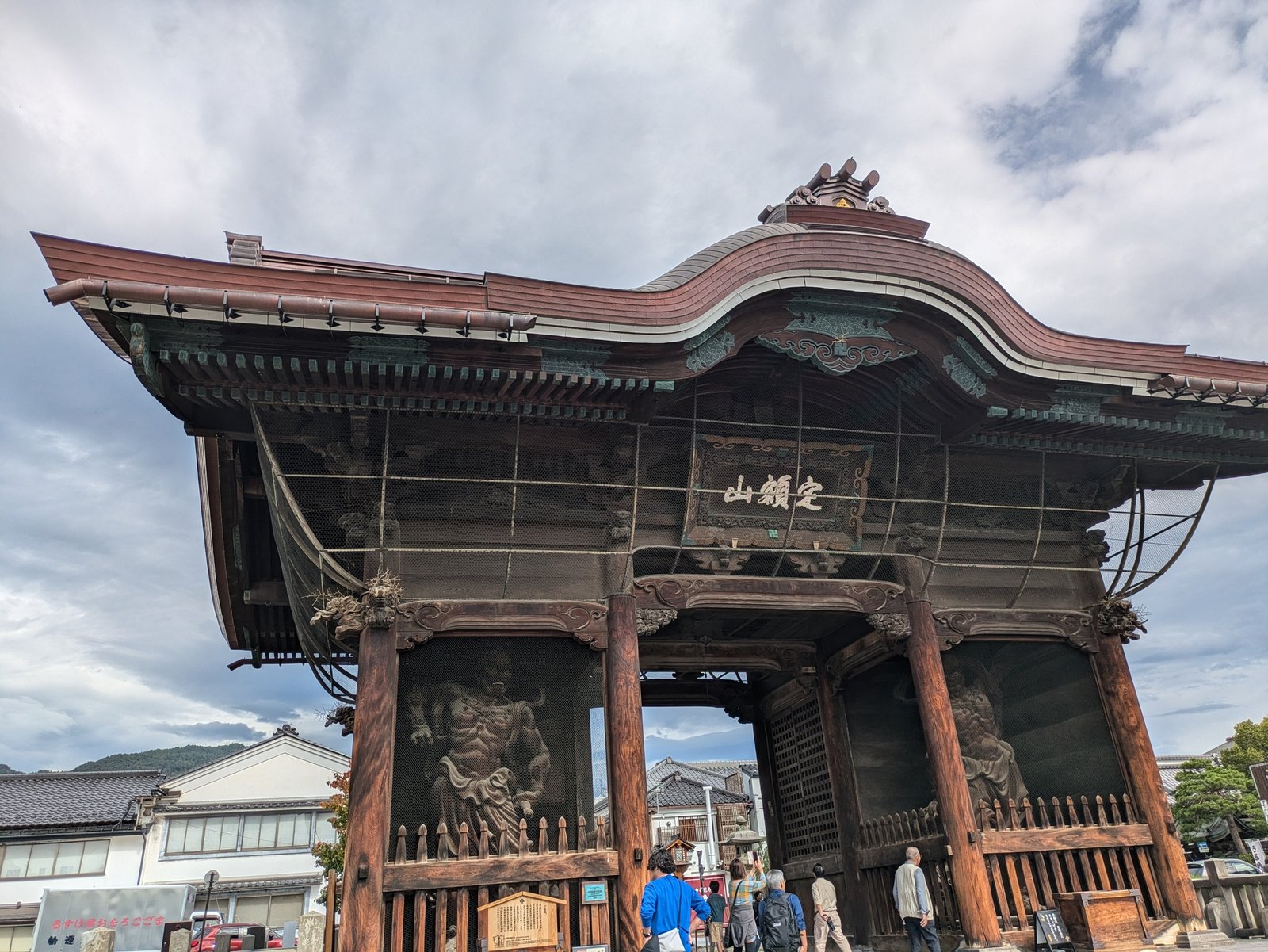
Zenkoji is a Buddhist temple in Nagano City, Nagano Prefecture. The Agency for Cultural Affairs lists its Main Hall (1707) as a National Treasure, designated a National Treasure on 31 March 1953 and first designated on 23 April 1908 (Agency for Cultural Affairs, Cultural Heritage Online: Main Hall (in Japanese)). It lists the Sanmon gate (1750) and the Sutra Repository (1759) as Important Cultural Properties, both designated on 29 May 1965 (Agency for Cultural Affairs, Cultural Heritage Online: Sanmon gate (in Japanese); Agency for Cultural Affairs, Cultural Heritage Online: Sutra Repository (in Japanese)).
Who this is for: travellers coming to Nagano by train who want to know how to reach the temple from the station and what the main buildings’ history and details are.
The short version: the temple gives the bus from stop No. 1 outside the Zenkoji Exit of JR Nagano Station to the Zenkoji-Daimon stop as about 15 minutes for 190 yen, then a walk of about 5 minutes to the Main Hall. The temple says the precincts and the outer part of the Main Hall can be entered free of charge; other areas need tickets. The present Main Hall was built after a fire in 1700.
What to plan for
| If… | Then lean towards… | Check |
|---|---|---|
| You are coming from JR Nagano Station | Bus stop No. 1 at the Zenkoji Exit, to Zenkoji-Daimon | Zenkoji, access |
| You are going back to the station by bus | The Zenkoji-Daimon stop on the side for buses towards Nagano Station | Bus operator, Zenkoji-Daimon stop (in Japanese) |
| You want to go inside the Main Hall or up the gate | A ticket for the area you want; the temple lists separate and combined tickets | Zenkoji, tickets (in Japanese) |
| You want to see the Sutra Repository | The temple’s notice on whether it is open | Zenkoji, visitor guide |
Getting there: the bus from JR Nagano Station
Zenkoji’s English access page gives the local bus from stop No. 1, “Bound for Zenkoji Temple”, at the bus rotary in front of the Zenkoji Exit of Nagano Station. It says all services from that stop can be taken, that the ride to the Zenkoji-Daimon stop takes 15 minutes for a fare of 190 yen, and that the Main Hall is a 5-minute walk from the stop (Zenkoji, access). The temple’s Japanese access page gives the same stop, about 15 minutes and 190 yen (Zenkoji, access (in Japanese)).
The bus operator’s page for the Zenkoji-Daimon stop lists its platforms and the routes from each, with a link to each route’s details and timetable; platforms 2 and 5 are marked as the stops for buses towards Nagano Station (Bus operator, Zenkoji-Daimon stop (in Japanese)).
What to do: look up your bus on the operator’s route timetable before you set out, and for the return trip use platforms 2 and 5 for Nagano Station. Where to verify: the operator’s page for the stop (in Japanese).
After the fire of 1700: how the main buildings were rebuilt
The Agency for Cultural Affairs’ description of the Sanmon gate and the Sutra Repository sets out what happened. Zenkoji is said to have begun when an image of Amida brought over from Baekje was moved to Shinano and a simple hall built for it. From its first fire in 809 to the fire of 1700, the temple is said to have burned eleven times. For the rebuilding after 1700 the temple site was moved back from its old position and the precinct laid out again. The Main Hall was begun in 1703 and completed in 1707, to a design by Kora Buzen, a master carpenter of the shogunate (Agency for Cultural Affairs, database of nationally designated cultural properties (in Japanese)).
The gate and the repository followed. Work on the Sanmon gate began in 1744, and its Buddhist images were installed in 1750; the master carpenter was Uemon, a Zenkoji carpenter. Work on the Sutra Repository began in 1754, four years after the gate, and its dedication was held in 1759, again under Uemon as chief carpenter. The agency’s record calls the gate and the repository valuable because, together with the Main Hall, they show a scale fitting the precinct of a large temple of the period (Agency for Cultural Affairs, database of nationally designated cultural properties (in Japanese)).
The temple tells the same history from its side: it says it has suffered more than ten great fires since its founding and that each time it was rebuilt by believers from across the country (Zenkoji, Main Hall (in Japanese)).
What to do: walk from the Sanmon gate to the Main Hall and compare the dates of the two buildings as you go. Where to verify: the agency’s description (in Japanese).
The T-shaped roof, the gate’s shingles and the pigeon plaque
The temple explains the shape of the Main Hall. Seen from above, its ridges form a T, which resembles the wooden striker used to sound a temple bell, a “shumoku”; this is why the style is called “shumoku-zukuri”. The roof is laid with hinoki cypress bark (Zenkoji, Main Hall (in Japanese)). The Agency for Cultural Affairs’ record of the Main Hall gives the same style, “shumoku-zukuri”, with a roof entirely of cypress bark (Agency for Cultural Affairs, Cultural Heritage Online: Main Hall (in Japanese)).
The gate’s roof has changed more than once. The agency’s description says it was first roofed with wooden shingles and changed to cypress bark in 1930 (Agency for Cultural Affairs, database of nationally designated cultural properties (in Japanese)). The temple says a major repair of the gate from October 2002 to December 2007 returned the roof from cypress bark to wooden shingles of the kind used when it was built, and that visits to the upper storey, suspended for about 40 years, resumed in 2008 (Zenkoji, main buildings (in Japanese)).
On the upper storey hangs a plaque reading “Zenkoji”, which the temple says was written by Rinnoji-no-miya Kocho Hosshinno, an imperial prince-abbot, and is about the size of three tatami mats. The temple says it is known as the “pigeon character plaque” because five pigeons are hidden in its three characters, and that the character “zen” is said to look like the face of an ox. The plaque now on the gate is a second one made during the repair; the earlier one is in the temple’s history museum. The temple also points out the many names written in ink on the walls of the upper storey, left by visitors who climbed the gate from the Edo period to the early Showa period, and it warns that writing on cultural property is a crime (Zenkoji, main buildings (in Japanese)).
What to do: look up at the plaque from in front of the gate and try to find the pigeons in the characters. Where to verify: the temple’s page on its main buildings (in Japanese).
What we have not verified
Check official before you go: opening times, ticket prices, the time of the morning service and whether each building is open can change, so use the temple’s pages linked on this page (Zenkoji, tickets (in Japanese); Zenkoji, visitor guide).
- Bus times: the bus timetable itself was not among the pages used, so no departure times are given.
- The Sutra Repository: the temple’s English visitor guide says it is suspending its opening for an inspection of the building; when it reopens is not confirmed here.
- The Sutra Repository’s designation date: the agency’s records give 29 May 1965, and the temple’s page gives 1974; the agency’s date is used above.
- Other routes: the railway to Zenkoji-shita Station, walking from the station and parking are not confirmed here.
- Other buildings and listings: only the three buildings in the agency’s records used here are given; other listings for buildings in the precinct are not confirmed here.
- English names: the temple prints HONDO (Main Hall), KYOZO (Sutra Repository) and ZENKOJI-DAIMON; the gate’s name and the bus operator’s name are this site’s renderings.
Official sources
| Topic | Source | Checked |
|---|---|---|
| Main Hall: National Treasure, dates, style, roof | Agency for Cultural Affairs, Cultural Heritage Online: Main Hall | 2026-11-11 |
| Sanmon gate: Important Cultural Property, 1750, designation date | Agency for Cultural Affairs, Cultural Heritage Online: Sanmon gate | 2026-11-11 |
| Sutra Repository: Important Cultural Property, 1759, designation date | Agency for Cultural Affairs, Cultural Heritage Online: Sutra Repository | 2026-11-11 |
| Fires, the rebuilding after 1700, carpenters, the gate’s roof in 1930 | Agency for Cultural Affairs, database of nationally designated cultural properties | 2026-11-11 |
| Fires and rebuilding by believers; the T-shaped roof | Zenkoji, Main Hall | 2026-11-11 |
| Gate repair, upper storey, plaque, ink names | Zenkoji, main buildings | 2026-11-11 |
| Bus from Nagano Station (English) | Zenkoji, access | 2026-11-11 |
| Bus from Nagano Station (Japanese) | Zenkoji, access | 2026-11-11 |
| Zenkoji-Daimon stop and routes | Bus operator, Zenkoji-Daimon stop | 2026-11-11 |
| Tickets and opening times | Zenkoji, tickets | 2026-11-11 |
| Free areas, Sutra Repository notice, English names | Zenkoji, visitor guide | 2026-11-11 |