Place name in Japanese: 吉野ヶ里, Yoshinogari.
Yoshinogari, Saga: the walk from the park station, the moat-encircled village, and the Special Historic Site
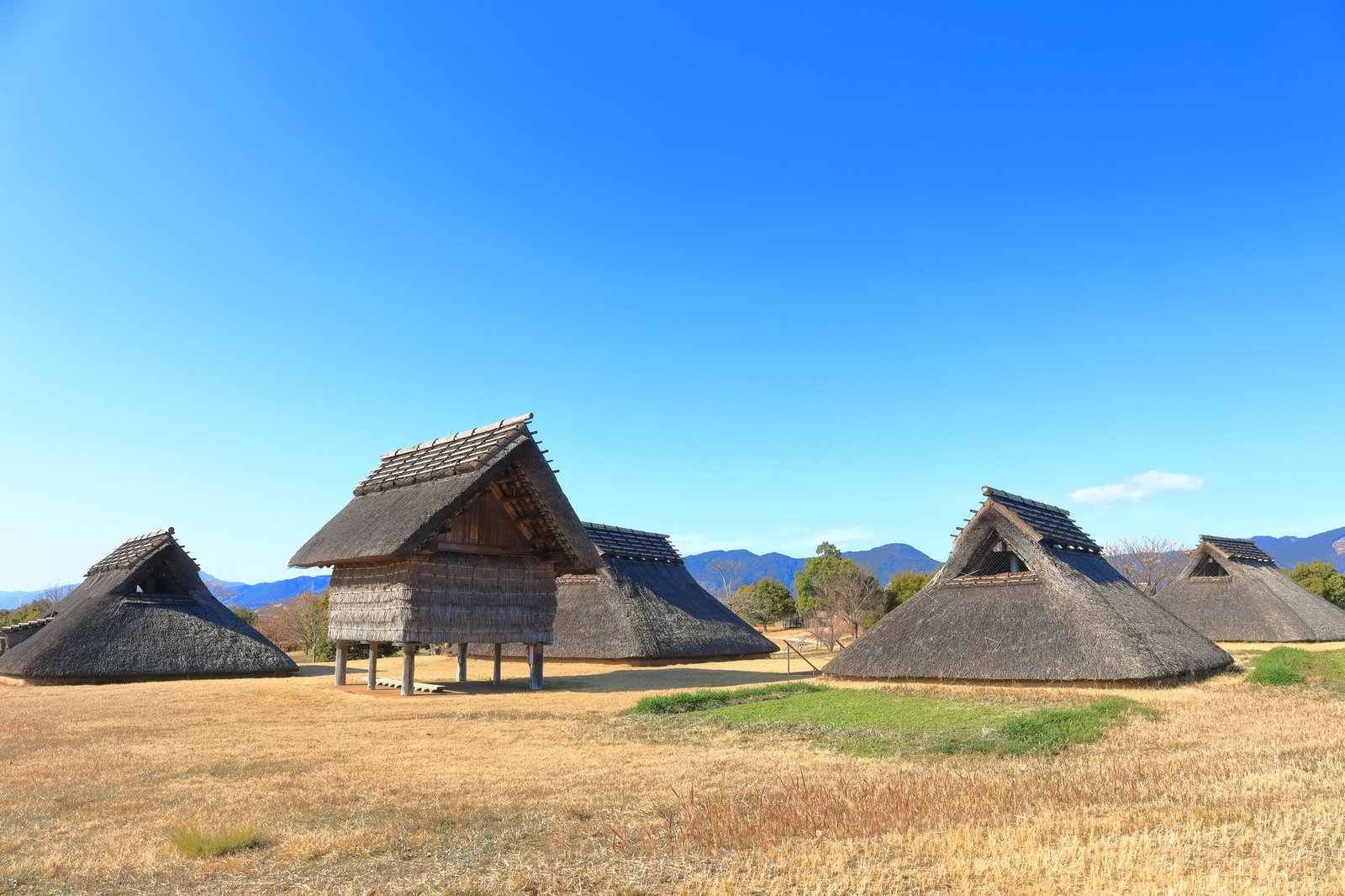
The national designated cultural properties database lists Yoshinogari as a Special Historic Site, in Kanzaki City and Yoshinogari Town, Kanzaki District, Saga Prefecture. It gives 19 May 1990 as the date of designation as a Historic Site, 28 May 1991 as the date of designation as a Special Historic Site, and 13 July 1999 as the date of an addition to the designation (National designated cultural properties database (in Japanese)). The site is presented to visitors as Yoshinogari Historical Park (Yoshinogari Historical Park, hours and fees).
Who this is for: travellers arriving by train who want to walk from the station to the reconstructed Yayoi village, and to know the park’s hours and what the national database says about the site.
The short version: from JR Yoshinogari Park Station, the park says it is about a 15-minute walk to the East Entrance, the closer gate for the ruins. The park is open from 9:00 to 17:00, and from 9:00 to 18:00 between 1 June and 31 August. It is closed on 31 December and on the third Monday of January and the following day. Admission is 460 yen for visitors aged 15 or over, 200 yen for visitors aged 65 or over, and free for junior high school students and younger, as the park’s Japanese page prints it.
Train, gate or bus
| If… | Then lean towards… | Check |
|---|---|---|
| You arrive by train and want to see the ruins | The walk from JR Yoshinogari Park Station to the East Entrance, about 15 minutes, in the park’s figure | Yoshinogari Historical Park, access |
| You want the play fields at the West Entrance | The walk from JR Kanzaki Station, about 15 minutes, in the park’s figure | Yoshinogari Historical Park, access |
| You come by bus | Check the park’s access pages for the current stop and the bus company’s timetable | Yoshinogari Historical Park, access (in Japanese) |
| You come by car | From the Higashisefuri Interchange, the park says, take Route 385 south for about five minutes | Yoshinogari Historical Park, access |
Times, hours and fees
| Item | Time or fee | Where to check |
|---|---|---|
| Park hours, 1 April to 31 May | 9:00 to 17:00 | Yoshinogari Historical Park, hours and fees |
| Park hours, 1 June to 31 August | 9:00 to 18:00 | Yoshinogari Historical Park, hours and fees |
| Park hours, 1 September to 31 March | 9:00 to 17:00 | Yoshinogari Historical Park, hours and fees |
| Park holidays | 31 December, and the third Monday of January and the following day | Yoshinogari Historical Park, hours and fees |
| Admission, aged 15 or over | 460 yen | Yoshinogari Historical Park, hours and fees |
| Admission, aged 65 or over | 200 yen | Yoshinogari Historical Park, hours and fees |
| Admission, junior high school students and younger | Free | Yoshinogari Historical Park, hours and fees (in Japanese) |
| Group rates and annual pass | Check official | Yoshinogari Historical Park, hours and fees |
| Parking | Check official | Yoshinogari Historical Park, hours and fees |
| Train times | Check official | JR Kyushu, station timetable (in Japanese) |
| Bus times and fares | Check official | Yoshinogari Historical Park, access (in Japanese) |
- Group admission: the park applies a group rate for 20 or more visitors of elementary-school age and up.
- Parking: the park lists standard charges of 310 yen for an ordinary car, 100 yen for a motorcycle and 1,050 yen for a large vehicle; check the hours and fees page for the charge that applies on the day.
- Before you go: check the park’s hours and fees page and the railway company’s timetable, which can change (Yoshinogari Historical Park, hours and fees; JR Kyushu, station timetable (in Japanese)).
What to do: confirm the hours and the holiday dates for the month you will visit. Where to verify: the park’s hours and fees page.
Getting there and how long it takes
- By train: the park’s English access page starts from the Nagasaki Honsen Line and names JR Yoshinogari Park Station and JR Kanzaki Station (Yoshinogari Historical Park, access; JR Kyushu, station page (in Japanese)).
- Walking times: the park says it is about 15 minutes on foot from JR Yoshinogari Park Station to the East Entrance, the closer gate for the ruins, and about 15 minutes on foot from JR Kanzaki Station to the West Entrance (ASOBINOHARA) (Yoshinogari Historical Park, access).
- Journey times the park gives as a guide: about 12 minutes by local train from JR Saga Station to JR Yoshinogari Park Station, or about 9 minutes to JR Kanzaki Station; from JR Tosu Station, about 14 minutes to JR Yoshinogari Park Station, or about 17 minutes to JR Kanzaki Station. For departure times, use the railway company’s timetable (JR Kyushu, station timetable (in Japanese)).
- By bus: the park describes a Nishitetsu bus route in its access pages, but the Japanese and English pages do not print the same stop name or walking time, so check those pages for the current stop (Yoshinogari Historical Park, access (in Japanese); Yoshinogari Historical Park, access).
What to do: if you are coming to see the ruins, get off at JR Yoshinogari Park Station and walk to the East Entrance. Where to verify: the park’s access page and the railway company’s timetable (in Japanese).
What to see
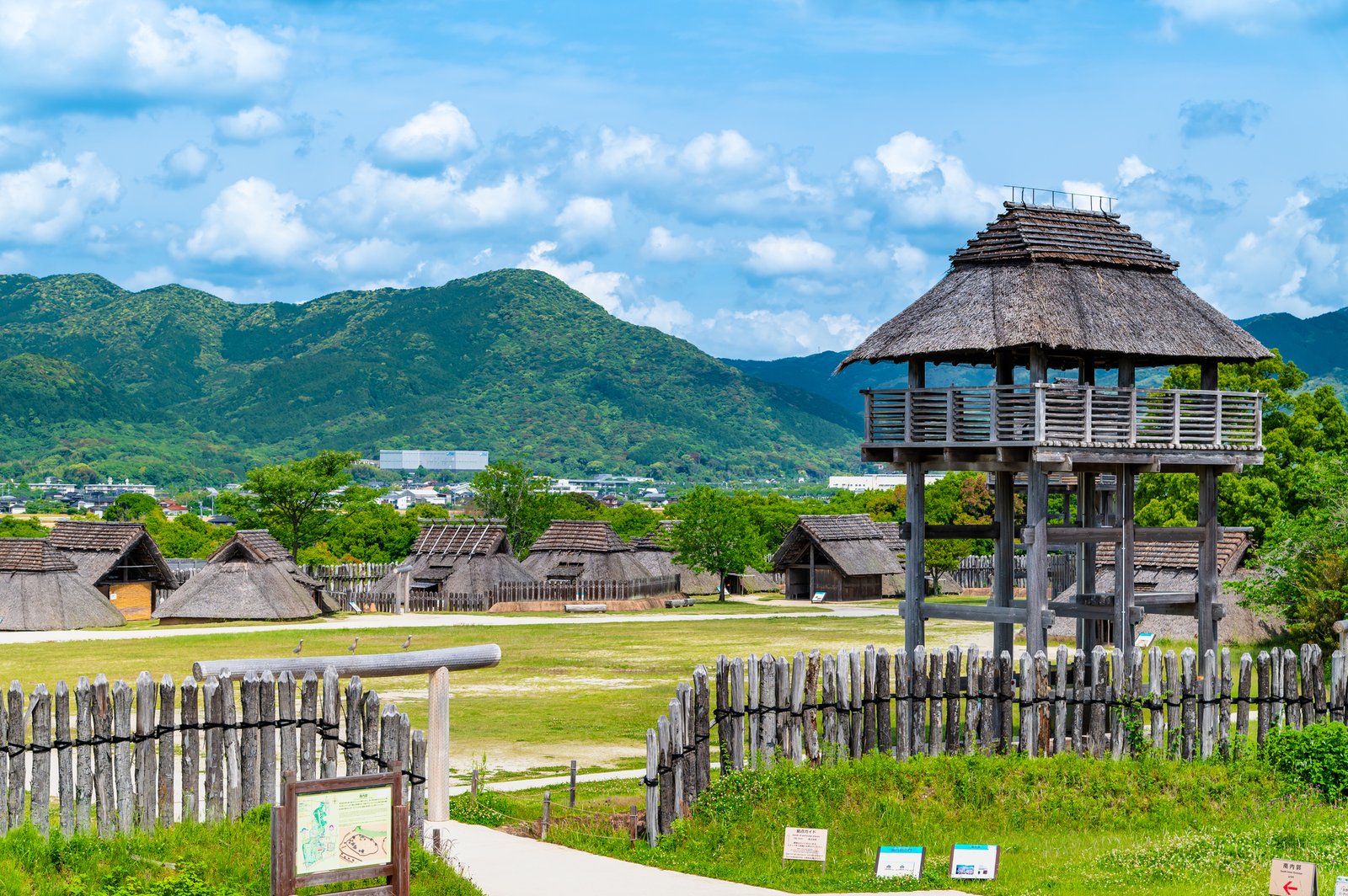
The park groups the reconstructed village in the Moat-Encircled Village Zone, reached from the East Entrance (Yoshinogari Historical Park, Moat-Encircled Village Zone). The South Inner Enclosure (Minaminaikaku) is believed, the park says, to have been where successive rulers of Yoshinogari resided; twenty structures have been reconstructed there, including four watchtowers and eleven pit dwellings. The North Inner Enclosure (Kitanaikaku) has nine reconstructed structures that the park says are believed to have been used for ceremonies and festival performances. The North Burial Mound is thought to be the burial place of successive rulers; the exterior has been restored, and the park says 14 authentic burial jars, which it calls kamekan, are on display inside, together with replicas of finds and an explanation of the mound.
What to do: start at the East Entrance and walk the Moat-Encircled Village Zone, and look at the reconstructed watchtowers of the South Inner Enclosure. Where to verify: the park’s zone page.
A large moated settlement of the Yayoi period
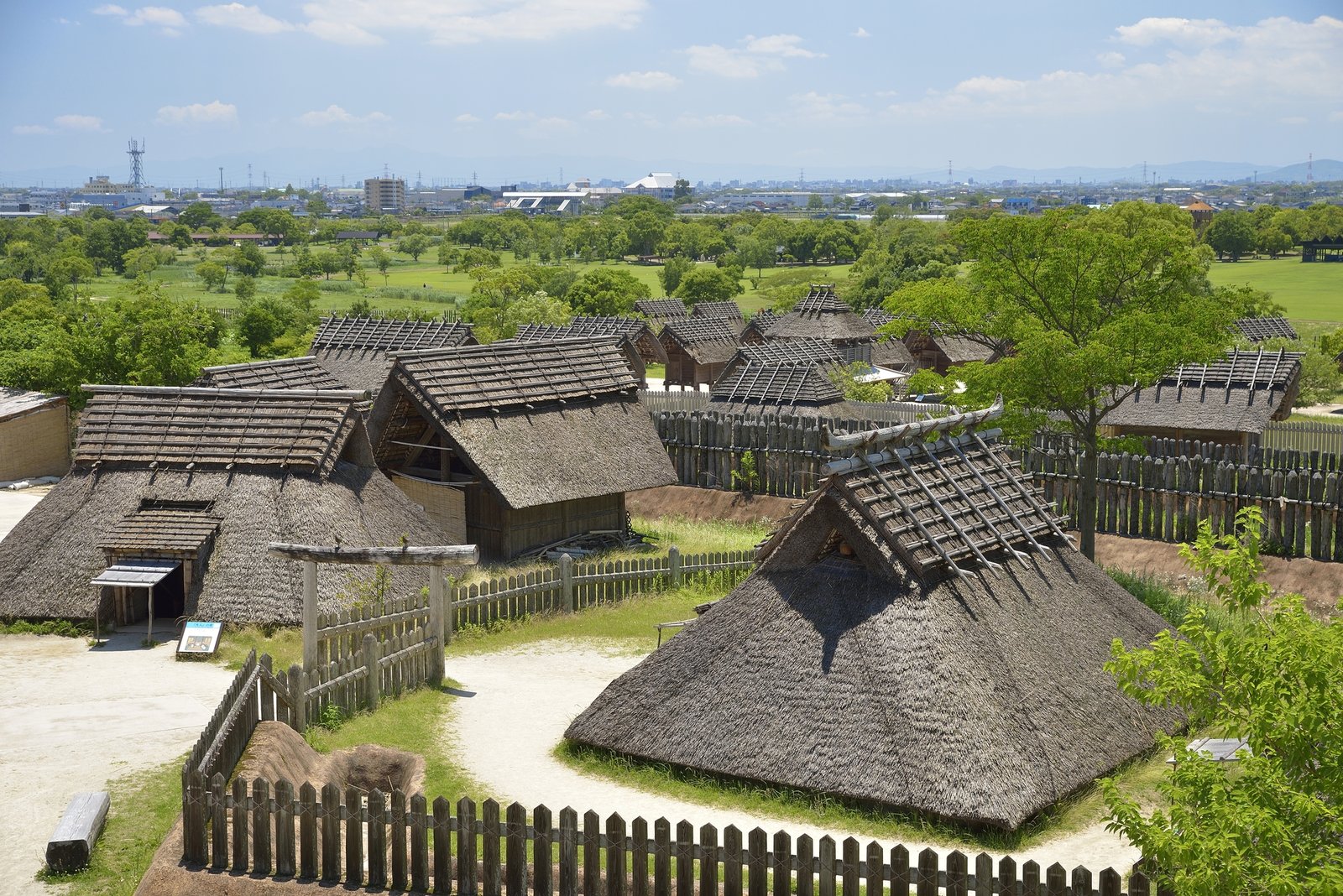
The commentary in the national designated cultural properties database describes Yoshinogari as a large moated settlement of the Yayoi period (National designated cultural properties database (in Japanese)). A confirmation survey by the Saga Prefecture Board of Education, the same commentary says, found that the settlement measures about one kilometre from north to south and about 600 metres from east to west, an area of about 40 hectares (National designated cultural properties database (in Japanese)). It also says that the settlement, and the burials that belong with it, changed together from the early to the late Yayoi period (National designated cultural properties database (in Japanese)). In the centre of the settlement are two precincts surrounded by moats, with large buildings inside; the database says these precincts are thought to have had a special function and an important place in the settlement, and that the northern one is enclosed by a double moat (National designated cultural properties database (in Japanese)).
What to do: in the two inner enclosures, look at how the moats and the large buildings sit inside the wider settlement the database describes. Where to verify: the database entry (in Japanese).
Official sources
| Topic | Source | Checked |
|---|---|---|
| Special Historic Site, designation dates, location | National designated cultural properties database | 2026-11-14 |
| Commentary, size of the settlement, inner precincts | Cultural Heritage Online | 2026-11-14 |
| Hours, holidays, admission, parking | Yoshinogari Historical Park, hours and fees | 2026-11-14 |
| Walking times, train guide times, gates | Yoshinogari Historical Park, access | 2026-11-14 |
| Bus route, Japanese stop name | Yoshinogari Historical Park, access (in Japanese) | 2026-11-14 |
| Moat-Encircled Village Zone, reconstructions | Yoshinogari Historical Park, Moat-Encircled Village Zone | 2026-11-14 |
| Station | JR Kyushu, station page | 2026-11-14 |
| Train times | JR Kyushu, station timetable | 2026-11-14 |
What we have not verified
- The railway company’s own English name for the station, which the park’s English access page writes as both JR Yoshinogari Park Station and JR Yoshinogari Koen Station (Yoshinogari Historical Park, access; JR Kyushu, station page (in Japanese)).
- The current Nishitetsu bus stop and the walking time from the stop, because the park’s Japanese and English access pages do not agree (Yoshinogari Historical Park, access (in Japanese); Yoshinogari Historical Park, access).
- Bus fares, which the park’s Japanese access page gives only as a guide (Yoshinogari Historical Park, access (in Japanese)).