Place name in Japanese: 吉野, Yoshino.
Yoshino, Nara: the ropeway from the station, the cherry-season traffic page, and the main hall of Kinpusen-ji
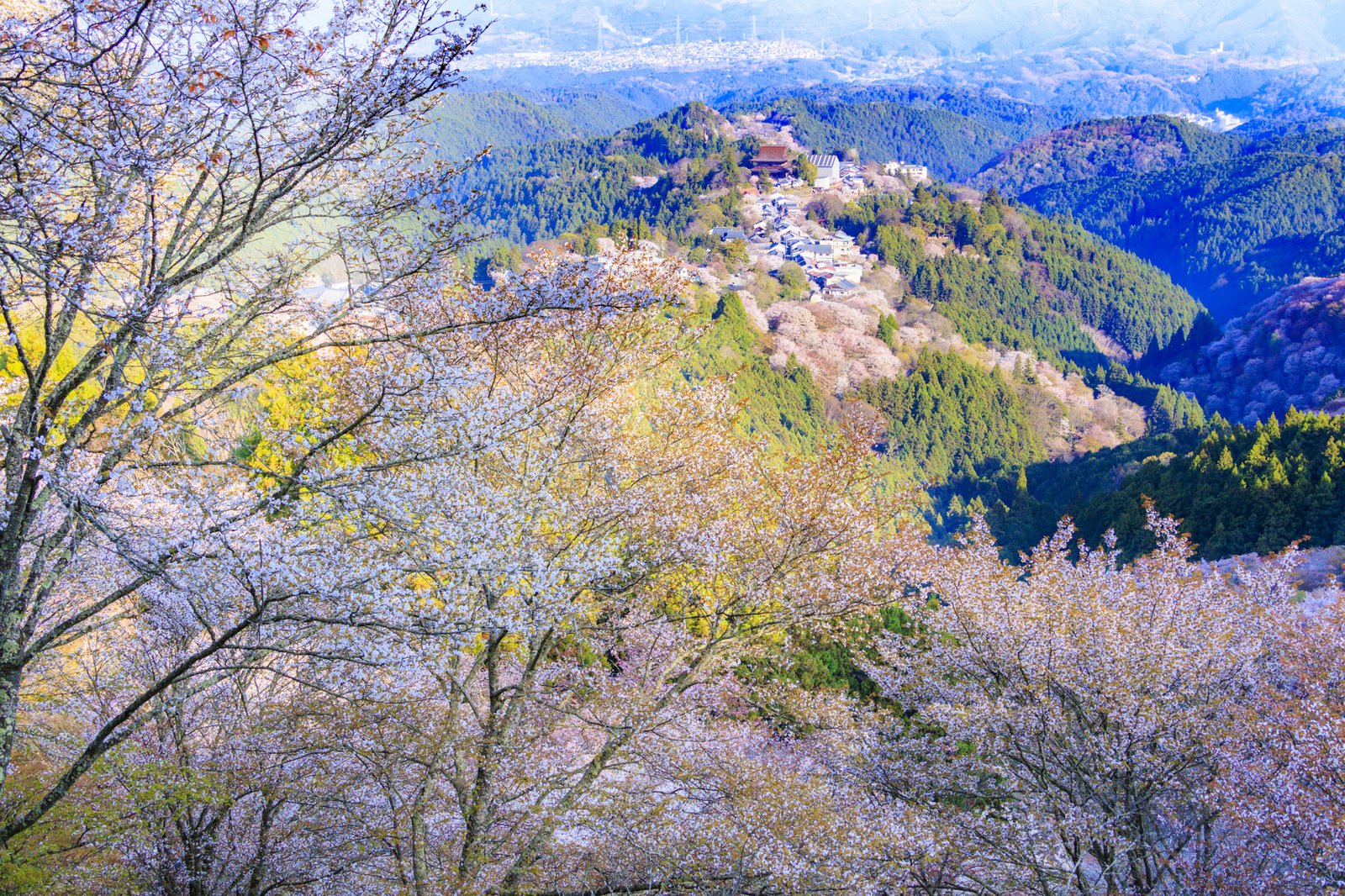
UNESCO gives 2004 as the date of inscription of the World Heritage property Sacred Sites and Pilgrimage Routes in the Kii Mountain Range, names Yoshino and Omine among the places it covers, and says Yoshinoyama is looked after by individual owners and local governments under a management plan drawn up by the local Board of Education (UNESCO World Heritage Centre). The national designated cultural properties database lists Yoshinoyama as both a Historic Site and a Place of Scenic Beauty, designated on 9 December 1924 (National designated cultural properties database (in Japanese)). The Ministry of the Environment gives 1 February 1936 as the designation date of Yoshino-Kumano National Park and says Mt. Yoshino is noted for its cherry blossoms (Ministry of the Environment, National Parks of Japan).
Who this is for: travellers coming to Yoshino by train who want to know how to get from the station up the mountain, and where the town announces traffic rules for the cherry season.
The short version: from Kintetsu’s Yoshino station, a ropeway climbs to the upper station in about three minutes, or you can walk up a winding slope in about 20 minutes. In the cherry season the town sets traffic restrictions and the roads are heavily congested, so the town asks visitors to avoid coming by car.
Ropeway, walk or temporary bus
| If… | Then lean towards… | Check |
|---|---|---|
| You arrive by train at Yoshino | The ropeway from its lower station, a walk of just under three minutes from the station, about three minutes to the top | Ropeway operator, ropeway (in Japanese) |
| You would rather walk | The winding slope from the station, about 20 minutes up and about 15 minutes down | Yoshino Town, cherry-season traffic (in Japanese) |
| You come in the cherry season | Leave the car at home; the town lists a temporary bus from the station run by a regional bus company | Yoshino Town, cherry-season traffic (in Japanese) |
| You want to see the main hall of Kinpusen-ji | Check the temple’s hours and admission first | Kinpusen-ji, hours and admission (in Japanese) |
Times, hours and fees
| Item | Time or fee | Where to check |
|---|---|---|
| Ropeway ride, lower to upper station | About three minutes | Ropeway operator, ropeway (in Japanese) |
| Ropeway operating days and timetable | Check official | Ropeway operator, ropeway (in Japanese) |
| Ropeway fares | Check official | Ropeway operator, ropeway (in Japanese) |
| Cherry-season traffic restrictions | Check official | Yoshino Town, cherry-season traffic (in Japanese) |
| Temporary bus and shuttle bus in the cherry season | Check official | Yoshino Town, cherry-season traffic (in Japanese) |
| Car park charges in the cherry season | Check official | Yoshino Town, cherry-season traffic (in Japanese) |
| Main hall of Kinpusen-ji, hours | Check official | Kinpusen-ji, hours and admission (in Japanese) |
| Main hall of Kinpusen-ji, admission | Check official | Kinpusen-ji, hours and admission (in Japanese) |
- Extra ropeway runs: the operator says it adds runs when the ropeway is crowded, and that times can change when events are held on the mountain.
- Car traffic in the cherry season: the town says roads around the mountain, which has few car parks, become heavily congested, that restrictions are tightened with the local police while the shuttle bus runs, and that cars may not be able to enter once the car parks nearby are full.
- Ceremonies at the temple: the temple says entry to the main hall may be limited during services and events, and that visitors may join the morning and evening services there.
- Before you go: check the ropeway operator’s, the town’s and the temple’s pages for operating days, timetables, fares, traffic restrictions and hours, which change with the season (Ropeway operator, ropeway (in Japanese); Yoshino Town, cherry-season traffic (in Japanese); Kinpusen-ji, hours and admission (in Japanese)).
What to do: in the cherry season, plan to arrive by train and decide between the ropeway and the slope at the station. Where to verify: the town’s traffic page (in Japanese).
Getting there and how long it takes
- By train: the ropeway operator and the town both start their directions at Kintetsu’s Yoshino station (Kintetsu, Yoshino station).
- By ropeway: the operator says its lower station is a walk of just under three minutes from Kintetsu’s Yoshino station, and the ride to the upper station takes about three minutes; the upper station is surrounded by cherry trees, and the cars are driven by hand from an operating room there (Ropeway operator, ropeway (in Japanese)).
- On foot: the town says the winding slope from the station, itself a well-known row of cherry trees, takes about 20 minutes up to the lower part of the mountain and about 15 minutes down (Yoshino Town, cherry-season traffic (in Japanese)).
What to do: if you take the ropeway, look out for the cars climbing through the cherry trees around the upper station. Where to verify: the operator’s ropeway page (in Japanese).
What to see
The national cultural heritage database entry for the main hall of Kinpusen-ji, a National Treasure since 14 November 1953, says the temple is said to have been founded by En no Ozunu, and is divided into a mountain-top and a mountain-foot group of buildings; this hall belongs to the lower group (Cultural Heritage Online, main hall of Kinpusen-ji (in Japanese)). The hall has burned many times. The present one was rebuilt after a fire in 1586, and an inscription of 1591 on the metal door fittings shows that the main work was largely finished by then. With its added outer aisle, it is 26 m wide at the front, 27 m deep and 27.5 m high, and inside stands a forest of long, unfinished pillars.
What to do: inside the main hall, look up at the long, unfinished pillars the database describes. Where to verify: the database entry (in Japanese).
How the ropeway was built
The ropeway operator tells its own history (Ropeway operator, ropeway (in Japanese)). In the early Showa years, Uchida Masao set out to build a passenger ropeway at Yoshino. People were cold to the idea and criticised the thought of travelling through the air, so he raised the money himself and, with local supporters, applied for a licence for about 21 km from the site of today’s lower station to the sacred mountain of Omine. Two years later the authorities allowed, as a trial, only the 349 m between today’s lower and upper stations. Construction began in 1928, and the line opened on 12 March 1929, when a single ticket cost 15 sen. During the Second World War the military pressed the company to give up the cable as steel, but it refused to part with what it saw as its own child, and the ropeway survived. The operator says it was recognised as mechanical heritage on 23 July 2012.
What to do: at the upper station, look for the operating room where the cars are still driven by hand. Where to verify: the operator’s ropeway page (in Japanese).
A hundred thousand cherry trees, in a 1924 text
The explanation written for the 1924 designation, shown on the national cultural heritage site, says the cherry trees of Yoshino all belong to a pure line of shiroyamazakura, a wild mountain cherry, and that their number was put at a hundred thousand (Cultural Heritage Online, Yoshinoyama (in Japanese)). It says the densest stand is the area named for a thousand trees at a glance, and that the middle, upper and inner groups of a thousand trees compete in beauty in the flowering season, each looking different because of the difference in height (Cultural Heritage Online, Yoshinoyama (in Japanese)).
What to do: walk uphill through the groups of trees and notice how the view changes with height. Where to verify: the database entry (in Japanese).
Official sources
| Topic | Source | Checked |
|---|---|---|
| World Heritage inscription, management | UNESCO World Heritage Centre | 2026-11-11 |
| Historic Site and Place of Scenic Beauty | National designated cultural properties database | 2026-11-11 |
| 1924 explanation, cherry trees | Cultural Heritage Online, Yoshinoyama | 2026-11-11 |
| National park | Ministry of the Environment, National Parks of Japan | 2026-11-11 |
| Main hall of Kinpusen-ji | Cultural Heritage Online, main hall of Kinpusen-ji | 2026-11-11 |
| Temple hours, admission, services | Kinpusen-ji, hours and admission | 2026-11-11 |
| Station | Kintetsu, Yoshino station | 2026-11-11 |
| Ropeway, timetable, fares, history | Ropeway operator, ropeway | 2026-11-11 |
| Cherry-season traffic, temporary bus, walking slope | Yoshino Town, cherry-season traffic | 2026-11-11 |
What we have not verified
- The English names of the ropeway operator, its two stations, the walking slope and the regional bus company, and the name of the mountain itself, which UNESCO writes as Yoshinoyama and the Ministry of the Environment as Mt. Yoshino (Ropeway operator, ropeway (in Japanese); UNESCO World Heritage Centre).
- The walking time from the upper ropeway station to Kinpusen-ji (Kinpusen-ji, hours and admission (in Japanese)).
- The train times to Yoshino (Kintetsu, Yoshino station).