Place name in Japanese: 柳川, Yanagawa.
Yanagawa, Fukuoka: a one-way punt through the moats, the rules on board, and the poet who named the water town
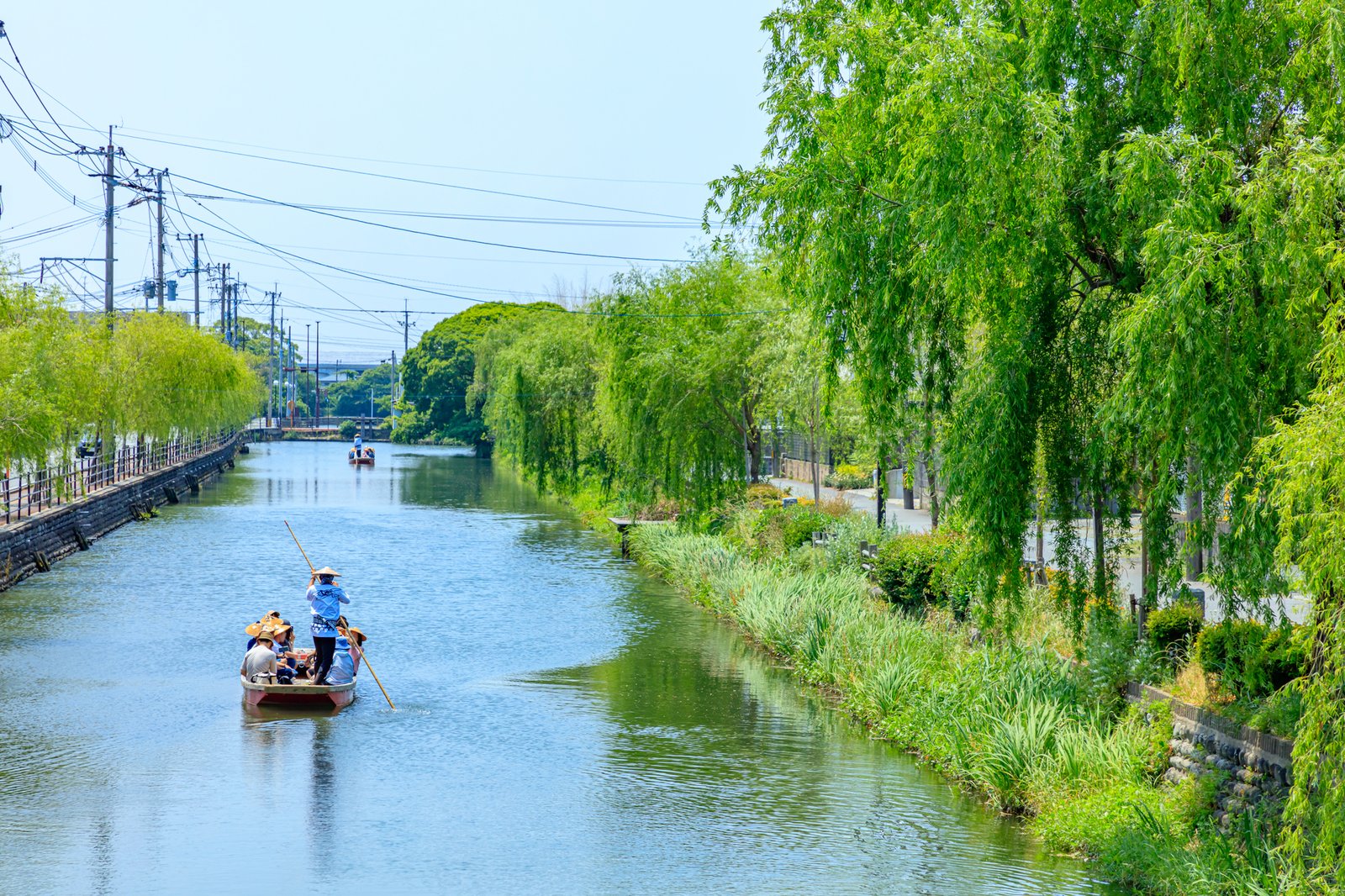
The national register lists Suikyo Yanagawa, the water landscape of Yanagawa, as a Place of Scenic Beauty from 10 March 2015, over an area of 184,291.88 square metres (Agency for Cultural Affairs, register entry for Suikyo Yanagawa (in Japanese)). Its description names the water surface of the moats that run through the old castle district and the fishing village of Okinohata, the shrine groves that lean over them, the birthplace of the poet Hakushu Kitahara, and the Namikura storehouses.
Who this is for: day visitors who want to ride the moats by boat, understand which kind of course to pick, and get back to the station afterwards.
The short version: the tourism bureau lists seven boat companies, each with its own landing stages and route. The standard course starts near Nishitetsu Yanagawa Station and goes one way to the Okinohata area; a shorter loop stays around Okinohata. Fares and hours differ by company, so check them before you board.
Standard course or short loop
| Your situation | Our suggestion | Where to check |
|---|---|---|
| Arriving by train with an hour to spare | The standard course, boarded near Nishitetsu Yanagawa Station, which ends in the Okinohata and Ohana area | Yanagawa Tourism Bureau, moat boat rides (in Japanese) |
| Short of time, or already in Okinohata | The short loop, which stays around Okinohata | Yanagawa Tourism Bureau, moat boat rides (in Japanese) |
| Carrying a large suitcase | Leaving it at the station or your hotel first, as the bureau asks | Yanagawa Tourism Bureau, boat ride guide and questions (in Japanese) |
| Visiting in mid to late February | Expecting shortened routes, because the moats are drained for cleaning and the dates change each year | Yanagawa Tourism Bureau, boat ride guide and questions (in Japanese) |
Fares, hours and dates to confirm
| Item | Value | Where to check |
|---|---|---|
| Standard course fares | Check official | Yanagawa Tourism Bureau, moat boat rides (in Japanese) |
| Short loop fares | Check official | Yanagawa Tourism Bureau, moat boat rides (in Japanese) |
| Boarding hours and days off, by company | Check official | Yanagawa Tourism Bureau, moat boat rides (in Japanese) |
| Draining period dates | Check official | Yanagawa Tourism Bureau, boat ride guide and questions (in Japanese) |
| Train times at Nishitetsu Yanagawa Station | Check official | Nishitetsu, Yanagawa station timetable (PDF) |
- Departures: the bureau says some companies sail to a timetable while others leave once enough passengers have gathered, and that the last sailing differs by company.
- Booking: you can board without a reservation; the bureau suggests booking ahead to avoid the busiest times.
- Before you go: confirm the day’s sailing with the boat company you pick (Yanagawa Tourism Bureau, boat ride guide and questions (in Japanese)).
What to do: choose your company from the bureau’s list, then check its fares and hours. Where to verify: the tourism bureau’s boat page (in Japanese).
On board
The tourism bureau’s guide sets out these points for passengers (Yanagawa Tourism Bureau, boat ride guide and questions (in Japanese)):
- Stay seated: do not stand up or put your hands outside the boat.
- Valuables: take care not to drop phones or cameras into the water.
- Luggage: large suitcases and oversized bags are not accepted on board.
- Parasols: not allowed.
- Sun and heat: the boats have no roof, so protect yourself from the sun and drink water often in summer.
- Rain: in light rain the companies decide whether to sail, normally with raincoats; sailings can stop when the water rises abnormally or the wind is strong.
What to do: pack light for the ride and plan for sun protection. Where to verify: the bureau’s guide (in Japanese).
Getting there and back
- By train: Nishitetsu’s day-trip page plans the outing as a train ride to Nishitetsu Yanagawa Station, followed by a boat ride of about an hour (Nishitetsu, Yanagawa day-trip course (in Japanese)).
- Timetable: the railway publishes a printable timetable for each station, revised on 14 March 2026 (Nishitetsu, printable station timetables (in Japanese)), including the one for Yanagawa (Nishitetsu, Yanagawa station timetable (PDF)).
- To the boats: the bureau says the standard course is boarded at landing stages within a walk of 5 to 10 minutes from Nishitetsu Yanagawa Station (Yanagawa Tourism Bureau, moat boat rides (in Japanese)).
- Coming back: the standard course is one way and no boat returns to the start (Yanagawa Tourism Bureau, boat ride guide and questions (in Japanese)). Some companies running that course provide a free shuttle bus back to the station; otherwise the bureau suggests a bus, a taxi, a rental bicycle, or walking, which it puts at about 50 minutes.
What to do: ask your boat company about its shuttle before you board. Where to verify: the bureau’s questions page (in Japanese).
The moats and the Tachibana garden
The register’s detailed description traces the water: a share of the Okinohata river is taken in at the Futatsugawa weir, about 6 km upstream of the old fishing village, flows into the moats around the edge of the Shirouchi district of the old castle town, crosses the district and rejoins the Okinohata river near the south-west corner of the former castle town (Agency for Cultural Affairs, register entry for Suikyo Yanagawa (in Japanese)). It adds that the moats were long needed for drinking water and for moving people and goods.
The city’s sightseeing map labels the Tachibana garden with the name Ohana (Yanagawa City, sightseeing map (PDF, in Japanese)), the area where the standard course ends. The garden is a separate Place of Scenic Beauty (Agency for Cultural Affairs, register entry for the Tachibana garden (in Japanese)). The register dates its listing to 25 August 1978 and records that on 21 September 2011 the area was extended and the name changed from Shotoen. Its description says the garden was first laid out in the Genroku era with a Tachibana family residence, that the large pond takes its water from the moats, and that seven small islands and nearly 100 rock islets are scattered across it, with only low black pines planted around it.
What to do: look for where the moat water enters the garden pond. Where to verify: the register entry for the garden (in Japanese).
Hakushu’s grey coffin on the water
The register’s description quotes the poet’s own words (Agency for Cultural Affairs, register entry for Suikyo Yanagawa (in Japanese)). Hakushu Kitahara, born in 1885 the eldest son of a sake brewer in Okinohata, left for Tokyo after quitting middle school in 1904, and his collection Omoide, published in 1911, drew wide attention to him. In Omoide he called his home a quiet, decaying town and likened it to a grey coffin floating on the water; in its essay on his upbringing he wrote of the many man-made waterways giving off a silver light near and far.
The same description says his family house survived the 1901 Okinohata fire with its main building and granary, and that Hakushu wrote 25 poems about the mould, the spirit and the smell of sake that filled it. The memorial hall’s page on the birthplace says the house was restored in November 1969 (Hakushu Kitahara Memorial Hall, the birthplace (in Japanese)).
What to do: walk from the Okinohata landing stages to the birthplace. Where to verify: the memorial hall’s page (in Japanese).
Suikyo, not suigo
The city explains that Yanagawa is widely known as a water town read suigo, but the listing uses the reading suikyo (Yanagawa City, Suikyo Yanagawa (in Japanese)). It says the name follows Hakushu’s own words in Omoide and in his later work Mizu no Kozu, and that the reading was taken from OMOIDE, the romanized edition of Omoide that Hakushu published.
The register’s description adds that the brick storehouses of Namikura, three buildings from the Taisho era, are still used as rooms for growing koji (Agency for Cultural Affairs, register entry for Suikyo Yanagawa (in Japanese)).
What to do: listen for which reading your boatman uses. Where to verify: the city’s page (in Japanese).
Official sources
| Topic | Source | Checked |
|---|---|---|
| Boat companies, courses, fares and hours | Yanagawa Tourism Bureau, moat boat rides | 2026-11-14 |
| Rules on board, return trip, draining period | Yanagawa Tourism Bureau, boat ride guide and questions | 2026-11-14 |
| Boat companies on the city map | Yanagawa City, sightseeing map (PDF) | 2026-11-14 |
| Suikyo Yanagawa listing and description | Agency for Cultural Affairs, register entry for Suikyo Yanagawa | 2026-11-14 |
| Tachibana garden listing and description | Agency for Cultural Affairs, register entry for the Tachibana garden | 2026-11-14 |
| The reading suikyo | Yanagawa City, Suikyo Yanagawa | 2026-11-14 |
| Day trip by train | Nishitetsu, Yanagawa day-trip course | 2026-11-14 |
| Timetable revision | Nishitetsu, printable station timetables | 2026-11-14 |
| Yanagawa station timetable | Nishitetsu, Yanagawa station timetable (PDF) | 2026-11-14 |
| Hakushu’s birthplace | Hakushu Kitahara Memorial Hall, the birthplace | 2026-11-14 |
What we have not verified
- Journey times by train from Fukuoka; the railway pages we opened give none we could read as text (Nishitetsu, Yanagawa station timetable (PDF)).
- Each boat company’s own pages; we used the tourism bureau’s list and did not fetch the companies’ booking pages (Yanagawa Tourism Bureau, moat boat rides (in Japanese)).
- Opening hours and admission for the Tachibana garden and Hakushu’s birthplace (Hakushu Kitahara Memorial Hall, the birthplace (in Japanese)).
- Which other buildings and places in Yanagawa are listed; we fetched only the two register entries above (Agency for Cultural Affairs, register entry for Suikyo Yanagawa (in Japanese)).
- English names: Suikyo Yanagawa, Okinohata, the Okinohata river, the Futatsugawa weir, Shirouchi, Namikura, Nishitetsu, Nishitetsu Yanagawa Station, Ohana, the Tachibana garden, the Tachibana family, Shotoen, Genroku, Omoide, Mizu no Kozu, Taisho, koji, suigo, suikyo, Place of Scenic Beauty and the Agency for Cultural Affairs are our own romanizations or translations; Hakushu Kitahara follows the memorial hall’s copyright line, and the Yanagawa Tourism Bureau follows the bureau’s (Hakushu Kitahara Memorial Hall, the birthplace (in Japanese); Yanagawa Tourism Bureau, moat boat rides (in Japanese)).