Udo Jingu, Nichinan: the main hall inside a sea cave, the stone steps of Hatchozaka, and the bus from Miyazaki Airport
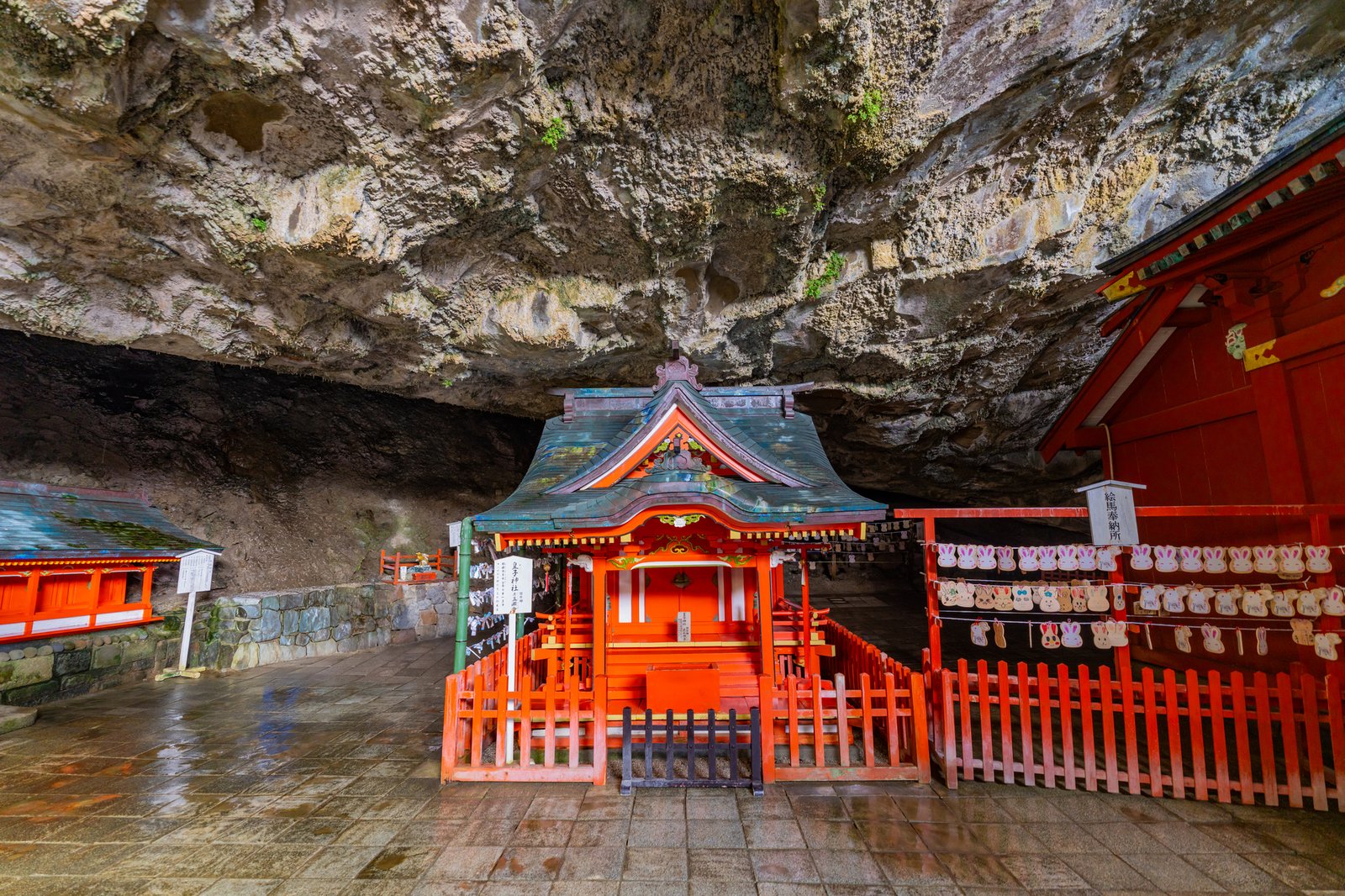
The national designated cultural properties database lists Udo, the cape and coast around the shrine in the city of Nichinan, as a Place of Scenic Beauty, designated on 13 October 2017 (National designated cultural properties database, Udo (in Japanese)). Its explanation says the shrine’s main hall, rebuilt in 1711, stands inside an uplifted sea cave of about 1,000 m² on the eastern coast of the cape.
Who this is for: travellers going to the shrine by bus from Miyazaki Airport or Miyazaki who want to know the gate hours, the walk from the stop and what to look for at the cave.
The short version: the shrine says its gates open at 6:00 and close at 18:00. From the Miyazaki Airport bus stop, it gives about 60 minutes by route bus to the Udo Jingu stop and about 10 minutes on foot from there. The main hall stands inside the cave, and a turtle-shaped rock lies on the shore below it.
Gate, bus and the cave
| If… | Then lean towards… | Check |
|---|---|---|
| You land at Miyazaki Airport | The route bus from the airport bus stop to the Udo Jingu stop, about 60 minutes | Udo Jingu, access (in Japanese) |
| You start in Miyazaki city | The route bus from the Miyako City or Miyazaki Airport stops, about 60 to 70 minutes | Udo Jingu, access (in Japanese) |
| You come by train | The JR line south to Ibii or Aburatsu, then a route bus of about 20 minutes | Udo Jingu, access (in Japanese) |
| You want to walk the old stone approach | Hatchozaka, the stone steps from the harbour at Fukei to the shrine gate | Udo Jingu, grounds (in Japanese) |
Times, hours and fees
| Item | Time or fee | Where to check |
|---|---|---|
| Shrine gates | Open 6:00, close 18:00 | Udo Jingu, access (in Japanese) |
| Route bus from the Miyazaki Airport bus stop to the Udo Jingu stop | About 60 minutes | Udo Jingu, access (in Japanese) |
| Walk from the Udo Jingu stop | About 10 minutes | Udo Jingu, access (in Japanese) |
| Bus timetable | Check official | Bus company, Miyazaki line timetable (PDF, in Japanese) |
| Bus fare | Check official | Bus company, Miyazaki line timetable (PDF, in Japanese) |
- Heavy rain: the shrine says the national road 220 closes between Oryuzako and Kazeta once continuous rainfall passes 170 mm, and gives prefectural road 28 as the detour.
- Days the bus does not run: the bus company’s timetable marks one run in each direction as not running on Saturdays, Sundays and public holidays.
- Before you go: if you plan to drive, read the city’s notice on the road to the shrine and its car parks (Nichinan City, traffic restriction on the road to Udo Jingu (in Japanese)).
What to do: check the return bus times before you leave the stop. Where to verify: the bus company’s timetable (PDF, in Japanese).
Getting there and how long it takes
- From Miyazaki Airport: the shrine says to take a route bus bound for Nichinan, Obi or Toimisaki from the airport bus stop, about 60 minutes to the Udo Jingu stop, then walk about 10 minutes (Udo Jingu, access (in Japanese)).
- From Miyazaki city: it gives about 60 to 70 minutes by route bus from the Miyako City or Miyazaki Airport stops (Udo Jingu, access (in Japanese)).
- By rail: it gives the JR line south from Miyazaki Station to Ibii or Aburatsu, then about 20 minutes by route bus from either (Udo Jingu, access (in Japanese)).
- By car: it gives about 60 minutes from central Miyazaki by national road 220 (Udo Jingu, access (in Japanese)).
- The bus line: the bus company’s timetable for its Miyazaki line along the coast lists the Udo Jingu stop between Miyazaki Station and Obi (Bus company, Miyazaki line timetable (PDF, in Japanese)).
What to do: from the stop, allow about 10 minutes on foot to reach the shrine. Where to verify: the shrine’s access page (in Japanese).
What to see
The shrine says the main hall, painted vermilion, stands inside a cave of about 1,000 m², which is held to be the site of the birth hut of the main deity (Udo Jingu, history (in Japanese)). It tells the story behind the name: the sea god’s daughter, who was carrying the child of the mountain-hunting brother of the myth, came to Udo to give birth, and a hut was being built in the cave, but the child was born before its roof of cormorant feathers was finished. The shrine’s guide to its grounds says worship takes place at the hall itself, with two bows, two claps and one bow; that the hall has been repaired many times since its revival in 782, most recently in 1968, the first time in 257 years, and in 1997 (Udo Jingu, grounds (in Japanese)).
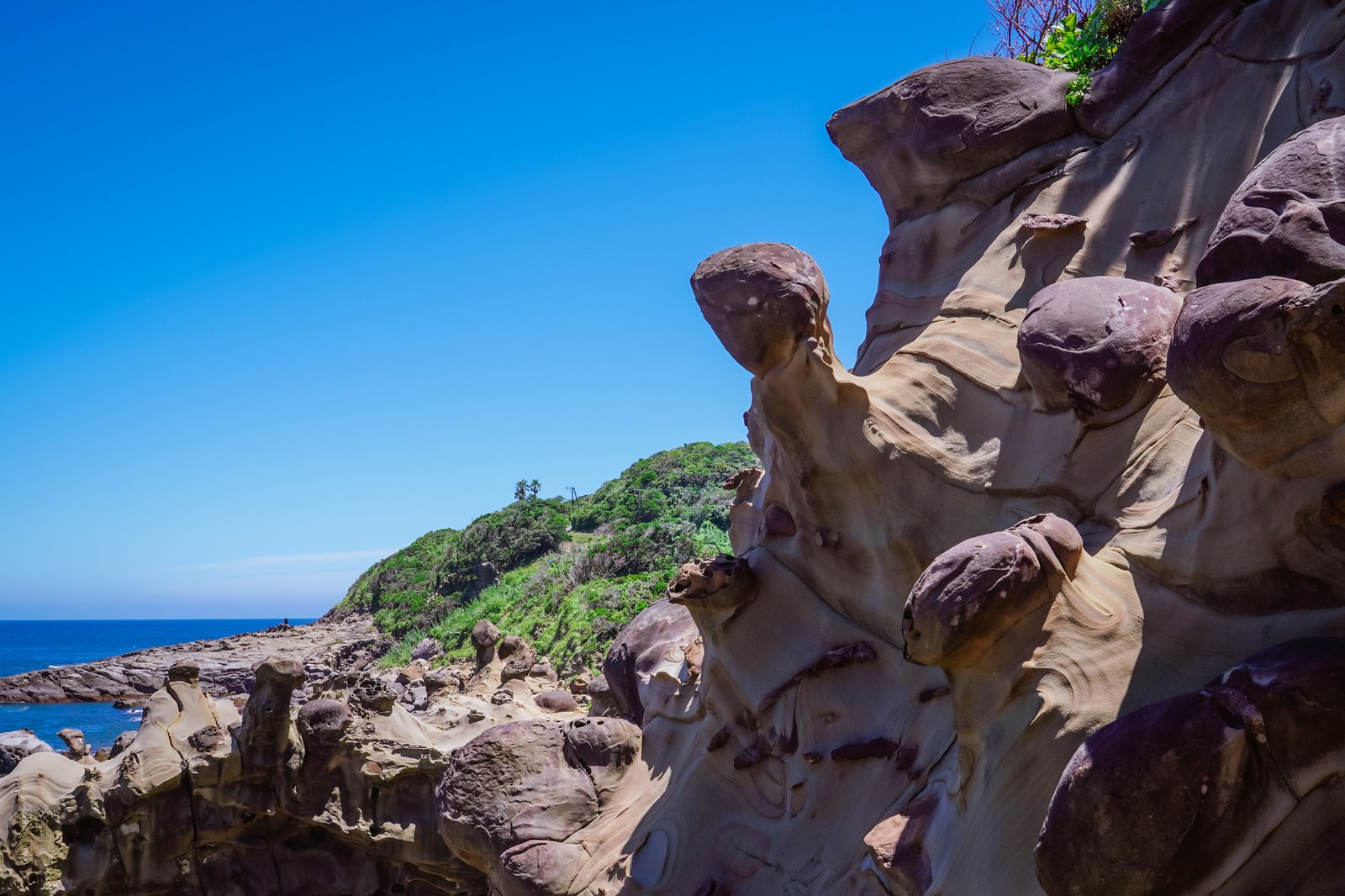
Below the hall, on the rocky shore, lies the turtle rock, said to be the turtle the mother rode here to give birth (Udo Jingu, the turtle rock and the luck balls (in Japanese)). The shrine gives it as about 12 m from the square in front of the hall and about 8 m from head to tail, with a hollow about 60 cm square in its back. Men throw with the left hand and women with the right, and a ball that lands in the hollow is said to grant the wish.
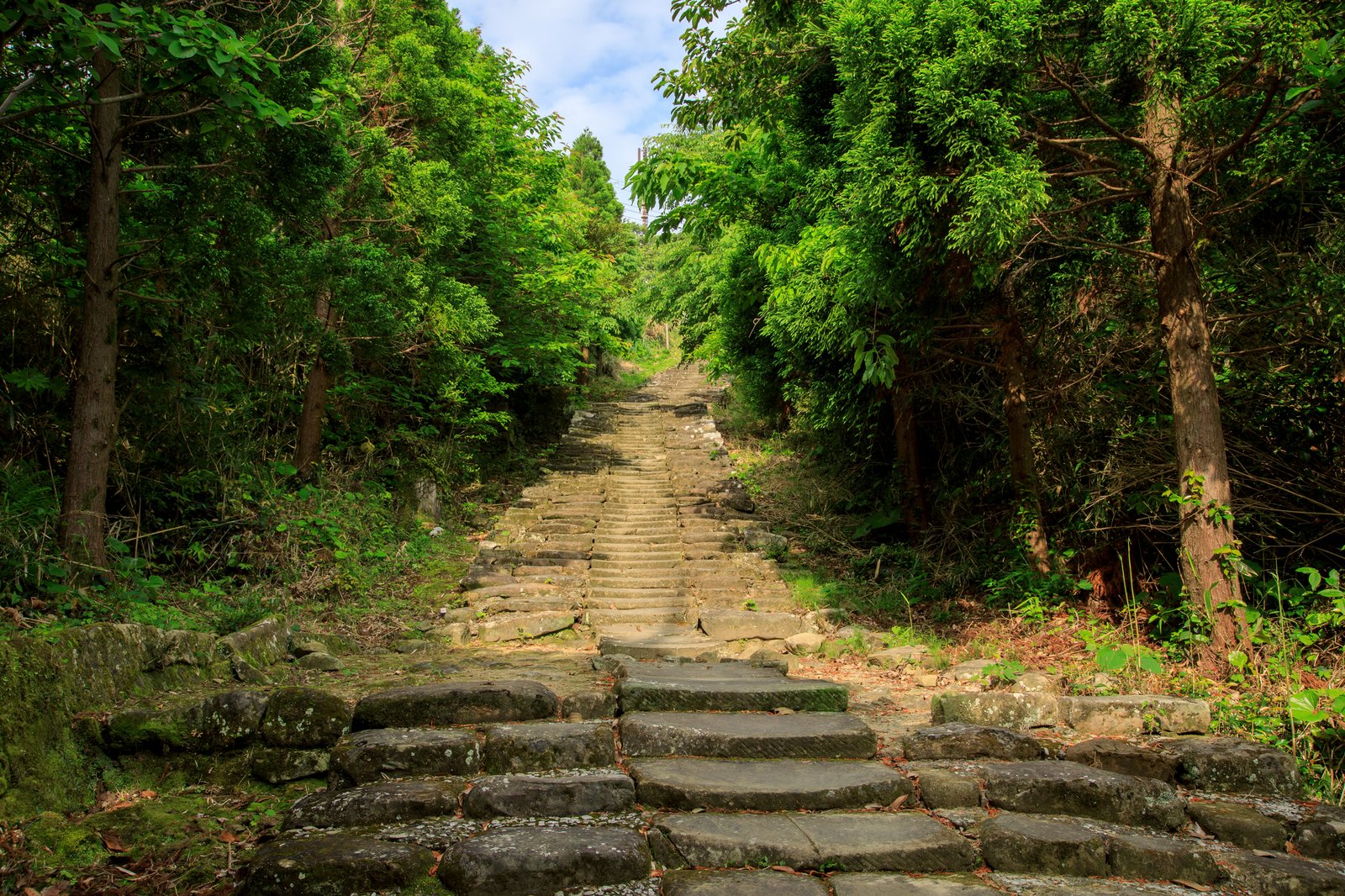
The old approach is Hatchozaka, stone steps running about 800 m from the harbour at Fukei to the shrine gate (Udo Jingu, grounds (in Japanese)). The shrine’s guide gives 438 steps up to the cemetery of the head priests of the former temple and 377 down, and says that by tradition a nun built the steps in the Enryaku era, 782 to 806, carrying stones from the nearby shore on her head. Another page of the shrine gives the descent as 277 steps, 715 in all, and says the stones are worn hollow in the middle, a sign of how many came to worship in the past. It counts 12 branch temples of the former temple on both sides of the steps going down (Udo Jingu, Hatchozaka (in Japanese)). The database adds that until the Meiji Restoration 18 temple lodgings stood on both sides of Hatchozaka, and that after they were abolished only the steps and the stone walls of the lodgings remain (National designated cultural properties database, Udo (in Japanese)).
What to do: look at the middle of the steps on Hatchozaka for the hollows the shrine describes. Where to verify: the shrine’s page (in Japanese).
How clay balls replaced coins
The shrine tells the history of the luck balls thrown at the turtle rock (Udo Jingu, the turtle rock and the luck balls (in Japanese)). Visitors once threw coins at the rock. Around 1954, it says, the schoolchildren of Udo were always late on Mondays, because early on Monday mornings they were quietly picking up the coins that visitors had thrown on Sunday. The chief priest of the time and the school staff worked out a plan: the children would make balls of clay, pressed with the character for luck and lightly fired, and give them to the shrine, and the shrine would help pay for their school costs and school trips. The shrine says the scheme continues, with the pupils of the local school and their parents making the balls, joined later by a facility for people with intellectual disabilities in the city.
What to do: throw a luck ball at the turtle rock with the hand the shrine names. Where to verify: the shrine’s page (in Japanese).
Brides on horseback
The database’s explanation records a custom from the Genroku period: newly married couples travelled the coast from Aoshima to Udo and back, over its difficult stretches, to report their marriage to the gods, the bride riding a horse with bells on its saddle and a red cloth laid over it (National designated cultural properties database, Udo (in Japanese)). The custom gave its name, Shanshan-uma, to a folk song, and the database says only a trace of it survives today, in an event at the festival of Miyazaki Jingu.
What to do: as you walk the coastal approach, picture the couples arriving after their journey from Aoshima. Where to verify: the database’s explanation (in Japanese).
Official sources
| Topic | Source | Checked |
|---|---|---|
| Place of Scenic Beauty, cave, temple lodgings, horse custom | National designated cultural properties database, Udo | 2026-11-11 |
| Main hall, cave, birth story | Udo Jingu, history | 2026-11-11 |
| Main hall, turtle rock, Hatchozaka | Udo Jingu, grounds | 2026-11-11 |
| Hatchozaka, steps and stones | Udo Jingu, Hatchozaka | 2026-11-11 |
| Turtle rock, luck balls | Udo Jingu, the turtle rock and the luck balls | 2026-11-11 |
| Gate hours, access, national road 220 | Udo Jingu, access | 2026-11-11 |
| Bus line, stops, days not running | Bus company, Miyazaki line timetable | 2026-11-11 |
| Road to the shrine | Nichinan City, traffic restriction on the road to Udo Jingu | 2026-11-11 |
What we have not verified
- The number of steps going down Hatchozaka, which the shrine gives as 377 on one page and 277 on another (Udo Jingu, grounds (in Japanese); Udo Jingu, Hatchozaka (in Japanese)).
- The route and time for walking Hatchozaka from the harbour at Fukei, and whether it can be reached by bus (Udo Jingu, grounds (in Japanese)).
- English names: Udo Jingu, Hatchozaka, Fukei, Miyako City, Ibii, Aburatsu, Obi, Toimisaki, Oryuzako, Kazeta and Aoshima, Miyazaki Jingu and Shanshan-uma are our own romanisations from Japanese, because the pages we used give them only in Japanese (Udo Jingu, access (in Japanese)).