Place name in Japanese: 鶴ヶ城, Tsuruga-jō.
Tsurugajo Castle, Aizuwakamatsu: the keep museum, the park rules, a rescued tea house and the red roof tiles
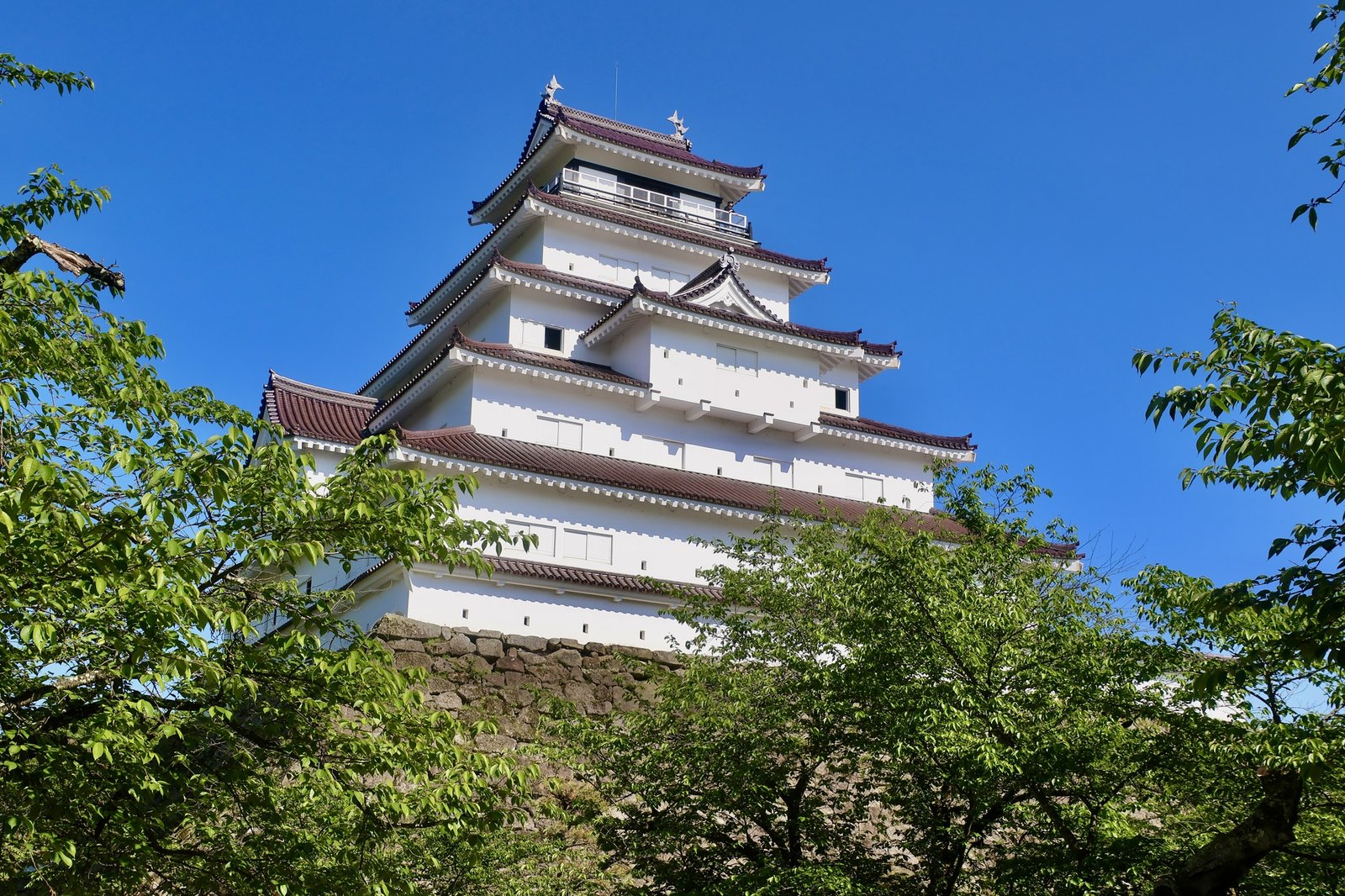
Tsurugajo Castle is in Aizuwakamatsu, and its operator says the castle town grew up around it in the south-east corner of the Aizu basin. The operator traces the castle to a residence built in 1384 by Ashina Naomori and says Gamo Ujisato gave the castle its name when his keep was finished in 1593 (Aizuwakamatsu Tourism Bureau, Tsurugajo Castle guide (in Japanese)). The buildings were pulled down in 1874, leaving only the stone walls, and the keep was rebuilt in 1965 to its outward form, using photographs taken early in the Meiji period.
Who this is for: visitors to Aizuwakamatsu who want to go up the keep, sit in the tea house and walk the park, and know the house rules before they go.
The short version: the keep is a local history museum, with five floors above a basement and a viewing room on the fifth. The Rinkaku tea house stands in the same park and has its own ticket, or a joint one with the keep. The town loop buses from JR Aizu-Wakamatsu Station stop at the castle. Check the operator’s pages for hours and admission before you set out.
Keep, tea house or park
| Your situation | Our suggestion | Where to check |
|---|---|---|
| A first visit with an hour or two | The keep museum, whose floors cover the lords of Aizu, the Boshin War, people linked with Aizu, and the view from the top | Aizuwakamatsu Tourism Bureau, Tsurugajo Castle guide (in Japanese) |
| Wanting a sit-down | Powdered green tea with a sweet at the Rinkaku tea house | Aizuwakamatsu Tourism Bureau, Rinkaku tea house (in Japanese) |
| Arriving by car | One of the three paid car parks; cars may enter the park itself only with a permit | Aizuwakamatsu Tourism Bureau, facility overview (in Japanese) |
| Travelling with a dog | A walk in the park on a lead; pets are not allowed in the keep | Aizuwakamatsu Tourism Bureau, facility overview (in Japanese) |
Hours, admission and dates to confirm
| Item | Value | Where to check |
|---|---|---|
| Keep museum opening hours and last entry | Check official | Aizuwakamatsu Tourism Bureau, Tsurugajo Castle guide (in Japanese) |
| Keep museum closing days | Check official | Aizuwakamatsu Tourism Bureau, Tsurugajo Castle guide (in Japanese) |
| Keep museum admission, the joint ticket with the tea house and the three-site ticket | Check official | Aizuwakamatsu Tourism Bureau, Tsurugajo Castle guide (in Japanese) |
| Tea house hours, closing days, admission and the price of a bowl of tea | Check official | Aizuwakamatsu Tourism Bureau, Rinkaku tea house (in Japanese) |
| Car park fees | Check official | Aizuwakamatsu Tourism Bureau, Tsurugajo Castle guide (in Japanese) |
| Loop bus fares and times | Check official | Aizu Bus, town loop buses (in Japanese) |
| Train times at JR Aizu-Wakamatsu Station towards Koriyama | Check official | JR East, Aizu-Wakamatsu Station, Ban’etsu West Line towards Koriyama, weekdays (in Japanese) |
| Walk from the bus stop to the keep | Not verified (see below) | Aizu Bus, town loop buses (in Japanese) |
- Paying: the operator says admission to the keep is paid in cash, in Japanese yen, at the ticket office, or in advance by card with a web ticket.
- Tea prices: the tea house page gives a new price for a bowl of tea from 1 December 2026.
- Before you go: check the keep page and the tea house page for the day you plan to visit (Aizuwakamatsu Tourism Bureau, Tsurugajo Castle guide (in Japanese)).
What to do: decide whether you want the keep, the tea house or both, then pick the ticket. Where to verify: the operator’s castle guide (in Japanese).
In the park and the turrets
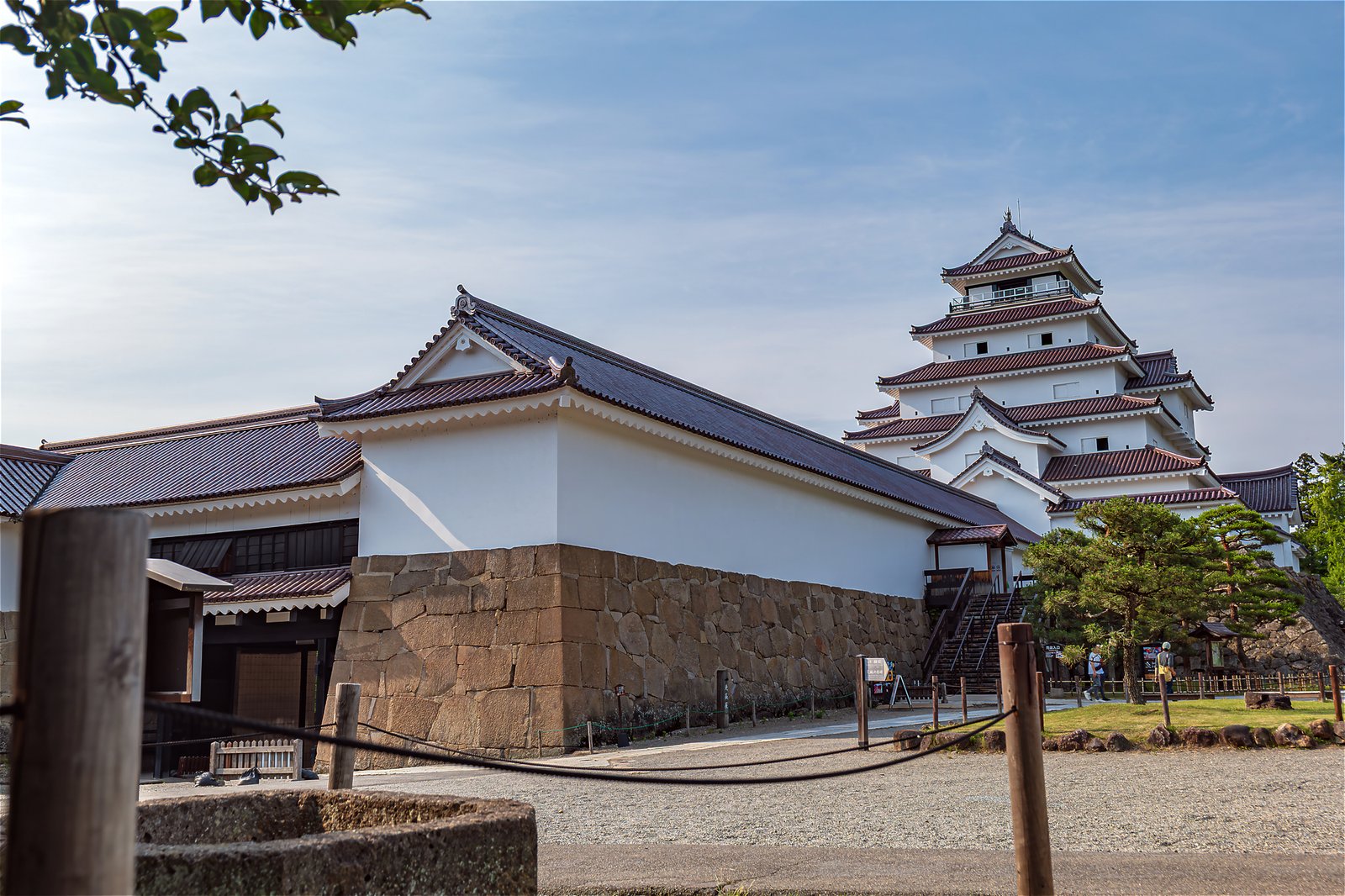
The operator’s facility overview sets out these points for the park (Aizuwakamatsu Tourism Bureau, facility overview (in Japanese)):
- Smoking: to protect the historic site, smoke only in the places set aside for it.
- Fire: using fire of any kind in the park is not allowed.
- Cars: entering the park by car needs a permit and is kept to the minimum necessary.
- Pets: not allowed in the keep; walking them in the park is fine, on a lead.
The digital art show is held in the Hoshii Turret and the South Long Barracks, and the operator says that because these are rebuilt timber and plaster buildings, visitors take off their shoes to go in (Aizuwakamatsu Tourism Bureau, Tsurugajo Castle guide (in Japanese)).
What to do: wear shoes that are easy to take off if you plan to see the turrets. Where to verify: the operator’s castle guide (in Japanese).
Getting there
- By loop bus: two town loop buses, Haikara-san and, running the other way round, Akabe, start from Aizu-Wakamatsu Ekimae; both stop at Tsurugajo Iriguchi and Tsurugajo Sannomaruguchi (Aizu Bus, town loop buses (in Japanese)). The same page sells a one-day pass for both routes. Aizuwakamatsu City’s bus timetable page links to this page and describes it as the website of Fukushima Transportation’s Aizu branch (Aizuwakamatsu City, local bus timetables (in Japanese)).
- By train: JR Aizu-Wakamatsu Station is on the Ban’etsu West Line, towards Koriyama and towards Kitakata and Niitsu, and on the Tadami Line towards Aizu-Kawaguchi and Tadami (JR East, Aizu-Wakamatsu Station timetables (in Japanese)).
- By car: the operator lists three car parks, at the west outer bailey, the east entrance and the south entrance, all paid (Aizuwakamatsu Tourism Bureau, Tsurugajo Castle guide (in Japanese)).
What to do: check the loop bus times for your return before you go up the keep. Where to verify: the Aizu Bus page (in Japanese).
The castle site on the national register
The site was listed as a Historic Site under the name Wakamatsu Castle site on 28 December 1934, with an addition on 29 October 1993 (Agency for Cultural Affairs, register entry for the Wakamatsu Castle site (in Japanese)). The entry places it in four districts of Aizuwakamatsu: Otemachi, Kashun-machi, Joto-machi and Sakae-machi. Its old description says that the Ashina family is said to have first built a castle here, that Gamo Ujisato rebuilt it on a larger scale in 1590, and that after Hoshina Masayuki entered it in 1643 it was the seat of the lords of the Aizu domain. It adds that the castle became famous through the Boshin War, and that although it is now a park, the stone walls and the remains of the moat are well preserved.
What to do: walk the outer stone walls as well as the keep. Where to verify: the register entry (in Japanese).
The siege of 1868
The operator’s history page gives a short timeline (Aizuwakamatsu Tourism Bureau, the end of the shogunate and the Boshin War (in Japanese)). Dates follow the page, by month of the old calendar. The Boshin War began in the first month of 1868 with the battle of Toba-Fushimi. In the eighth month the defence at Tonoguchihara was broken and the western army entered the castle town. On the 22nd day of the ninth month, after a month of siege, the castle was handed over, and that day the lord Matsudaira Katamori and his son took leave of about 3,000 retainers and went into confinement at Myokokuji temple. The city’s page says the castle withstood a siege of a month (Aizuwakamatsu City, Wakamatsu Castle site (in Japanese)).
What to do: see the third floor of the keep, which covers this period. Where to verify: the operator’s castle guide (in Japanese).
How the tea house was saved
The operator’s page on the Rinkaku tea house tells its story (Aizuwakamatsu Tourism Bureau, Rinkaku tea house (in Japanese)). When the tea master Sen no Rikyu was ordered to die by Toyotomi Hideyoshi in 1591, Gamo Ujisato, then lord of Aizu, hid Rikyu’s son Shoan in Aizu and, together with Tokugawa Ieyasu, asked Hideyoshi to let the Sen family start again. Shoan was pardoned in 1594 and went back to Kyoto. The tea house is said to have been built while he was in hiding. When the castle buildings were taken down after the war, a tea practitioner named Morikawa Zenbei moved it to his own home in May 1872 and looked after it. The city moved it back to its old place in the castle on 12 September 1990, to mark 90 years as a city.
What to do: look for the three name boards given by the heads of the three Sen tea schools, on the south side and above the main and side gates. Where to verify: the tea house page (in Japanese).
Red roof tiles for a snowy country
In 2011 the keep’s roof was re-tiled for the first time in 45 years, and the black tiles were replaced with red ones (Aizuwakamatsu City, Wakamatsu Castle site (in Japanese)). The city says records show red tiles being laid from the time of Hoshina Masayuki, and that the glazed, fired tiles were strong and seem to have stood up to the hard Aizu winters and freezing. The operator adds that the roof first had black tiles of a kind developed in western Japan, and that red tiles with an iron-rich glaze were developed in Aizu on Masayuki’s orders to cope with the cold and snow of the north; they later spread across the region (Aizuwakamatsu Tourism Bureau, Tsurugajo Castle guide (in Japanese)).
What to do: look at the roof from the park as well as from below the keep. Where to verify: the city’s page (in Japanese).
Official sources
| Topic | Source | Checked |
|---|---|---|
| Keep museum hours, admission, car parks, history, turrets, red tiles | Aizuwakamatsu Tourism Bureau, Tsurugajo Castle guide | 2026-11-14 |
| Park rules | Aizuwakamatsu Tourism Bureau, facility overview | 2026-11-14 |
| Tea house history, hours and admission | Aizuwakamatsu Tourism Bureau, Rinkaku tea house | 2026-11-14 |
| The siege of 1868 | Aizuwakamatsu Tourism Bureau, the end of the shogunate and the Boshin War | 2026-11-14 |
| Castle history and red tiles | Aizuwakamatsu City, Wakamatsu Castle site | 2026-11-14 |
| Operator of the keep, tea house and car parks | Aizuwakamatsu City, designated managers | 2026-11-14 |
| National listing | Agency for Cultural Affairs, register entry for the Wakamatsu Castle site | 2026-11-14 |
| Loop bus routes, fares and times | Aizu Bus, town loop buses | 2026-11-14 |
| Bus company | Aizuwakamatsu City, local bus timetables | 2026-11-14 |
| Train lines | JR East, Aizu-Wakamatsu Station timetables | 2026-11-14 |
| Train times towards Koriyama | JR East, Aizu-Wakamatsu Station, Ban’etsu West Line towards Koriyama, weekdays | 2026-11-14 |
What we have not verified
- The walk from Tsurugajo Iriguchi or Tsurugajo Sannomaruguchi to the keep; the bus page and the castle pages we read give no walking time (Aizu Bus, town loop buses (in Japanese)).
- The year the tea house went back into the castle: the tea house page gives 12 September 1990, while the timeline on the castle guide gives 1991 (Aizuwakamatsu Tourism Bureau, Rinkaku tea house (in Japanese)).
- The year the Hoshii Turret and the South Long Barracks were rebuilt: the castle guide gives 2000 and the city’s page gives 2001 (Aizuwakamatsu City, Wakamatsu Castle site (in Japanese)).
- Train journey times from Tokyo; the JR pages we read list departures from Aizu-Wakamatsu only (JR East, Aizu-Wakamatsu Station timetables (in Japanese)).
- Any national listing for the tea house; the only register entry read here is the one for the castle site (Agency for Cultural Affairs, register entry for the Wakamatsu Castle site (in Japanese)).
- English names: Aizuwakamatsu Tourism Bureau, Aizuwakamatsu, the Aizu basin, the Aizu domain, Ashina Naomori, the Ashina family, Gamo Ujisato, Hoshina Masayuki, Matsudaira Katamori, Myokokuji temple, Tonoguchihara, Toba-Fushimi, Sen no Rikyu, Shoan, Toyotomi Hideyoshi, Tokugawa Ieyasu, Morikawa Zenbei, the Sen family, Meiji, Edo, the Hoshii Turret, the South Long Barracks, Wakamatsu Castle site, Otemachi, Kashun-machi, Joto-machi, Sakae-machi, Historic Site, the Agency for Cultural Affairs, Aizu Bus, Fukushima Transportation, Haikara-san, Akabe, Aizu-Wakamatsu Ekimae, Tsurugajo Iriguchi, Tsurugajo Sannomaruguchi, JR East, JR Aizu-Wakamatsu Station, the Ban’etsu West Line, the Tadami Line, Koriyama, Kitakata, Niitsu, Aizu-Kawaguchi, Tadami, Kyoto, Aizu, Fukushima and the Boshin War are our own romanizations or translations; Tsurugajo Castle and the Rinkaku tea house (printed as Chashitsu Rinkaku) follow the English labels on the operator’s pages (Aizuwakamatsu Tourism Bureau, Rinkaku tea house).