Place name in Japanese: 角島, Tsunoshima.
Tsunoshima, Yamaguchi: the 1,780 m road bridge, a Meiji lighthouse you can climb, and the island’s seaweed in the Man’yoshu
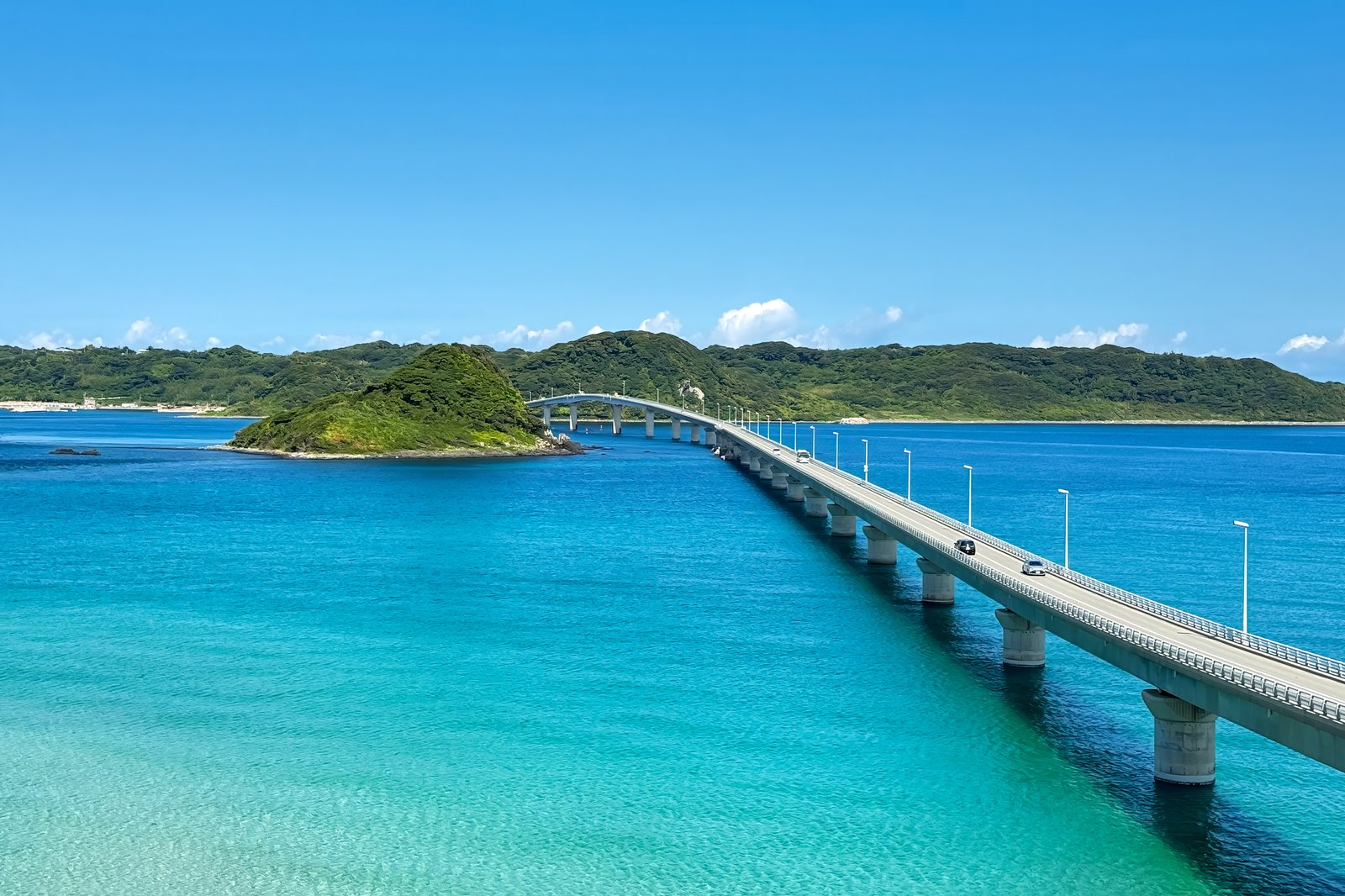
Yamaguchi Prefecture’s island profile places Tsunoshima about 1.5 km off the northwest of Hohoku, in Shimonoseki, and describes it as a low, rolling island shaped like a hand drum, 3.84 square kilometres in area, with 602 residents as of 1 April 2025 (Yamaguchi Prefecture, island profile of Tsunoshima (in Japanese)). The same page records that a road bridge 1,780 m long was completed on 3 November 2000.
Who this is for: day visitors coming by train and local bus, or by car, who want to cross the bridge, climb the lighthouse at the island’s western tip, and know which official page holds each time and fee.
The short version: the rail stop the lighthouse operator names is Kottoi Station on the JR San’in Line, with a Blue Line Kotsu bus from there to the lighthouse park. The lighthouse first shone on 1 March 1876 and is still in service; visitors can go up it for a donation. The bus company warns that few buses run to the island.
Bus, car or a mix
| If… | Then lean towards… | Check |
|---|---|---|
| Your trip is by JR | Kottoi Station, then the bus to the Todai Koen-mae stop, about 25 minutes, and a walk of about 5 minutes | Tokokai, Tsunoshima lighthouse visits (in Japanese) |
| You want the bus operator’s own sheet | The Takibe to Tsunoshima route timetable, dated 1 October 2026 on the operator’s list | Blue Line Kotsu, timetables (in Japanese) |
| You drive from the Chugoku Expressway | From Shimonoseki IC by Route 191 and prefectural roads 275 and 276, about 1 hour 20 minutes, or from Mine IC by Route 435, about 1 hour 10 minutes | Tokokai, Tsunoshima lighthouse visits (in Japanese) |
| You travel in a holiday week | Allow extra time: the operator warns of long delays in traffic jams around Golden Week and Silver Week | Blue Line Kotsu, Tsunoshima bus guide (in Japanese) |
Times and fees to confirm
| Item | Time or fee | Where to check |
|---|---|---|
| Lighthouse visiting hours | 9:00 to 17:00 from March to September, 9:00 to 16:30 from October to February; enter at least 20 minutes before closing | Tokokai, Tsunoshima lighthouse visits (in Japanese) |
| Lighthouse donation | 300 yen from junior-high age up; none for primary-school age and under, or for holders of a disability certificate and one companion | Tokokai, Tsunoshima lighthouse visits (in Japanese) |
| Pauses in lighthouse visits | Check official | Tokokai, Tsunoshima lighthouse visits (in Japanese) |
| Bus times to and from the island | Check official | Blue Line Kotsu, timetables (in Japanese) |
| Road closures | Check official | Shimonoseki City, road information (in Japanese) |
- Few buses: the operator’s Tsunoshima page asks riders to note that only a small number of buses run towards the island.
- Road information: the city’s page covers city roads and points readers to the prefecture’s road map and a road-traffic information service for national and prefectural roads.
- Before you go: match your bus to the operator’s timetable on the day you travel (Blue Line Kotsu, timetables (in Japanese)).
What to do: fix your last bus off the island before you start exploring. Where to verify: the Blue Line Kotsu timetable list (in Japanese).
Getting to Tsunoshima
- By train and bus: the lighthouse operator gives the route as Kottoi Station on the JR San’in Line, then the Blue Line Kotsu bus to Todai Koen-mae (Tokokai, Tsunoshima lighthouse visits (in Japanese)). The prefecture’s profile lists the same company’s buses from JR Nagato-Futami and Kottoi stations (Yamaguchi Prefecture, island profile of Tsunoshima (in Japanese)).
- At Kottoi Station: the bus company’s station guide notes that the station’s two-character name is read Kottoi, and that the bus stop is on the left as you leave the station building (Blue Line Kotsu, Kottoi Station bus guide (PDF, in Japanese)).
- The bus sheet: the operator’s list, dated 1 October 2026, links one timetable for the route from Takibe to Tsunoshima and on to Oyama Ikoi no Ie (Blue Line Kotsu, Takibe to Tsunoshima timetable (PDF, in Japanese)).
- By car: the lighthouse operator gives the routes from Shimonoseki IC and Mine IC on the Chugoku Expressway, with the road numbers in the table above.
What to do: look for the bus stop to the left of the Kottoi station building. Where to verify: the station guide (PDF, in Japanese).
The bridge and the island
The prefecture’s profile gives the bridge’s length as 1,780 m and its completion date as 3 November 2000 (Yamaguchi Prefecture, island profile of Tsunoshima (in Japanese)). The lighthouse operator adds that the bridge’s opening in November 2000 joined the island to the mainland by road (Tokokai, Tsunoshima lighthouse visits (in Japanese)).
On the island itself, the profile says fishing is the main industry, landing about 60 percent of the catch of the former Hohoku town, and that green peas and strawberries are grown and Japanese cattle have long been grazed there. It names the hamayu, the crinum lily that is Shimonoseki’s city flower, as growing wild on the island and flowering white and fragrant in summer.
What to do: look out for the hamayu if you visit in summer. Where to verify: the prefecture’s island profile (in Japanese).
The lighthouse at the western tip
The lighthouse operator’s leaflet says work began on 13 August 1873 and took about three years, and the light was first lit on 1 March 1876 (Tokokai, Tsunoshima lighthouse leaflet (PDF, in Japanese)). It was designed by Brunton, the lighthouse engineer the Meiji government brought from Britain, and building was overseen by three British engineers in turn. Because the site stands only 18.66 m above sea level, the leaflet explains, a tall tower was chosen, rare for the time.
The operator’s visit page describes a 30 m tower faced with roughly dressed granite up to 24 m, with cut stones set decoratively above, stone from Tokuyama in Yamaguchi Prefecture, and a spiral staircase of 105 steps inside (Tokokai, Tsunoshima lighthouse visits (in Japanese)). The national heritage register kept by the Agency for Cultural Affairs records the lighthouse as an Important Cultural Property from 23 December 2020, describes it as a working lighthouse and the first Western-style lighthouse placed on the Sea of Japan side, and lists the owners as the state (Japan Coast Guard), Shimonoseki City and Tokokai (Agency for Cultural Affairs, national heritage register entry (in Japanese)).
The leaflet adds that the exhibition room sits in the old keepers’ quarters, restored by the former Hohoku town, and uses models to explain the hard work of building the light and the fact that its first head keeper was a foreigner.
What to do: count the 105 steps on the way up. Where to verify: the operator’s visit page (in Japanese).
Seaweed for the palace: Tsunoshima in the Man’yoshu
The prefecture’s profile says the island’s name appears in the Man’yoshu poetry anthology and on a wooden tablet dug up at the site of the Heijo Palace in Nara (Yamaguchi Prefecture, island profile of Tsunoshima (in Japanese)). It quotes a poem by an unknown author from volume 16 that sets the wakame of the strait at Tsunoshima as its image; in our paraphrase, the seaweed that was rough with others is soft with the speaker.
The same page says the tablet shows that wakame, still a product of the island today, was presented to the emperor, and that a monument made to mark the tablet stands in a park on the island. Among local products it lists nigime, a simmered relish of fresh wakame stems and leopard plant.
What to do: look for the tablet monument in the park on the island side. Where to verify: the prefecture’s island profile (in Japanese).
A lens from 1874 and a name from two capes
The lighthouse operator says the lens is a regular octagonal first-order Fresnel lens, 2.59 m tall, designed in 1874 by the Stevenson company in Britain and made by the Barbier company in France, and that it is still in use (Tokokai, Tsunoshima lighthouse visits (in Japanese)).
The prefecture’s profile says the island is said to have been named Tsunoshima, horn island, because its two capes, Yumezaki and Makizaki, look like the horns of an ox (Yamaguchi Prefecture, island profile of Tsunoshima (in Japanese)).
What to do: compare the two capes on a map with the profile’s description. Where to verify: the prefecture’s island profile (in Japanese).
Official sources
| Topic | Source | Checked |
|---|---|---|
| Island profile, bridge length and date, park, poem and tablet, name | Yamaguchi Prefecture, island profile of Tsunoshima | 2026-11-11 |
| Lighthouse visits, hours, donation, tower, lens, access | Tokokai, Tsunoshima lighthouse visits | 2026-11-11 |
| Lighthouse construction and exhibition room | Tokokai, Tsunoshima lighthouse leaflet (PDF) | 2026-11-11 |
| Lighthouse designation and owners | Agency for Cultural Affairs, national heritage register entry | 2026-11-11 |
| Bus timetables | Blue Line Kotsu, timetables | 2026-11-11 |
| Bus notes and station guides | Blue Line Kotsu, Tsunoshima bus guide | 2026-11-11 |
| Kottoi Station bus stop | Blue Line Kotsu, Kottoi Station bus guide (PDF) | 2026-11-11 |
| Road information | Shimonoseki City, road information | 2026-11-11 |
What we have not verified
- Bus departure times and fares: the Takibe to Tsunoshima timetable we opened carries no machine-readable text, so we give no times (Blue Line Kotsu, Takibe to Tsunoshima timetable (PDF, in Japanese)).
- Train times at Kottoi Station; we fetched no JR timetable page (Tokokai, Tsunoshima lighthouse visits (in Japanese)).
- Wind limits for crossing the bridge; the official sheet we tried did not load, so we give none (Shimonoseki City, road information (in Japanese)).
- Designations for the old quarters and storehouse beside the lighthouse; we fetched only the database page for the tower (Agency for Cultural Affairs, national heritage register entry (in Japanese)).
- English names: Hohoku, the Kita-Nagato coast quasi-national park, Kottoi Station, Nagato-Futami, Takibe, Oyama Ikoi no Ie, Todai Koen-mae, Blue Line Kotsu, Tokokai, Brunton, Tokuyama, the Stevenson and Barbier companies, the Heijo Palace, the Man’yoshu, nigime, hamayu, Yumezaki, Makizaki, Shimonoseki IC, Mine IC, the Chugoku Expressway, the San’in Line, the Japan Coast Guard, the Agency for Cultural Affairs and Important Cultural Property are our own romanizations or translations; Tsunoshima follows the bus operator’s English heading (Blue Line Kotsu, timetables (in Japanese)).