Place name in Japanese: 妻籠宿, Tsumago-juku.
Tsumago-juku, Nagiso: the town buses from JR Nagiso Station, a street without cars by day, the old Nakasendo to Magome, the residents’ charter of 1971, and the fire walls of a post town
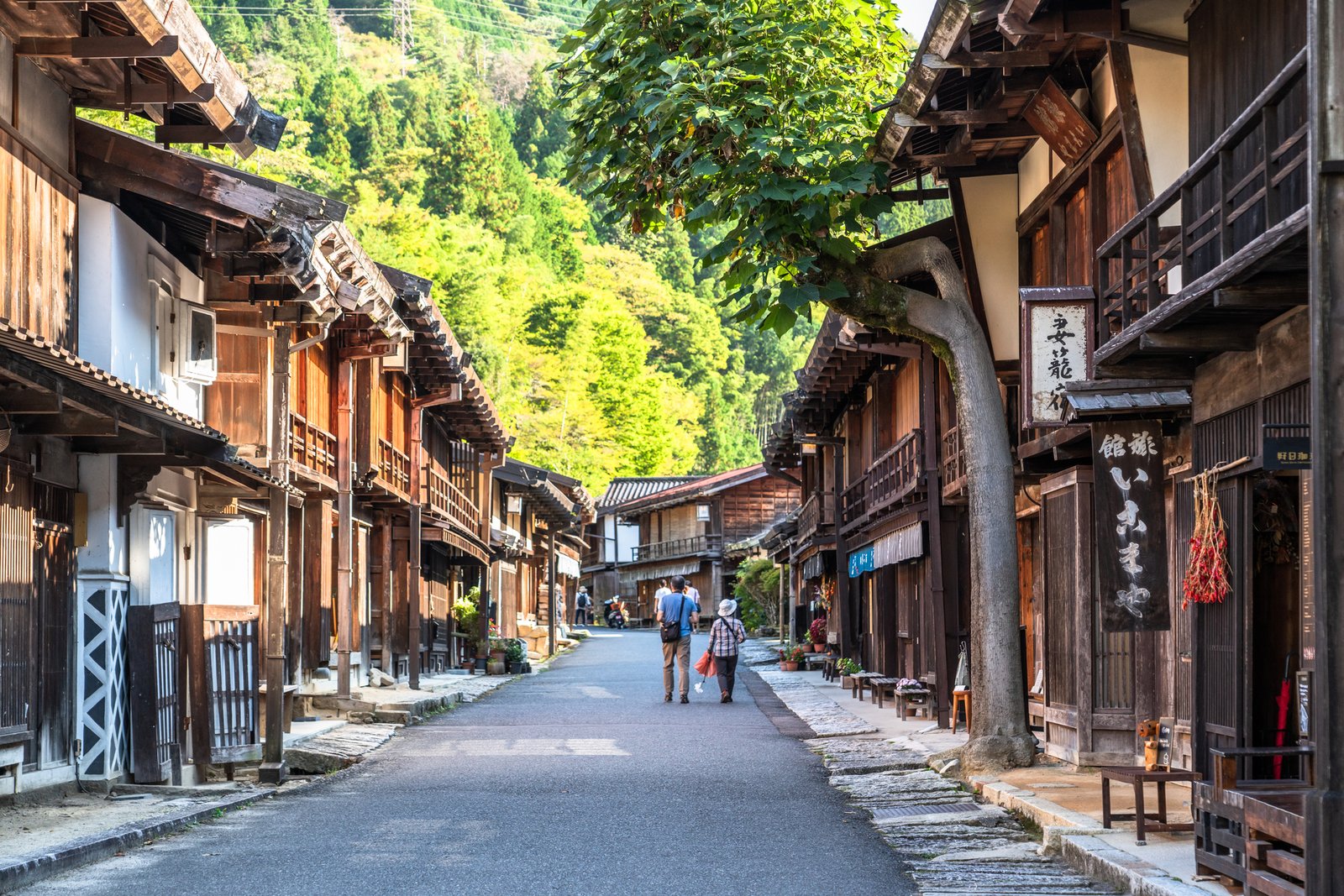
The Agency for Cultural Affairs database lists Nagiso-machi Tsumago-juku in Nagiso Town, Kiso District, Nagano Prefecture, as an Important Preservation District for Groups of Traditional Buildings of the post-town type, selected on 4 September 1976 and covering 1245.4 ha. Its explanation calls Tsumago one of the eleven Kiso post towns of the Nakasendo, says the district takes in the post town, the outlying village and the land around them, and says the post-town area keeps much of its look from the late Edo period to the Meiji period (Agency for Cultural Affairs, Nagiso-machi Tsumago-juku (in Japanese)).
Who this is for: travellers coming to Tsumago for a day by train or car, and walkers taking the old Nakasendo between Tsumago and Magome, who want to know the buses, the rules on the street and what the local tourist associations say about the trail.
The short version: From JR Nagiso Station, the Nagiso town bus reaches Tsumago in about 7 minutes; the Tsumago tourist association gives about 40 minutes on foot. The street through the post town is for pedestrians only from 10:00 to 16:00. On the old road to Magome, the associations ask walkers to carry a bell and to take care on the stone paving after rain.
What to plan for
| If… | Then lean towards… | Check |
|---|---|---|
| You arrive by train at JR Nagiso Station | The Nagiso town bus, Magome Line or Tsumago Line, to the Tsumago stop | Nagiso Town, Magome Line timetable (in Japanese) |
| You are driving | The car parks along National Route 256, not the street itself | Tsumago tourist association, access (in Japanese) |
| You want to walk the old road to Magome | About 9 km and about 3 hours, or the bus to Magome Pass and the walk down | Tsumago tourist association, walking (in Japanese) |
| It has rained | Slow going on the stone paving, using the handrails | Nagiso tourist association, for Nakasendo walkers (in Japanese) |
Getting there: the town buses from JR Nagiso Station
Nagiso Town says the times and fares of its community buses were revised on 1 April 2026. It gives the adult fare on the Tsumago Line as 300 yen, and on the Magome Line as 300 yen within the town, from Nagiso Station to Ichikoku, 300 yen from Magome Pass to Magome, and 1,000 yen from Nagiso Station to stops beyond Magome Pass (Nagiso Town, community buses (in Japanese)).
Both timetables say the buses run every day. On the Magome Line, buses leave Nagiso Station at 10:10, 12:40, 14:15 and 16:35 and reach the Tsumago stop 7 minutes later, with an 8:40 bus only from 25 April to 6 May and from 25 July to 23 August; buses back from Tsumago to the station leave at 11:21, 13:51, 15:26 and 17:41, with a 9:51 bus on the same dates (Nagiso Town, Magome Line timetable (in Japanese)). On the Tsumago Line, buses leave Nagiso Station at 11:15, 12:40 and 13:30, and leave Tsumago for the station at 9:50, 10:40, 11:50, 13:00, 13:50, 15:40 and 16:10 (Nagiso Town, Tsumago Line timetable (in Japanese)).
The Nagiso tourist association sells bus tickets of 300 yen and 1,000 yen at the Tsumago tourist information office, from 8:30 to 17:00, to avoid crowding when passengers get off; a ticket is valid for two days from purchase and only on the Hogami and Magome Lines (Nagiso tourist association, bus tickets (in Japanese)). The Tsumago tourist association gives about 10 minutes by taxi from the station and about 40 minutes on foot, by the Nakasendo or by the roadside paths of National Routes 19 and 256 (Tsumago tourist association, access (in Japanese)).
What to do: note the time of the last bus back to the station for the line you are using. Where to verify: the town’s bus page (in Japanese).
The street: closed to cars by day, with the poles moved behind the houses
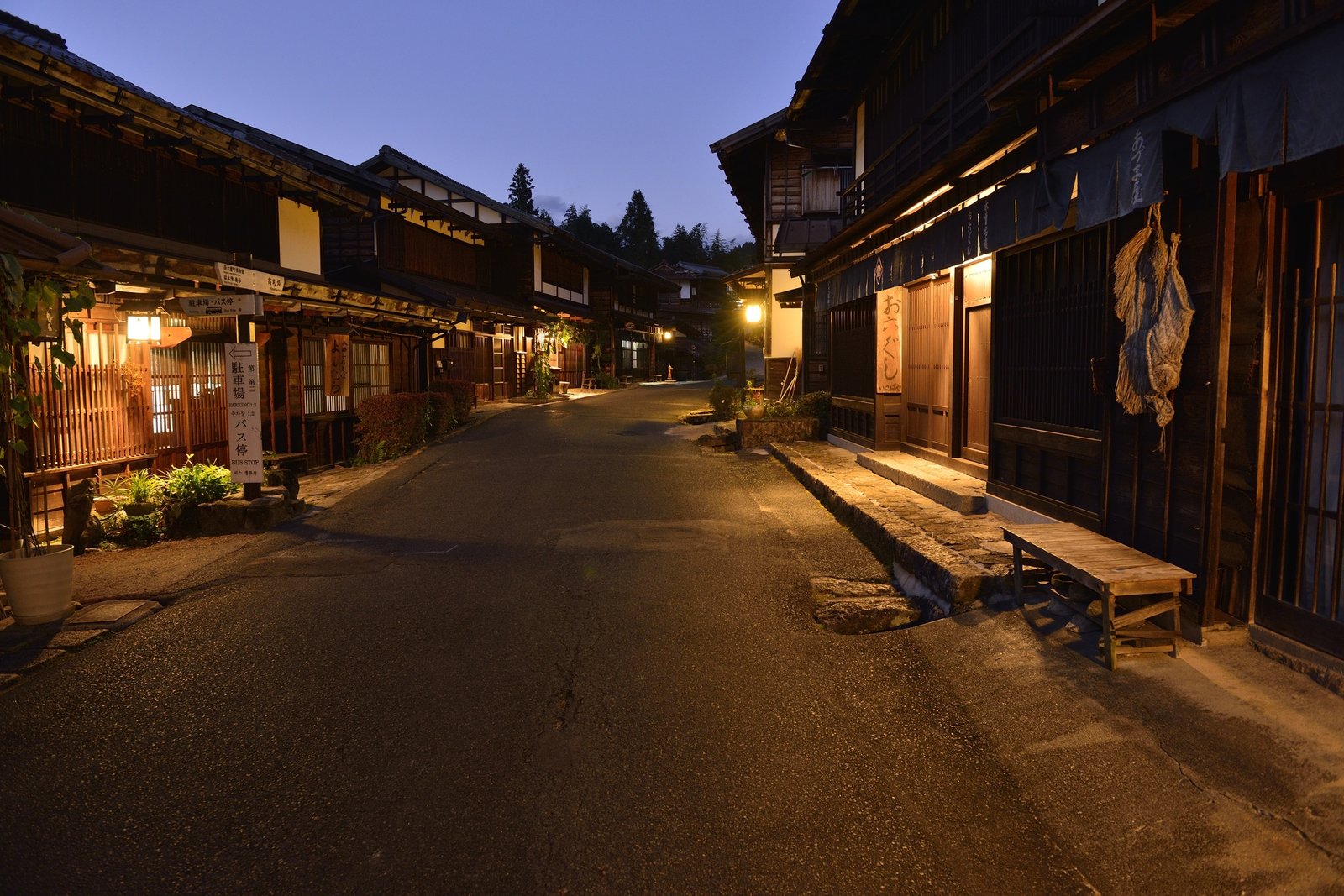
The Tsumago tourist association says the street through the post town is closed to vehicles by the Public Safety Commission from 10:00 to 16:00 and is for pedestrians only in those hours. It asks drivers to use the No. 2 car park and the central car park along National Route 256, and coaches to use the No. 1 car park, which is for buses only (Tsumago tourist association, access (in Japanese)).
The association’s page on preservation says that in 1970, under Nagano Prefecture’s plan for a nature trail, part of the stone paving in the post town was restored and a notice board was rebuilt, and that the electricity poles were moved to the back of the houses along the whole post town with the help of the National Trust of Japan, Chubu Electric Power and the telephone corporation of the time (Tsumago tourist association, preserving the streetscape (in Japanese)).
What to do: if you drive, leave the car on Route 256 and walk in. Where to verify: the association’s access page (in Japanese).
Walking the old Nakasendo to Magome
The Tsumago tourist association gives the walk from Magome-juku to Tsumago-juku as 9 km, about 3 hours at an easy pace, with a short steep climb from Magome to Magome Pass and a long gentle slope from Tsumago to the pass. A shorter way, it says, is to go to the pass by bus or car and walk only downhill, about 1.5 hours from the pass to Tsumago. It gives the pass as 790 m high, on the border of Gifu and Nagano, and warns that the stretches of old stone paving become slippery after rain. Because of reports of bears coming down near villages, it recommends carrying something that makes a sound, such as a bell, and lends bells at the Tsumago and Magome tourist information offices (Tsumago tourist association, walking (in Japanese)).
The Nagiso tourist association says walkers have hurt their feet on the stone paving from Koshinzuka in Otsumago towards Magome, that the paving is uneven and slippery after rain, and asks them to use the handrails and go slowly (Nagiso tourist association, for Nakasendo walkers (in Japanese)). It also reported bear sightings on the Nakasendo and the Yogawa road as of 5 May 2026, and says that fatal accidents in rivers happen in Nagano Prefecture every year (Nagiso tourist association, bears and accidents in the water (in Japanese)).
What to do: carry a bell, and on the stone paving use the handrails. Where to verify: the Nagiso tourist association’s page for walkers (in Japanese).
Do not sell, do not rent, do not destroy: the residents’ charter of 1971
The Tsumago tourist association says that in the Meiji period new railways and roads were built, Tsumago lost its work as a post town and went into decline, and that later, during Japan’s economic growth, its streetscape, which still showed the look of an Edo-period post town, came to be valued again. In August 1968, it says, the preservation of Tsumago was taken up as one of Nagano Prefecture’s projects marking a hundred years since the Meiji Restoration, with a three-year plan from 1969 under which town houses were taken apart and rebuilt, or repaired. In the same year the local residents set up an association for the love of Tsumago, and agreed that the work would be led by the residents and that tourism would mean keeping the post-town landscape together with its natural setting.
In July 1971, the association says, the residents declared a charter to protect Tsumago-juku: to put preservation before everything, they would not sell, not rent and not destroy the buildings, houses, farmland and forests of Tsumago-juku and along the old Nakasendo. It says the charter is still kept by the residents today, and that in 1976 the area was selected as an Important Preservation District for Groups of Traditional Buildings (Tsumago tourist association, preserving the streetscape (in Japanese)).
What to do: as you walk the street, remember that the houses are lived in. Where to verify: the association’s page on preservation (in Japanese).
Two families, the inns and the fire walls
The Nagiso Board of Education, writing for the Japan Heritage portal, says Tsumago was set up in 1601 as the 42nd post town counted from Edo (Japan Heritage portal, Tsumago-juku Preservation District (in Japanese)). The Tsumago tourist association names a document that tells of its founding: a letter of 1601 from the Kiso deputy appointing a member of the Hayashi family to a half share of the post station’s office (Tsumago tourist association, preserving the streetscape (in Japanese)). It says that throughout the Edo period the Shimazaki and Hayashi families ran that office, the Shimazaki family kept the honjin, the inn for official travellers, and the Hayashi family the waki-honjin, the second inn, and that a record called the Daigaicho counted 7 large, 10 middle-sized and 14 small inns (Tsumago tourist association, preserving the streetscape (in Japanese)).
Post towns and fires went together, the association says, and Tsumago was no exception, with many records of fires from that of 1634 onwards (Tsumago tourist association, preserving the streetscape (in Japanese)). Among the defences against fire it lists udatsu walls, high walls and the post town’s water channel, and says udatsu can still be seen along the street and in Otsumago (Tsumago tourist association, preserving the streetscape (in Japanese)). The name Otsumago, it says elsewhere, came from Oku-Tsumago, the inner Tsumago (Tsumago tourist association, walking (in Japanese)).
What to do: look along the roof lines for the udatsu walls. Where to verify: the association’s page on preservation (in Japanese).
What we have not verified
Check official before you go: bus times and fares, and any change to them (Nagiso Town, community buses (in Japanese)). Check official before you go: the hours the street is closed to cars, and car park fees (Tsumago tourist association, access (in Japanese)). Check official before you go: the latest bear sightings on the trail (Nagiso tourist association, bears and accidents in the water (in Japanese)).
- Train times at JR Nagiso Station: not checked.
- Other designations: only the Agency for Cultural Affairs database entry above was read for designations.
- Names: the bus operator, the residents’ association and the people named in the history are given here by role or in this site’s renderings; no English names for them were printed on the pages read.
Official sources
| Topic | Source | Checked |
|---|---|---|
| Designation and explanation | Agency for Cultural Affairs, Nagiso-machi Tsumago-juku | 2026-11-11 |
| Community buses and fares | Nagiso Town, community buses | 2026-11-11 |
| Magome Line times | Nagiso Town, Magome Line timetable | 2026-11-11 |
| Tsumago Line times | Nagiso Town, Tsumago Line timetable | 2026-11-11 |
| Bus tickets | Nagiso tourist association, bus tickets | 2026-11-11 |
| Access, cars, parking | Tsumago tourist association, access | 2026-11-11 |
| The walk to Magome | Tsumago tourist association, walking | 2026-11-11 |
| Preservation and history | Tsumago tourist association, preserving the streetscape | 2026-11-11 |
| Stone paving | Nagiso tourist association, for Nakasendo walkers | 2026-11-11 |
| Bears and rivers | Nagiso tourist association, bears and accidents in the water | 2026-11-11 |
| Founding in 1601 | Japan Heritage portal, Tsumago-juku Preservation District | 2026-11-11 |