Tomioka Silk Mill, Gunma: the Joshin Dentetsu line from Takasaki, how the mill was set up in 1870 to 1872, and its brick buildings
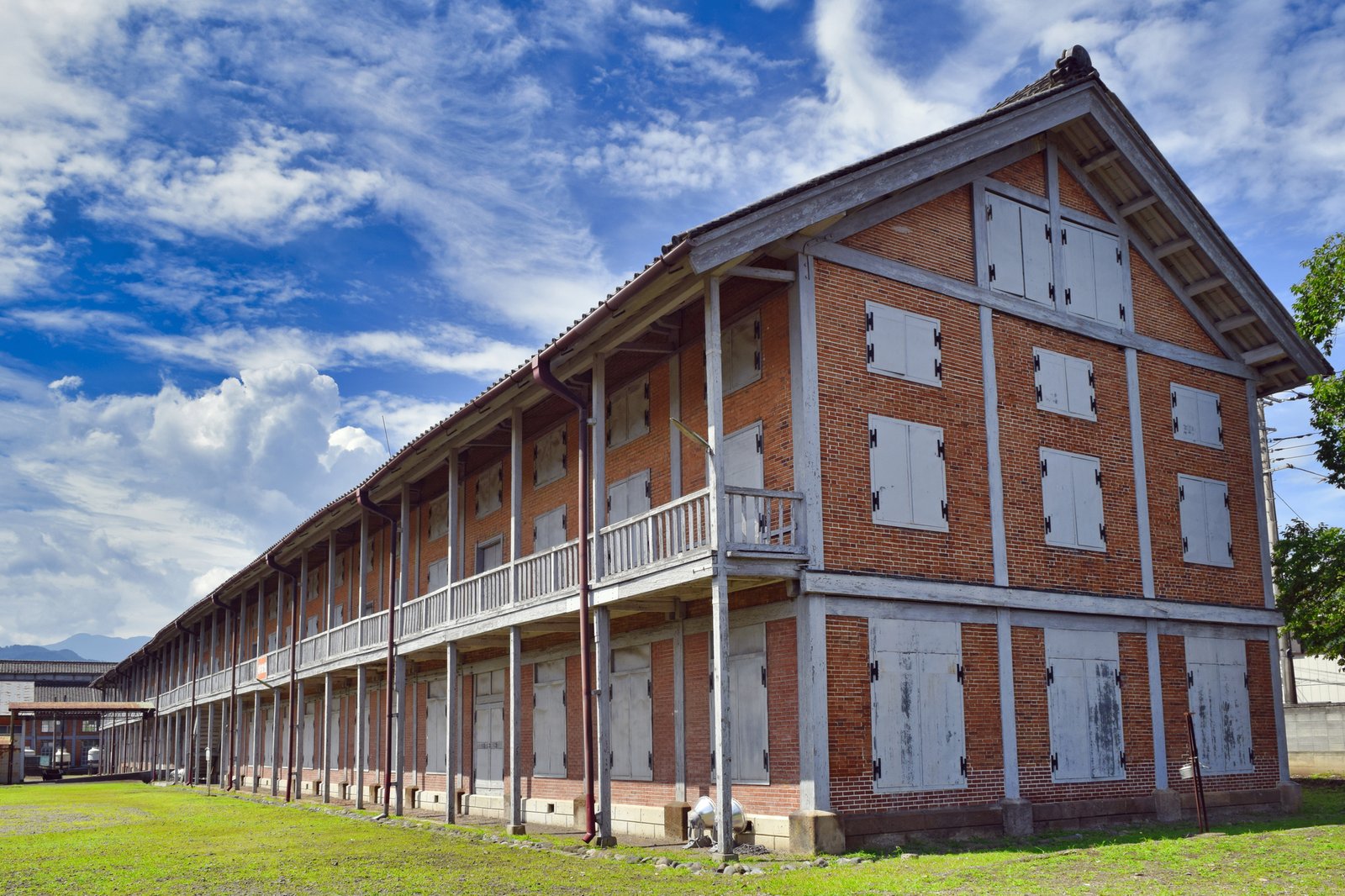
The Tomioka Silk Mill is a former silk-reeling mill in Tomioka, Gunma Prefecture. It is part of the World Heritage property Tomioka Silk Mill and Related Sites, inscribed in 2014; UNESCO describes the property as four sites, one of them a large raw silk reeling plant whose machinery and industrial expertise were imported from France (UNESCO World Heritage Centre). The Agency for Cultural Affairs lists the reeling building of the former Tomioka Silk Mill as a National Treasure, designated an Important Cultural Property on 5 July 2006 and a National Treasure on 10 December 2014 (Agency for Cultural Affairs, database of nationally designated cultural properties: reeling building (in Japanese)), and lists the East Cocoon Warehouse with the same dates (Agency for Cultural Affairs, database of nationally designated cultural properties: East Cocoon Warehouse (in Japanese)). It lists the former Tomioka Silk Mill as a Historic Site, designated on 14 July 2005 (Agency for Cultural Affairs, database of nationally designated cultural properties: Historic Site (in Japanese)).
Who this is for: travellers going to Tomioka by train from Takasaki who want to know how the mill came to be built and what to look for in its brick buildings.
The short version: take the Joshin Dentetsu line from Takasaki to Joshu-Tomioka Station, about 40 minutes by train, then walk about 15 minutes. The mill opened in 1872 with machinery bought in France. The agency notes the date “Meiji 5” carved on the keystone of the East Cocoon Warehouse arch.
What to plan for
| If… | Then lean towards… | Check |
|---|---|---|
| You are coming by Shinkansen or JR to Takasaki | The Joshin Dentetsu line from Takasaki to Joshu-Tomioka Station, then on foot | Tomioka Silk Mill, access (in Japanese) |
| You want the train fare and the mill’s admission together | The return ticket with mill admission that Joshin Dentetsu sells | Joshin Dentetsu, Tomioka Silk Mill return ticket (in Japanese) |
| You are coming by car | A car park near the mill, since vehicles cannot enter the site | Tomioka Silk Mill, access (in Japanese) |
| You want the buildings explained on site | A guided tour or the audio guide app | Tomioka Silk Mill, visitor information (in Japanese) |
Getting there: the Joshin Dentetsu line from Takasaki
The mill’s access page routes rail visitors to Takasaki Station, then onto the Joshin Dentetsu line to Joshu-Tomioka Station, and says the Joshin Dentetsu part of the journey takes about 40 minutes. To change at Takasaki, it says, go out through the JR ticket gates, leave by the west exit and turn left, and you will find the Joshin Dentetsu gates. From Joshu-Tomioka Station to the mill it gives about 15 minutes on foot (Tomioka Silk Mill, access (in Japanese)). Joshin Dentetsu’s own page for Joshu-Tomioka Station also gives about 15 minutes on foot to the mill, and links to the station’s timetables in each direction (Joshin Dentetsu, Joshu-Tomioka Station (in Japanese)).
For drivers, the access page says vehicles cannot enter the mill, and points to nearby city car parks, about 10 minutes (3 km) from the Tomioka interchange on the Joshin-etsu Expressway and about 10 minutes (500 m) on foot from the mill (Tomioka Silk Mill, access (in Japanese)).
What to do: before you set out from the mill, look up the departures towards Takasaki on the operator’s timetable for Joshu-Tomioka. Where to verify: Joshin Dentetsu, Joshu-Tomioka timetable towards Takasaki (in Japanese).
Choosing Tomioka and finding its workers, 1870 to 1872
The Agency for Cultural Affairs’ entry for the Historic Site tells how the mill was set up. In Meiji 3 (1870) the government engaged the Frenchman Paul Brunat to establish a mill. The following year he went to France, bought a full set of reeling machinery, and came back with French raw-silk inspectors and women workers he had hired. The site chosen was flat land in Tomioka, picked because sericulture had thrived there since the Edo period and good cocoons could be had, because it was not far from Tokyo and Yokohama, where silk was exported, because water for reeling could be secured, and because a large former magistrate’s estate was available (Agency for Cultural Affairs, database of nationally designated cultural properties: Historic Site (in Japanese)).
The design was by Bastien, a Frenchman who had been involved in building the Yokosuka ironworks at the end of the Edo period. Work began in the third month of Meiji 4 (1871); cedar from Mount Myogi and pine from Agatsuma were used, and the roof tiles and bricks were fired at Fukushima, east of Tomioka. By the seventh month of Meiji 5 (1872) the mill was almost complete. Women workers were then sought across the country, but rumours spread and few applied. The government issued notices several times to help recruitment, and in the end 404 daughters of notable families and former samurai of the domains came. The mill opened in the tenth month of Meiji 5 (1872) (Agency for Cultural Affairs, database of nationally designated cultural properties: Historic Site (in Japanese)).
The same entry follows the mill after that. It was renamed the Tomioka Seishisho in 1876, sold to the Mitsui group in 1893, passed to Hara Gomei Kaisha in 1902 and to Katakura in 1939, and stopped operating in 1987 (Agency for Cultural Affairs, database of nationally designated cultural properties: Historic Site (in Japanese)).
What to do: read the buildings around you as the mill of 1872 that kept working until 1987. Where to verify: the agency’s Historic Site entry (in Japanese).
Timber frames, French bond and “Meiji 5” on the keystone
The agency’s explanation for the three National Treasure buildings, the reeling building and the east and west cocoon warehouses, says that Paul Brunat planned and guided the work, that Edmond Bastien of the Yokosuka shipyard drew the plans, and that Japanese builders put them up. All three are wooden-frame brick: a timber frame with walls of laid brick (Agency for Cultural Affairs, database of nationally designated cultural properties: reeling building (in Japanese)). The Historic Site entry adds that the brick of the cocoon warehouses is laid in French bond (Agency for Cultural Affairs, database of nationally designated cultural properties: Historic Site (in Japanese)).
The reeling building, where the silk was reeled, stands at the centre of the site and is 140 metres long. The agency points to its king post truss roof, high ceiling and iron-framed glass windows, which give it a large, bright interior. The two cocoon warehouses, each 104 metres long and two storeys high, stand at right angles to it; they were used to dry and store cocoons and have many windows for the drying. The East Cocoon Warehouse is the building facing the entrance, and the keystone of its arch is carved with “Meiji 5”, the year the mill opened (Agency for Cultural Affairs, database of nationally designated cultural properties: reeling building (in Japanese)). The agency lists the East Cocoon Warehouse with a veranda on its west and south sides (Agency for Cultural Affairs, database of nationally designated cultural properties: East Cocoon Warehouse (in Japanese)).
What to do: as you come in, stop at the East Cocoon Warehouse arch and find the carved keystone, then look up at the roof trusses inside the reeling building. Where to verify: the agency’s entry for the reeling building (in Japanese).
What we have not verified
Check official before you go: opening hours and last entry (Tomioka Silk Mill, visitor information (in Japanese)). Check official before you go: closing days, including any temporary closures (Tomioka Silk Mill, visitor information (in Japanese)). Check official before you go: admission fees (Tomioka Silk Mill, visitor information (in Japanese)). Check official before you go: guided-tour times, fees, meeting point and group booking (Tomioka Silk Mill, visitor information (in Japanese)). Check official before you go: train fares and the return ticket with admission (Joshin Dentetsu, Joshu-Tomioka Station (in Japanese)).
- Walking time from the station: the mill’s access page and Joshin Dentetsu’s station page give about 15 minutes; another Joshin Dentetsu page gives 10 minutes.
- Paul Brunat’s role: the agency’s building entry calls him a raw-silk inspector and its Historic Site entry calls him an engineer; this page gives neither title.
- Dates: the Meiji-era months above are given as the agency prints them and are not converted to Western calendar dates.
- The other sites of the World Heritage property: UNESCO describes four sites; the three besides the mill in Tomioka, and how to reach them, are not checked.
- English names: the operator prints “Joshin Dentetsu”; the names of the station and the buildings on this page are this site’s renderings.
Official sources
| Topic | Source | Checked |
|---|---|---|
| World Heritage property and inscription | UNESCO World Heritage Centre | 2026-11-11 |
| Reeling building: National Treasure, dates, the three buildings explained | Agency for Cultural Affairs, database of nationally designated cultural properties: reeling building | 2026-11-11 |
| East Cocoon Warehouse: National Treasure, dates, verandas | Agency for Cultural Affairs, database of nationally designated cultural properties: East Cocoon Warehouse | 2026-11-11 |
| Historic Site, date, history from 1870 to 1987, French bond | Agency for Cultural Affairs, database of nationally designated cultural properties: Historic Site | 2026-11-11 |
| The city’s link to the mill’s official site | Tomioka City, Tomioka Silk Mill | 2026-11-11 |
| Rail and road access, car parks | Tomioka Silk Mill, access | 2026-11-11 |
| Hours, closing days, fees, guided tours, audio guide | Tomioka Silk Mill, visitor information | 2026-11-11 |
| Joshu-Tomioka Station, walking time, fares | Joshin Dentetsu, Joshu-Tomioka Station | 2026-11-11 |
| Timetable towards Takasaki | Joshin Dentetsu, Joshu-Tomioka timetable | 2026-11-11 |
| Return ticket with admission | Joshin Dentetsu, Tomioka Silk Mill return ticket | 2026-11-11 |