Place name in Japanese: 竹田城跡, Takeda-jō ato.
Takeda Castle ruins, Asago: the walk from JR Takeda Station, the season’s opening hours, the rules on a mountain castle site, the last lord of 1600, and the walls of mixed stones
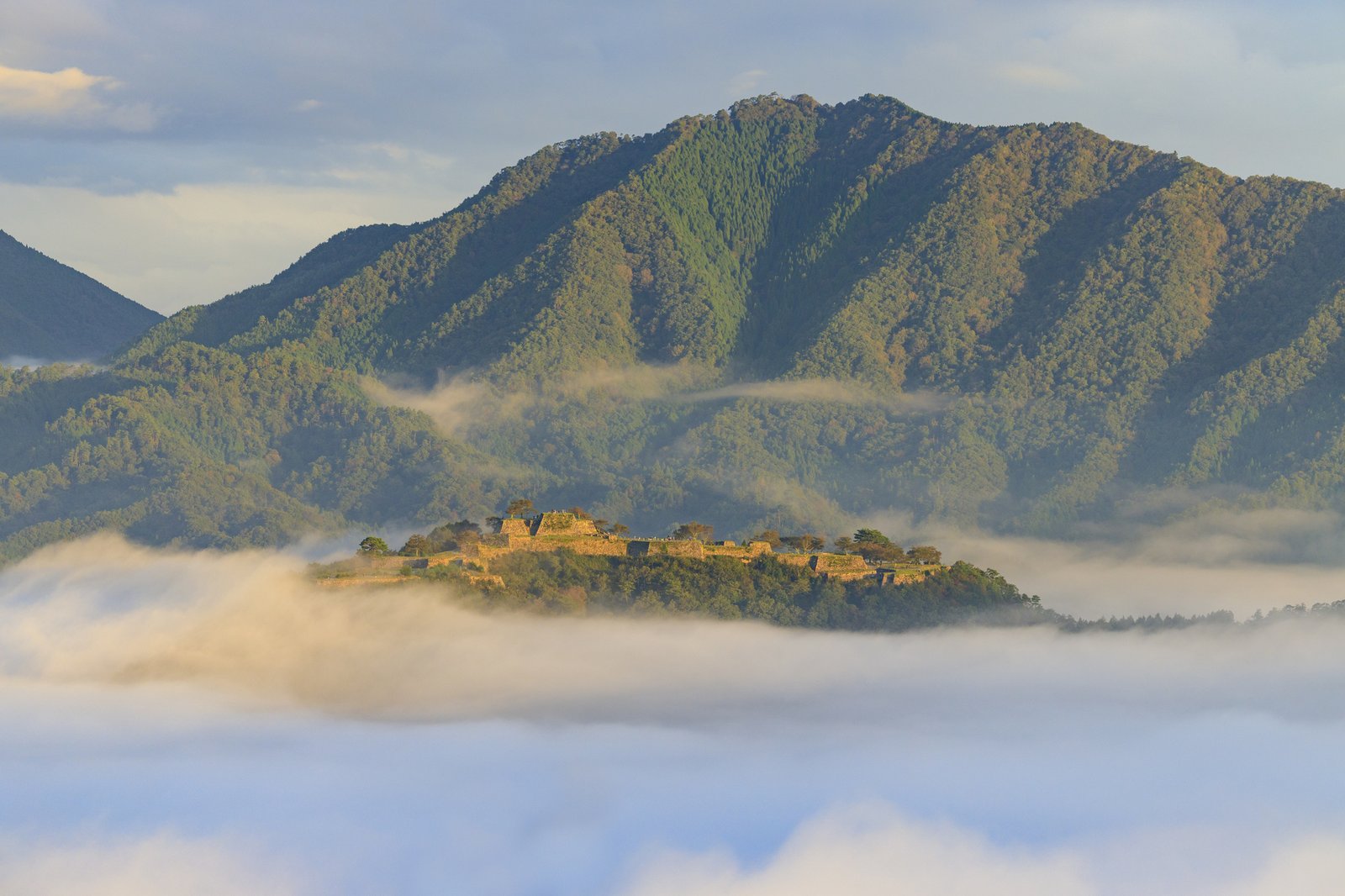
The Agency for Cultural Affairs database lists the Takeda Castle ruins (Takeda-jo ato) in Wadayama-cho Takeda, Asago City, Hyogo Prefecture, as a Historic Site, designated on 8 September 1943, with an addition on 23 July 2009 (Agency for Cultural Affairs, Takeda Castle ruins (in Japanese)). Asago City gives the height of the ruins as 353.7 m, about 250 m above the town of Takeda at the foot of the hill, and says no buildings remain, only the stone walls (Asago City, questions about the Takeda Castle ruins (in Japanese)).
Who this is for: travellers going up to the Takeda Castle ruins for a few hours from JR Takeda Station or by car, who want to know the ways up, the opening hours for the season and what the city asks of visitors on the site.
The short version: From JR Takeda Station the city gives about 40 minutes on foot by the trail behind the station. If you go by bus or taxi, everyone still walks the last 900 m, about 20 minutes, from the mid-slope stop to the entrance. Until 6 December 2026 the ruins are open from 5:00 to 17:00; they are closed for winter from 4 January to the end of February.
What to plan for
| If… | Then lean towards… | Check |
|---|---|---|
| You arrive at JR Takeda Station and are happy to walk | The trail behind the station, about 700 m and about 40 minutes | Asago City, for visitors to the Takeda Castle ruins (in Japanese) |
| You would rather ride most of the way | The Tenku circular bus or a taxi to the mid-slope stop, then 900 m on foot | Asago City, opening hours to 6 December 2026 (in Japanese) |
| You are driving | The Yamashiro no Sato car park, the last one for ordinary cars | Asago City, opening hours to 6 December 2026 (in Japanese) |
| You plan to go in winter | The winter hours, and the closure from 4 January to the end of February | Asago City, opening hours (in Japanese) |
Getting there: on foot, by taxi or by the Tenku bus
Asago City asks visitors to come by public transport, because the car parks nearby can fill up at weekends, on public holidays and in the tourist season. From JR Takeda Station, it says, the trail behind the station passes the site of the last lord’s residence and is about 700 m, about 40 minutes on foot; it asks walkers to wear trainers and to carry something to drink against heatstroke. By taxi it gives about 20 minutes from the station to the mid-slope bus stop and taxi stand. Because the road is one way, a taxi back from that stop to Yamashiro no Sato has to go down to the town and round again, about three times the distance of the way up (Asago City, for visitors to the Takeda Castle ruins (in Japanese)).
The city’s page for the season to 6 December 2026 says Zentan Bus runs the Tenku circular bus in the daytime, between the 8:00 and 16:00 hours, from JR Takeda Station and Yamashiro no Sato, and that it does not run in December. In November, on Saturdays, Sundays and public holidays, Zentan Bus also runs the early-morning Unkai bus; it runs only between the Takeda town car park or Asago Bridge, on National Route 312, and Yamashiro no Sato, and does not go to the mid-slope stop. The city’s page and Zentan Bus’s timetable do not give the same hours for this bus, so check official: Asago City, opening hours to 6 December 2026 (in Japanese) and Zentan Bus, Unkai bus (in Japanese). The city’s page says ordinary cars and large coaches can go no further than the Yamashiro no Sato car park, and that from the mid-slope stop everyone has to walk the 900 m, about 20 minutes, to the entrance (Asago City, opening hours to 6 December 2026 (in Japanese)). The city adds that both buses take cash only (Asago City, paying the admission fee (in Japanese)).
What to do: if you go by bus, carry cash for the fare. Where to verify: the city’s page for the season (in Japanese).
Opening hours and the trails’ gates
Asago City says that from 1 June to 6 December 2026 the ruins are open from 5:00 to 17:00. The gate of the west trail from Yamashiro no Sato can be passed on the way up from 4:30 to 16:30, the gates of the station trail and the Hyomai Shrine trail from 5:00 to 16:30, and the gate of the south trail from 5:00 to 16:00. The west trail gate closes at 18:30 and the others at 18:00. It gives about 40 minutes from Yamashiro no Sato by the west trail, and, from the car parks by the town, about 40 minutes by the station trail or the Hyomai Shrine trail and about 60 minutes by the south trail (Asago City, opening hours to 6 December 2026 (in Japanese)).
Its general page on hours gives winter hours from early December to 3 January of 10:00 to 15:00, with the last entry at 14:30, and says the ruins are closed for winter from 4 January to the end of February. It says visitors may not be able to enter when heavy rain, flood or storm warnings are issued, when a typhoon is near, during lightning, when there is snow or the trails are frozen, or when entry is judged dangerous (Asago City, opening hours (in Japanese)).
What to do: check the weather warnings for Asago on the morning you go. Where to verify: the city’s page on hours (in Japanese).
On the site: what Asago City asks
The city says the trails from the station and from Hyomai Shrine are unpaved forest paths with stone steps, and that the ruins themselves are unpaved, with stone steps; it asks visitors to bring a torch and a bell that makes a sound, and to wear shoes such as trainers (Asago City, opening hours to 6 December 2026 (in Japanese)). It does not allow fire, and the whole area from the car parks to the ruins, trails included, is non-smoking. It also does not allow putting up structures such as tents, taking away roof tiles or stones, writing on or climbing the stone walls, and dropping litter. It says high heels and sandals are unsuitable, asks visitors not to use walking sticks or umbrellas as sticks on the site, and asks those unsure of their strength or unwell not to make the climb (Asago City, cautions for visitors (in Japanese)).
Inside the ruins the route is one way, and the areas outside the marked route are closed (Asago City, the route through the ruins (in Japanese)). There are no toilets inside the ruins; eating is asked to be kept to the Kita-senjo, the first wide area, with litter taken home; and the city gives the visit itself as taking 30 to 60 minutes, not counting the way up (Asago City, questions about the Takeda Castle ruins (in Japanese)).
What to do: use the toilets before you reach the entrance, and keep to the marked route. Where to verify: the city’s cautions page (in Japanese).
The last lord and the year 1600
Asago City says that, by oral tradition, the castle was begun around 1443, when the military governor of Tajima province ordered his retainers of the Otagaki family to build it, and that the Otagaki were lords of it for seven generations; it thinks the castle fell in 1580 to the attack on Tajima by Hashiba Hideyoshi, later Toyotomi Hideyoshi. In 1585, it says, the lord of Tatsuno Castle in Harima entered Takeda with a domain of 20,000 koku, later 22,000, and the stone walls that remain are thought to have been put in order while he was lord. The city says he is said to have been loved by his people as a lord of benevolent rule, and that he encouraged silk farming and lacquerware.
In 1600, the city says, when the Battle of Sekigahara came, he first sided with the Western army and joined the attack on Tanabe Castle in Tango. After the Western army’s defeat he went back to Takeda, and then, at the request of the lord of Shikano Castle, who was attacking Tottori Castle for the Eastern army, he joined that attack. He was accused of setting fire to the castle town of Tottori, was made to take his own life, and Takeda Castle was abandoned (Asago City, the history of Takeda Castle (in Japanese)).
What to do: on the trail behind the station, look for the site of the last lord’s residence the city names. Where to verify: the city’s history page (in Japanese).
A tiger lying down, a bird spreading its wings, and walls of mixed stones
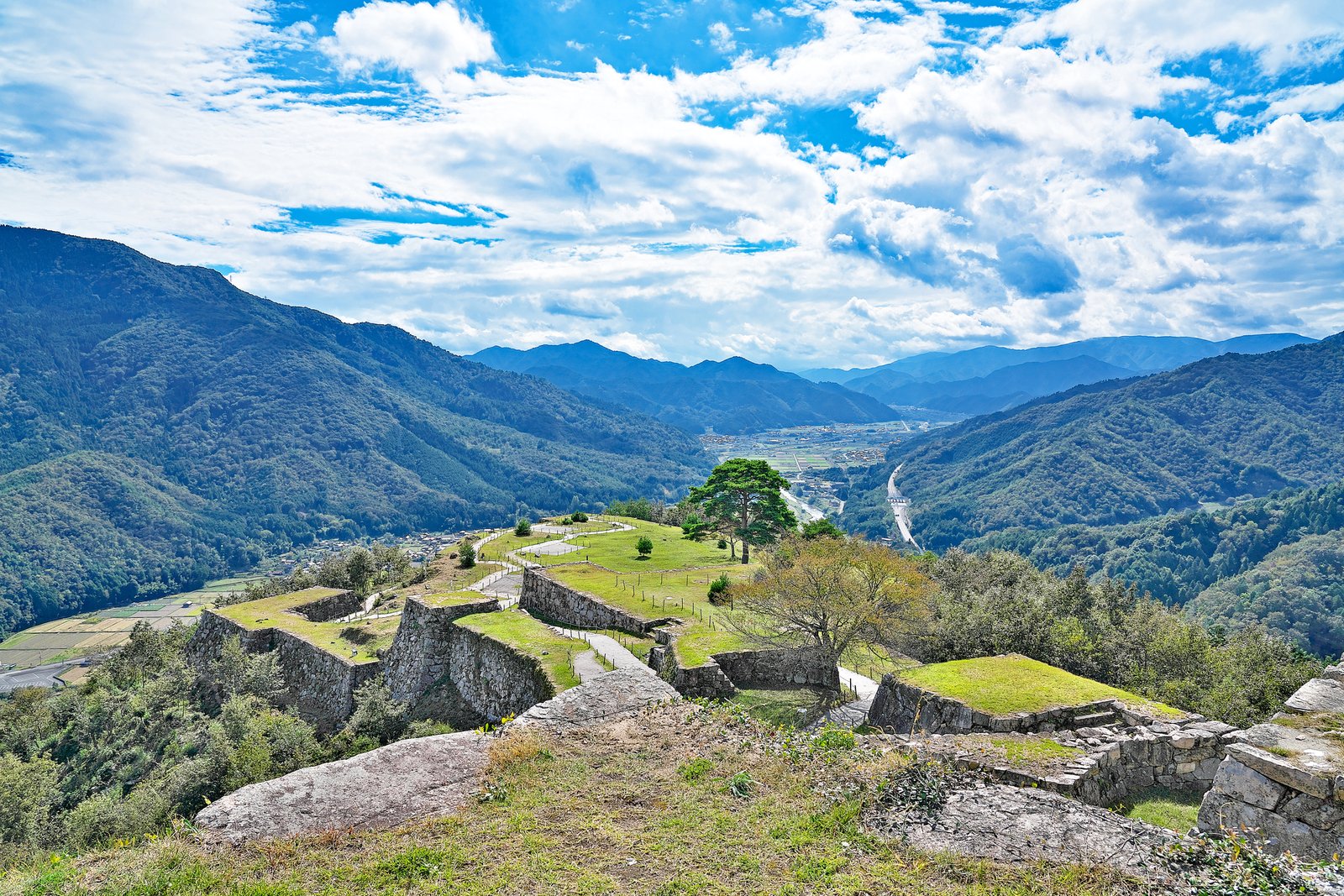
The Agency for Cultural Affairs’ description says the castle stands on a hill on the left bank of the Maruyama River and was also called by a name written with the characters for “a tiger lying down”. It describes the main enclosure built on the levelled summit, with stone walls set in steps around it, as being like a flying bird spreading both its wings, with the Kita-senjojiki near the north end and the Minami-senjojiki at the south (Agency for Cultural Affairs, Takeda Castle ruins (in Japanese)).
Asago City says the stone walls use the technique called nozura-zumi, which combines stones of many sizes, and that they are said to have been built by the Anoshu, a group of stonemasons from Omi, now Shiga Prefecture. It points out drill holes left in the stones, corners of the keep base laid in the sangi-zumi way, and gates built to hold off attackers, such as the square masugata gates and the offset kuichigai gate (Asago City, the castle’s layout and stone walls (in Japanese)).
What to do: at the base of the keep, look at how the corner stones are laid. Where to verify: the city’s page on the stone walls (in Japanese).
What we have not verified
Check official before you go: the times of the Tenku bus (Asago City, opening hours to 6 December 2026 (in Japanese)). Check official before you go: the hours of the Unkai bus, which the city and the operator do not give the same way (Asago City, opening hours to 6 December 2026 (in Japanese); Zentan Bus, Unkai bus (in Japanese)). Check official before you go: the opening hours after 6 December and the dates of the winter closure (Asago City, opening hours (in Japanese)). Check official before you go: the admission fee and how to pay it (Asago City, paying the admission fee (in Japanese)).
- The Unkai bus hours: the city’s page and Zentan Bus’s timetable, both checked on 2026-11-14, do not agree, so those hours are not given here.
- Train times at JR Takeda Station: not checked.
- Other designations: only the Historic Site entry above was read in the Agency for Cultural Affairs database.
- Names: the Agency for Cultural Affairs and Asago City write the last lord’s name in different forms, and no English is printed for it, so this page calls him the last lord. The English names on this page are this site’s renderings.
Official sources
| Topic | Source | Checked |
|---|---|---|
| Designation and the description | Agency for Cultural Affairs, Takeda Castle ruins | 2026-11-11 |
| Hours to 6 December 2026, trails, buses | Asago City, opening hours to 6 December 2026 | 2026-11-11 |
| Unkai bus hours (operator timetable) | Zentan Bus, Unkai bus | 2026-11-14 |
| Seasons, winter closure, weather | Asago City, opening hours | 2026-11-11 |
| From JR Takeda Station | Asago City, for visitors to the Takeda Castle ruins | 2026-11-11 |
| Acts not allowed, footwear | Asago City, cautions for visitors | 2026-11-11 |
| One-way route | Asago City, the route through the ruins | 2026-11-11 |
| Height, toilets, eating, time on site | Asago City, questions about the Takeda Castle ruins | 2026-11-11 |
| History | Asago City, the history of Takeda Castle | 2026-11-11 |
| Layout and stone walls | Asago City, the castle’s layout and stone walls | 2026-11-11 |
| Admission fee, cash-only buses | Asago City, paying the admission fee | 2026-11-11 |