Place name in Japanese: 修善寺温泉, Shuzenji Onsen.
Shuzenji Onsen, Izu: the Tokko-no-yu spring, the temple’s treasure hall, and the hair found inside a statue
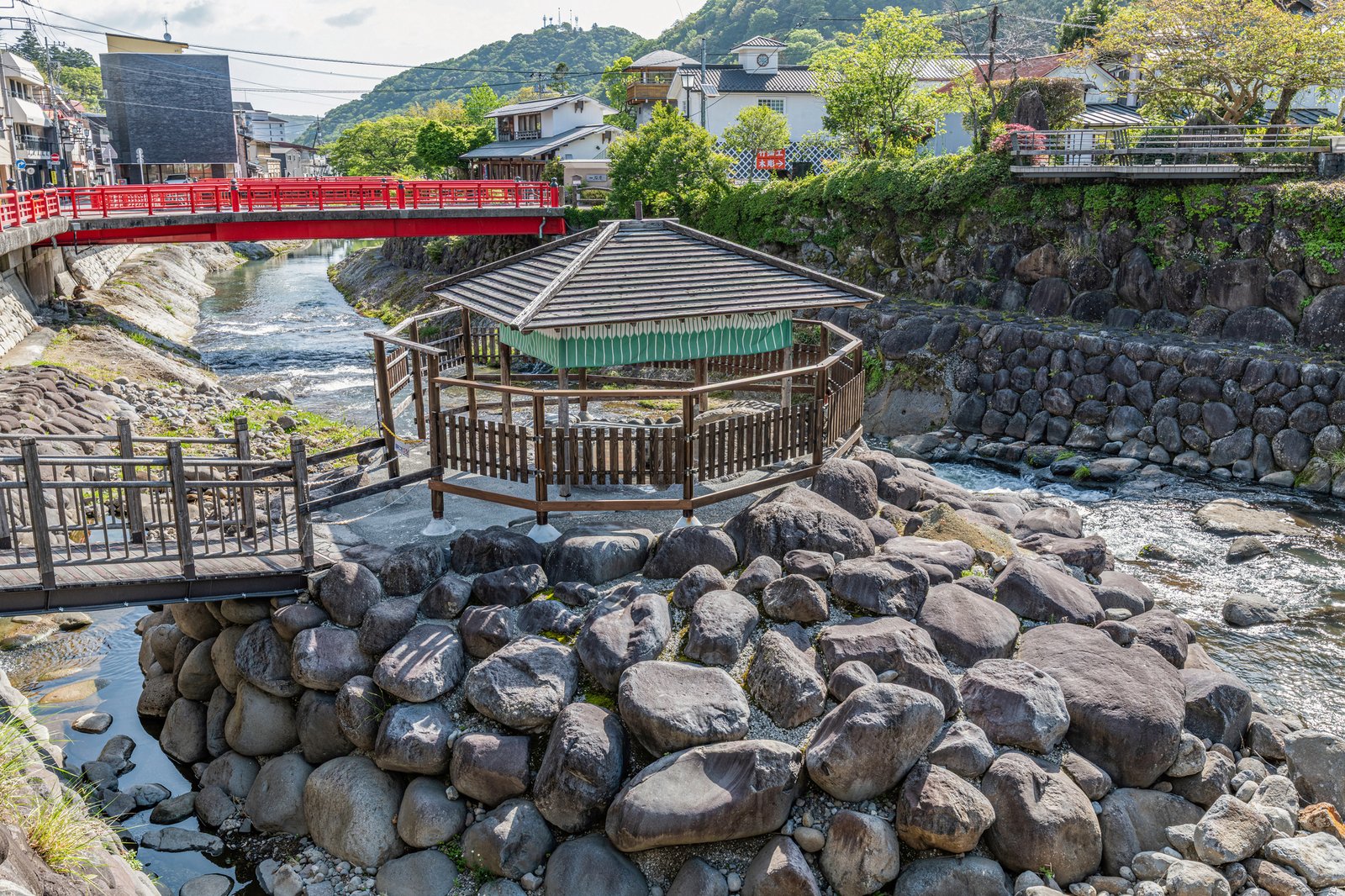
Shuzenji temple says it was founded in 807 by Kobo Daishi, Kukai, the founder of the Shingon school (Shuzenji temple, about the temple (in Japanese)). Its story of the hot spring is that Kukai, seeing a child pouring river water over an old father’s sore body in the Katsura River, broke a rock with the ritual tool he carried, and hot water gushed out. The temple says the spot is still there as Tokko-no-yu, in the Katsura River in front of the temple.
Who this is for: visitors to Shuzenji Onsen who want to see the spring and the temple’s treasure hall, and know how the spring may be used before they arrive.
The short version: Tokko-no-yu is meant to be looked at; for a soak of the feet, the city lists two footbaths nearby. The temple’s treasure hall charges admission, and the temple has no car park of its own. Buses run from Shuzenji Station to the Shuzenji Onsen stop. Check the temple’s and the bus company’s pages before you set out.
Spring, footbaths or treasure hall
| Your situation | Our suggestion | Where to check |
|---|---|---|
| A short stop between buses | Tokko-no-yu, in the river in front of the temple, and the temple itself | Shuzenji temple, about the temple (in Japanese) |
| Wanting to put your feet in hot water | The Kawara-yu footbath, or the Sugi-no-yu footbath on the river terrace of Tokko-no-yu Park | Izu City, filming at tourist facilities (in Japanese) |
| Visiting in November | The treasure hall, where the temple shows its main image, the seated Dainichi statue, every November | Shuzenji temple, treasures (in Japanese) |
| Arriving by car | A paid car park in the onsen town, as the temple asks; it has no parking of its own | Shuzenji temple, access (in Japanese) |
Hours, admission and dates to confirm
| Item | Value | Where to check |
|---|---|---|
| Treasure hall admission | Check official | Shuzenji temple, treasures (in Japanese) |
| Temple gate hours and treasure hall reception hours | Not verified (see below) | Shuzenji temple, access (in Japanese) |
| Bus times, Shuzenji Station to Shuzenji Onsen | Check official | Tokai Bus, Shuzenji Station to Shuzenji Onsen and Yubuneguchi timetable (PDF, in Japanese) |
| Bus fare | Not verified (see below) | Tokai Bus, Shuzenji Station to Shuzenji Onsen and Yubuneguchi timetable (PDF, in Japanese) |
| Train times on the Izuhakone Railway | Not verified (see below) | Izuhakone Railway, timetables and fares (in Japanese) |
| Car park fees in the onsen town | Not verified (see below) | Shuzenji temple, access (in Japanese) |
- The November showing: the temple says the main image is shown in the treasure hall every November.
- Displays: the temple says some of the items on show change from season to season.
- Before you go: check the treasure hall page for the month you plan to visit (Shuzenji temple, treasures (in Japanese)).
What to do: decide whether you want the treasure hall as well as the spring, then check the bus times for your return. Where to verify: the Tokai Bus timetable (PDF, in Japanese).
At Tokko-no-yu and the footbaths
Izu City sets out how the spring is treated on its page about filming at the tourist facilities it manages (Izu City, filming at tourist facilities (in Japanese)):
- A sacred spring: the city calls Tokko-no-yu the symbol of Shuzenji Onsen and says its water is used as sacred water in the rites of local events.
- For looking at: the city says the shared view of the onsen town is that the spring is for viewing; visitors may dip their hands and feet.
- Media: television and magazines are asked not to film people with their hands or feet in it, and not to call it a footbath.
- Footbaths: for footbath shots, the city points to Kawara-yu nearby and to Sugi-no-yu on the river terrace of Tokko-no-yu Park.
- Filming: the city says photography and filming at the tourist facilities it manages, including these, need a permit application.
For the temple, the access page asks drivers to use the paid car parks of the onsen town, and says parts of the town have one-way streets and limits on large vehicles (Shuzenji temple, access (in Japanese)).
What to do: look at Tokko-no-yu from the bank, then walk on to a footbath if you want a soak. Where to verify: the city’s page (in Japanese).
Getting there
- By train: the temple says to change at Mishima from the Tokaido Line or the Shinkansen to the Izuhakone Railway and ride about 32 minutes to the end of the line at Shuzenji Station (Shuzenji temple, access (in Japanese)). The city gives about 30 minutes from Mishima, and about two hours from Tokyo Station on the Odoriko limited express (Izu City, how to reach the city (in Japanese)).
- By bus: from Shuzenji Station, the temple says to take a bus for Shuzenji Onsen, about 10 minutes to the end of the route, and to check times on Tokai Bus’s site (Shuzenji temple, access (in Japanese)). Izu City says all the route buses in the city are run by Tokai Bus (Izu City, the state of local buses (in Japanese)). Tokai Bus’s timetable for this line, revised on 1 April 2025, starts from stand 1 at Shuzenji Station (Tokai Bus, Shuzenji Station to Shuzenji Onsen and Yubuneguchi timetable (PDF, in Japanese)).
- By taxi: about 10 minutes from the station, according to the temple (Shuzenji temple, access (in Japanese)).
- By car: about 30 minutes from Numazu IC on the Tomei Expressway or Nagaizumi-Numazu IC on the Shin-Tomei, by the Izu Jukan Expressway, the Izu Chuo Road and the Shuzenji Road, the last two tolled, according to the temple (Shuzenji temple, access (in Japanese)).
What to do: check the last bus back to the station before you start exploring. Where to verify: the Tokai Bus timetable (PDF, in Japanese).
The statue on the national register
The temple’s wooden seated Dainichi Nyorai was listed as an Important Cultural Property on 20 January 1993 (Agency for Cultural Affairs, register entry for the wooden seated Dainichi Nyorai (in Japanese)). The entry dates it to the Kamakura period, 1210, names Shuzenji as the owner, and notes an inscription inside saying it was made in the eighth month of Shogen 4 by the master sculptor Jikkei. Its description calls it a standard Kongokai Dainichi with the wisdom-fist hand gesture, of joined cypress blocks with inlaid crystal eyes.
What to do: if you visit in November, see the statue in the treasure hall. Where to verify: the register entry (in Japanese).
What was found inside the statue
The register’s description tells what a repair turned up (Agency for Cultural Affairs, register entry for the wooden seated Dainichi Nyorai (in Japanese)). Inside the neck was an ink inscription dated the 28th day of the eighth month of 1210, naming the master sculptor Jikkei, and with it a pillow-shaped bag of gold brocade holding two bundles of hair, thought to be a woman’s, and one bundle from a wig. The description says there is no direct clue to whose hair it was. Because the brocade, seen as imported from Southern Song China, suits a woman of high rank, it suggests the hair may be that of Tsuji-dono, the wife of Minamoto no Yoriie, who was confined and killed at this temple; she took the tonsure on the eighth day of the seventh month, a little over a month before the statue was made.
The temple’s own account adds that Yoriie’s mother, Hojo Masako, gave the statue for the seventh-year memorial of his death, and that the hair was put back inside after the repair and remains there (Shuzenji temple, treasures (in Japanese)). Its history page says Yoriie, the second shogun, lost his post in the struggle between the Hojo and Hiki families, was sent here, and is said to have been attacked and killed while bathing by an assassin sent by the Hojo (Shuzenji temple, about the temple (in Japanese)). The temple and the city give different years for the repair; see the last section.
What to do: read the temple’s treasure page before your visit. Where to verify: the treasure page (in Japanese).
A wooden mask and a kabuki play
Among the treasures is a carved wooden mask that, the temple says, Yoriie is said to have had made to show his mother Masako how his face had swollen because of a plot against him (Shuzenji temple, treasures (in Japanese)). The temple’s history page says the writer Okamoto Kido saw the mask while staying here in 1908 and wrote the play Shuzenji Monogatari from it, which is still performed as kabuki (Shuzenji temple, about the temple (in Japanese)); the treasure page gives 1911 as the year the work was published.
The same history page notes a point of reading: the ritual tool is read dokko, but the spring named after it is read tokko.
What to do: look for the mask among the items in the treasure hall. Where to verify: the treasure page (in Japanese).
Official sources
| Topic | Source | Checked |
|---|---|---|
| Founding, the spring’s story, Yoriie, the play, the readings | Shuzenji temple, about the temple | 2026-11-14 |
| Treasure hall admission, the statue, the November showing, the mask | Shuzenji temple, treasures | 2026-11-14 |
| Train, bus, taxi, car and parking | Shuzenji temple, access | 2026-11-14 |
| Tokko-no-yu, the footbaths and filming | Izu City, filming at tourist facilities | 2026-11-14 |
| Bus company | Izu City, the state of local buses | 2026-11-14 |
| Train journey times | Izu City, how to reach the city | 2026-11-14 |
| Bus times | Tokai Bus, Shuzenji Station to Shuzenji Onsen and Yubuneguchi timetable | 2026-11-14 |
| National listing and the finds inside the statue | Agency for Cultural Affairs, register entry for the wooden seated Dainichi Nyorai | 2026-11-14 |
| Train timetables | Izuhakone Railway, timetables and fares | 2026-11-14 |
What we have not verified
- The temple’s gate hours and the reception hours of the treasure hall; the temple’s access and treasure pages give neither (Shuzenji temple, access (in Japanese)).
- The bus fare from Shuzenji Station to Shuzenji Onsen; the timetable gives times only (Tokai Bus, Shuzenji Station to Shuzenji Onsen and Yubuneguchi timetable (PDF, in Japanese)).
- Train times on the Izuhakone Railway; the railway’s timetable page links to a search service and prints no times, and its timetable article returned a server error twice (Izuhakone Railway, timetables and fares (in Japanese)).
- Car park fees and locations in the onsen town; the temple’s page points to a site that is not one of the official pages read here (Shuzenji temple, access (in Japanese)).
- The year of the repair that found the hair: the temple gives 1984 and the city’s list of national cultural properties gives 1985 (Izu City, national cultural properties (in Japanese)).
- Opening hours of the footbaths (Izu City, filming at tourist facilities (in Japanese)).
- English names: Shuzenji temple, Shuzenji Onsen, Izu City, Izu, Shizuoka, Kobo Daishi, Kukai, Shingon, the Katsura River, Tokko-no-yu, Tokko-no-yu Park, Kawara-yu, Sugi-no-yu, Dainichi Nyorai, Kongokai, Jikkei, Shogen, Kamakura, Southern Song, Tsuji-dono, Minamoto no Yoriie, Hojo Masako, the Hojo and Hiki families, Okamoto Kido, Shuzenji Monogatari, dokko, tokko, Tokai Bus, Yubuneguchi, Shuzenji Station, Mishima, the Tokaido Line, the Shinkansen, the Izuhakone Railway, the Odoriko limited express, Tokyo Station, Numazu IC, Nagaizumi-Numazu IC, the Tomei and Shin-Tomei Expressways, the Izu Jukan Expressway, the Izu Chuo Road, the Shuzenji Road and Important Cultural Property are our own romanizations or translations; the pages read do not print English names for these (Shuzenji temple, about the temple (in Japanese)).