Place name in Japanese: 大内宿, Ōuchi-juku.
Ouchi-juku, Shimogo, Fukushima: the train to Yunokami Onsen, the bus up to the post town and the thatched roofs
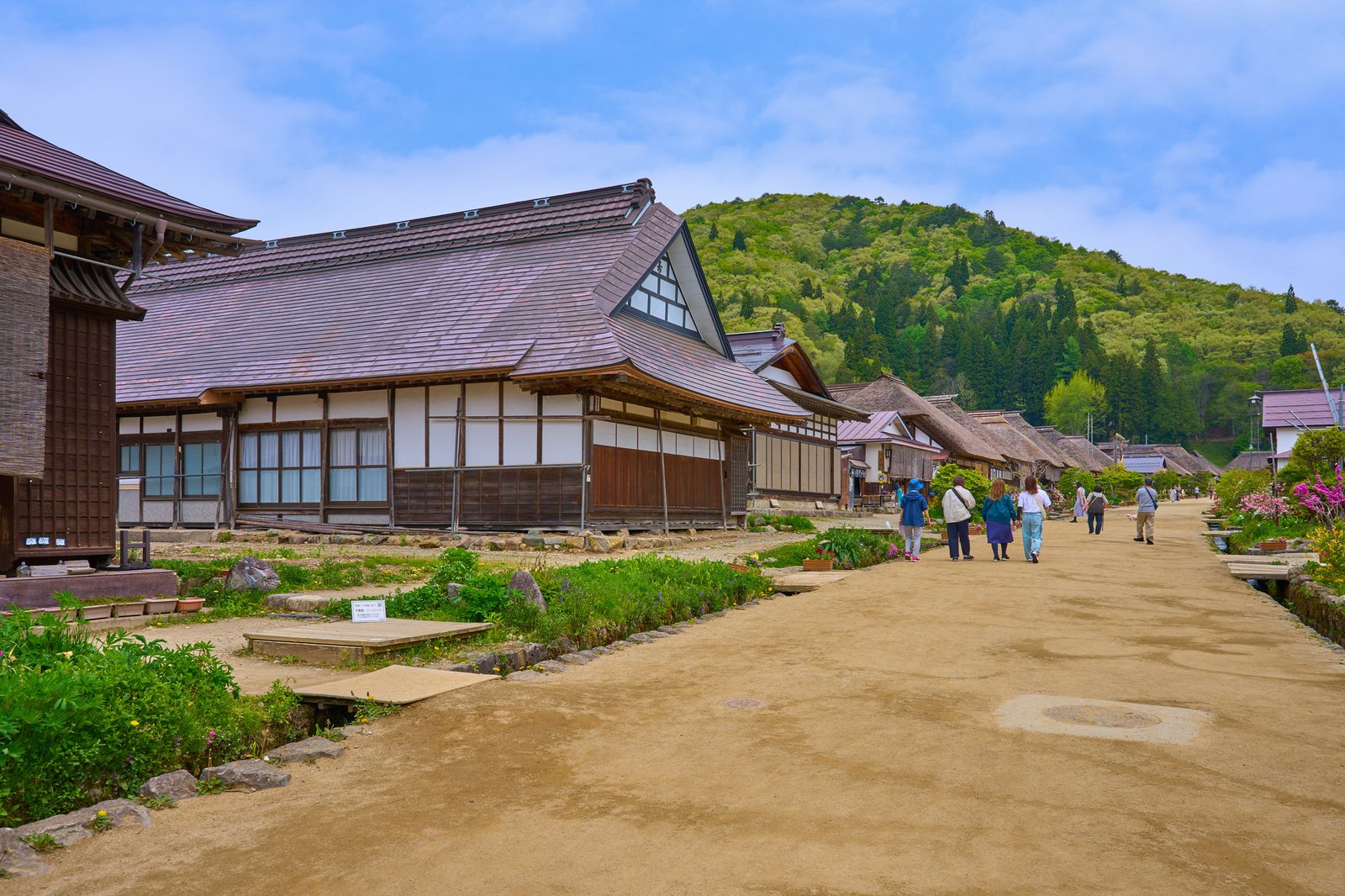
Ouchi-juku is an old post town in Shimogo, in Fukushima. The Agency for Cultural Affairs database describes it as a post town on an old highway running from Aizu-Wakamatsu, where thatched houses with hipped roofs stand at almost equal intervals on both sides of a road about 450 metres long, with their gable ends facing the street (Agency for Cultural Affairs database (in Japanese)). The database records it as an Important Preservation District for Groups of Traditional Buildings, selected on 18 April 1981.
Who this is for: travellers staying in Aizu-Wakamatsu who want a day trip by train and bus to walk the old street.
The short version: take the train from Aizu-Wakamatsu to Yunokami Onsen Station, then the shuttle bus to the entrance of Ouchi-juku. The bus runs six times a day, and passengers who book by the day before have priority. Always follow the official pages linked below.
Train and bus, or a later bus back
| If… | Then lean towards… | Check |
|---|---|---|
| You start from Aizu-Wakamatsu | The train to Yunokami Onsen Station, then the shuttle bus | Aizu Railway, timetable from 14 March 2026 (PDF, in Japanese) |
| You want a seat on a set bus | Book with the bus company by the day before, as booked passengers board first | Aizu Railway, leaflet with the bus timetable (PDF, in Japanese) |
| You plan to ride both train and bus | The railway’s combined ticket for the train and the bus | Aizu Railway, leaflet with the bus timetable (PDF, in Japanese) |
| You want time for the museum and the hill as well | A later bus back from the entrance; the last one leaves at 15:15 | Aizu Railway, leaflet with the bus timetable (PDF, in Japanese) |
Trains and buses
| Item | Time | Where to check |
|---|---|---|
| Train, Aizu-Wakamatsu to Yunokami Onsen Station | 33 to 48 minutes on most trains; some sightseeing trains take up to an hour | Aizu Railway, timetable from 14 March 2026 (PDF, in Japanese) |
| Shuttle bus, Yunokami Onsen Station to the entrance of Ouchi-juku | 20 minutes; departs 9:45, 10:30, 11:30, 12:15, 13:35 and 14:55 | Aizu Railway, leaflet with the bus timetable (PDF, in Japanese) |
| Shuttle bus, entrance of Ouchi-juku to Yunokami Onsen Station | 20 minutes; departs 10:05, 10:50, 11:50, 12:35, 13:55 and 15:15 | Aizu Railway, leaflet with the bus timetable (PDF, in Japanese) |
- Bus fares: the railway’s leaflet says a bus-only pass costs 1,100 yen for adults and 500 yen for children and is sold on the bus (Aizu Railway, leaflet with the bus timetable (PDF, in Japanese)).
- Combined ticket: the same leaflet lists a train and bus ticket at 2,200 yen for adults and 1,100 yen for children, with the train part valid for two days for one single or one return journey and the bus free to ride for two days.
- Booking: the leaflet says passengers who book by the day before have priority, and that if the bus is full you take the next one.
- Winter and closures: snow can affect the roads and the trains and buses in winter, and shops in the village may be closed on some days, so check before you go.
What to do: pick the bus back before you set out, as there are only six a day. Where to verify: the railway’s leaflet with the bus timetable (PDF, in Japanese).
Getting there and how long it takes
- Aizu-Wakamatsu to Yunokami Onsen Station: the railway’s timetable shows 33 to 48 minutes on most trains (Aizu Railway, timetable from 14 March 2026 (PDF, in Japanese)).
- Station to the village: the shuttle bus takes 20 minutes from Yunokami Onsen Station to the entrance of Ouchi-juku (Aizu Railway, leaflet with the bus timetable (PDF, in Japanese)). The prefecture’s tourism site says the bus stop is down the hill to the left as you leave the station (Fukushima Travel, Getting to Ouchi-juku); Check official with the railway’s leaflet (PDF, in Japanese).
What to do: match your train to a bus departure, as the bus runs only six times a day. Where to verify: the railway’s timetable (PDF, in Japanese).
What to see
The town says many of the residents belong to families that have lived in Ouchi-juku for generations, and that they run most of the shops, restaurants and other facilities (Shimogo Town, Ouchi-juku). It describes the Ouchi-juku Pavilion, the town museum, as the former honjin, the inn kept for daimyo lords and other high-ranking travellers, with a thatched roof and a large sunken hearth. For a view over the town, it suggests walking up the small hill to Shohoji Temple on the west side; another walk leads west through a small cedar wood to Takakura Shrine.
What to do: leave time for the climb to the temple as well as the main street. Where to verify: the town’s Ouchi-juku page.
Why the old street survived, and how the roofs are kept
The town’s page on the preservation district says that in 1868, during the Boshin War, there was heavy fighting near Ouchi but the village escaped being burned (Shimogo Town, the preservation district (in Japanese)). It says that in 1884 a new road, today’s National Route 121, was opened on a different line, so the old highway lost its traffic and the village slowly became a forgotten farming village in the hills; together, it says, these are why the old townscape remains. It gives the district as 500 metres north to south and 200 metres east to west, with 44 main houses on both sides of the old road.
The same page says two to four thatched roofs are redone every year, and that villagers practise thatching themselves, with younger people learning the skill, and keep fields of thatching grass around the village. The town’s English page says neighbours belong to a mutual-help group called yui, whose members all join in when a roof needs replacing or repairing, and that a fire drill is held every year on 1 September (Shimogo Town, Ouchi-juku).
What to do: look along the street at the thatched roofs, two to four of which the town says are redone every year. Where to verify: the town’s preservation district page (in Japanese).
Official sources
| Topic | Source | Checked |
|---|---|---|
| Post town, road length, houses, selection in 1981 | Agency for Cultural Affairs database | 2026-11-11 |
| Boshin War, Route 121, district size, 44 houses, rethatching | Shimogo Town, the preservation district | 2026-11-11 |
| Residents, Ouchi-juku Pavilion, Shohoji Temple, Takakura Shrine, yui, fire drill | Shimogo Town, Ouchi-juku | 2026-11-11 |
| Station name | Shimogo Town, Yunokami Onsen | 2026-11-11 |
| Train times | Aizu Railway, timetable from 14 March 2026 (PDF) | 2026-11-11 |
| Bus times, fares, combined ticket, booking | Aizu Railway, leaflet with the bus timetable (PDF) | 2026-11-11 |
| Bus stop at the station | Fukushima Travel, Getting to Ouchi-juku | 2026-11-11 |