Place name in Japanese: 倉敷, Kurashiki.
A Kurashiki art museum that began with a painter’s choices: the 1930 temple-style main building, three buildings on one ticket, and visiting details
Who this is for: A reader planning a visit to 大原美術館 in Kurashiki, Okayama prefecture, who wants the museum’s own account of how its collection began and how its main building was designed, together with the hours, fees and closures it listed when we checked on 2026-11-09.
The short version: The museum’s history page says that the businessman 大原孫三郎 founded it in 1930 in memory of his friend, the painter 児島虎次郎, who had died the year before, and that 児島 chose works by El Greco, Gauguin, Monet, Matisse and others on three trips to Europe. The museum’s building guide describes the main building as having the look of an ancient Greek or Roman temple. One ticket covers the main building, 工芸・東洋館 and 児島虎次郎記念館; on 2026-11-09 the museum listed it at 2,000 yen for adults.
What the official pages answer, and what they leave to you
| If… | Then lean towards… | Check |
|---|---|---|
| You want to know how the collection began | The museum’s history page: 児島 chose the works in Europe, with 孫三郎’s agreement | History |
| You want to see a particular painting | Treat the works named in the history as holdings, not as a promise of what is hanging that day | About the museum |
| You are planning the day | The hours, fees and closures below, as listed on 2026-11-09, then the opening calendar | Visitor information · Calendar |
| You are driving | The museum has no car park of its own; it asks visitors to use paid car parks nearby | Access |
A painter’s choices, a friend’s museum
The museum tells its own beginning through two people. According to its history page, 大原孫三郎, a businessman based in Kurashiki, urged his friend, the painter 児島虎次郎, to make three trips to Europe. While he painted there, 児島 chose European works with 孫三郎’s agreement, among them works by El Greco, Gauguin, Monet and Matisse, and brought them back to Kurashiki.
児島 died, and the following year, 1930, 孫三郎 founded the museum in his memory. The museum describes itself, in its own words, as 「日本で最初の西洋美術中心の私立美術館」, a private museum centred on Western art. Its timeline gives the completion date as 5 November 1930. The museum’s history page says that the collection also widened to Japanese modern and contemporary art and to the work of artists connected with the folk-crafts (民芸) movement.
These are the works the museum holds and describes. Which of them are on view, and where, can change; before you travel for a particular work, read the museum’s history and collection pages and check what is on display.
- Official: History · About the museum
Why the main building looks like a temple
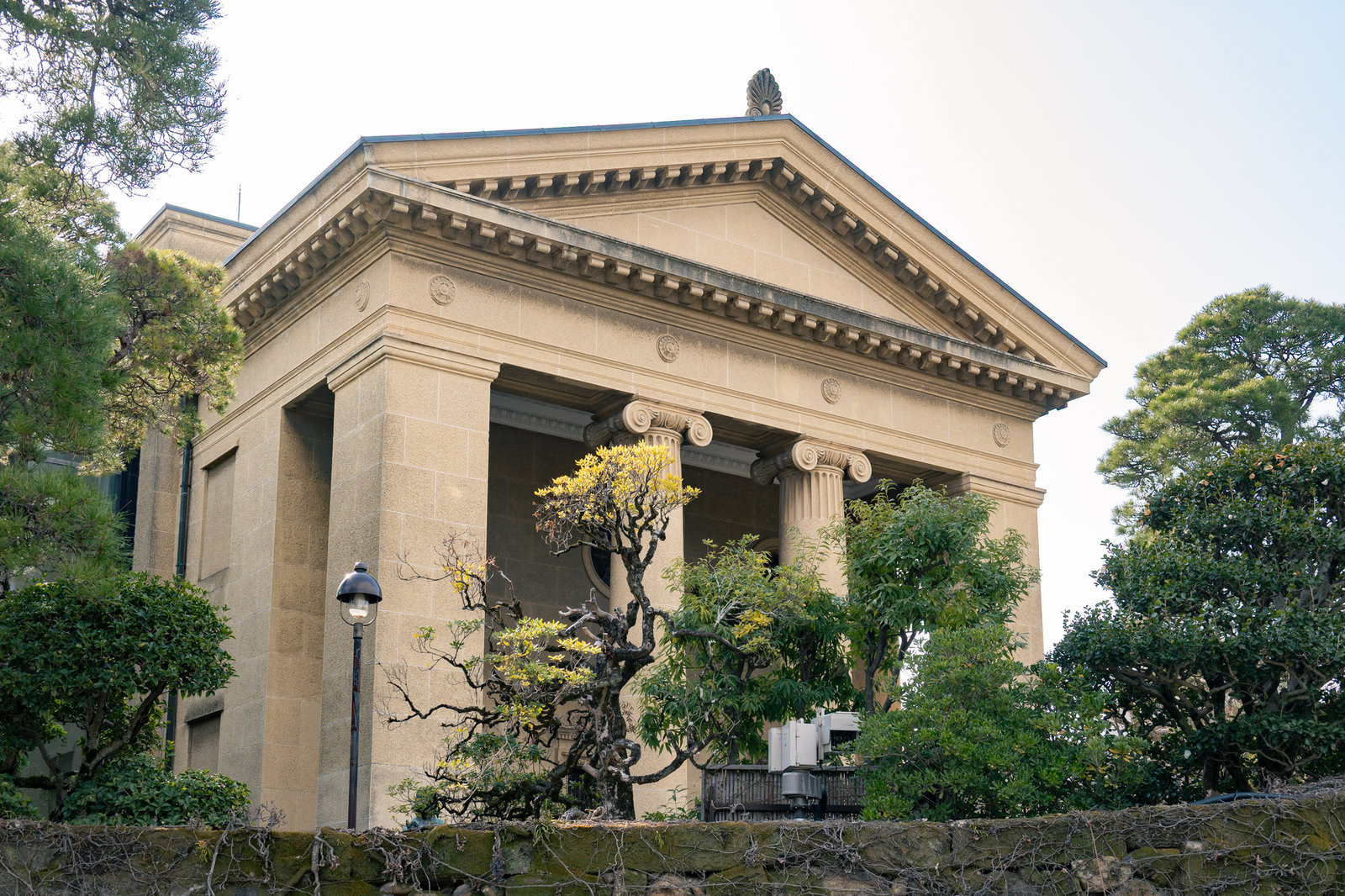
Stand in front of the main building and the frontage is what faces you. The museum’s building guide describes the exterior as in the style of an ancient Greek or Roman temple, with Ionic columns, of the kind associated with Greek temples, supporting a triangular pediment. The architect was 薬師寺主計 (read やくしじかずえ), and the building opened in 1930.
The museum’s building guide says the design is thought to have had in mind a Roman temple, the type that gives weight to the front.
The building also mixes periods. Beside the entrance, the guide points out, the straight-lined iron grilles on the windows show Art Deco expression, while the three round windows recall the rose windows of Gothic architecture. Not all of today’s main building dates from 1930: the parts there from the opening are the original exhibition room (本館1室) and the room above it (本館2室), and the rest was added in 1991.
To see this for yourself, look at the columns, the pediment, the entrance grilles and the round windows from outside, and read the building guide before you go. For how to get there, see the Getting there section.
- Official: Building guide
Three buildings on one ticket
The museum lists three buildings on the common ticket: the main building, 工芸・東洋館 and 児島虎次郎記念館. Its 分館 (annex) was listed on 2026-11-09 as closed for a long period.
- 工芸・東洋館: the floor guide describes it as exhibition space in a converted rice storehouse, showing ceramics, prints, dyeing and ancient art of 東洋.
- 児島虎次郎記念館: the building guide says it uses the former 第一合同銀行倉敷支店 building and shows 児島’s own paintings together with the ancient Egyptian and West Asian objects he collected.
Start from the floor guide.
- Official: Floor guide · Building guide
Hours, fees and closures (as listed on 2026-11-09)
These figures come from the museum’s visitor information page, checked on 2026-11-09. The museum notes that hours vary by period, and its calendar page warns that actual opening may differ from what is shown.
| Item | December to February | March to November |
|---|---|---|
| Museum hours | 9:00–15:00 (last entry 14:30) | 9:00–17:00 (last entry 16:30) |
| 児島虎次郎記念館 hours | 10:00–15:00 | 10:00–16:00 |
| Common ticket (main building, 工芸・東洋館, 児島虎次郎記念館) | Price listed on 2026-11-09 |
|---|---|
| Adults | 2,000 yen |
| High school, junior high and elementary school students (under 18) | 500 yen |
| Preschool children | Free |
- Closures: closed on Mondays, with temporary closures; when a Monday closure falls on a public holiday or substitute holiday, the museum opens; open every day in August.
- Ticket use: staff stamp the ticket at the entrance to each of the three buildings. A building you have not yet entered can be visited on a different day, and the ticket has no expiry date. As a rule, you cannot re-enter a building you have already visited.
Before you go, check the visitor information page and the opening calendar for your date.
- Official: Visitor information · Calendar
Getting there
The museum gives its address as 岡山県倉敷市中央1-1-15. By train, its access page describes this route: the 山陽新幹線 to Okayama, then the 山陽本線 to Kurashiki, then about 15 minutes on foot. Coming from the 広島 direction, it describes leaving the 山陽新幹線 at 新倉敷, taking the 山陽本線 to Kurashiki, and walking about 15 minutes. The museum has no car park; it asks drivers to use paid car parks nearby.
Check the route, journey time and parking on the access page before you set out.
- Official: Access
Photography inside
The museum asks visitors not to take photographs without permission. Read its requests to visitors on the visitor information page before you go.
- Official: Visitor information
Before you go
- Check the opening calendar and the visitor information page for your date, including any temporary closure.
- If you are going for a particular work, confirm that it is on display; the works named in the museum’s history are holdings.
- Confirm the route and parking on the access page.
Always follow the official pages linked below.
What we have not verified
- Which works are on display on any given day.
- Hours, fees and closures after 2026-11-09, and the opening dates on the calendar for your visit.
- When the 分館 will reopen.
- Official English names for 大原美術館 and for 工芸・東洋館, 児島虎次郎記念館 and 分館.
Official sources
| Topic | Source | Checked |
|---|---|---|
| Founding in 1930 in memory of 児島虎次郎; three trips to Europe; works chosen with 孫三郎’s agreement (El Greco, Gauguin, Monet, Matisse and others); the museum’s description of itself; completion on 5 November 1930; later widening of the collection | History | 2026-11-09 |
| Architect 薬師寺主計 (やくしじかずえ); temple-style exterior; Ionic columns and pediment; Roman temple design is thought; Art Deco grilles and round windows; 1930 rooms and 1991 additions; 児島虎次郎記念館 building | Building guide | 2026-11-09 |
| 工芸・東洋館 in a converted rice storehouse; what it shows | Floor guide | 2026-11-09 |
| Common ticket and prices; hours; closures; 分館 long-term closure; ticket use; photography request | Visitor information | 2026-11-09 |
| Opening calendar; actual opening may differ | Calendar | 2026-11-09 |
| Train and walking route; no museum car park | Access | 2026-11-09 |
| Address; collection | About the museum | 2026-11-09 |