Place name in Japanese: 日光東照宮, Nikkō Tōshōgū.
Nikko Toshogu: The 1636 Shrine Buildings, the Carved Gate, and What a Visit Costs
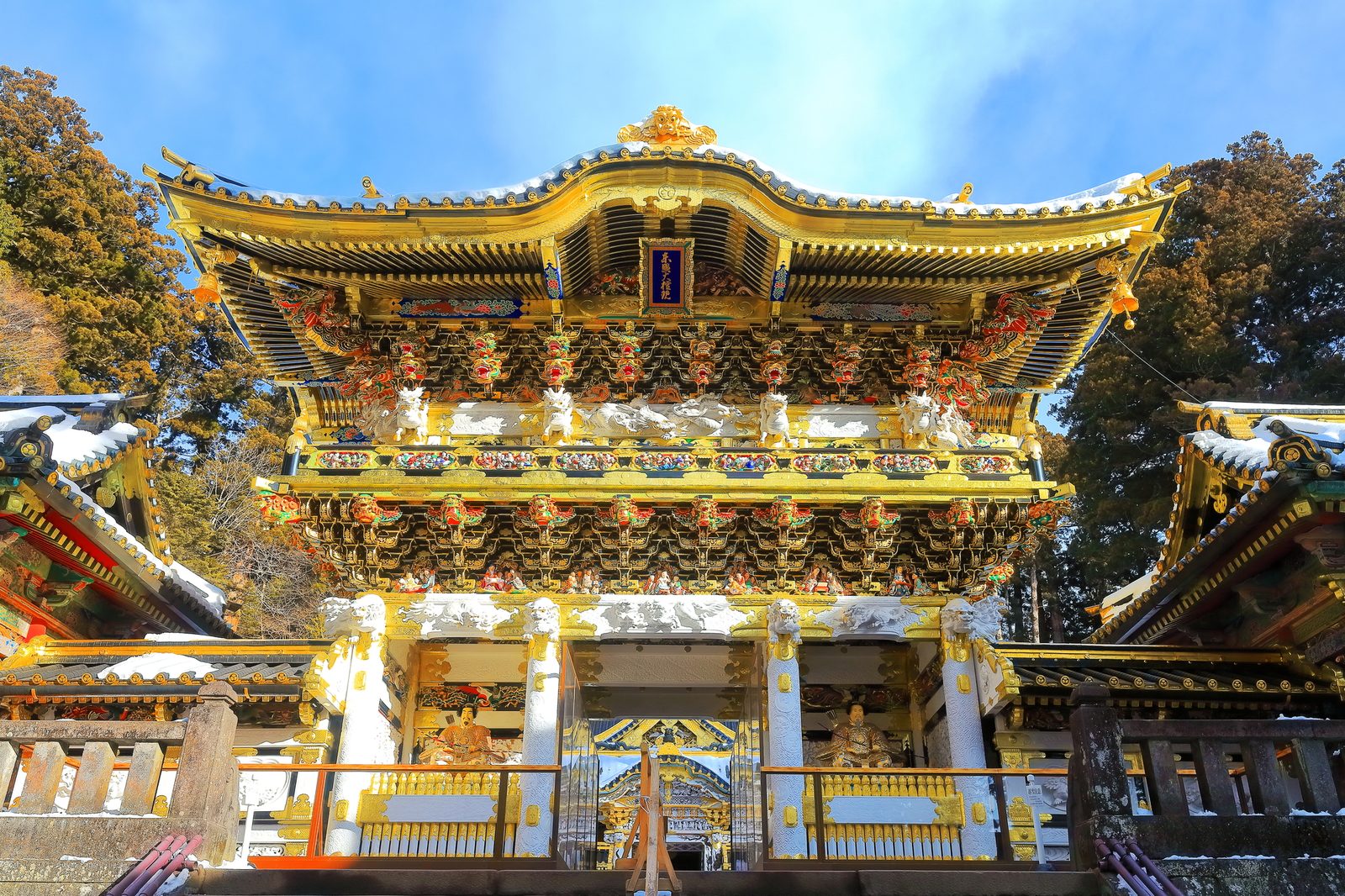
Nikko Toshogu is the shrine where Tokugawa Ieyasu is enshrined. The shrine says its main group of buildings standing today was rebuilt in 1636, in work that took one year and five months, and the sources that describe it do not count its buildings the same way.
Who this is for: readers planning a visit who want the hours, fees and transport, and a short account of the shrine’s history and carvings.
The short version: The shrine says Ieyasu was enshrined here in 1617 and that its main buildings were rebuilt in 1636 by the third shogun, 家光. The gate 陽明門 is a National Treasure in the Agency for Cultural Affairs database. The shrine is one of the three religious sites that make up the World Heritage property UNESCO lists as Shrines and Temples of Nikko, inscribed in 1999. From April to October the shrine is open 9:00 to 17:00; adult admission is 1,600 yen (shrine pages, retrieved 2026-11-09).
If you want to know this, then start here
| If you want to know… | Then… | Check |
|---|---|---|
| Opening hours and admission | 9:00–17:00 (April–October) or 9:00–16:00 (November–March); adults and high school students 1,600 yen | The shrine’s visiting page |
| How long the train takes | About 1 hour 50 minutes from 浅草 by the limited express services the shrine lists | The shrine’s access page |
| What is World Heritage here | The shrine is one part of Shrines and Temples of Nikko | UNESCO’s list page |
| Whether some buildings are closed on your day | The shrine says festivals and repair work can restrict parts of the visit | The shrine’s visiting page, on the day |
Enshrined in 1617, rebuilt in 1636
The shrine’s history page says Tokugawa Ieyasu died at 駿府城 and was first buried at 久能山. Following his will, it says, he was moved to the present site on 元和3年4月15日, and the formal enshrinement took place on the 17th of the same month with the second shogun, 秀忠, attending. The shrine gives the year as 1617. It was first called 東照社 and, the shrine says, received the title 宮号 in 1645, after which it became known as Toshogu.
According to the same page, the main group of buildings standing today was rebuilt in 1636 by the third shogun, 家光. The shrine’s buildings page adds that the work took one year and five months, and that it covered 55 buildings, including 陽明門. It gives the cost, citing a construction record, as 568,000 ryo of gold, 100 kanme of silver and 1,000 koku of rice.
The city of Nikko’s page on the shrine also dates the founding to 1617 and the building of the main shrine structures to 1636.
Where to check: the shrine’s history page and the city’s Toshogu page (updated 2024-02-01).
How the buildings are counted
The sources give different numbers.
- The shrine’s buildings page says the 1636 rebuilding covered 55 buildings.
- UNESCO’s list page says the World Heritage property has 103 buildings: 42 at the Tôshôgû shrine, 23 at Futarasan-jinja shrine and 38 at Rinnô-ji temple, spelt as UNESCO prints them.
- The city’s Toshogu page says 8 of the shrine’s buildings are National Treasures and 34 are Important Cultural Properties.
Reading the place
Start at the gate. In the Agency for Cultural Affairs database, 陽明門 is entered as a National Treasure: one building, early Edo period, dated 1636, owned by the shrine. The database describes it as a 楼門, a two-storey gate, roofed with copper tiles. It records designation as an Important Cultural Property on 1 August 1908 and as a National Treasure on 9 June 1951.
The city’s page says the gate was built in 1636; its roofs have been re-laid and its paint renewed, but the carvings and main decorative members are original. The shrine’s buildings page says the gate carries more than 500 carvings. It is also called 日暮の門, the shrine says, because you could look at it all day without tiring of it. The shrine adds that the gate is said to have received the name of a gate of the imperial palace.
Further in, the sleeping cat, 眠り猫, is said to be the work of 左甚五郎, according to the shrine’s buildings page. The shrine also says it is said to have been carved with the name Nikko, meaning sunlight, in mind, because it dozes among peonies in the sun.
At the sacred stable, 神厩舎, the shrine’s buildings page says monkeys have long been held to protect horses. That is why monkey carvings appear above it, among them the three monkeys who see, speak and hear no evil.
The city’s page says the central pillar of the five-storey pagoda hangs from the fourth storey, and its foot does not rest on the foundation stone but is held about 10 centimetres clear of it. The city describes this as a measure against wind and earthquakes. The city’s page dates the pagoda to 1650, its fire to 1815 and its rebuilding to 1818. The shrine’s buildings page gives 1650 and 1818 and dates the fire to 文化12年.
Where to see it: the visiting area on the shrine’s visiting page runs from the front gate through 陽明門 to the prayer hall, 石の間, the east corridor with the sleeping cat, the inner shrine and 本地堂 (鳴龍), among others.
Shrines and Temples of Nikko on the World Heritage List
UNESCO’s decision page records that the World Heritage Committee, at its 23rd session in 1999, inscribed Shrines and Temples of Nikko on the basis of criteria (i), (iv) and (vi). The city of Nikko’s overview page gives the date as 4 December 1999, at the 23rd session held in Morocco. UNESCO’s list page gives the property as 50.8 hectares with a buffer zone of 373.2 hectares; the city’s page gives the same figures.
The property covers two shrines and one temple. Nikko Toshogu is one of them.
Where to check: UNESCO’s decision 23 COM VIII.C.1 and the city’s World Heritage overview (updated 2026-09-08).
Basho’s day at the mountain
In the Nikko passage of おくのほそ道, Matsuo Basho writes that he paid his respects at the mountain on the first day of the fourth month. He writes that the mountain, once written 二荒山, was given its present name by 空海 when 空海 founded it, and he records this verse:
あらたうと青葉若葉の日の光
The edition on 青空文庫, an online archive of texts, carries the annotator’s footnotes, and one of them disagrees. It says the mountain was actually founded by 勝道 in the 延暦 era, and that the story of 空海 founding it and renaming it is probably a later mistaken tradition. The renaming belongs to Basho’s text, and the footnote is the annotator’s, not Basho’s.
Where to read it: the text on 青空文庫 (Japanese), annotated by 杉浦正一郎. Its card gives the base text as 芭蕉 おくのほそ道, 岩波版ほるぷ図書館文庫, published by 岩波書店, first edition 1975 (青空文庫 card).
Planning a visit
Hours and admission
Hours, as the shrine’s visiting page gives them (retrieved 2026-11-09):
| Period | Hours | Last entry | Closed days |
|---|---|---|---|
| 1 April to 31 October | 9:00 to 17:00 | 30 minutes before closing | Check official: the shrine’s visiting page |
| 1 November to 31 March | 9:00 to 16:00 | 30 minutes before closing | Check official: the shrine’s visiting page |
Admission, in yen, as the same page gives it (retrieved 2026-11-09). Individual rates apply to 1–34 people and group rates to 35 or more.
| Ticket | Individual | Group |
|---|---|---|
| Shrine only, adults and high school students | 1,600 | 1,440 |
| Shrine only, elementary and junior high school students | 550 | 495 |
| Shrine and treasure museum, adults and high school students | 2,400 | 2,240 |
| Shrine and treasure museum, elementary and junior high school students | 870 | 815 |
| Treasure museum only, adults and high school students | 1,000 | 900 |
| Treasure museum only, elementary and junior high school students | 400 | 360 |
| Art museum, adults and high school students | 800 | 640 |
| Art museum, elementary and junior high school students | 400 | 320 |
The page says teachers accompanying elementary and junior high school students pay the student rate. It has no row for preschool children or university students, and no closing days are listed.
An audio guide to the grounds costs 500 yen a day (same page, retrieved 2026-11-09). It is available in Japanese (adult and children’s versions), English and Chinese, and is handed out straight ahead after the front gate. Individuals do not need to book.
Trains and parking
The shrine’s access page (retrieved 2026-11-09) lists these journey times:
| Route as the page gives it | Time |
|---|---|
| 浅草 to 東武日光, limited express けごん | about 1 hour 50 minutes |
| 浅草 to 東武日光, changing at 下今市 (limited express きぬ, then a local train) | about 1 hour 50 minutes |
| 浅草 to 東武日光, rapid service | about 2 hours 5 minutes |
| 新宿 to 東武日光, JR特急日光 | about 2 hours |
| 宇都宮 to 日光駅, JR日光線 | about 45 minutes |
From the station to the shrine, the Nikko City Tourism Association’s page on the shrine says to take the 世界遺産めぐり bus from 日光駅 or 東武日光, then walk about 5 minutes from the 表参道 bus stop or about 15 minutes from the 神橋 bus stop, and notes that the bus route may change. The Nikko area page of 東武バス lists 表参道 and 神橋 among the stops of the 世界遺産めぐり bus (route W) and carries a notice that part of its route changes on some days (東武バス Nikko area page). Fares and timetables are on that page.
By car, the page says to leave the expressway at the Nikko IC, 2 km from the shrine. Its large car park is open every day; a car pays 600 yen per day per entry, there are 200 car spaces, and no booking is needed (same page, retrieved 2026-11-09).
Festival days
The shrine’s festival page lists the spring grand festival on 17 and 18 May, with mounted archery on the 17th and the procession of more than 1,200 people on the 18th, and an autumn mounted archery on 16 October and procession on 17 October. The page gives no year.
Where to check: the shrine’s festival page.
The cedar avenue
The shrine’s cedar avenue page says the avenue is a national Special Historic Site and Special Natural Monument. It says 松平正綱 planted it over about 20 years from around 1625 and donated it to the shrine, and that it runs about 37 km in total, with about 12,500 trees still standing.
Where to check: the shrine’s cedar avenue page.
Always follow the official pages linked below.
What we have not verified
- Ieyasu’s birth year (the shrine prints 1542, UNESCO prints 1543) and the Western year of his death; how the shrine’s 55 buildings, UNESCO’s 42 and the city’s 8 and 34 relate; how the database’s single entry for the main hall, 石の間 and prayer hall maps onto the city’s count of National Treasures; closing days and fares for preschool children and university students; whether photography is allowed in the grounds; the scope and end of the current major repair work; whether the 2026 festivals keep the listed dates; the date the cedar avenue was designated; and the date the mountain was founded.
Official sources
| Topic | Source | Checked |
|---|---|---|
| Enshrinement in 1617 (moved on the 15th, formal enshrinement on the 17th), title 宮号 in 1645, rebuilding in 1636 | Shrine: history (Japanese) | 2026-11-09 |
| Hours, last entry 30 minutes before closing, admission fees, visiting area, audio guide 500 yen | Shrine: visiting (Japanese) | 2026-11-09 |
| Train times, Nikko IC 2 km, car park 600 yen and 200 spaces | Shrine: access (Japanese) | 2026-11-09 |
| Station to the shrine: 世界遺産めぐり bus, 表参道 and 神橋 bus stops, walking times, route may change | Nikko City Tourism Association: Nikko Toshogu (Japanese) | 2026-11-09 |
| 世界遺産めぐり bus (route W): stops and fares, notice of route changes, timetables | 東武バス: Nikko area (Japanese) | 2026-11-09 |
| 55 buildings, cost, one year and five months, more than 500 carvings, 日暮の門, 眠り猫, three monkeys, pagoda history | Shrine: buildings (Japanese) | 2026-11-09 |
| Spring and autumn festival days (no year given) | Shrine: festivals (Japanese) | 2026-11-09 |
| Cedar avenue: designations, about 37 km, about 12,500 trees | Shrine: cedar avenue (Japanese) | 2026-11-09 |
| Founded 1617, built 1636, 8 National Treasures and 34 Important Cultural Properties, 陽明門 carvings original, pagoda pillar about 10 cm clear | City of Nikko: Toshogu (Japanese), updated 2024-02-01 | 2026-11-09 |
| Inscription 4 December 1999, 23rd session, 50.8 ha and 373.2 ha | City of Nikko: World Heritage overview (Japanese), updated 2026-09-08 | 2026-11-09 |
| 陽明門: National Treasure, 1636, 楼門, designations 1908 and 1951 | Agency for Cultural Affairs: heritage database (Japanese) | 2026-11-09 |
| Main hall, 石の間 and prayer hall entered as one building | Agency for Cultural Affairs: heritage database (Japanese) | 2026-11-09 |
| 103 buildings (42, 23, 38), 50.8 ha, buffer zone 373.2 ha | UNESCO World Heritage Centre: Shrines and Temples of Nikko | 2026-11-09 |
| Inscribed 1999, 23rd session, criteria (i), (iv), (vi) | UNESCO: decision 23 COM VIII.C.1 | 2026-11-09 |
| おくのほそ道: the Nikko passage and the annotator’s footnote | 青空文庫: text (Japanese); card | 2026-11-09 |