Place name in Japanese: 二条城, Nijō-jō.
Nijo Castle, Kyoto: the Ninomaru-goten palace rooms and floors, how the designations read, and tickets, hours and access
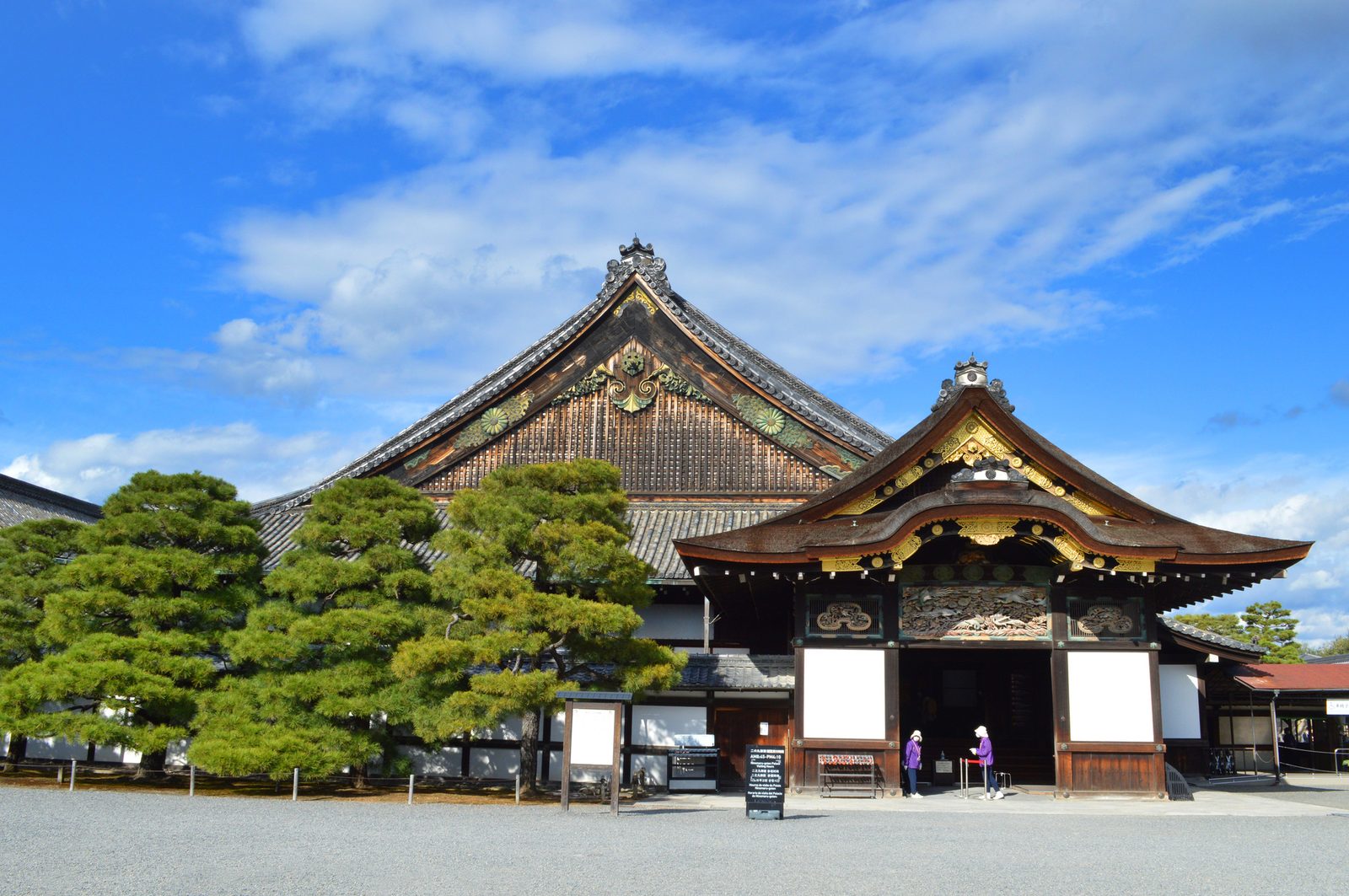
At Nijo Castle in Kyoto there is no keep to climb. The castle office’s highlights page says the five-storey keep was lost to lightning in 1750 and never rebuilt, and that only the stone base remains. What visitors walk through instead is the Ninomaru-goten (the palace of the second enclosure), six buildings whose corridors make a sound like birdsong underfoot.
Who this is for: visitors to Kyoto who want to know which ticket covers which palace, when each palace is closed, and how to get there by public transport, along with a short, sourced account of the castle’s history and the palace they will walk through.
The short version: on the castle office’s guide page as fetched on 2026-11-09, the castle admits visitors from 8:45 to 16:00 and closes at 17:00; it is closed from 29 to 31 December. Entry and the Ninomaru-goten are sold together as a set ticket (1,300 yen for adults), while the Honmaru-goten (the palace of the main enclosure) needs a separate ticket booked in advance. Photography is not allowed inside either palace. Always follow the official pages linked below.
Which ticket fits your visit
| If… | Then lean towards… | Check |
|---|---|---|
| You want the grounds and the Ninomaru-goten | The entry and Ninomaru-goten set ticket: 1,300 yen adults, 400 yen junior and senior high school students, 300 yen primary school pupils | Ticket page |
| You want the grounds only | The entry ticket: 800 yen adults, 400 yen junior and senior high school students, 300 yen primary school pupils | Ticket page |
| You bought an adult entry ticket and then decide to see the Ninomaru-goten | An add-on Ninomaru-goten ticket bought inside, 500 yen (400 yen in a group) | Fee page |
| You also want the Honmaru-goten | A separate, timed web ticket booked in advance (1,000 yen adults, 300 yen junior and senior high school students, 200 yen primary school pupils), on sale from 30 days before your visit; it does not include entry, so you need an entry ticket as well | Ticket page |
| You are in a group of 30 or more | Group rates for entry (700 yen) and for the set ticket (1,100 yen) for adults; the ticket page says there is no group rate for the Honmaru-goten | Ticket page |
| You hold a city subway or subway and bus one-day pass | Individual adult entry at 700 yen instead of 800 yen on the day of use | Fee page |
Children below primary school age enter free, according to the ticket page. The fee page also lists exemptions for certain residents and certificate holders, and says that even exempt visitors must book the Honmaru-goten in advance.
Hours, closing days and the two palaces
All times below are from the castle office’s guide page as fetched on 2026-11-09.
| Item | What the guide page says |
|---|---|
| Admission to the castle | 8:45 to 16:00; the castle closes at 17:00 |
| Ninomaru-goten reception | 8:45 to 16:10 |
| Honmaru-goten reception | 9:30 to 16:00, by advance booking |
| Castle closed | 29 to 31 December |
| Ninomaru-goten closed | Every Tuesday in January, July, August and December (if that Tuesday is a public holiday, the palace opens and closes the next day instead); 26 to 28 December; 1 to 3 January |
| Honmaru-goten closed | The third Monday of every month and the day after (the palace opens if that day is a public holiday); 26 to 28 December; 1 to 3 January |
The ticket page adds that it takes about 15 to 20 minutes to walk from the Higashi-otemon (the east main gate) entrance to the Honmaru-goten, and that visitors who arrive late for their booked time may be turned away. The guide page lists what is not allowed, including photography inside the Ninomaru-goten and the Honmaru-goten, eating and drinking outside designated places, and drones.
What to do: check your date against both palace rows above, book the Honmaru-goten before you travel if you want it, and leave time for the walk from the gate. Where to verify: the guide page and the ticket page.
How the castle changed hands
The castle office’s timeline says that in 1601 Tokugawa Ieyasu ordered the lords of western Japan to build the castle, and that in 1603 it was completed, as the present Ninomaru area, and Ieyasu entered it (castle timeline). The Agency for Cultural Affairs’ commentary on the Tozamurai (the waiting-hall building) is more guarded: it says work began in 1601 but seems to have been carried out from the following year, and that the main parts were probably finished by the third month of 1603, when Ieyasu entered (cultural heritage page). For the Kan’ei-era expansion, the timeline names Tokugawa Hidetada as starting it in 1624 and gives 1626 for the completion of the main enclosure, the second enclosure and the keep, followed in the ninth month by a five-day visit from Emperor Go-Mizunoo (castle timeline); the Agency’s commentary instead says Tokugawa Iemitsu carried out a major remodelling to receive that visit (cultural heritage page). The timeline records that in the tenth month of 1867 Tokugawa Yoshinobu declared, in the Ninomaru-goten, his intention to return governing power to the imperial court (castle timeline). It then says the imperial household ministry granted the castle to Kyoto city in 1939, and that public opening began on 11 February 1940 (castle timeline). Read as a periodization, the timeline runs from the Keicho-era build through the Kan’ei-era expansion to the declaration of 1867 and city ownership from 1939.
What to do: when you visit the Ninomaru-goten, look for the Ohiroma (the great hall of audience), which the castle office’s palace page labels as the room where the return of power was declared. Where to verify: the castle timeline and the palace page.
Reading the palace: the floors and the line of rooms
The castle office’s highlights page describes the Ninomaru-goten as six buildings set in a staggered line from south-east to north-west: the Tozamurai, the Shikidai (the reception building), the Ohiroma, the Sotetsu-no-ma (the cycad room), the Kuro-shoin and the Shiro-shoin (the black and the white shoin halls), with 33 rooms and more than 800 tatami mats inside (highlights page). Its palace page says the corridors are called uguisu-bari, after the uguisu songbird, because they make a sound like a bird’s call when people walk on them, and that the sound comes from metal clamps rubbing against the nails (palace page). The same page says about 3,600 painted wall and door panels remain in the palace, of which 1,016 were designated important cultural properties in 1982 (palace page). It also describes the transom carving in the third room of the Ohiroma as cypress boards 35 centimetres thick, carved through from both sides (palace page).
What to do: listen to the corridor floor as you walk through the palace, and look up at the transom in the Ohiroma. Where to verify: the palace page.
The keep that is not there
The castle office’s timeline says lightning burned the five-tier keep in the eighth month of 1750 (castle timeline). Its highlights page places that keep at the south-west corner of the Honmaru-goten and describes it as five storeys, five floors above ground and one below; the page says the keep is said to have been moved from Fushimi Castle, that it was never rebuilt after the 1750 lightning strike, and that only the stone walls of the keep base remain today (highlights page).
What to do: note where the highlights page places the keep base, at the south-west corner of the Honmaru-goten, and that only its stone walls remain. Where to verify: the highlights page.
How the designations read
| What | Designation, as the source records it | Source |
|---|---|---|
| Tozamurai and Kurumayose (the carriage porch) of the Ninomaru-goten | National treasure, designated 29 March 1952; important cultural property from 28 October 1939 | Cultural heritage page |
| The six buildings of the Ninomaru-goten | The castle timeline says they became national treasures in 1952 | Castle timeline |
| The castle site, recorded as the former Nijo detached palace (Nijo Castle) | Historic site, designated 30 November 1939; the special designation field is empty | Designated properties database |
| The Ninomaru garden | Special place of scenic beauty, designated 30 November 1939, with special designation on 31 March 1953 | Designated properties database |
| The castle within the Kyoto world heritage property | The castle timeline says it was registered as a world cultural heritage site in 1994 | Castle timeline |
UNESCO’s page for the world heritage property, which is made up of 17 component parts in Kyoto, Uji and Otsu, says that all of them are religious establishments except this castle, and that Kyoto city owns the castle while religious organisations own the other 16 (UNESCO page).
What to do: read each designation with its date and its record, rather than as one label for the whole castle. Where to verify: the pages linked in the table above.
Getting there
The castle office’s access page asks visitors to use public transport, and says the car parks are for castle visitors only. Its printed guide issued in October 2025, which doubles as a festival leaflet, gives these routes: Nijojo-mae station on the Tozai line of the city subway is right by the castle; JR Nijo station is about 17 minutes on foot; and city buses 9, 12 and 50 stop at Nijojo-mae, right by the castle (printed guide, October 2025). From Kyoto station, the same guide lists city buses 9 and 50. The guide page gives the address as 541 Nijojo-cho, Nijo-dori Horikawa Nishi-iru, Nakagyo-ku, Kyoto 604-8301.
What to do: plan on the subway or a city bus rather than a car. Where to verify: the access page and the printed guide.
What we have not verified
- When building began, and who led the Kan’ei-era expansion: the two sources above differ, and this guide gives both rather than choosing.
- The designation dates of the other five Ninomaru-goten buildings, and the individual dates behind the timeline’s 1952 summary of other buildings: we opened the record for the Tozamurai and Kurumayose only.
- Student prices for the add-on Ninomaru-goten ticket and for the painting storage and exhibition hall: the pages we read do not give them.
- How far visitors can go into the Ohiroma and the other rooms of the Ninomaru-goten: the castle office’s pages we read do not say.
- A notice on the castle site about a change to entry times on 6 December 2026: we read only its title, so no times for that day are given here.
- Official English names for the castle, its buildings, its stations and the people named above: these are romanisations with short descriptions.
Official sources
| Topic | Source | Checked |
|---|---|---|
| Castle office guide page: admission hours, palace reception hours, closing days, prohibitions, address | nijo-jocastle.city.kyoto.lg.jp/guide/annai/ | 2026-11-09 |
| Castle office ticket page: entry, set and Honmaru-goten prices, group size, advance sales, walk from the gate | nijo-jocastle.city.kyoto.lg.jp/admission/ticket/ | 2026-11-09 |
| Castle office fee page: add-on Ninomaru-goten ticket, one-day pass discount, exemptions | nijo-jocastle.city.kyoto.lg.jp/admission/fee/ | 2026-11-09 |
| Castle office timeline: 1601 to 1994 | nijo-jocastle.city.kyoto.lg.jp/introduction/highlights/nenpyo/ | 2026-11-09 |
| Castle office highlights page: six buildings, rooms, keep base | nijo-jocastle.city.kyoto.lg.jp/introduction/highlights/teien/ | 2026-11-09 |
| Castle office palace page: uguisu-bari, panels, transom, the Ohiroma | nijo-jocastle.city.kyoto.lg.jp/introduction/highlights/ninomaru/ | 2026-11-09 |
| Agency for Cultural Affairs, Tozamurai and Kurumayose: designations and commentary | online.bunka.go.jp/heritages/detail/194360 | 2026-11-09 |
| Agency for Cultural Affairs database: historic site | kunishitei.bunka.go.jp/heritage/detail/401/1695 | 2026-11-09 |
| Agency for Cultural Affairs database: Ninomaru garden | kunishitei.bunka.go.jp/heritage/detail/401/1696 | 2026-11-09 |
| UNESCO: component parts and ownership | whc.unesco.org/en/list/688/ | 2026-11-09 |
| Castle office access page and printed guide (October 2025): public transport, routes and walking time | nijo-jocastle.city.kyoto.lg.jp/access/ | 2026-11-09 |