Place name in Japanese: 東大寺, Tōdai-ji.
Nara Park and Tōdai-ji, Nara: the Great Buddha Hall, the deer and the bus from Kintetsu-Nara Station
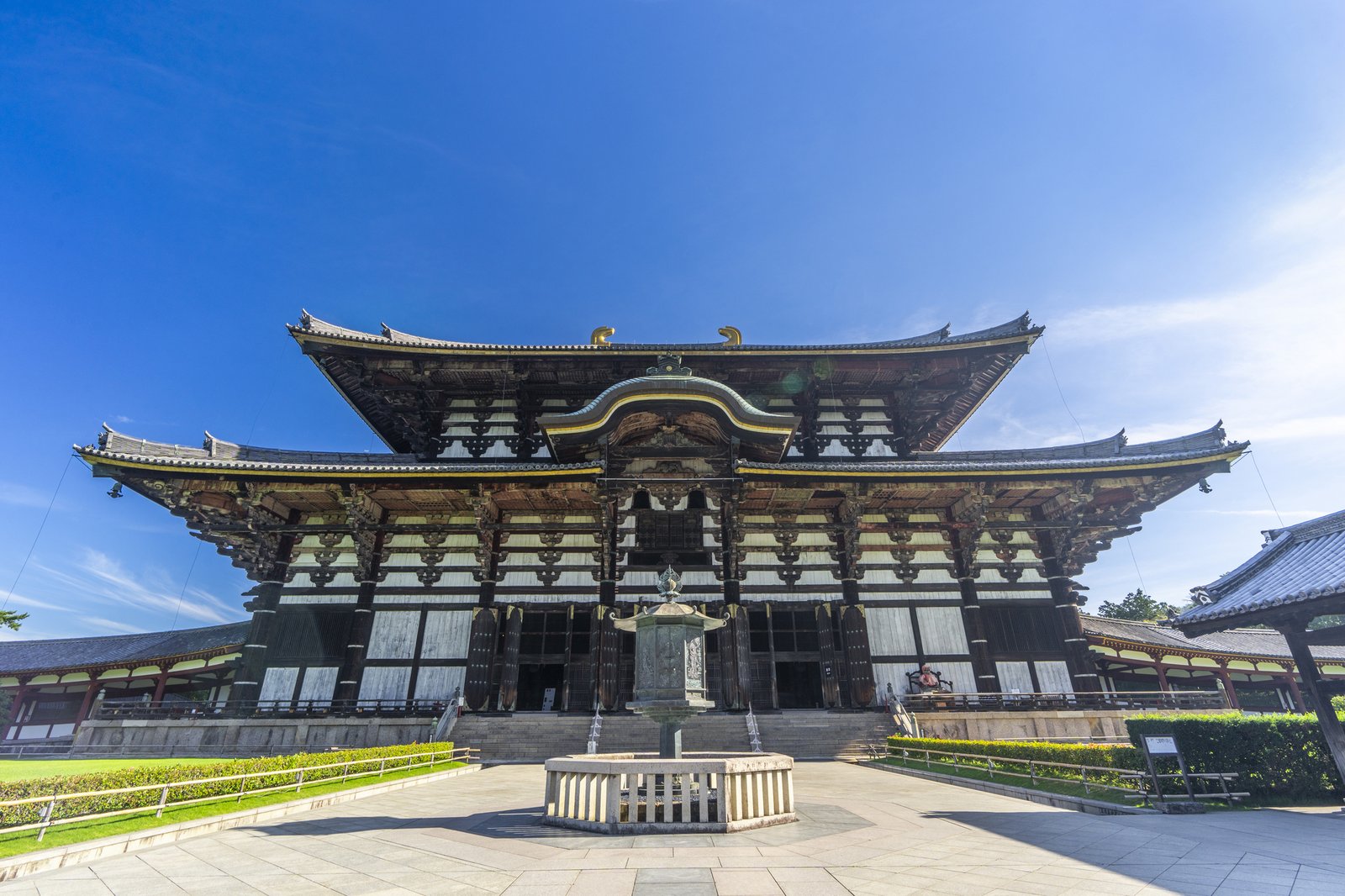
Tōdai-ji is in Nara City, and Kintetsu lists it among the tourist spots of its Nara Park and Mt. Ikoma Area (Kintetsu, recommended spots). UNESCO lists it as component 870-001, “Tôdai-ji”, of the World Heritage property “Historic Monuments of Ancient Nara”, inscribed in 1998 under criteria (ii), (iii), (iv) and (vi) (UNESCO World Heritage Centre, maps; UNESCO World Heritage Centre, Historic Monuments of Ancient Nara). The temple calls the Great Buddha Hall (Daibutsu-den) its Main Hall, and lists both the hall and the Vairocana Buddha (Daibutsu) inside it as National Treasures (Tōdai-ji, Great Buddha Hall).
Who this is for: travellers who want to see the Great Buddha Hall and walk through Nara Park among the deer, and who will check the hall hours and bus times on the official pages before they go.
The short version: from Kintetsu-Nara Station, either walk for about 20 minutes or take a Nara Kotsu bus for about 4 minutes and walk about 5 minutes more. The Great Buddha Hall has one set of hours from April to October and another from November to March, and charges its own admission fee. Always follow the official pages linked below.
What to plan for
| If… | Then lean towards… | Check |
|---|---|---|
| You are coming by Kintetsu train | Kintetsu-Nara Station, then the bus or a walk of about 20 minutes | Kintetsu, recommended spots |
| You want a shorter walk | A Nara Kotsu bus from stop 1 at Kintetsu-Nara Station | Nara Kotsu, bus stops at Kintetsu Nara Station |
| You want to see the hall and the museum | The joint pass the temple sells at both | Tōdai-ji, opening hours and admission fees |
| You want an early start | The Great Buddha Hall’s opening time for the month of your visit | Tōdai-ji, opening hours and admission fees |
Hours and admission
Tōdai-ji prints these opening hours (Tōdai-ji, opening hours and admission fees):
| Place | April to October | November to March |
|---|---|---|
| Great Buddha Hall (Daibutsu-den) | 7:30 to 17:30 | 8:00 to 17:00 |
| Todai-ji Museum | 9:30 to 17:30 (last admission 17:00) | 9:30 to 17:00 (last admission 16:30) |
The temple says admission fees are charged at the Great Buddha Hall, Hokke-dō, Kaidan-dō and Todai-ji Museum, and prints these individual fees (Tōdai-ji, opening hours and admission fees):
| Ticket | Adult | 6 to 12 years old |
|---|---|---|
| One hall (individual) | ¥800 | ¥400 |
| Great Buddha Hall and Todai-ji Museum joint pass | ¥1,200 | ¥600 |
- Group and other fees: fees for groups of 30 or more and for ages 13 to 18 in groups are on the temple’s page; Check official (Tōdai-ji, opening hours and admission fees).
- Before you go: check the temple’s hours and fees page for the hall you plan to enter on the day of your visit (Tōdai-ji, opening hours and admission fees).
What to do: if you plan to enter both the Great Buddha Hall and the museum, compare the joint pass with two single tickets. Where to verify: the temple’s hours and fees page.
Getting there: Kintetsu-Nara Station and the Nara Kotsu bus
- On foot: Kintetsu gives a walk of approx. 20 minutes from Kintetsu-Nara Station (A28) to the temple (Kintetsu, recommended spots).
- Bus: Nara Kotsu Bus Lines lists stop 1 at Kintetsu Nara Station, lines 2, 6, 72 and 163, about 4 minutes to Todaiji-daibutsuden, Kasugataisha-mae, then about 5 minutes on foot (Nara Kotsu, bus stops at Kintetsu Nara Station). It also lists lines 77 and 197, about 5 minutes to Todaiji-daibutsuden, then about 5 minutes on foot (Nara Kotsu).
- From Osaka: Kintetsu describes its Nara Park and Mt. Ikoma Area as about 40 minutes by train from Osaka-Namba Station; for train times, Check official (Kintetsu, recommended spots).
- Bus times on the day: before you travel, look up times and fares on the bus operator’s search page (Nara Kotsu, timetable and fare search (in Japanese, with an English setting)).
What to do: at Kintetsu-Nara Station, find bus stop 1 and check the line number on the bus. Where to verify: the Nara Kotsu bus stop page.
How the monk Kōkei brought back the Great Buddha Hall
Tōdai-ji says the Great Buddha Hall was destroyed by fire twice, in 1180 and in 1567, and that the present hall was built in the Edo period under the direction of the monk Kōkei (Tōdai-ji, Great Buddha Hall). The temple’s history page says that after the fire of 1567 the Great Buddha was repaired and given a temporary shelter, but the shelter was blown down by strong winds and the statue stood exposed to wind and rain for nearly 100 years (Tōdai-ji, Edo-period revival (in Japanese)).
The same page says Kōkei resolved to rebuild the hall after seeing the statue in that state; in 1684 he asked the Edo shogunate for permission to repair the hall and was given it, and from 1686 work began on recasting parts of the statue, including the head and 18 lotus petals, with an eye-opening ceremony in 1692 (Tōdai-ji, Edo-period revival (in Japanese)). The temple says the money of the time did not allow the earlier size, so the hall was rebuilt about six-tenths as wide from east to west, and a dedication ceremony was held in 1709; the middle gate and corridors took another 30 years (Tōdai-ji, Edo-period revival (in Japanese)). Its English page puts the change as eleven bays reduced to seven, with the height and depth kept as before (Tōdai-ji, Great Buddha Hall).
What to do: stand in front of the hall and count the bays across its front. Where to verify: the temple’s Great Buddha Hall page.
The hall, the lantern and the deer as the records list them
The Agency for Cultural Affairs’ Cultural Heritage Online lists the Great Buddha Hall as a National Treasure, designated an Important Cultural Property on 28 December 1898 and a National Treasure on 29 March 1952, and dates it to the middle Edo period, 1705 (Agency for Cultural Affairs, Cultural Heritage Online, Great Buddha Hall (in Japanese)). The Agency’s database of designated properties puts the hall under “National Treasures and Important Cultural Properties (structures)” and gives its date as Hōei 2, 1705 (Agency for Cultural Affairs, database of nationally designated cultural properties (in Japanese)). The temple gives its dimensions as width 57.012 m, length 50.480 m and height 48.742 m (Tōdai-ji, Great Buddha Hall).
Cultural Heritage Online lists the seated bronze Buddha in the hall under “National Treasures and Important Cultural Properties (fine arts)”, designated an Important Cultural Property on 28 December 1897 and a National Treasure on 8 February 1958, and describes it as a work of the Nara and Edo periods (Agency for Cultural Affairs, Cultural Heritage Online, seated Buddha (in Japanese)). The temple says the lotus petals on the statue’s base carry engravings of the World of the Lotus Treasury (Tōdai-ji, Great Buddha Hall).
In front of the hall stands the Octagonal Lantern, which the temple lists as a National Treasure of the 8th century dating from the time of the temple’s founding (Tōdai-ji, Great Buddha Hall). The temple says four of its eight panels carry celestial musicians, and the four pairs of hinged doors carry lions running across clouds (Tōdai-ji, Great Buddha Hall).
The deer of Nara are listed by Cultural Heritage Online under “Historic Sites, Places of Scenic Beauty and Natural Monuments”, designated on 18 September 1957 without a defined area, across Nara City (Agency for Cultural Affairs, Cultural Heritage Online, the deer of Nara (in Japanese)). Its description says they have long been protected as sacred deer and live in groups in the grounds of the Kasuga shrine, in Nara Park and around them (Agency for Cultural Affairs (in Japanese)). Kintetsu calls them wild deer, traditionally believed to be the messengers of a deity (Kintetsu, recommended spots).
What to do: before you enter the hall, walk round the lantern and look for the musicians and the lions on its panels. Where to verify: the temple’s Great Buddha Hall page.