Place name in Japanese: 三徳山, Mitokusan.
Mitokusan and the Nageiredo, Tottori: the rules for the climb, the bus from Kurayoshi, and two accounts of the name
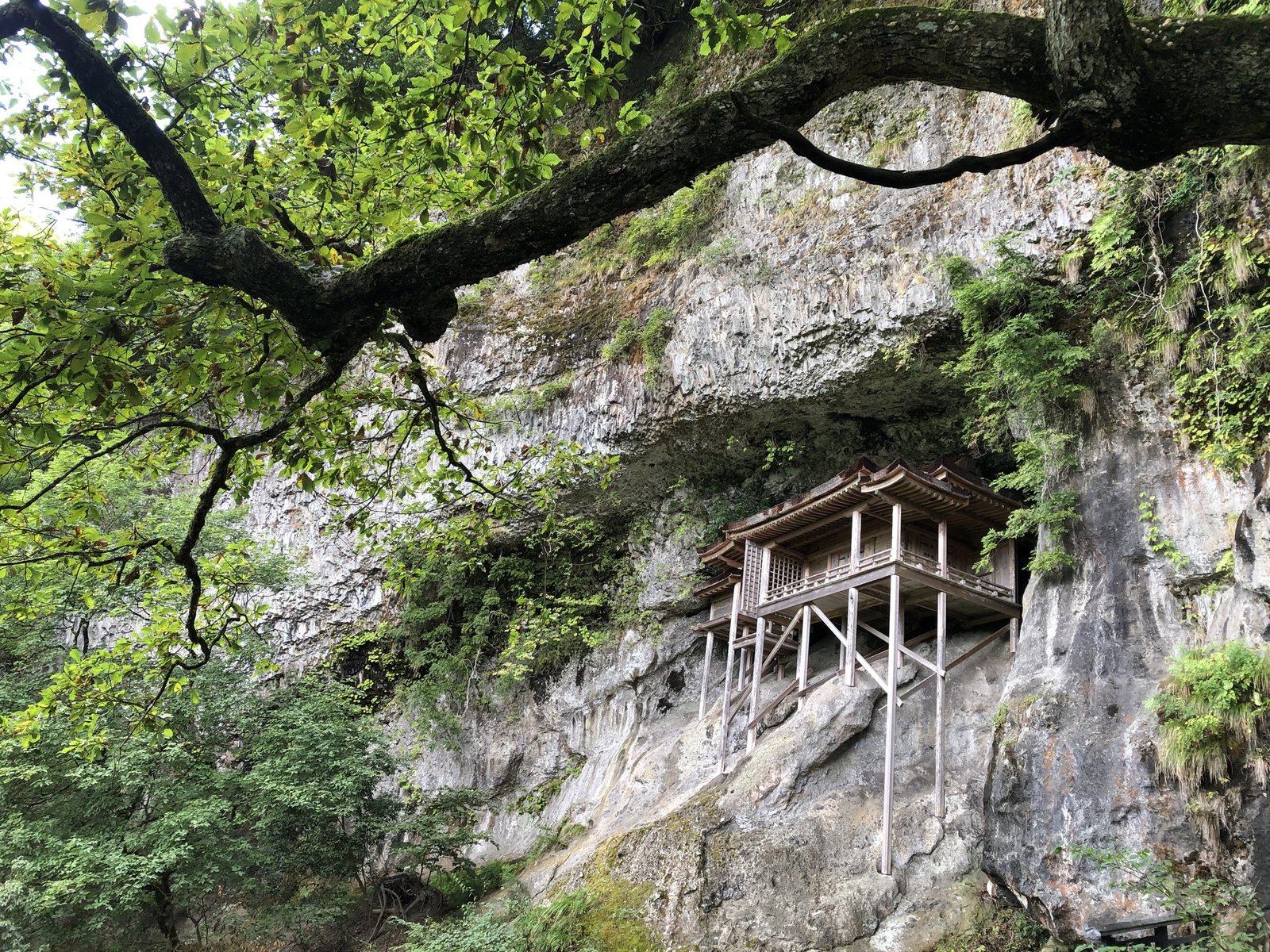
The Agency for Cultural Affairs’ register places Mitokusan about 8 km east of Misasa Onsen, on the upper Mitoku river, at a height of about 900 m, and describes the mountain as the former precinct of the temple Sanbutsuji (Agency for Cultural Affairs, register entry for Mitokusan (in Japanese)). The mountain has been a national Scenic Spot and Historic Site since 7 July 1934. The temple’s inner hall, the Nageiredo, has been a National Treasure since 29 March 1952; the register lists Sanbutsuji as its owner and dates it to the late Heian period, 1086 to 1184 (Agency for Cultural Affairs, register entry for the Nageiredo (in Japanese)).
Who this is for: visitors who want to climb the practice trail to the Nageiredo, or only reach the main hall, and who plan to come by bus from Kurayoshi.
The short version: the climb to the Nageiredo is registered between 8:00 and 15:00, nobody may climb alone, clothing and shoes are checked at the start, and the mountain is closed when rain or snow makes it dangerous. Hinomaru Bus runs from JR Kurayoshi Station to two stops named for Mitokusan.
Before you set out
| If… | Then lean towards… | Check |
|---|---|---|
| You plan to go up on your own | Bringing a companion: climbers to the Nageiredo must come as a party of two or more | Kaijoin, climbing to the Nageiredo (in Japanese) |
| You only have sneakers | Mountain shoes without metal fittings, named as the surest choice; sneakers may be refused | Kaijoin, climbing to the Nageiredo (in Japanese) |
| You come by bus | A Hinomaru Bus marked for Mitokusan or Kami-Yoshihara from Kurayoshi Station, not one that ends at the Misasa depot | Hinomaru Bus, Agei–Misasa line timetable (in Japanese) |
| You only want to see the main hall | The lower rate in the fee table, for a visit up to the main hall | Kaijoin, climbing to the Nageiredo (in Japanese) |
Times and fees to confirm
| Item | Time or fee | Where to check |
|---|---|---|
| Registration for the Nageiredo climb | 8:00 to 15:00; the gate is closed outside visiting hours | Kaijoin, climbing to the Nageiredo (in Japanese) |
| Donations and climbing fee | Check official | Kaijoin, climbing to the Nageiredo (in Japanese) |
| Whether the climb is open today | Check official | Kaijoin, climbing to the Nageiredo (in Japanese) |
| Bus times and fares | Check official | Hinomaru Bus, Agei–Misasa line timetable (in Japanese) |
- Two rates: the fee table separates a visit up to the main hall from the climb to the Nageiredo, with group rates from 20 people.
- Weekday and weekend buses differ: the operator gives one table for weekdays and another for Saturdays, Sundays and holidays.
- Before you go: match your bus to the operator’s timetable on the day you travel (Hinomaru Bus, Agei–Misasa line timetable (in Japanese)).
What to do: plan to reach the registration desk well before the 15:00 cut-off. Where to verify: Kaijoin’s climbing page (in Japanese).
The conditions for the climb
Kaijoin, a temple at Mitoku in Misasa, posts these notes for anyone climbing to the Nageiredo (Kaijoin, climbing to the Nageiredo (in Japanese)). It opens by saying that, because the mountain is dangerous, nobody may make the climb alone, and describes Mitokusan as a place of religious practice with steep stretches where you climb over tree roots and rocks. The notes say:
- Clothing and shoes: because falls and similar accidents are frequent, everyone is checked mainly for clothing and footwear on entry. Sneakers may not be accepted, mountain shoes without metal fittings are the surest choice, and anyone turned away for their shoes may be allowed in after changing into straw sandals, which are sold.
- Not accepted: skirts, high heels, leather shoes, sandals, slippers, slippery shoes, and mountain boots with spikes or metal on the soles; ice axes, trekking poles and walking sticks, which damage the path and the tree roots; and any other clothing unsuited to worship or practice. Small children cannot climb.
- Companions and hands: come as two or more people, dressed so you can move easily and keep both hands free.
- Hours and weather: registration runs from 8:00 to 15:00 and the gate is closed outside visiting hours. When the mountain is judged dangerous because of rain or snow, entry is banned; in a usual year this applies through the winter, from about December to March, because of snow.
- Health: people who have been drinking, who feel unwell, or whose doctor has told them not to exercise are asked not to climb.
- On the mountain: no smoking, incense, candles or other flames; no eating; take rubbish home; leave no charms or offerings; no pets or loud voices; stay off closed areas and off any path other than the Nageiredo trail; and take nothing, plant or animal, since the whole precinct is a national Historic Site and Scenic Spot.
- The stole: a wagesa, a loop-shaped stole, is lent at registration, and climbers are asked to wear it.
The page ends by saying that the trail is part of the precinct of Sanbutsuji, a path for practice and worship, and that anyone who does not follow these points, the staff’s instructions or the law on cultural properties will be refused entry.
What to do: check your shoes against the list before leaving for the mountain. Where to verify: Kaijoin’s climbing page (in Japanese).
Getting to Mitokusan
- By bus: Hinomaru Bus runs routes 70 and 71, the Agei–Misasa line, from JR Kurayoshi Station through the Misasa town hall stop and the Misasa hot-spring area to the Mitokusan Sando Iriguchi and Mitokusan Chushajo stops (Hinomaru Bus, Agei–Misasa line timetable (in Japanese)).
- Which bus: the operator’s timetable is headed as in effect from 1 April 2025. Buses marked for Mitokusan or for Kami-Yoshihara call at the two Mitokusan stops; those marked for the Misasa depot end before them.
- Journey time: on the weekday table, buses for Mitokusan reach the Mitokusan Chushajo stop about 35 minutes after leaving Kurayoshi Station.
- Getting off: the operator notes that on some sections passengers getting off should tell the driver, as marked on its timetable.
What to do: note the last bus back from the Mitokusan stops before you start the climb. Where to verify: the operator’s timetable (in Japanese).
A hall on a cliff, as the register describes it
The register’s description says the hall is a small building set inside a rock cave on the mountainside, hanging over the cliff, with its floor held up by very long pillars in the style known as kakezukuri (Agency for Cultural Affairs, register entry for the Nageiredo (in Japanese)). It notes the slender timbers, the gentle slope of the rafters and the side roofs added to the main body as features of the Heian period, and records the roof as cypress bark.
The register entry for the mountain records an addition to the designated area on 13 February 2018 and an area of 2,568,413.19 square metres, under criteria that include the sites of temples and other places of worship, rocks and caves, gorges and waterfalls, and mountains (Agency for Cultural Affairs, register entry for Mitokusan (in Japanese)).
What to do: look for the long pillars under the floor when the hall comes into view. Where to verify: the register entry (in Japanese).
What the records say about the hall
The register’s description says the Nageiredo was once called the Zaodono, the hall guarding Sanbutsuji (Agency for Cultural Affairs, register entry for the Nageiredo (in Japanese)). It states that the date the hall was built is not known but that it has the style of the Heian period, and that the only later event known is a repair in 1375. The entry records that the hall was listed as an Important Cultural Property on 18 February 1904, before becoming a National Treasure in 1952.
Kaijoin’s account of the mountain’s origins tells the same building from the temple side (Kaijoin, origins of Mitokusan (in Japanese)). It says the founding is attributed to En no Ozunu in 706, that he built a Zaodono inside the rock cave to enshrine the deity Zao Gongen, and that in 849 Ennin enshrined three Buddhas in the hall now used as the main hall, which gave the temple the name Sanbutsuji and placed it in the Tendai school. It adds that Minamoto no Yoritomo built halls and lodgings in 1196, gave land, and presented a temple bell weighing 500 kan for the mountaintop, and that the present main hall was rebuilt in 1839 by Ikeda Narinori, lord of the province.
What to do: look at the main hall, which the account says was rebuilt in 1839. Where to verify: Kaijoin’s account (in Japanese).
Two accounts of the name Nageiredo
Kaijoin’s account gives the explanation that comes from people’s talk (Kaijoin, origins of Mitokusan (in Japanese)). It says that after En no Ozunu built his hall in the cave, people said he had thrown it into the cave by his powers, and that in time it came to be called the Nageiredo, the thrown-in hall.
The register’s detailed description of the mountain gives a plainer account (Agency for Cultural Affairs, register entry for Mitokusan (in Japanese)). It says the hall stands inside a large cave formed where agglomerate meets lava, above a sheer drop, in a spot so hard to approach that it got its name from it.
What to do: look at where the hall sits in its cave and weigh the two accounts. Where to verify: the register entry for the mountain (in Japanese).
Official sources
| Topic | Source | Checked |
|---|---|---|
| Mountain listing, area, location and description | Agency for Cultural Affairs, register entry for Mitokusan | 2026-11-11 |
| Nageiredo listing, dates, owner and description | Agency for Cultural Affairs, register entry for the Nageiredo | 2026-11-11 |
| Conditions for the climb, hours, fee table | Kaijoin, climbing to the Nageiredo | 2026-11-11 |
| Founding, name, later history | Kaijoin, origins of Mitokusan | 2026-11-11 |
| Buses | Hinomaru Bus, Agei–Misasa line timetable | 2026-11-11 |
What we have not verified
- Whether the climb is open on a given day; the climbing page we cite gives the rule for closures but no daily notice (Kaijoin, climbing to the Nageiredo (in Japanese)).
- Bus fares and train times at Kurayoshi Station; the operator links fare tables as separate files, which we did not open, and we fetched no JR timetable page (Hinomaru Bus, Agei–Misasa line timetable (in Japanese)).
- How long the climb takes; the climbing page gives no time (Kaijoin, climbing to the Nageiredo (in Japanese)).
- Designations of the other halls on the mountain; we fetched only the register entries for the Nageiredo and for the mountain (Agency for Cultural Affairs, register entry for Mitokusan (in Japanese)).
- English names: Mitokusan, Sanbutsuji, Kaijoin, the Nageiredo, the Zaodono, Zao Gongen, kakezukuri, wagesa, Tendai, En no Ozunu, Ennin, Minamoto no Yoritomo, Ikeda Narinori, kan, Misasa, Misasa Onsen, Mitoku, the Mitoku river, Kurayoshi, Kami-Yoshihara, Mitokusan Sando Iriguchi, Mitokusan Chushajo, the Agei–Misasa line, the Agency for Cultural Affairs, National Treasure, Important Cultural Property, and Scenic Spot and Historic Site are our own romanizations or translations; Hinomaru Bus follows the operator’s copyright line (Hinomaru Bus, Agei–Misasa line timetable (in Japanese)).