Place name in Japanese: 松島, Matsushima.
Matsushima, Miyagi: the island cruise, Zuiganji Temple and why the islands keep changing shape
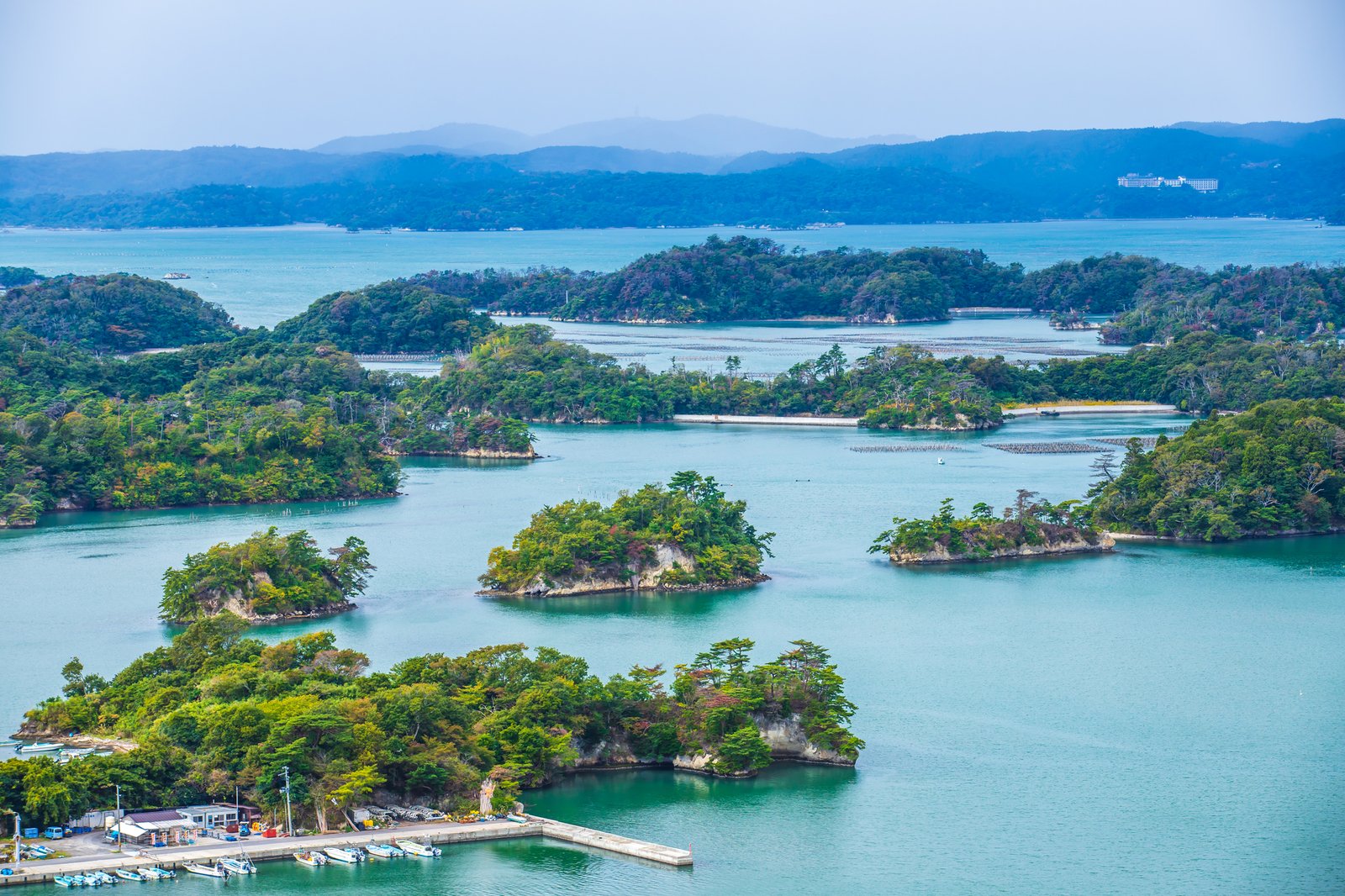
Matsushima is a bay in Miyagi scattered with small islands. The Agency for Cultural Affairs describes more than 200 islands of Tertiary tuff, each topped with pines, scattered in one bay (Agency for Cultural Affairs database (in Japanese)). On the shore stands Zuiganji Temple, whose main hall and living quarters are National Treasures (Zuiganji Temple, history (in Japanese)).
Who this is for: travellers who want to see the islands from the water and walk to a Zen temple on the shore, and who will check boat times and opening hours on the official pages before they go.
The short version: take the JR Senseki Line to the station for Matsushima’s shore, or start from Shiogama and come by boat. Marubun Matsushima Kisen runs the Basho Cruise between Shiogama and Matsushima and a round-trip cruise from Matsushima, each about 50 minutes. Zuiganji Temple is a walk from the station. Boat times, fares and temple hours change, so check on the day. Always follow the official pages linked below.
Boat, temple or both
| If… | Then lean towards… | Check |
|---|---|---|
| You want to travel between Shiogama and Matsushima and see the islands on the way | The Basho Cruise, about 50 minutes one way | Marubun Matsushima Kisen, pleasure cruises (English) |
| You want to start and finish in Matsushima | The operator’s round-trip cruise from Matsushima, about 50 minutes | Marubun Matsushima Kisen, pleasure cruises (English) |
| You want to see the temple buildings | Zuiganji Temple and its museum | Zuiganji Temple, visitor guide (in Japanese) |
| You use a wheelchair | Plan on the temple museum; the temple says only the museum can be visited in a wheelchair, not the main hall or the living quarters | Zuiganji Temple, visitor guide (in Japanese) |
Sightseeing cruise: times, fares and closures
| Item | Times | Fares | Closures | Where to check |
|---|---|---|---|---|
| Basho Cruise (Matsushima and Shiogama) | Check official | Check official | Check official | Marubun Matsushima Kisen, timetable (English) |
| Round-trip cruise from Matsushima | Check official | Check official | Check official | Marubun Matsushima Kisen, timetable (English) |
- The courses: the operator’s English page says the Basho Cruise passes through shallow waters only 2 metres deep to see the islands up close, and that the round-trip cruise from Matsushima takes in major islands including Nioujima (Marubun Matsushima Kisen, pleasure cruises). It says the round trip takes about 40 minutes when a medium-sized ship is used.
- Tickets and boarding: the operator’s Japanese page asks you to collect your ticket at the counter for your departure point at least 10 minutes before sailing; its Shiogama counter is at Marine Gate Shiogama (Marubun Matsushima Kisen, boarding (in Japanese)). Whether a booking is needed differs between its English and Japanese pages: Check official.
- Suspensions: the operator says the time on the water can vary and the course can change with the weather and the waves, so check with it before you go (Marubun Matsushima Kisen, Basho Cruise (in Japanese)).
What to do: call or check the operator’s page on the day you sail, and reach the counter at least 10 minutes before departure. Where to verify: the boarding page (in Japanese).
Zuiganji Temple
Zuiganji says it is a Zen temple that now belongs to the Myoshinji school of the Rinzai sect (Zuiganji Temple, history (in Japanese)). It says its main hall, with its entrance hall, was designated a National Treasure in 1953 as a building that carries the art of the Momoyama period into the present, and its living quarters and corridor in 1959, and that a ten-year restoration of the buildings was completed in 2018 (Zuiganji Temple, history (in Japanese)). The temple’s museum, Seiryuden, keeps Important Cultural Properties including a set of five Heian-period wooden statues and the main hall’s wall paintings, painted between 1620 and 1622 (Zuiganji Temple, museum (in Japanese)). The temple says a visit takes about 30 to 40 minutes (Zuiganji Temple, visitor guide (in Japanese)).
| Item | Hours | Fees | Closures | Where to check |
|---|---|---|---|---|
| Zuiganji Temple and museum | Closing time changes by month: Check official | Check official | Check official | Zuiganji Temple, visitor guide (in Japanese) |
- Other halls by the bay: the Matsushima Tourism Association’s English page describes Godaido, a hall it says has come to symbolise Matsushima, whose current structure it says Date Masamune built in 1604 with carvings of the 12 signs of the Chinese zodiac facing their directions, and Entsuin Temple, the mausoleum of Date Mitsumune (Matsushima Tourism Association, sightseeing). Hours: Check official.
- Closures: the temple’s page sets the hours and notes that it has revised its opening time before, so check it before you go (Zuiganji Temple, visitor guide (in Japanese)).
What to do: check the closing time for the month you visit, since the temple’s last admission is 30 minutes before the gate closes. Where to verify: the visitor guide (in Japanese).
Getting there and how long it takes
- By train: JR East’s timetable page lists the Senseki Line station for Matsushima’s shore, with trains towards Sendai in one direction and towards Ishinomaki in the other (JR East, timetable for the station). Miyagi Prefecture gives the Special Place of Scenic Beauty as right by that station on the Senseki Line (Miyagi Prefecture (in Japanese)).
- To the temple: Zuiganji gives a 10-minute walk from the JR station on the Senseki Line, and a 25-minute walk from Matsushima Station on the Tohoku Main Line; it has no car park of its own (Zuiganji Temple, visitor guide (in Japanese)).
- By boat from Shiogama: the Basho Cruise runs between Shiogama and Matsushima in about 50 minutes (Marubun Matsushima Kisen, pleasure cruises).
What to do: check the train times on JR East’s page and the boat times on the operator’s page together if you plan to arrive by train and leave by boat. Where to verify: the JR East timetable and the cruise timetable.
How Zuiganji got its name
Zuiganji says its forerunner was a Tendai temple founded in the early 9th century by Jikaku Daishi Ennin, and that in the mid-13th century Hojo Tokiyori converted it to the Rinzai sect and the temple was renamed Empukuji (Zuiganji Temple, history (in Japanese)). It says it was long thought that the Tendai temple ended when the sect changed, but that an excavation in 2011 found Empukuji’s main buildings on the site of today’s Zuiganji, apart from the earlier temple (Zuiganji Temple, history (in Japanese)).
After the Battle of Sekigahara, the temple says, Date Masamune put particular effort into reviving Empukuji: he laid out the ground plan himself, sought timber from Kumano in Kishu, and invited 130 master craftsmen from the Kinai region (Zuiganji Temple, history (in Japanese)). The large bell cast in 1608 carries a line naming the mountain Matsushima and the temple Zuigan, which the temple says is the first appearance of the name Zuiganji; the work was completed in 1609, after five years (Zuiganji Temple, history (in Japanese)).
What to do: in the museum, look for the main hall’s original wall paintings, which the temple says it shows only for limited periods to protect them. Where to verify: the museum page (in Japanese).
Why the islands keep changing shape
The Agency for Cultural Affairs database lists Matsushima as a Special Place of Scenic Beauty, designated a Place of Scenic Beauty on 7 March 1923 and a Special Place of Scenic Beauty on 22 November 1952 (Agency for Cultural Affairs database (in Japanese)). It describes more than 200 islands of Tertiary tuff, each topped with pines, scattered in one bay, and calls it a many-island landscape sung of since ancient times as one of the Three Views of Japan (Agency for Cultural Affairs, Cultural Heritage Online (in Japanese)).
Miyagi Prefecture says the islands’ own make-up works against them: because of sea erosion and tuff that does not stand up well to freezing, some islands have visibly changed shape, and the collapse of one island’s arch is a sign of this (Miyagi Prefecture (in Japanese)). It says the national and prefectural governments are working against the natural collapse, with reinforcement of the neck of Nioujima and works to stop sea erosion on the island where Godaido stands (Miyagi Prefecture (in Japanese)).
The prefecture’s cultural properties division adds that Matsushima has been a place celebrated in poetry since the Heian period, and that its name spread across the country after Basho wrote of it on his journey for Oku no Hosomichi (Japan Heritage portal (in Japanese)). The boat operator says Basho set out on that journey in 1689, and quotes his description of the bay: “Islands are piled above islands and islands are joined to islands” (Marubun Matsushima Kisen, pleasure cruises).
What to do: from the boat, look for Nioujima among the islands the round-trip cruise passes, and for the island under Godaido. Where to verify: the operator’s English page and Miyagi Prefecture’s page (in Japanese).