Place name in Japanese: 霞ヶ浦, Kasumigaura.
Lake Kasumigaura, Ibaraki: the excursion boat from Tsuchiura, the sail-trawling boats of 1880, a lake fished under sea rules, and a place among the hundred views of 1927
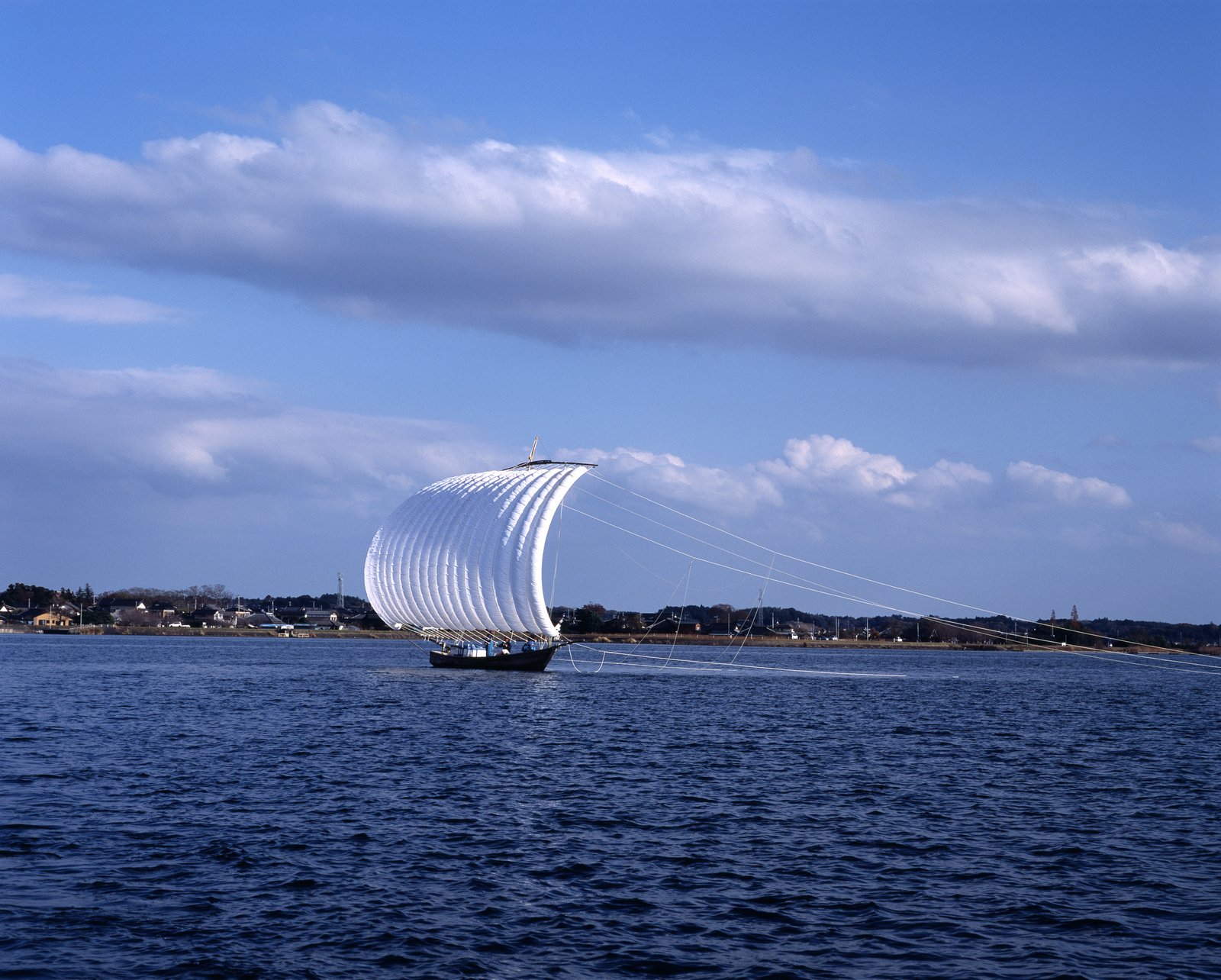
Lake Kasumigaura lies in the south-east of Ibaraki Prefecture. The prefecture’s environmental science centre for Kasumigaura says that what people call Kasumigaura takes in three waters, the lake itself, a second lake and the Hitachi-tonegawa, and that with an area of 220 square kilometres it ranks second in Japan in area; its average depth is about 4 m, so it is broad and shallow (Ibaraki Prefecture, environmental science centre for Kasumigaura, about the lake (in Japanese)). This page is a way in to the lake: the excursion boat and the sail boats you can watch from it, the old way of fishing with sails, and the rules that let you fish here without a ticket.
Who this is for: visitors who want to see the lake from the water or watch the white sails in summer, and anyone curious about how a broad, shallow lake shaped a way of fishing.
The short version: an excursion boat runs from the port at Tsuchiura, and its operator prints the departures, the fares and the winter breaks. In summer the sightseeing sail boats can be watched from that boat. The sail-trawling technique, said to have been devised in 1880, is listed in the national cultural properties database, and the lake is fished under the same system as the sea.
On the water or on the shore: where to start
| Your situation | Our suggestion | Where to check |
|---|---|---|
| You want to go out on the lake | The excursion boat White Iris leaves from the port at Tsuchiura; read its timetable and fares on the operator’s page | Lacus Marina, White Iris timetable and fares (in Japanese) |
| You want to watch the sail boats | Tsuchiura City says they can be seen from the excursion boat or from a park named after the lake, and names one departure for watching them | Tsuchiura City, sightseeing sail boats (in Japanese) |
| You want to fish from the shore | The prefecture says no fishing ticket is needed, but nothing may be taken in protected waters and prohibited areas | Ibaraki Prefecture, fisheries of the lake (in Japanese) |
| You want to know what the lake is | The prefecture’s science centre sets out its parts, area and depth | Ibaraki Prefecture, environmental science centre for Kasumigaura, about the lake (in Japanese) |
The boats: what to confirm
| Item | Value | Where to check |
|---|---|---|
| Excursion boat departures | Check official | Lacus Marina, White Iris timetable and fares (in Japanese) |
| Excursion boat fares and discounts | Check official | Lacus Marina, White Iris timetable and fares (in Japanese) |
| Winter breaks and days with no sailings | Check official | Lacus Marina, White Iris timetable and fares (in Japanese) |
| Season of the sightseeing sail boats in Tsuchiura | Check official | Tsuchiura City, sightseeing sail boats (in Japanese) |
| Where the protected waters and prohibited areas are | Not verified (see below) | Ibaraki Prefecture, fisheries of the lake (in Japanese) |
| How to reach the port | Not verified (see below) | Lacus Marina, White Iris page (in Japanese) |
- The excursion boat: the operator says departure times may change and asks you to check them, that extra sailings run when there are many passengers, and that a sailing may be cancelled for a group charter (Lacus Marina, White Iris timetable and fares (in Japanese)).
- The sail boats: Tsuchiura City says they do not sail when there is no wind or in bad weather, and that the two neighbouring cities also run sightseeing sail boats at different times (Tsuchiura City, sightseeing sail boats (in Japanese)).
- Before you go: read the operator’s timetable on the day you plan to sail, since some departures stop in winter and the sail boats can be watched from it only on some days of the summer.
What to do: if you want to watch the sail boats, plan around the departure the city names and the operator’s notes on it. Where to verify: the city’s page (in Japanese) and the operator’s timetable (in Japanese).
What the lake is made of
The prefecture’s science centre explains that the name covers the lake itself, a second lake and the Hitachi-tonegawa, which in turn joins three waters together (Ibaraki Prefecture, environmental science centre for Kasumigaura, about the lake (in Japanese)). It says that the catchment is about ten times the area of the lake, so that water flows in from a wide area, and that for this reason the lake is said to gather dirty water easily.
The river office of the Ministry of Land, Infrastructure, Transport and Tourism adds that under the River Act the whole is called the Hitachi-tonegawa, and that its catchment makes up 35 percent of Ibaraki Prefecture (Ministry of Land, Infrastructure, Transport and Tourism, Kasumigaura River Office, outline of the area (in Japanese)).
What to do: when you look out over the water, remember that the name covers more than one lake. Where to verify: the science centre’s page (in Japanese).
The excursion boat from Tsuchiura
Lacus Marina’s page describes White Iris as a wide excursion boat that runs out over the lake, and says that from October to April flocks of gulls follow it (Lacus Marina, White Iris page (in Japanese)). The same page gives the company’s office in Tsuchiura and its safety information. Its fare page notes that in winter the boat becomes a kotatsu cruise, with heated low tables, and lists the departures that stop for the winter (Lacus Marina, White Iris timetable and fares (in Japanese)).
What to do: if you sail in the cold months, expect the kotatsu tables and a shorter list of departures. Where to verify: the operator’s timetable (in Japanese).
Selection: the sail-trawling technique
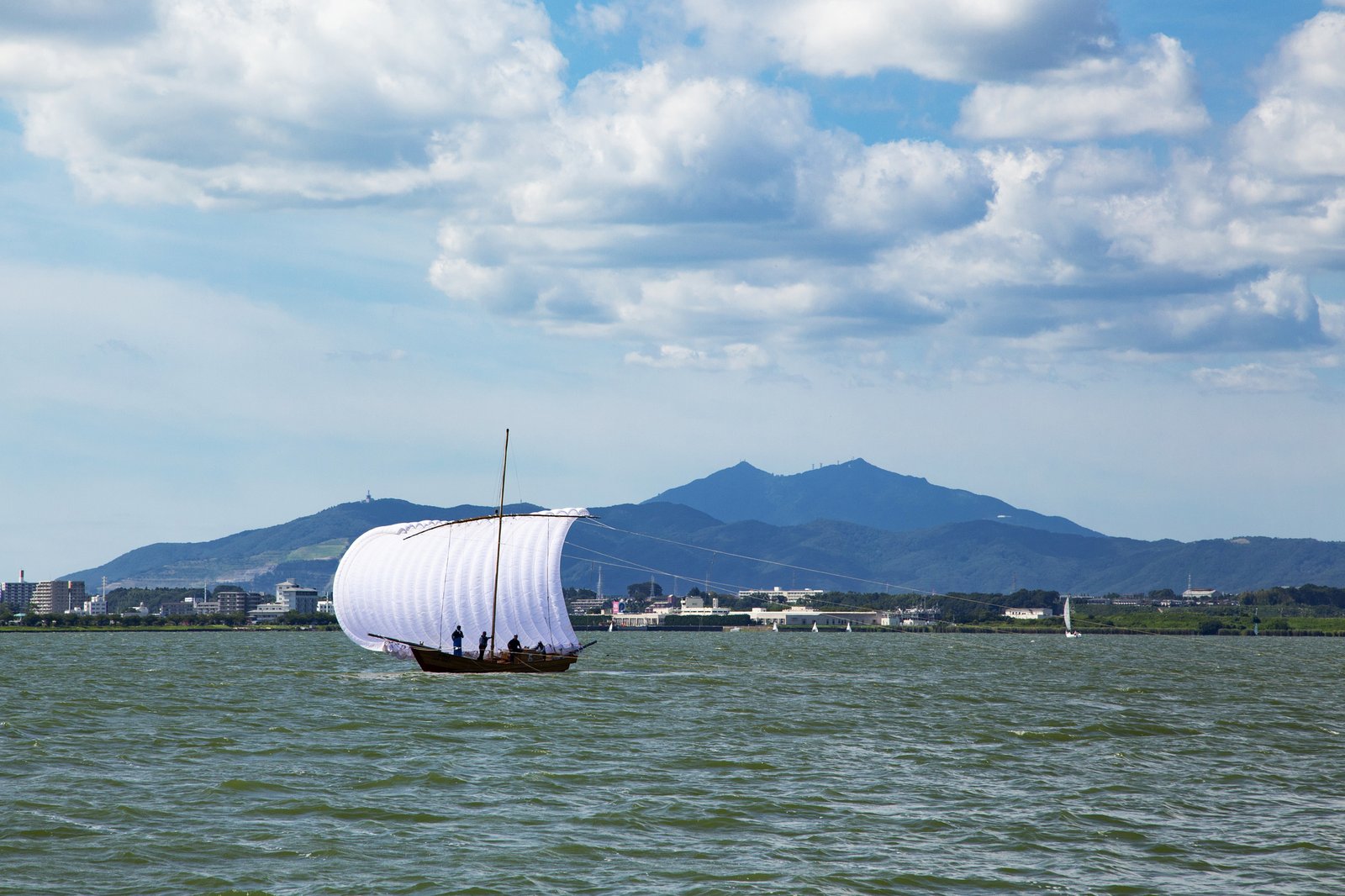
The national cultural properties database lists the sail-trawling technique of Kasumigaura as an intangible folk cultural property for which records should be made, selected on 8 March 2018 under the standard of showing local character, with three preservation societies named (Agency for Cultural Affairs, sail-trawling technique entry (in Japanese)). The entry is a selection of the technique, not of the lake.
The sail boats of 1880
The database commentary tells the story of the technique (Agency for Cultural Affairs, sail-trawling technique entry (in Japanese)). It says the lake was once an inlet of the sea, closed off by sandbars and river deposits. The technique is thought to have grown out of an older kind of net fishing, and is said to have been devised in 1880 by a local resident, so that a net could be pulled quickly by as few as two or three people. With a single sail up to about 9 m tall and 16 m wide, the boat slides sideways before the wind, dragging a bag-shaped net, and at the height of the fishing as many as 900 boats are said to have crossed the lake. The technique is known to have spread to Akita Prefecture in the later years of the Meiji era. After trawling by powered boats was allowed in 1967 it declined, and since 1971 it has been carried on mainly as a sight for visitors.
Kasumigaura City adds that the inventor did not keep the method to himself but taught it to many fishermen around the lake, and that the boats did not fish on days without wind (Kasumigaura City, about the sail boats (in Japanese)).
What to do: when you see a white sail on the lake, remember that the boat is meant to slide sideways, its sail balanced against the pull of the net. Where to verify: the database entry (in Japanese).
Among the hundred views of 1927
The Ministry of the Environment’s table of the 1927 Eight Views of Japan explains that a committee picked the eight views from the candidates and at the same time recommended twenty-five fine sights and a hundred views (Ministry of the Environment, table of the 1927 selection (PDF, Japanese only)). Kasumigaura is in the hundred views, on a line that gives Ibaraki and the lakes category.
A lake fished under sea rules
Ibaraki Prefecture’s fisheries page says that although the lake is a lake, for fishing law it is not treated as inland water: like one other large lake, it has been made a sea area and is fished under the same system as the sea (Ibaraki Prefecture, fisheries of the lake (in Japanese)). For that reason, the page says, you can fish here without buying a fishing ticket, just as on the sea (Ibaraki Prefecture, fisheries of the lake (in Japanese)). It adds that in other lakes with large catches the main catch is mostly freshwater clams, while here it is mainly fish and shrimp (Ibaraki Prefecture, fisheries of the lake (in Japanese)).
What to do: if you bring a rod, remember that the sea rules also mean that protected waters and prohibited areas are closed to all catching. Where to verify: the prefecture’s fisheries page (in Japanese).
Official sources
| Topic | Source | Checked |
|---|---|---|
| The parts of the lake, its area and depth, the catchment | Ibaraki Prefecture, environmental science centre for Kasumigaura, about the lake | 2026-11-14 |
| The name under the River Act, the catchment’s share of the prefecture | Ministry of Land, Infrastructure, Transport and Tourism, Kasumigaura River Office, outline of the area | 2026-11-14 |
| Excursion boat departures, fares, winter breaks | Lacus Marina, White Iris timetable and fares | 2026-11-14 |
| The boat, the gulls, the operator’s office and safety information | Lacus Marina, White Iris page | 2026-11-14 |
| Sightseeing sail boats in Tsuchiura, the departure for watching them | Tsuchiura City, sightseeing sail boats | 2026-11-14 |
| The sail-trawling technique, its selection and its story | Agency for Cultural Affairs, sail-trawling technique entry | 2026-11-14 |
| The inventor’s teaching, no fishing on windless days | Kasumigaura City, about the sail boats | 2026-11-14 |
| Sea rules, fishing without a ticket, the catch | Ibaraki Prefecture, fisheries of the lake | 2026-11-14 |
| The hundred views of 1927 | Ministry of the Environment, table of the 1927 selection (PDF) | 2026-11-10 |
What we have not verified
- Protected waters and prohibited areas: the prefecture’s page says catching is not allowed there but does not show where they are, so we cannot point you to a map (Ibaraki Prefecture, fisheries of the lake (in Japanese)).
- How to reach the port: the operator’s pages we opened give the office address but no route or walking time, so we give none (Lacus Marina, White Iris page (in Japanese)).
- The sail boats in the neighbouring cities: Tsuchiura City says they run at different times, but we did not open those cities’ timetables, so we give no season for them (Tsuchiura City, sightseeing sail boats (in Japanese)).
- Names of the inventor and the parts of the lake: the pages we opened print the inventor’s name and the name of the second lake without readings, so we describe them instead of naming them (Agency for Cultural Affairs, sail-trawling technique entry (in Japanese)).
- Names: Tsuchiura, Meiji and White Iris are our romanizations of the Japanese names on the pages above.