Kusatsu Onsen, Gunma: the Yubatake, yumomi at Netsunoyu and the JR Bus Kanto bus from Naganoharakusatsuguchi
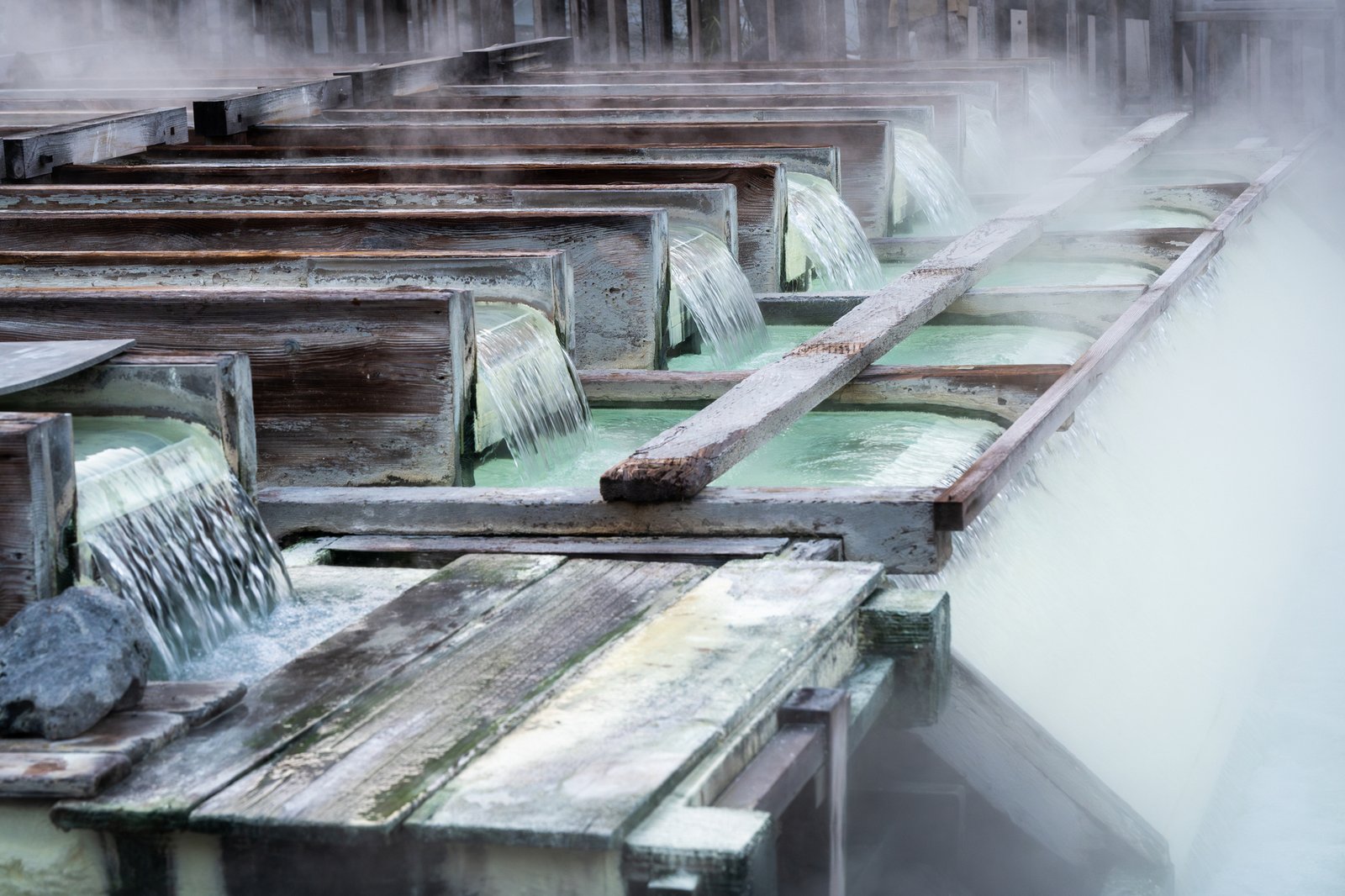
Kusatsu Onsen is a hot spring town in Kusatsu, Gunma. At its centre is the Yubatake, a spring where the water runs through wooden channels before it falls as a cascade. The Agency for Cultural Affairs lists the Yubatake as a Place of Scenic Beauty, designated on 13 October 2017 under the criterion “volcanoes and hot springs” (Agency for Cultural Affairs, database of nationally designated cultural properties (in Japanese)). Its commentary calls the Yubatake “a source of hot spring water at the centre of Kusatsu Onsen”, where the water is cooled in the channels, mineral deposits are collected, and the cascade at the end gives the place a character of its own (Agency for Cultural Affairs (in Japanese)).
Who this is for: travellers who want to see the Yubatake, watch or try yumomi and take a public bath, and who will check the bus times, road status and volcano notices on the official pages before they go.
The short version: take the JR East Agatsuma Line to Naganoharakusatsuguchi, then the JR Bus Kanto route bus to Kusatsu Onsen. The Kusatsu Onsen Tourism Association says the Yubatake is a 5-minute walk from the bus terminal. Watch the yumomi show at Netsunoyu, which stands in front of the Yubatake, and follow the association’s bathing advice in the hot water. Before any trip into the mountains above the town, check the road and volcano notices. Always follow the official pages linked below.
What to plan for
| If… | Then lean towards… | Check |
|---|---|---|
| You are coming by train | The JR Bus Kanto route bus from Naganoharakusatsuguchi, which cannot be booked | JR Bus Kanto, timetable (in Japanese) |
| You want to see the spring itself | The Yubatake, a 5-minute walk from the bus terminal | Kusatsu Onsen Tourism Association, Yubatake (in Japanese) |
| You want to see how the hot water is cooled by hand | The yumomi show at Netsunoyu | Kusatsu Onsen Tourism Association, Netsunoyu (in Japanese) |
| You want to drive or go up the mountain | Check the road status and the volcano restriction first | Kusatsu Onsen Tourism Association, road information (in Japanese) |
The Yubatake: the water as the official pages print it
The official pages print slightly different figures for the same spring, so each is given here with its source.
- Flow: the Agency for Cultural Affairs gives a natural flow of 4,040 litres a minute; the Kusatsu Onsen Tourism Association gives about 4,000 litres a minute (Agency for Cultural Affairs (in Japanese); Kusatsu Onsen Tourism Association, Yubatake (in Japanese)).
- Temperature and acidity: the Agency gives the source as 52.7°C and pH 2.1, strongly acidic, and says the water is piped to more than 80 places in the town, including inns and communal baths (Agency for Cultural Affairs (in Japanese)). The association also prints pH 2.1 (Kusatsu Onsen Tourism Association, Yubatake (in Japanese)).
- Spring type: for the Yubatake source, the association prints “acidic, sulphur-containing, aluminium-sulphate-chloride spring (hydrogen sulphide type) (acidic, hypotonic, high-temperature spring)” (Kusatsu Onsen Tourism Association, spring type and bathing (in Japanese)).
- The town’s springs: Kusatsu Town says all its springs flow out naturally and are strongly acidic, at around pH 2.0, and names six main sources, one of them the Yubatake source (Kusatsu Town, about Kusatsu Onsen (in Japanese)). It says one of the six comes out at about 94.5°C and is cooled to about 60°C with a plate heat exchanger and tap water, while the other sources come out at around 50°C and have long been used for bathing as they are (Kusatsu Town (in Japanese)).
What to do: stand at the end of the wooden channels to see where the water falls as a cascade. Where to verify: the Agency’s entry (in Japanese).
Bathing: the advice the association gives
- Ease in: the association says Kusatsu’s water is hot, and that a sudden change of temperature puts a strain on the body, so pour hot water over yourself first and get used to it slowly from your feet up (Kusatsu Onsen Tourism Association, spring type and bathing (in Japanese)).
- How often: it says about three baths a day is a safe limit, and that bathing while drunk is dangerous (Kusatsu Onsen Tourism Association (in Japanese)).
- Children: for children who find the water too hot, it suggests scooping some water in a pail, letting it cool a little and pouring it over them first (Kusatsu Onsen Tourism Association (in Japanese)).
- Clothes: it says the water contains a lot of sulphur and that underwear and other clothes can change colour or deteriorate (Kusatsu Onsen Tourism Association (in Japanese)).
- When not to bathe: the association lists conditions in which bathing is not advised, and says to ask your own doctor first if you are worried (Kusatsu Onsen Tourism Association (in Japanese)).
- Public baths: Kusatsu Town says it runs 19 communal baths around the town and opens some of them free of charge to residents and visitors; which baths, and their hours: Check official (Kusatsu Town (in Japanese)).
What to do: wear clothes you do not mind marking if you plan several baths in a day. Where to verify: the association’s bathing page (in Japanese).
Yumomi at Netsunoyu
The Gunma Official Tourist Guide says Netsunoyu, a two-storey bathhouse built in 1968 and renovated in 2015, stands in front of the Yubatake, and that since the Edo period (1603–1868) the hot water has been stirred with a wooden paddle to cool it without diluting it; the method, yumomi, is performed to traditional folk songs (Gunma Official Tourist Guide, Netsunoyu).
- The show: the Kusatsu Onsen Tourism Association’s calendar lists morning and afternoon performances of its yumomi and dance show, and says tickets go on sale 30 minutes before each one (Kusatsu Onsen Tourism Association, Netsunoyu (in Japanese)).
- Fee: the association prints 700 yen for adults and 350 yen for primary school children, tax included, per show (Kusatsu Onsen Tourism Association, Netsunoyu (in Japanese)).
- Trying it yourself: the calendar lists a yumomi experience at the reception for primary school age and up on some days; days, times and fee: Check official (Kusatsu Onsen Tourism Association, Netsunoyu (in Japanese)).
- Times: the show times and any extra performances change by date on the calendar; Check official (Kusatsu Onsen Tourism Association, Netsunoyu (in Japanese)).
What to do: check the calendar for the day of your visit and be at Netsunoyu before the ticket sales open. Where to verify: the association’s Netsunoyu page (in Japanese).
Getting there and road conditions
- Train: JR East’s timetable lists Naganoharakusatsuguchi Station on the Agatsuma Line (JR East, Naganoharakusatsuguchi Station timetable).
- Bus: JR Bus Kanto runs the route from Naganoharakusatsuguchi to Kusatsu Onsen, and says it is the only operator between the two. Its timetable, for journeys from 22 December 2025, shows a daily bus leaving Naganoharakusatsuguchi at 7:54 and reaching Kusatsu Onsen at 8:19; other times: Check official (JR Bus Kanto, timetable (in Japanese)).
- On the bus: JR Bus Kanto says the bus connects with trains at Naganoharakusatsuguchi, except some trains; it cannot be booked, and passengers board in the order they queue at the stop; because it runs with seated capacity, you cannot board once it is full (JR Bus Kanto, timetable (in Japanese)).
- Fare: JR Bus Kanto says you pay on the bus when you get off, and that transport IC cards such as Suica and PASMO are accepted, except on some extra buses; the fare: Check official (JR Bus Kanto, timetable (in Japanese)).
- Suspensions: before you travel, check JR Bus Kanto’s service status page for the Kusatsu area, which also shows whether the bus above the town to the volcano area is running (JR Bus Kanto, Kusatsu area service status (in Japanese)).
- Winter roads: before you drive, check the association’s road information page, which lists closures on National Route 292 and the other roads to Kusatsu (Kusatsu Onsen Tourism Association, road information (in Japanese)). Kusatsu Town says the mountain section of Route 292 closes for winter from mid-November (Kusatsu Town, volcano notice (in Japanese)).
- Volcano: before you go up the mountain, check Kusatsu Town’s volcano notices; the town restricts entry within a 500 m radius of the crater area of the volcano above the town, and says it will close areas if volcanic activity or other conditions call for it (Kusatsu Town, volcano notice (in Japanese); Kusatsu Onsen Tourism Association, road information (in Japanese)).
What to do: join the bus queue at Naganoharakusatsuguchi as soon as your train arrives, because the bus cannot be booked. Where to verify: the JR Bus Kanto timetable (in Japanese).
Dr. Erwin von Baelz and Kusatsu
The Kusatsu Onsen Tourism Association calls Dr. Erwin von Baelz, born on 13 January 1849, a benefactor of Kusatsu (Kusatsu Onsen Tourism Association, people linked to Kusatsu (in Japanese)). It says he came to Japan in 1876 (Meiji 9) at the invitation of the government and taught physiology, pathology, internal medicine and gynaecology at the Tokyo school of medicine that came before the University of Tokyo’s faculty of medicine (Kusatsu Onsen Tourism Association (in Japanese)). Kusatsu Town adds that he also served as a physician to the imperial household (Kusatsu Town, Baelz Memorial Hall (in Japanese)).
The association says that from around 1878 (Meiji 11) he visited Kusatsu several times, analysed the water and taught a correct way of bathing (Kusatsu Onsen Tourism Association (in Japanese)). The town quotes his diary as saying that, besides its matchless hot springs, Kusatsu had the best mountains and air in Japan and ideal drinking water (Kusatsu Town (in Japanese)). The association says that, in return, the town set up a monument to him in 1934 (Shōwa 9) and became a sister city of the German town where he was born (Kusatsu Onsen Tourism Association (in Japanese)).
The town’s Dr. Erwin von Baelz Memorial Hall shows material on his life and his links with Kusatsu Onsen. The town gives its hours as 9:00 to 16:30 and says it is open every day, with closures for maintenance; before you go, check the town’s page for closures (Kusatsu Town (in Japanese)).
What to do: read the Baelz quote in the town’s page before you visit the memorial hall, then look for the material on his visits to Kusatsu. Where to verify: the town’s page (in Japanese).
How the Yubatake got its name and its fence
The Agency for Cultural Affairs says the name appears on a map in a guide of 1884, written with an older character for “field”, and in its present form on a map in a local history of 1910; before that, it finds names meaning “the foot of the falls”, “the hot river”, “the hot pot”, “the hot pond” and “the pond of mineral flowers” (Agency for Cultural Affairs (in Japanese)). The association explains the name as a field where the mineral deposits can be harvested, because the deposits settle in the channels over time (Kusatsu Onsen Tourism Association, Yubatake (in Japanese)).
The Agency says Kusatsu first appears in writing in the later 15th century: a monk stayed there for 14 days in 1486 and recorded it in a travel journal, and in 1491 another monk wrote that of the hot springs in every province, three stood out, Kusatsu and two other hot spring towns, though he placed Kusatsu in the wrong province (Agency for Cultural Affairs (in Japanese)). It says the water was sent as a gift to the eighth Tokugawa shogun twice, in 1726 and 1743, and that a frame marks the place where it was drawn (Agency for Cultural Affairs (in Japanese)).
The Agency says the wooden channels were first set up in the 1880s and 1890s (Meiji 20s) and are still replaced from time to time; there are now seven, each about 40 m long, made of red pine more than 150 years old, and they are thought to have been put there to collect mineral deposits, cool the water and release hydrogen sulphide (Agency for Cultural Affairs (in Japanese)). A communal bath once stood at the plunge pool below the cascade; it was closed and demolished in 1972 (Shōwa 47) (Agency for Cultural Affairs (in Japanese)).
The Agency says nobody knows when the first fence went up, but a record of 1722 already mentions a fence around the spring. The fence was wooden until a stone one was built in 1934, and the present stone fence dates from 1975, designed by a contemporary art institute led by an artist; part of the 1934 fence was moved and survives (Agency for Cultural Affairs (in Japanese)).
What to do: walk round the stone fence and find the frame marking where the shogun’s water was drawn; the association also notes a stone pillar for it. Where to verify: the association’s Yubatake page (in Japanese).