Place name in Japanese: 黒川温泉, Kurokawa Onsen.
Kurokawa Onsen, Kumamoto: the open-air bath pass, the three daily buses from Kumamoto, and the signs that came down in 1986
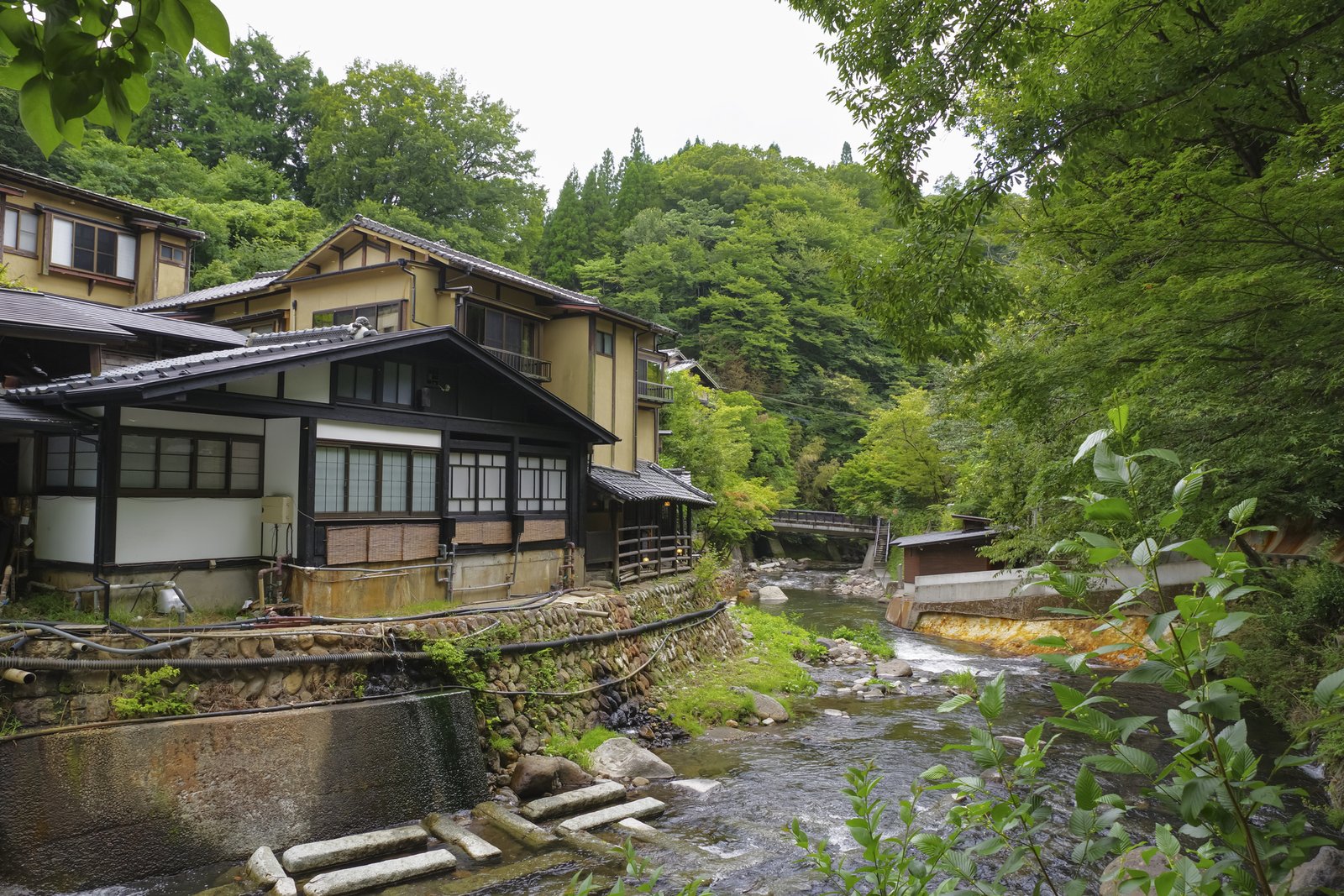
The Kurokawa Onsen Ryokan Association describes Kurokawa as a mountain onsen village in Minamioguni, Kumamoto Prefecture, at about 700 metres above sea level, where around 30 ryokan treat the whole village as one inn: the lanes are its corridors and each ryokan is a room (Kurokawa Onsen Ryokan Association, FAQ). Its wooden Onsen Hopping Pass lets one person bathe in three open-air baths chosen from 25 (Kurokawa Onsen Ryokan Association, Onsen Hopping Pass).
Who this is for: day visitors and overnight guests planning a round of ryokan baths, wondering how to reach the village without a car, and what to expect on the roads in winter.
The short version: buy one pass per person at Kazenoya or at a ryokan, get it stamped at each ryokan’s front desk, and use up to three baths, or two baths and one food, drink or souvenir item. Buses from Kumamoto run only a few times a day and must be booked by the day before. In winter the association says snow tyres or chains are essential.
Pass, bus or car
| If… | Then lean towards… | Check |
|---|---|---|
| You want to try several ryokan baths | The Onsen Hopping Pass, one per person and not shareable | Kurokawa Onsen Ryokan Association, Onsen Hopping Pass |
| You only want one bath | Paying at the front desk of that ryokan, at a price that differs from one ryokan to the next | Kurokawa Onsen Ryokan Association, FAQ |
| You are coming from Kumamoto without a car | The reserved express bus, which the association puts at about three hours from Kumamoto Station | Kurokawa Onsen Ryokan Association, access |
| You are driving between December and March | Snow tyres or chains, which the association calls essential | Kurokawa Onsen Ryokan Association, FAQ |
Prices, hours and departures
| Item | Price or time | Where to check |
|---|---|---|
| Onsen Hopping Pass price and validity | Check official | Kurokawa Onsen Ryokan Association, Onsen Hopping Pass |
| Bathing hours for pass holders | Check official | Kurokawa Onsen Ryokan Association, Onsen Hopping Pass |
| Each ryokan’s day-bathing hours today | Check official | Kurokawa Onsen Ryokan Association, FAQ |
| Kazenoya opening hours | Check official | Kurokawa Onsen Ryokan Association, FAQ |
| Bus departures from Kumamoto | Check official | Bus operator: departures from Kumamoto, PDF file, Japanese only |
| Bus fares | Check official | Bus operator: express bus times and fare table, Japanese only |
- Daily updates: the association says each ryokan’s day-bathing hours are updated every day and suggests checking around 9:00 on the morning of your visit.
- Cash: it says there is no ATM in the village and the nearest is about a 15-minute drive away.
- Before you go: book the bus by the day before and bring cash (Kurokawa Onsen Ryokan Association, FAQ).
What to do: decide on the morning which baths to aim for, once the day’s hours are posted. Where to verify: the association’s FAQ.
Getting there without a car
- From Kumamoto: the bus operator’s timetable lists three buses a day from Kumamoto Station through Kumamoto Airport and Aso Station to the Kurokawa Onsen stop, the same on weekdays, weekends and holidays, with the buses carrying on beyond the village (Bus operator: departures from Kumamoto, PDF file, Japanese only).
- Booking: the association says buses come in from three directions, Kumamoto and Hakata among them, only three times a day, and must be booked by the day before, and that the buses from Hakata are run by two other operators (Kurokawa Onsen Ryokan Association, FAQ).
- From the stop: it puts the walk from the bus stop to Kazenoya at about 10 minutes, roughly 600 metres, on a path that includes a hill.
- Taxis: it says taxis are very limited and none cruise the streets.
What to do: book your return bus when you book the outward one. Where to verify: the association’s FAQ.
How the pass works
The association’s pass page explains the routine (Kurokawa Onsen Ryokan Association, Onsen Hopping Pass). Show the pass at a ryokan’s front desk, where it is stamped with that ryokan’s own design, then go to the bath. The back carries three stickers: use all three for baths, or two red ones for baths and the green one for food, drink or a souvenir at shops in the village. Stickers left over can be used on a later visit within the validity period.
The association’s FAQ says the pass is cut from timber grown in Minamioguni and that three baths usually take two to three hours (Kurokawa Onsen Ryokan Association, FAQ). The pass page adds that photography is generally not allowed in the open-air baths, and that once used, the pass can be kept or offered at the Jizodo.
What to do: leave room in your day for the walk between baths. Where to verify: the association’s pass page.
1986: the signs, the trees and the pass
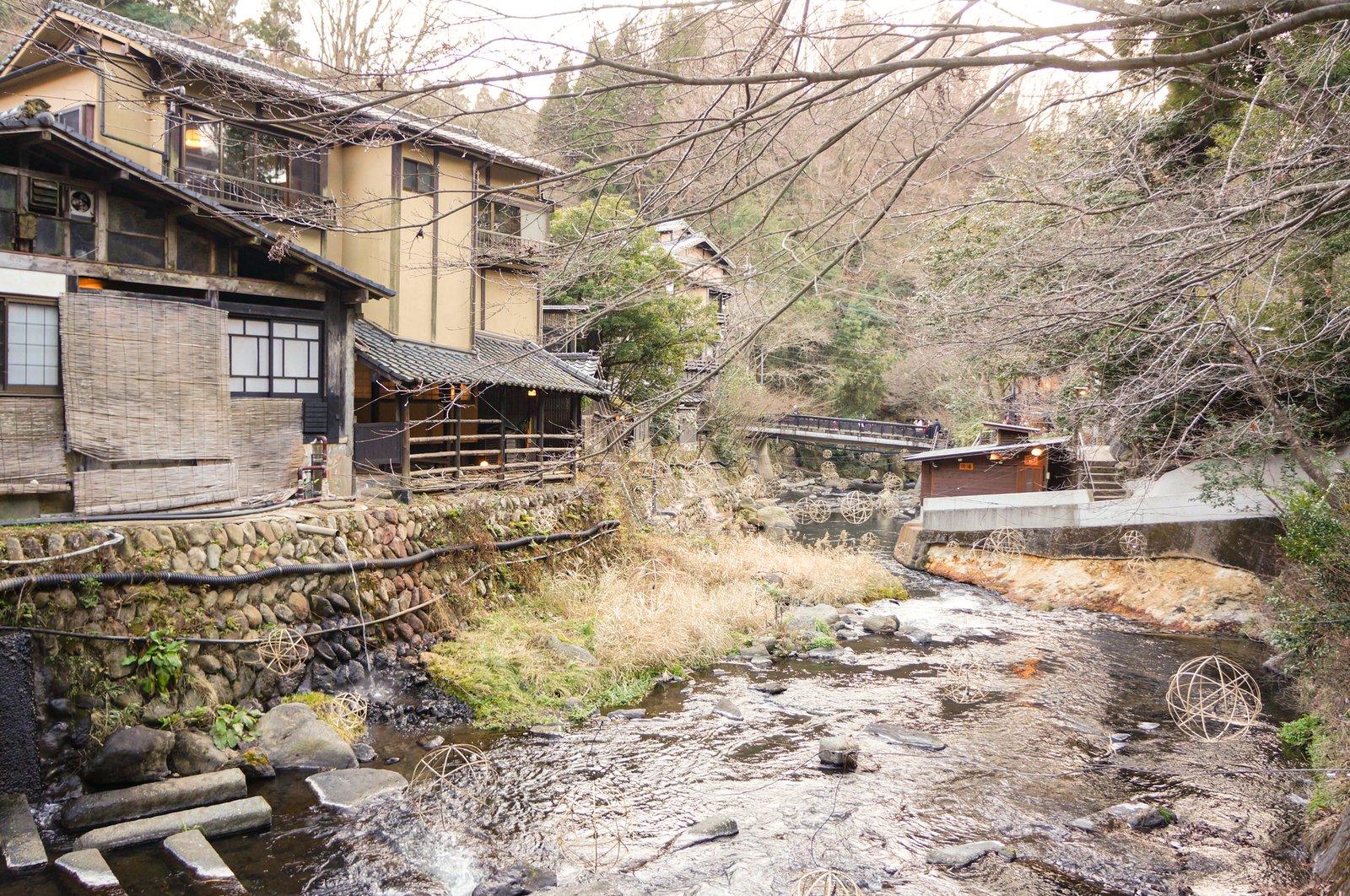
The association’s history page says Kurokawa was known as a place to take the waters by the mid-Edo years, and that its ryokan cooperative was founded by six inns in 1961 (Kurokawa Onsen Ryokan Association, about Kurokawa (in Japanese)). After a short-lived rise in visitors when the Yamanami Highway opened in 1964, the village struggled, and until 2000 its name did not even appear on a road map of Kumamoto Prefecture published by a local newspaper.
In 1986 the cooperative reorganised into three teams. The sign team took down all 200 mismatched signs and replaced them with shared signs of a single design; the landscape team pruned and planted to turn slopes of cedar into scenery; and the planning team, to help two inns whose sites left no room for an open-air bath, came up with a pass that opened every open-air bath in the village. A sheet from the Ministry of Land, Infrastructure, Transport and Tourism dates the first passes to 1986 and the shared signs to 1987 (MLIT, Kurokawa Onsen (PDF, in Japanese)).
What to do: notice the shared signs and the planted trees as you walk between baths. Where to verify: the association’s history page (in Japanese).
The headless Jizo
The association tells the legend behind the hot spring (Kurokawa Onsen Ryokan Association, about Kurokawa (in Japanese)). A poor young salt seller in Bungo, whose bedridden father longed for a melon, offered his salt to a local Jizo and then went to steal one. The landowner caught him and struck off his head, but the head that fell was the Jizo’s: the statue had taken his place. An ascetic of the Hosokawa domain set out to carry the head back to Higo, and as he passed through Kurokawa the Jizo asked to be enshrined there. A hall was built, and one day hot water began to well up from the ground (Kurokawa Onsen Ryokan Association, about Kurokawa (in Japanese)). Minamioguni Town says the head is still kept in the hall at the foot of Igo-zaka (Minamioguni Town, Jizodo (in Japanese)), and that the communal bath Jizo-yu stands where the water is said to have first risen (Minamioguni Town, Jizo-yu (in Japanese)).
What to do: if you offer your used pass at the Jizodo, you leave it with the statue in the legend. Where to verify: the town’s Jizodo page (in Japanese).
Official sources
| Topic | Source | Checked |
|---|---|---|
| Pass rules, stickers, stamps, photography | Kurokawa Onsen Ryokan Association, Onsen Hopping Pass | 2026-11-11 |
| Pass price and hours (Japanese page) | Kurokawa Onsen Ryokan Association, Onsen Hopping Pass (in Japanese) | 2026-11-11 |
| Village, buses, walk from the stop, winter roads, cash | Kurokawa Onsen Ryokan Association, FAQ | 2026-11-11 |
| Journey times from Kumamoto | Kurokawa Onsen Ryokan Association, access | 2026-11-11 |
| History and the legend | Kurokawa Onsen Ryokan Association, about Kurokawa | 2026-11-11 |
| Dates of the first passes and shared signs | MLIT, Kurokawa Onsen (PDF) | 2026-11-11 |
| Jizodo and Jizo-yu | Minamioguni Town, Jizodo; Minamioguni Town, Jizo-yu | 2026-11-11 |
| Bus stops and departures | Bus operator: departures from Kumamoto, PDF file, Japanese only; Bus operator: express bus times and fare table | 2026-11-11 |
What we have not verified
- Whether the village holds a national designation or lies in a national park: no database or Ministry of the Environment page we fetched names it, so we give none (Kurokawa Onsen Ryokan Association, about Kurokawa (in Japanese)).
- The bus fares and the timetable of the buses from Hakata, which we did not open (Bus operator: express bus times and fare table, Japanese only).
- How many ryokan take the pass: the pass page counts 25 open-air baths, while the FAQ speaks of about 24 participating ryokan (Kurokawa Onsen Ryokan Association, FAQ).
- Which ryokan baths are open on a given day, and the price of each single bath (Kurokawa Onsen Ryokan Association, FAQ).
- English names: we romanised or translated Bungo, Higo, the Hosokawa domain, Jizo-yu, the Ministry of Land, Infrastructure, Transport and Tourism and Minamioguni Town ourselves, and the bus company and its express bus appear only by role; the pass, Kazenoya, the Jizodo, Igo-zaka, the Yamanami Highway, the stations, Kumamoto Airport and the association follow the association’s English pages (Kurokawa Onsen Ryokan Association, Onsen Hopping Pass).