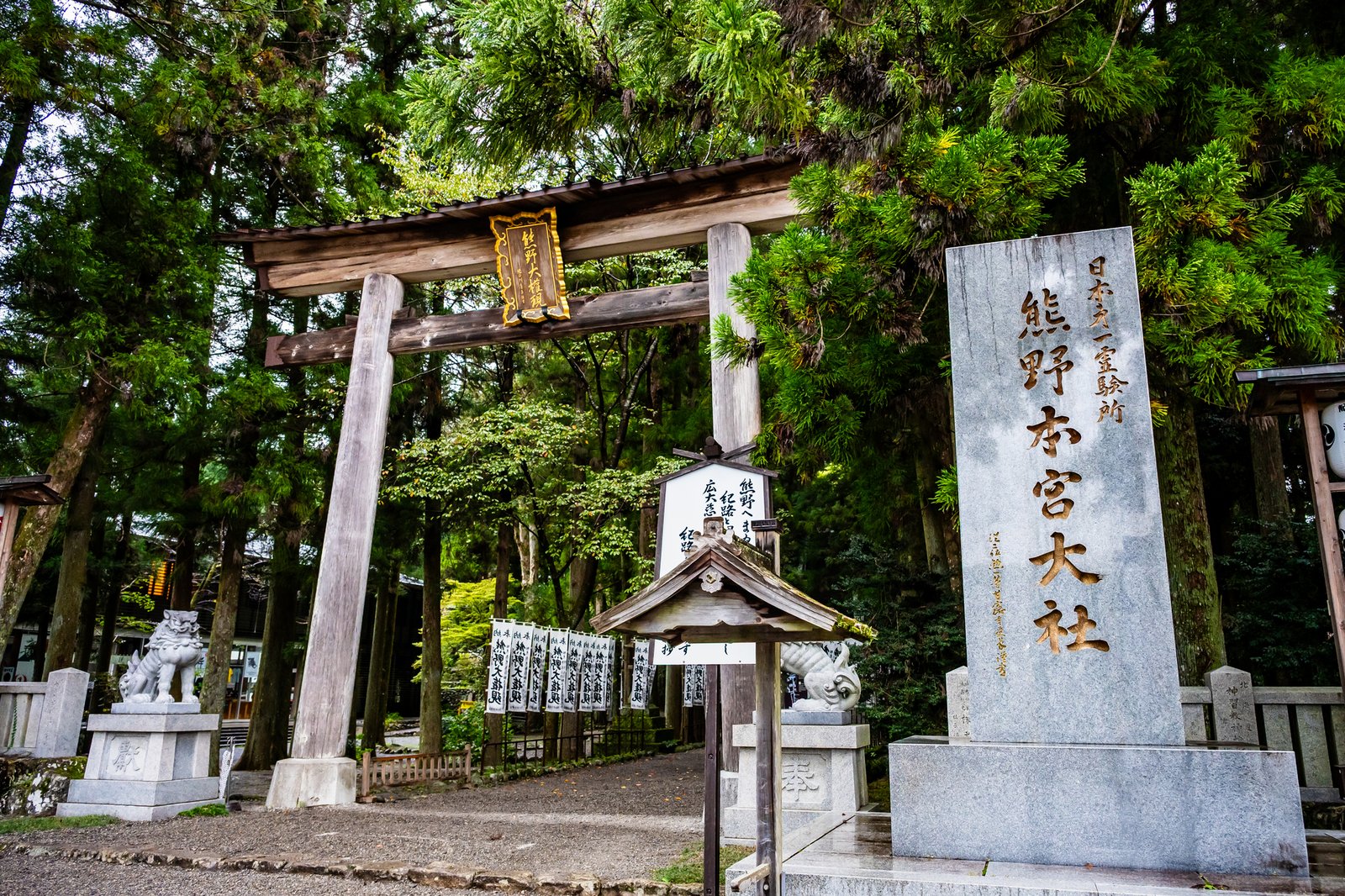
Place name in Japanese: 熊野本宮大社, Kumano Hongū Taisha.
Kumano Hongu Taisha: the bus to Hongu Taisha-mae, the old site at Oyunohara, and the flood that moved the shrine
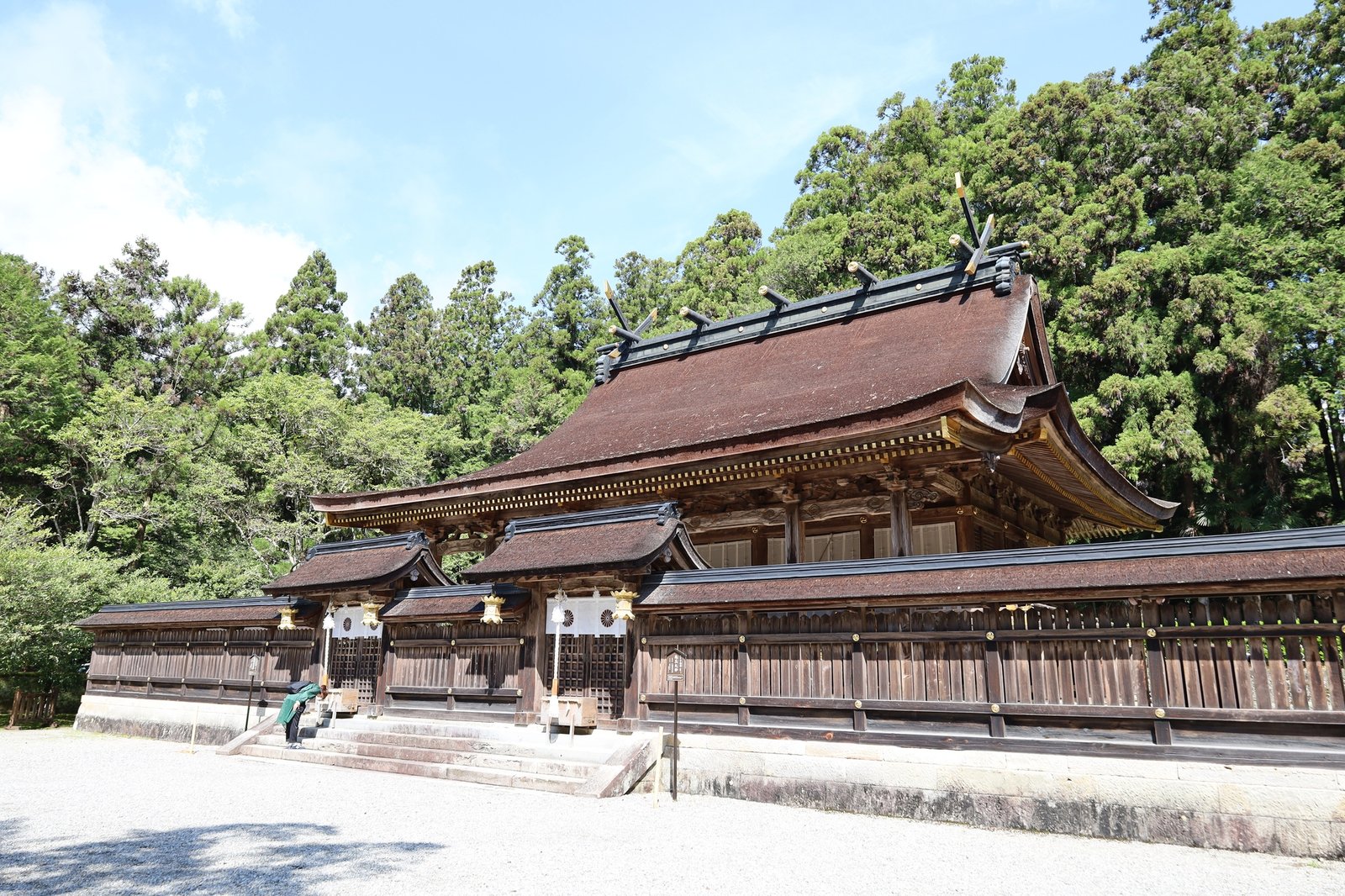
UNESCO’s list of component parts for Sacred Sites and Pilgrimage Routes in the Kii Mountain Range, a World Heritage property since 2004, places this shrine under Kumano Sanzan, as a part of 10.8 ha (UNESCO World Heritage Centre; UNESCO World Heritage Centre, maps). The national designated cultural properties database lists three of the shrine’s halls as Important Cultural Properties, all designated on 26 December 1995 (National designated cultural properties database, first and second halls (in Japanese)).
Who this is for: travellers reaching the shrine by bus from Kii-Tanabe Station who also want to see the former shrine site on the river.
The short version: the Kumano Hongu Line timetable lists buses from Kii-Tanabe Station to the Hongu Taisha-mae stop, with buses from two companies, Ryujin Bus and Meiko Bus. The database places the former shrine site, Oyunohara, about 0.5 km south-east of the present grounds. The shrine’s treasure hall opens only on some days, so check its page before you go.
Bus, shrine and the old site
| If… | Then lean towards… | Check |
|---|---|---|
| You come from Kii-Tanabe Station | The Kumano Hongu Line bus to Hongu Taisha-mae | Ryujin Bus, Kumano Hongu Line timetable (PDF) |
| You plan to use the bus company’s 4-day pass | Buses run by Ryujin Bus, because the pass does not cover Meiko Bus | Ryujin Bus, Kumano Hongu Line timetable (PDF) |
| You want to see where the shrine stood before 1889 | Oyunohara, about 0.5 km south-east of the present grounds | National designated cultural properties database, World Heritage component (in Japanese) |
| You want to see the treasure hall | Look up its opening days, hours and admission first | Kumano Hongu Taisha, treasure hall (in Japanese) |
Times, hours and fees
| Item | Time or fee | Where to check |
|---|---|---|
| Bus times between Kii-Tanabe Station and Hongu Taisha-mae | Check official | Ryujin Bus, Kumano Hongu Line timetable (PDF) |
| Bus fares, including the express fare | Check official | Ryujin Bus, Kumano Hongu Line timetable (PDF) |
| Runs that operate only part of the year | Check official | Ryujin Bus, Kumano Hongu Line timetable (PDF) |
| Treasure hall opening days and hours | Check official | Kumano Hongu Taisha, treasure hall (in Japanese) |
| Treasure hall admission | Check official | Kumano Hongu Taisha, treasure hall (in Japanese) |
- Two companies on one line: the timetable names the operating company for each run. It says the Ryujin Bus 4-day pass is not available on Meiko Bus.
- Express runs: the timetable marks some runs as the Kumano Kodo Express Bus, with no reservation required and an express fare.
- Before you go: check which company runs the bus you plan to take and whether it runs in your season, on the bus company’s timetable (Ryujin Bus, Kumano Hongu Line timetable (PDF)).
What to do: note the times back to Kii-Tanabe Station as well as the times out. Where to verify: the bus company’s timetable (PDF).
Getting there and how long it takes
- By bus from Kii-Tanabe Station: the timetable lists the Kumano Hongu Line from Kii-Tanabe Sta. through stops including Takijiri, Kurisugawa and Chikatsuyu-oji to Hongu Taisha-mae (Ryujin Bus, Kumano Hongu Line timetable (PDF)).
- Hot spring stops on the same line: the timetable also lists Yunomine Onsen, Watarase Onsen and Kawayu Onsen among its stops (Ryujin Bus, Kumano Hongu Line timetable (PDF)).
- Seasons: the timetable marks some runs as operating from April to November and others from December to March (Ryujin Bus, Kumano Hongu Line timetable (PDF)).
What to do: look up the journey time for the run you choose on the timetable, as times differ between runs. Where to verify: the bus company’s timetable (PDF).
What to see
The three halls the database lists stand in one row. Their database entries give the first and second halls as a single building with a hipped-and-gabled roof, dated 1801 to 1802; the third hall, also 1801 to 1802; and the fourth hall, 1810; all are roofed with cypress bark (first and second halls (in Japanese); third hall (in Japanese); fourth hall (in Japanese)). The database’s World Heritage entry says the row places one building for the main deities of Kumano Nachi Taisha and Kumano Hayatama Taisha, one for the shrine’s own main deity, and one for the young deity, side by side from east to west in a single row, a form that an 11th-century pilgrim’s diary and a painting of 1299 confirm (National designated cultural properties database, World Heritage component (in Japanese)).
The same entry describes the former site at Oyunohara, on a sandbank in the Kumano River about 0.5 km south-east of the present grounds, where a 19th-century platform of cut stone remains, and says the forest around it once held Buddhist buildings such as a pagoda. Across the river to the south, at a site of sutra mounds, excavations in 2001 and 2002 found many mounds spread over about 7 ha, among rock outcrops several metres high. The database’s entry for the pilgrimage routes adds that a road ran from Hongu to Yunomine, where pilgrims bathed to rest (National designated cultural properties database, Kumano pilgrimage routes (in Japanese)).
The shrine holds its annual festival from 13 to 15 April, and on the 15th its deities are carried to Oyunohara, once a year (Kumano Hongu Taisha, the shrine in five minutes (in Japanese)).
What to do: after the main halls, walk to Oyunohara to see the stone platform. Where to verify: the database entry (in Japanese).
The flood of 1889 and the move of 1891
The database’s World Heritage entry says the shrine stood on a sandbank of the Kumano River from its founding, until the river flooded in 1889 (National designated cultural properties database, World Heritage component (in Japanese)). Three main buildings escaped being washed away, and in 1891 they were moved to the present site and rebuilt; most of their timber still dates from the rebuilding of 1801 to 1807, before the flood. The shrine says that before the flood it also had a noh stage, among other buildings, and was eight times its present size, that the upper four shrines were moved in 1891, and that the deities of the middle four and lower four shrines and of the smaller shrines in the grounds are now enshrined at Oyunohara (Kumano Hongu Taisha, the shrine in five minutes (in Japanese)). It adds that in September 2011 a flood on the Kii Peninsula again caused heavy damage at Oyunohara and elsewhere, and that rebuilding followed. The treasure hall keeps a painting, said to date from the middle to late Edo period, that shows the shrine buildings at Oyunohara before they were lost in 1889; the shrine says the area around a smaller shrine drawn at its upper left is today’s grounds (Kumano Hongu Taisha, treasure hall (in Japanese)).
What to do: stand at Oyunohara and look back towards the present grounds, about 0.5 km away. Where to verify: the database entry (in Japanese).
The crow with three legs
The shrine says a three-legged crow, Yatagarasu, can be seen all around its grounds, and that the bird is also known as the symbol of Japan’s football association (Kumano Hongu Taisha, the shrine in five minutes (in Japanese)). It explains that Yatagarasu appears in the Nihon Shoki and the Kojiki, in the story of the journey east that ends with the first emperor taking the throne: when he reached Kumano, Yatagarasu, a messenger of the gods, guided him to Nara (Kumano Hongu Taisha, the shrine in five minutes (in Japanese)). For that reason, the shrine says, the bird is worshipped across all three Kumano shrines as a sacred guide (Kumano Hongu Taisha, the shrine in five minutes (in Japanese)).
What to do: as you walk through the grounds, watch for the three-legged crow. Where to verify: the shrine’s page (in Japanese).
Official sources
| Topic | Source | Checked |
|---|---|---|
| World Heritage inscription | UNESCO World Heritage Centre | 2026-11-11 |
| Component parts | UNESCO World Heritage Centre, maps | 2026-11-11 |
| First and second halls, Important Cultural Property | National designated cultural properties database, first and second halls | 2026-11-11 |
| Third hall | National designated cultural properties database, third hall | 2026-11-11 |
| Fourth hall | National designated cultural properties database, fourth hall | 2026-11-11 |
| Flood and move, Oyunohara, sutra mounds | National designated cultural properties database, World Heritage component | 2026-11-11 |
| Road to Yunomine | National designated cultural properties database, Kumano pilgrimage routes | 2026-11-11 |
| Shrine history, festival, Yatagarasu | Kumano Hongu Taisha, the shrine in five minutes | 2026-11-11 |
| Treasure hall, painting | Kumano Hongu Taisha, treasure hall | 2026-11-11 |
| Bus line, stops, operators, pass | Ryujin Bus, Kumano Hongu Line timetable | 2026-11-11 |
What we have not verified
- The shrine’s own visiting hours, because none of the shrine pages we fetched, on the treasure hall and on the shrine’s history, gives them (Kumano Hongu Taisha, treasure hall (in Japanese)).
- Routes to the shrine other than the Kumano Hongu Line from Kii-Tanabe Station, and the walking time from the Hongu Taisha-mae stop to the main halls and to Oyunohara (Ryujin Bus, Kumano Hongu Line timetable (PDF)).
- The English spelling of the shrine’s name, which UNESCO writes with a circumflex as Hongû while the bus company writes Hongu Taisha, and the spelling Oyunohara, which is our own romanisation from the shrine’s Japanese reading (UNESCO World Heritage Centre, maps).