Place name in Japanese: 清水寺, Kiyomizu-dera.
Kiyomizu-dera, Kyoto: the bus stops and station the temple lists, opening hours, and the main hall on the cliff
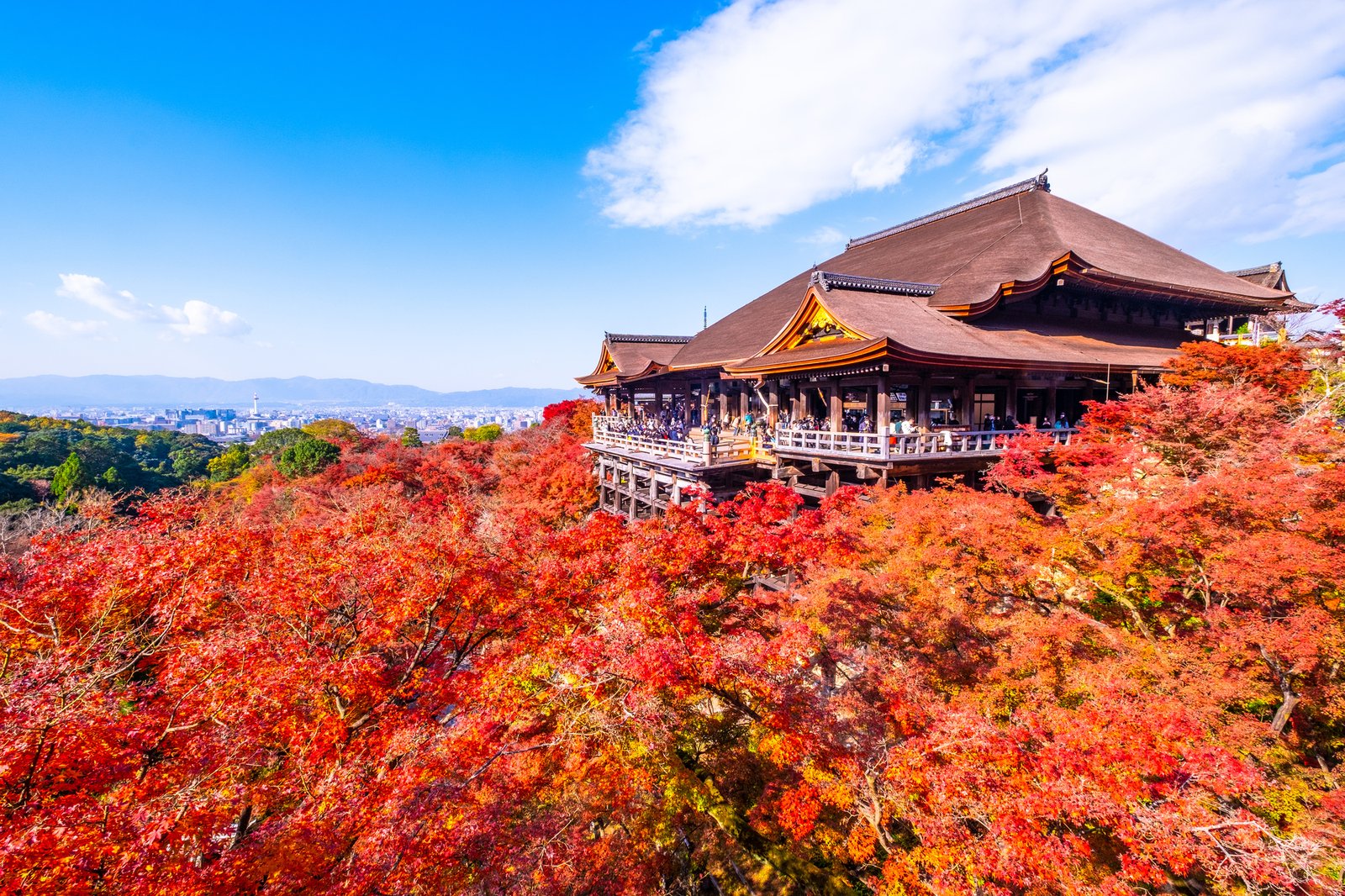
Kiyomizu-dera belongs to the World Heritage property Historic Monuments of Ancient Kyoto (Kyoto, Uji and Otsu Cities), inscribed in 1994 (UNESCO World Heritage Centre); the Agency for Cultural Affairs lists the temple among its component parts (Agency for Cultural Affairs, World Heritage (in Japanese)). The main hall, completed in 1633, is a National Treasure: the national designated cultural properties database gives its designation as an Important Cultural Property on 28 December 1897 and as a National Treasure on 22 November 1952 (National designated cultural properties database (in Japanese)).
Who this is for: travellers in Kyoto who want to know which bus or train gets them to the temple and when it opens and closes.
The short version: from JR Kyoto Station, take city bus route 206 to the Gojozaka stop and walk about 10 minutes east. The temple opens at 6:00 and closes at 18:00, or 18:30 in July and August, with later closing during its night viewings.
Bus or train
| If… | Then lean towards… | Check |
|---|---|---|
| You are at JR Kyoto Station | City bus route 206 to the Gojozaka stop, then about 10 minutes east on foot | Temple, location; Kyoto Municipal Transportation Bureau, Gojozaka stop |
| You start from the Hankyu and Keihan stations the temple lists for route 207 | City bus route 207 to the Kiyomizu-michi stop, then about 10 minutes south-east on foot | Temple, location; Kyoto Municipal Transportation Bureau, Kiyomizu-michi stop |
| You would rather walk from a train | Keihan station KH38, about 25 minutes on foot | Temple, location; Keihan, station KH38 (in Japanese) |
Times, hours and fees
| Item | Time or fee | Where to check |
|---|---|---|
| Opening | 6:00 | Temple, opening hours (in Japanese) |
| Closing, most of the year | 18:00 | Temple, opening hours (in Japanese) |
| Closing, July and August | 18:30 | Temple, opening hours (in Japanese) |
| Special night viewings in spring, summer and autumn | Open until 21:30, last entry 21:00; no reservation needed | Temple, special night viewing (in Japanese) |
| Amulets and temple stamps | From about 8:00 | Temple, opening hours (in Japanese) |
| Admission fee | Check official | Temple, FAQ |
| Walk from the Gojozaka or Kiyomizu-michi stop | About 10 minutes | Temple, location |
| Walk from Keihan station KH38 | About 25 minutes | Temple, location |
| Bus fares and timetables | Check official | Kyoto Municipal Transportation Bureau, Gojozaka stop |
- Two ways in: the temple says there are only two routes to its grounds, one from the Nio-mon Gate at the top of the Kiyomizu-zaka hill and one from the emergency road entrance at the top of the Chawan-zaka hill, and warns that some online mapping apps may show a route that does not lead to the grounds.
- No parking: the temple has no parking lot on its grounds and strongly recommends public transport or a taxi, since nearby parking tends to be jammed in busy seasons.
- Free admission: the FAQ says a visitor with a disability and one companion may enter free on showing a disability handbook, pass or card at the gate, and that representatives of educational institutions on official events enter free with an ID card; there is no group discount.
- Before you go: check the temple’s and the bus operator’s official pages for closing times, night viewing dates, fees and timetables, which can change (Temple, opening hours (in Japanese); Kyoto Municipal Transportation Bureau, Gojozaka stop).
What to do: set your map to the Nio-mon Gate rather than the temple’s address. Where to verify: the temple’s location page.
Getting there and how long it takes
- By bus from JR Kyoto Station: the temple gives city bus route 206 to the Gojozaka stop and a walk of 10 minutes east (Temple, location). The bus operator’s page for the Gojozaka stop lists route 206 among the routes that call there (Kyoto Municipal Transportation Bureau, Gojozaka stop). On Saturdays and holidays the temple also lists a Kyoto Bus route to the same stop.
- By bus from central Kyoto: the temple gives city bus route 207 to the Kiyomizu-michi stop and a walk of 10 minutes south-east, and Keihan Bus routes to the Kiyomizu-michi or Gojozaka stop. The operator’s page for the Kiyomizu-michi stop lists route 207 towards Tofukuji Temple via Kiyomizu-dera Temple (Kyoto Municipal Transportation Bureau, Kiyomizu-michi stop).
- By train and on foot: the temple gives approximately 25 minutes on foot from the Keihan station that Keihan numbers KH38 (Keihan, station KH38 (in Japanese)).
What to do: at the bus stop, check the route number and the destination on the front of the bus before you board. Where to verify: the bus operator’s page for the Gojozaka stop.
What to see
The Agency for Cultural Affairs’ World Heritage page for the temple tells how it came to look as it does today (Agency for Cultural Affairs, World Heritage (in Japanese)). It says the temple was founded in 780 as a private temple and became a temple of imperial prayer in 805, when its land was granted. It burned nine times after its founding and was rebuilt each time; apart from a horse stable and the Nio-mon Gate from the late 15th century and a bell tower from 1607, which escaped the fire of 1629, the buildings were rebuilt in the 1630s. The page adds that the layout seen today, with the halls lined up from west to east, was already in place by the end of the 15th century.
The database entry for the main hall explains its form (National designated cultural properties database (in Japanese)). The present hall was completed in 1633 after a fire in 1629. Because it stands on a steep cliff, the floor at the front is high and rests on long posts, and the front of the hall opens onto a wide stage. Inside, the inner sanctuary has a stone floor and the outer hall a wooden one. The temple’s own guide says the hall stands on the steep cliff of Mt. Otowa and was built solidly enough to support the stage (Temple, visit).
What to do: after the stage of the main hall, walk on to Okuno-in Hall, which the temple says has its own stage and a view of the main hall stage and the city. Where to verify: the temple’s visit page.
The three streams of Otowa Waterfall
The temple’s guide says Kiyomizu-dera originates from Otowa Waterfall and takes its name from the pureness of its waters (Temple, visit). The water has long been called “Konjiki-sui” (golden water) or “Enmei-sui” (life-prolonging water). Visitors catch each of the three streams with ladles and pray for the purification of their six senses and for their wishes to come true.
What to do: find Otowa Waterfall below Okuno-in Hall, which the temple says stands directly above it. Where to verify: the temple’s visit page.
Official sources
| Topic | Source | Checked |
|---|---|---|
| World Heritage property and inscription | UNESCO World Heritage Centre | 2026-11-11 |
| The temple as a component part, history and rebuilding | Agency for Cultural Affairs, World Heritage | 2026-11-11 |
| Main hall, National Treasure, construction | National designated cultural properties database | 2026-11-11 |
| Opening and closing times | Temple, opening hours | 2026-11-11 |
| Night viewings | Temple, special night viewing | 2026-11-11 |
| Routes, stops, walking times, parking | Temple, location | 2026-11-11 |
| Free admission | Temple, FAQ | 2026-11-11 |
| Main hall, Okuno-in Hall, Otowa Waterfall | Temple, visit | 2026-11-11 |
| Gojozaka stop | Kyoto Municipal Transportation Bureau, Gojozaka stop | 2026-11-11 |
| Kiyomizu-michi stop | Kyoto Municipal Transportation Bureau, Kiyomizu-michi stop | 2026-11-11 |
| Station KH38 | Keihan, station KH38 | 2026-11-11 |
What we have not verified
- The admission fee, which the temple pages linked here do not print (Temple, FAQ).
- Bus fares, bus journey times and timetables (Kyoto Municipal Transportation Bureau, Gojozaka stop).
- The dates of the night viewings in the year of your visit (Temple, special night viewing (in Japanese)).
- A second city bus route from JR Kyoto Station that the temple numbers differently from the bus operator’s stop page (Temple, location).