Place name in Japanese: 錦帯橋, Kintaikyō.
Kintaikyo, Iwakuni: the buses the city lists, crossing after the toll booth closes, and how the bridge was built
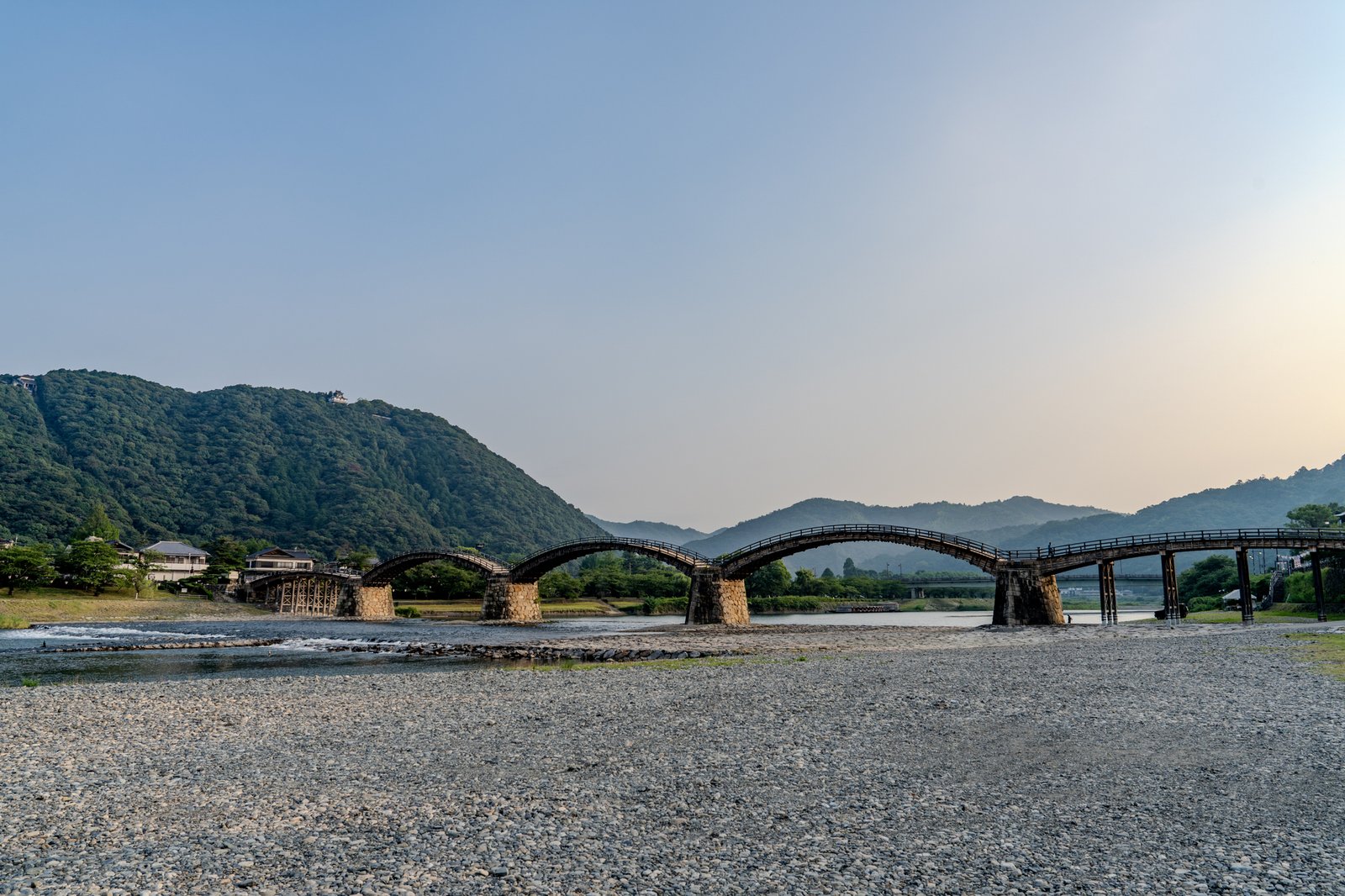
Kintaikyo is a wooden bridge of five arches in Iwakuni, Yamaguchi Prefecture. The national designated cultural properties database lists it as a Place of Scenic Beauty, designated on 8 March 1922, with an area added on 24 August 1943 (National designated cultural properties database (in Japanese)).
Who this is for: travellers heading to Iwakuni who want to know which bus to take to the bridge and how paying to cross works.
The short version: from the JR station in central Iwakuni, the city lists a bus from stand 1 outside the west exit that takes about 20 minutes and runs about every 10 to 15 minutes; from the Shinkansen station, a bus takes about 15 minutes. Tickets are sold as returns only, and outside the toll booth’s hours you can still cross by putting the fee in the night fee box.
Which station, and which ticket
| If… | Then lean towards… | Check |
|---|---|---|
| You arrive at the JR station in central Iwakuni | The bus from stand 1 outside the west exit, about 20 minutes | Iwakuni City tourism division, FAQ (in Japanese); Iwakuni City, public transport map and timetables (in Japanese) |
| You arrive by Shinkansen | The bus from the station’s bus stop, about 15 minutes, or a taxi, about 10 minutes | Iwakuni City tourism division, FAQ (in Japanese) |
| You also want the ropeway and the castle | The set ticket for the bridge, a return on the ropeway and the castle, which the city says takes about 1 hour 30 minutes to 2 hours; choose it at the start, as a bridge ticket cannot be changed to a set ticket later | Iwakuni City, Kintaikyo overview (in Japanese); Iwakuni City, bridge tickets (in Japanese) |
| You arrive when the toll booth is closed | Cross anyway and put the fee in the night fee box | Iwakuni City, crossing hours (in Japanese) |
Times, hours and fees
| Item | Time or fee | Where to check |
|---|---|---|
| Toll booth hours | Check official | Iwakuni City, crossing hours (in Japanese) |
| Bridge ticket and set ticket | Check official | Iwakuni City, bridge tickets (in Japanese) |
| Bus from the JR station in central Iwakuni | About 20 minutes, about every 10 to 15 minutes | Iwakuni City tourism division, FAQ (in Japanese) |
| Bus from the Shinkansen station | About 15 minutes | Iwakuni City tourism division, FAQ (in Japanese) |
| Walk from the bus centre by the bridge | About 1 minute | Iwakuni City, Kintaikyo overview (in Japanese) |
| Bus fares and timetables | Check official | Iwakuni City, public transport map and timetables (in Japanese) |
- Return tickets only: the city says there is no one-way fee, no reservation is needed, and preschool children cross free (Iwakuni City, bridge tickets (in Japanese)).
- Either end: the city’s overview says you can start from either the town side or the mountain side without booking.
- Weather: the city says crossing may be stopped in storms or when the river is high, and that the bridge is slippery in rain and snow.
- On the bridge: the overview warns that there are steps, asks visitors not to eat or drink on the bridge, and bans bringing or using fire.
- Before you go: check the city’s pages for the toll booth hours, the ticket prices and the bus timetables, which can change (Iwakuni City, crossing hours (in Japanese); Iwakuni City, bridge tickets (in Japanese); Iwakuni City, public transport map and timetables (in Japanese)).
What to do: keep your ticket for the walk back, as it covers both ways. Where to verify: the city’s ticket page (in Japanese).
Getting there and how long it takes
- From the JR station in central Iwakuni: the city’s tourism division says to go through the ticket gates, leave by the west exit and take a bus bound for the bridge from stand 1 straight ahead; the ride takes about 20 minutes, buses run about every 10 to 15 minutes, and a taxi takes about 15 minutes (Iwakuni City tourism division, FAQ (in Japanese)).
- From the Shinkansen station: the same page gives about 15 minutes by bus from the bus stop in front of the station and about 10 minutes by taxi.
- Timetables: the city’s public transport page publishes a map and timetable booklet and links to the bus operator for the latest information (Iwakuni City, public transport map and timetables (in Japanese)).
What to do: look up the return bus before you set off from the bridge. Where to verify: the city’s public transport page (in Japanese).
What to see
The city’s history pages tell how the bridge came to be (Iwakuni City, history chapter 2 (in Japanese)). The river at the castle town is about 200 m wide and its current turns fast, and earlier bridges were washed away. Kikkawa Hiroyoshi, the third lord of Iwakuni, studied arch bridges but could not see how to span that width in one arch. In 1664 Dokuryu, a monk from Ming China who had settled in Japan and was known as a fine doctor, came to Iwakuni to treat him and spoke of West Lake in his home city of Hangzhou. Hiroyoshi asked to see the monk’s book on the lake, and a courier brought it from Nagasaki. When he opened it, he is said to have struck the desk with delight: it showed small arch bridges joining five little islands. The idea came to him to build islands in the river and set arches on them.
The next chapter says sturdy piers like those islands were built, and the bridge was finished in 1673 (Iwakuni City, history chapter 3 (in Japanese)). A flood took it the following year; it was rebuilt within the year, and the stone paving under it was later strengthened. The city’s overview says the bridge then stood for 276 years, being rebuilt again and again, until a typhoon flood in September 1950. There were calls to rebuild it in reinforced concrete, but at the strong request of residents it was rebuilt in wood in 1953, and the worn timber was replaced again in a project completed in March 2004 (Iwakuni City, Kintaikyo overview (in Japanese)).
What to do: from the bank, count the five curved wooden spans and the four stone piers that the 1922 designation text describes. Where to verify: the city’s page on the name and the designation (in Japanese).
Where the name may come from
The city says the bridge had no name of Kintaikyo when it was built (Iwakuni City, the name (in Japanese)). It was mostly called the big bridge, and Hiroyoshi is said to have written Iwakuni Ohashi when the shogunate asked for its name. The name Kintaikyo first appears in a text of 1706 by an Iwakuni Confucian scholar, which links it to the nearby village of Nishimi. Another theory points to a Chinese arched causeway whose scenery was called a brocade sash, and the city says no one yet knows which account is right.
What to do: before you cross, read the other names the city lists for the bridge, among them the abacus bridge. Where to verify: the city’s page on the name (in Japanese).
Official sources
| Topic | Source | Checked |
|---|---|---|
| Place of Scenic Beauty, designation dates | National designated cultural properties database | 2026-11-11 |
| Ticket types and rules | Iwakuni City, bridge tickets | 2026-11-11 |
| Toll booth hours, night fee box, weather closures | Iwakuni City, crossing hours | 2026-11-11 |
| Overview, rebuilding, set ticket, rules on the bridge, walk from the bus centre | Iwakuni City, Kintaikyo overview | 2026-11-11 |
| Buses and taxis from the stations | Iwakuni City tourism division, FAQ | 2026-11-11 |
| Timetables | Iwakuni City, public transport map and timetables | 2026-11-11 |
| West Lake book, earlier bridges | Iwakuni City, history chapter 2 | 2026-11-11 |
| Completion, flood and rebuilding | Iwakuni City, history chapter 3 | 2026-11-11 |
| The name, 1922 designation text | Iwakuni City, the name | 2026-11-11 |
What we have not verified
- The closing time of the toll booth in the season of your visit, which the city’s hours page and its tourism FAQ describe by different seasons (Iwakuni City, crossing hours (in Japanese)).
- Bus fares, timetables and which operator runs a given bus (Iwakuni City, public transport map and timetables (in Japanese)).
- The English names that the stations and the bus stop by the bridge use (Iwakuni City tourism division, FAQ (in Japanese)).