Place name in Japanese: 城崎温泉, Kinosaki Onsen.
Kinosaki Onsen: the public bathhouses, the bath pass, the ropeway to Onsenji and the town rebuilt after 1925
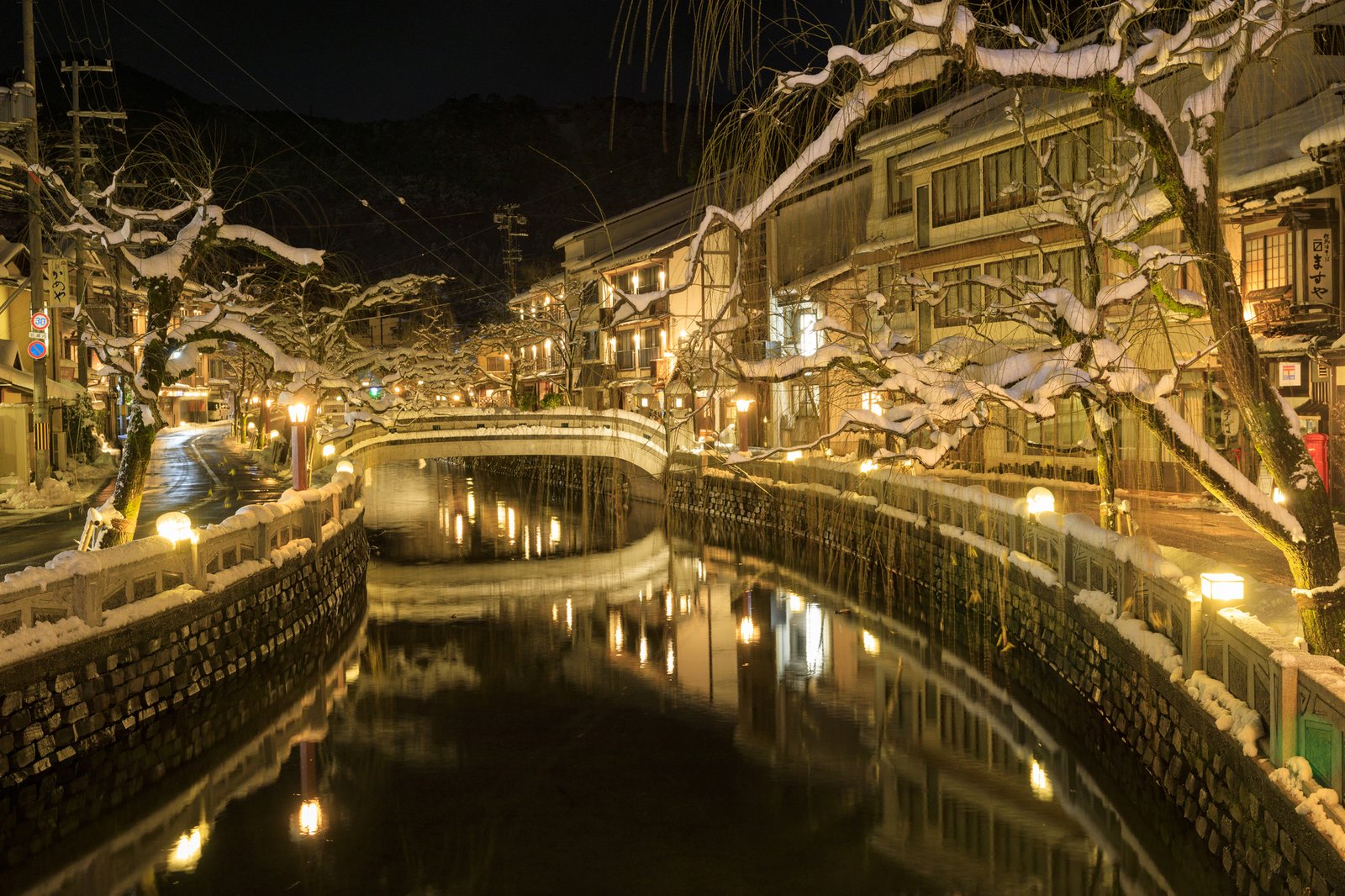
Toyooka’s official tourism site says Kinosaki Onsen has seven public bathhouses, known as soto-yu, spread through the town, and that one of them, Satono-Yu, is closed (Toyooka official tourism site, Kinosaki’s public baths (in Japanese)). Onsenji, the temple on the hill above the town, dates the hot spring to 720, when the monk Dochi opened it, and its own founding to 738 (Onsenji, history (in Japanese)).
Who this is for: travellers staying in Kinosaki or coming for the day who want to know how the bath pass works, which bathhouse is which, and how to fit in the ropeway and the temple.
The short version: you can pay at each bathhouse, buy a one-day pass, or use the pass most inns give their guests. The bathhouses differ in their opening hours and closing days, and Satono-Yu is closed. The ropeway climbs from the edge of town, stopping at Onsenji on the way to the summit.
Pass, ropeway and train
| If… | Then lean towards… | Check |
|---|---|---|
| You come for the day and plan several baths | The one-day pass, valid at every bathhouse open that day | Toyooka official tourism site, Kinosaki’s public baths (in Japanese) |
| You are staying at an inn | The bath pass the inn gives you, valid from check-in until 13:00 the next day, except at some inns | Toyooka official tourism site, Kinosaki’s public baths (in Japanese) |
| You want the temple and a view over the town | The ropeway, which stops at Onsenji on both the way up and the way down | Ropeway operator, questions and answers (in Japanese) |
| You arrive by train | Kinosaki Onsen Station, a walk of about 20 minutes from the ropeway | Ropeway operator, questions and answers (in Japanese) |
Times, fees and closing days
| Item | Time or fee | Where to check |
|---|---|---|
| Bathhouse hours and closing days | Check official | Kinosaki Onsen Tourism Association, public baths (in Japanese) |
| Single bath and one-day pass | Check official | Toyooka City, public bath fees (in Japanese) |
| Ropeway departures and closing days | Check official | Ropeway operator, ropeway guide (in Japanese) |
| Ropeway fares | Check official | Ropeway operator, ropeway guide (in Japanese) |
| Train departures from Kinosaki Onsen Station | Check official | JR-West, Kinosaki Onsen Station timetable (in Japanese) |
- Last entry: the tourism association gives the last admission at each bathhouse as 30 minutes before closing.
- Opening times: it lists four bathhouses that open in the morning and two, Mandara-Yu and Yanagi-Yu, that open in the afternoon, each with a weekly closing day.
- Before you go: compare the closing days on the association’s list with the day you plan to visit (Kinosaki Onsen Tourism Association, public baths (in Japanese)).
What to do: plan your route between bathhouses around the ones closed that day. Where to verify: the association’s list (in Japanese).
Getting there and up the hill
- By train: JR-West’s timetable for Kinosaki Onsen Station lists limited expresses towards Shin-Osaka, Kyoto and Osaka, and marks every one of them as reserved seats only (JR-West, Kinosaki Onsen Station timetable (in Japanese)).
- To the ropeway: the ropeway operator puts its boarding station a walk of about 20 minutes away from the railway (Ropeway operator, questions and answers (in Japanese)).
- The ride: it takes about seven minutes to the summit including the stop at Onsenji, and three minutes to Onsenji.
- On foot: the operator says the temple path from the foot of the hill has about 500 steps, and that it does not currently recommend walking it because bears may appear.
What to do: buy a ticket that lets you get off at Onsenji. Where to verify: the operator’s questions and answers (in Japanese).
What to see: the bathhouses and their names
The tourism association tells where each bathhouse’s name comes from (Kinosaki Onsen Tourism Association, public baths (in Japanese)). Kono-Yu keeps a second founding legend: a stork with an injured leg was seen healing it where hot water was welling up. Mandara-Yu takes its name from the sutra Dochi chanted for a thousand days before the spring rose, and its building has long had a curved Chinese-style gable. Goshono-Yu is named for a passage in the historical tale Masukagami saying that Ankamon-in, elder sister of Emperor Go-Horikawa, bathed here in 1267. Yanagi-Yu is said to have risen from beneath a willow brought from West Lake in China, and Jizo-Yu from a spring in which a statue of Jizo was found.
Toyooka’s tourism site adds that a local ordinance limits the size of baths inside the inns, to keep the public bathhouses going and to protect the hot spring, so the inns send their guests out into the town to bathe (Toyooka official tourism site, Kinosaki’s public baths (in Japanese)).
At its middle station, Onsenji, the ropeway operator lists the temple’s main hall, a pagoda and the temple museum (Ropeway operator, ropeway guide (in Japanese)).
What to do: read the name of each bathhouse before you go in. Where to verify: the association’s list (in Japanese).
Rebuilding the town around its baths after 1925
Toyooka’s tourism site tells how the town recovered from the North Tajima earthquake of 1925, a quake of more than magnitude 6 that, with the fires that followed, devastated the town (Toyooka official tourism site, Kinosaki’s public baths (in Japanese)). The mayor of the time, Nishimura Sahei, checked that the hot spring sources were unharmed and told the stunned townspeople that Kinosaki would be all right and would grow for as long as the water kept welling up.
Restoring the public baths came first. Between 1926 and 1932 all six were built anew, the land was readjusted, and inns, shops and streets were rebuilt around the baths; by 1935, the site says, the framework of today’s town was largely in place. Ichino-Yu was one of the baths rebuilt in reinforced concrete, to stop fire from spreading, and the present building, put up in 1999, follows the look of that rebuilt bath.
What to do: look at Ichino-Yu’s front as a building shaped by the fire of 1925. Where to verify: the tourism site’s page (in Japanese).
How Arayu became Ichino-Yu
The tourism association says that when Ichino-Yu was built in the middle of the Edo period it was called Arayu, the new bath (Kinosaki Onsen Tourism Association, public baths (in Japanese)). What made it famous was a book of medicines by the Edo-period physician Kagawa Shutoku, in which he wrote that Kinosaki’s Arayu was the first under heaven. Praised in those words, the bath was renamed Ichino-Yu, the first bath, and the association notes that the ichi in its name is the ichi of that phrase.
What to do: at Ichino-Yu, remember the physician’s verdict in its name. Where to verify: the association’s list (in Japanese).
Official sources
| Topic | Source | Checked |
|---|---|---|
| Seven bathhouses, passes, ordinance, 1925 rebuilding | Toyooka official tourism site, Kinosaki’s public baths | 2026-11-11 |
| Bathhouse names, hours, Ichino-Yu’s old name | Kinosaki Onsen Tourism Association, public baths | 2026-11-11 |
| Bath fees | Toyooka City, public bath fees | 2026-11-11 |
| Founding of the spring and the temple | Onsenji, history | 2026-11-11 |
| Ropeway stations, departures, fares | Ropeway operator, ropeway guide | 2026-11-11 |
| Walk from the station, ride times, temple path | Ropeway operator, questions and answers | 2026-11-11 |
| Trains | JR-West, Kinosaki Onsen Station timetable | 2026-11-11 |
| English names of the bathhouses and station | Visit Kinosaki, FAQ | 2026-11-11 |
What we have not verified
- Any national designation for the temple’s statues or buildings; the database page we opened was for a different statue, so we give none (Ropeway operator, questions and answers (in Japanese)).
- Seasonal changes to the ropeway’s last departures (Ropeway operator, ropeway guide (in Japanese)).
- English names: Onsenji, Dochi, Arayu, Kagawa Shutoku, Nishimura Sahei, Ankamon-in, Emperor Go-Horikawa, Masukagami, the North Tajima earthquake, the Kinosaki Onsen Tourism Association, JR-West and the stations Shin-Osaka, Kyoto and Osaka are our own romanisations or translations from Japanese, and we name the ropeway company by its role; the bathhouses and the station follow Visit Kinosaki (Visit Kinosaki, FAQ).