Kinkaku-ji, Kyoto: the city buses to Kinkakuji-michi, the 1950 fire and rebuilding, and the pavilion’s three storeys
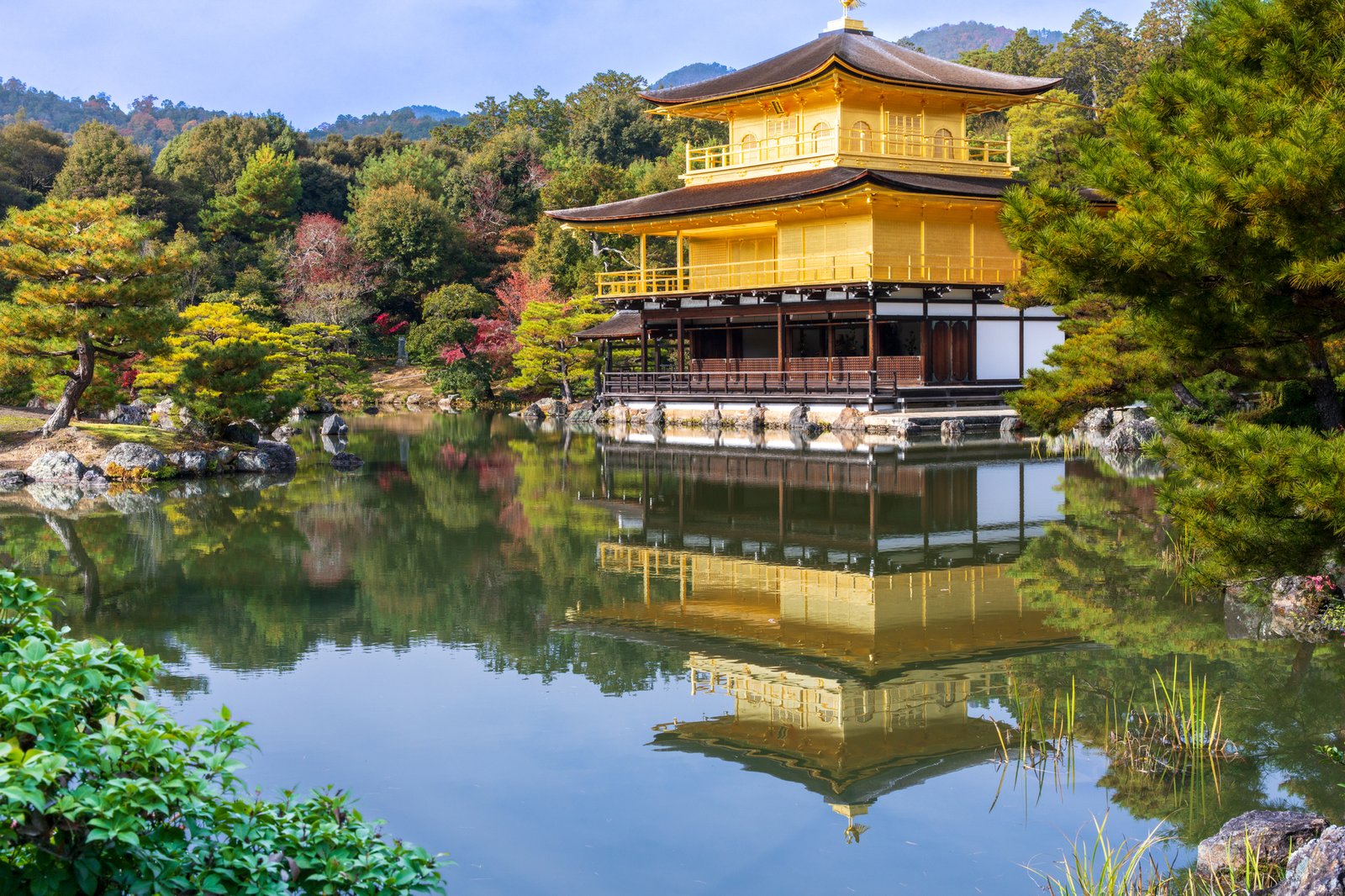
Kinkaku-ji is a Zen temple in Kita Ward, Kyoto; the temple says its formal name is Rokuon-ji and that it is one of the sub-temples of Shokoku-ji (Kinkaku-ji, about the temple (in Japanese)). It is part of the World Heritage property Historic Monuments of Ancient Kyoto (Kyoto, Uji and Otsu Cities), inscribed in 1994 (UNESCO World Heritage Centre). The Agency for Cultural Affairs lists the garden of Rokuon-ji (Kinkaku-ji) as a Special Historic Site and a Special Place of Scenic Beauty, designated on 8 October 1925 and given its special designation on 19 July 1956 (Agency for Cultural Affairs, database of nationally designated cultural properties (in Japanese)).
Who this is for: travellers in Kyoto who want to know which city buses stop at Kinkakuji-michi, and what happened to the pavilion in 1950.
The short version: the temple names city bus routes 12, 59, 205 and M1 to the Kinkakuji-michi stop. The bus operator’s page for route 205 at that stop lists the Kyoto Sta. stop among those on the way. The pavilion standing today was rebuilt in 1955 after the original was lost to fire in 1950.
What to plan for
| If… | Then lean towards… | Check |
|---|---|---|
| You are coming from JR Kyoto Station | City bus route 205, which the temple names and the operator runs between Kinkakuji-michi and Kyoto Station | Kyoto Municipal Transportation Bureau, route 205 from Kinkakuji-michi (in Japanese) |
| You are coming from Ginkaku-ji | City bus route 204 from the Ginkakuji-michi stop, which the temple gives | Kinkaku-ji, access (in Japanese) |
| You want to plan your return | The operator’s page for the Kinkakuji-michi stop, which lists each route and destination by platform | Kyoto Municipal Transportation Bureau, Kinkakuji-michi stop (in Japanese) |
| You use a wheelchair or a pushchair | The temple’s notes on how far the route through the garden is step-free | Kinkaku-ji, frequently asked questions (in Japanese) |
Getting there: the city buses to Kinkakuji-michi
The temple’s access page tells visitors coming by bus to get off at the Kyoto City Bus stop Kinkakuji-michi, and names routes 12, 59, 205 and M1. From Shokoku-ji it gives route 59 from the Karasuma Imadegawa or Doshisha-mae stops, and from Ginkaku-ji it gives route 204 from the Ginkakuji-michi stop (Kinkaku-ji, access (in Japanese)).
The bus operator, Kyoto Municipal Transportation Bureau, prints the stop’s English name as “Kinkakuji-michi (Kinkakuji Temple)”. Its page for the stop lists, by platform, routes 12, 25, 59, 102, 204, 205 and M1 with their destinations and a link to each timetable (Kyoto Municipal Transportation Bureau, Kinkakuji-michi stop (in Japanese)). Its timetable for route 205 from Kinkakuji-michi towards “Kyoto Sta. Via Nishioji Shijo” lists the stops on the way, including Nishinokyo Enmachi for JR Enmachi Station and Kyoto Sta., and notes that buses can run late because of traffic (Kyoto Municipal Transportation Bureau, route 205 from Kinkakuji-michi (in Japanese)).
What to do: before you leave the temple, open the operator’s page for the stop and find the platform for your route and direction. Where to verify: the operator’s page for Kinkakuji-michi (in Japanese).
The fire of 1950 and the pavilion rebuilt in 1955
The Agency for Cultural Affairs’ World Heritage page for Rokuon-ji tells the story. The retired shogun Ashikaga Yoshimitsu took over a nobleman’s villa built in the Kamakura period in 1397 and remade it as his villa, Kitayama-dono; after his death it became the Zen temple Rokuon-ji, with Muso Soseki as its founding priest. The temple later declined and was badly hit in the Onin War (1467 to 1477), and in the Edo period the temple organisation repaired the pavilion and the garden (Agency for Cultural Affairs, Cultural Heritage Online: Rokuon-ji (in Japanese)).
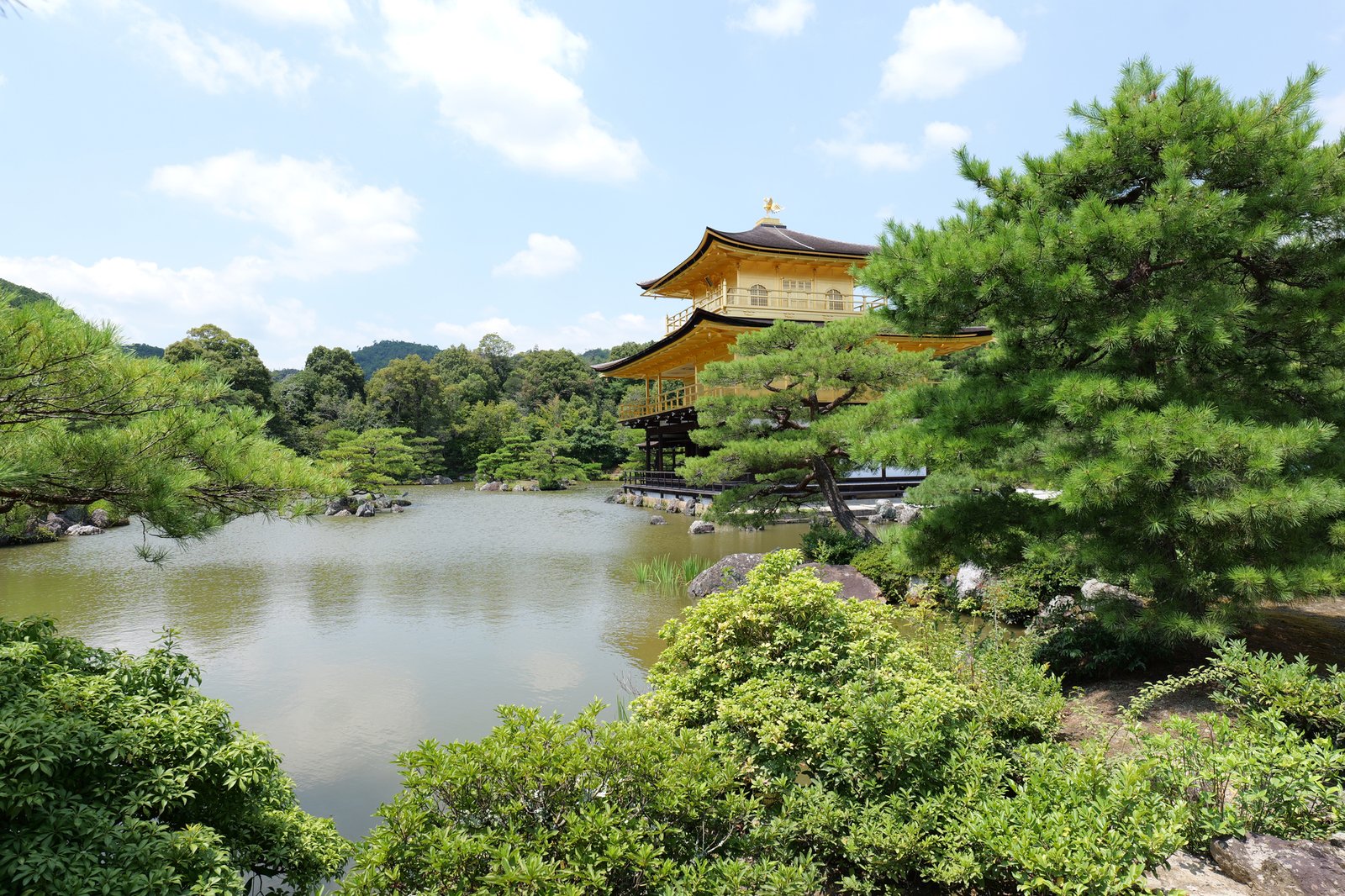
In 1950 a fire destroyed the Kinkaku, the only building that had survived from Yoshimitsu’s time. It was then a National Treasure, and the agency notes that its designation was removed because of the loss. The pavilion was rebuilt in 1955 as an important building of the garden. The agency says that detailed drawings made during a repair project in 1904 made an accurate restoration possible. Further repair work was carried out in 1987, and from 1988 to 1990 disaster-prevention work, centred on fire-fighting equipment, installed water cannons among other things (Agency for Cultural Affairs, Cultural Heritage Online: Rokuon-ji (in Japanese)). Kyoto City’s World Heritage page gives the same sequence: the Kinkaku was lost to fire in 1950 and rebuilt as a restoration in 1955 (Kyoto City, World Heritage: Rokuon-ji (in Japanese)).
The temple adds what the 1987 work involved: in the autumn of that year the lacquer was redone, the gold leaf replaced, and the ceiling painting and the statue of Yoshimitsu restored (Kinkaku-ji, temple grounds (in Japanese)).
What to do: read the pavilion you see as the 1955 building, restored again in 1987. Where to verify: the agency’s World Heritage page (in Japanese).
Three storeys, three names, and a carp at the waterfall
The temple’s guide to its grounds gives each storey of the pavilion its own name and style. The first storey, Hossuiin, is in the shinden style of court residences; the second, Choondo, is in the buke style of warrior houses; and the third, Kukyocho, is in the style of a Chinese Zen Buddhist hall. The second and third storeys are covered in pure gold leaf over lacquer, and the roof is made of many thin layers of sawara cypress, with a phoenix on top (Kinkaku-ji, temple grounds (in Japanese)). The Agency for Cultural Affairs describes the same three storeys as built in the shinden style, a residential style and the Zen Buddhist hall style, under a pyramid-shaped roof of wooden shingles (Agency for Cultural Affairs, Cultural Heritage Online: Rokuon-ji (in Japanese)).
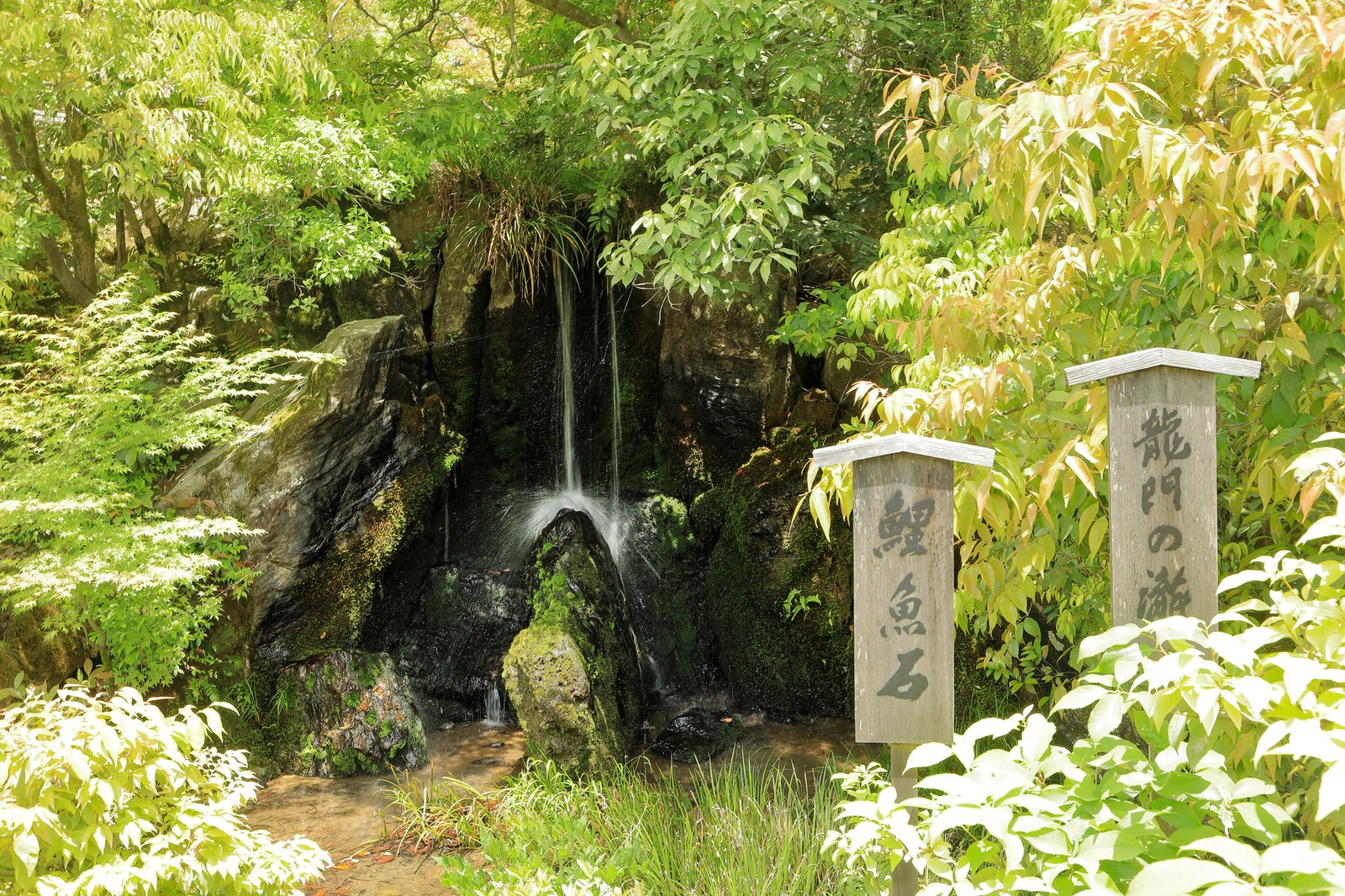
Further into the garden is the Ryumon waterfall, which the temple says drops 2.3 metres in a single fall. At its foot is the Rigyoseki, a carp stone named after the Chinese tale in which a carp that climbs the Dragon Gate falls becomes a dragon. The temple describes the stone as set at a slant, as if the carp were about to leap up the falls (Kinkaku-ji, temple grounds (in Japanese)).
What to do: at the Ryumon waterfall, look at the foot of the falls for the slanting stone. Where to verify: the temple’s guide to its grounds (in Japanese).
What we have not verified
Check official before you go: opening hours, admission fees and parking can change, so use the temple’s access page (Kinkaku-ji, access (in Japanese)).
- Bus routes: the temple names routes 12, 59, 205 and M1, and the operator’s stop page also lists routes 25, 102 and 204; which of them suits a given starting point is not confirmed here.
- Journey times and fares: the bus journey time and fare are not confirmed here, and no departure times are given.
- The second storey’s style: the temple calls it the buke style of warrior houses and the Agency for Cultural Affairs calls it a residential style; both are given above.
- The cause of the 1950 fire: the official pages used here say only that the pavilion was lost to fire.
- English names: the temple prints “Kinkaku-ji” and the bus operator prints “Kinkakuji-michi (Kinkakuji Temple)”; the other names on this page are this site’s renderings.
Official sources
| Topic | Source | Checked |
|---|---|---|
| World Heritage property and inscription | UNESCO World Heritage Centre | 2026-11-11 |
| Garden: Special Historic Site, Special Place of Scenic Beauty, dates | Agency for Cultural Affairs, database of nationally designated cultural properties | 2026-11-11 |
| History, the 1950 fire, the 1955 rebuilding, the storeys | Agency for Cultural Affairs, Cultural Heritage Online: Rokuon-ji | 2026-11-11 |
| The 1950 fire and 1955 rebuilding | Kyoto City, World Heritage: Rokuon-ji | 2026-11-11 |
| Formal name, sub-temple of Shokoku-ji | Kinkaku-ji, about the temple | 2026-11-11 |
| Storeys, the 1987 work, the waterfall and carp stone | Kinkaku-ji, temple grounds | 2026-11-11 |
| Bus routes named by the temple; hours, fees, parking | Kinkaku-ji, access | 2026-11-11 |
| Step-free route | Kinkaku-ji, frequently asked questions | 2026-11-11 |
| Kinkakuji-michi stop, routes by platform | Kyoto Municipal Transportation Bureau, Kinkakuji-michi stop | 2026-11-11 |
| Route 205 towards Kyoto Station | Kyoto Municipal Transportation Bureau, route 205 from Kinkakuji-michi | 2026-11-11 |