Place name in Japanese: 川越, Kawagoe.
Kawagoe, Saitama: the Tobu Tojo Line from Ikebukuro, the loop buses to the old town and the storehouse-style shops
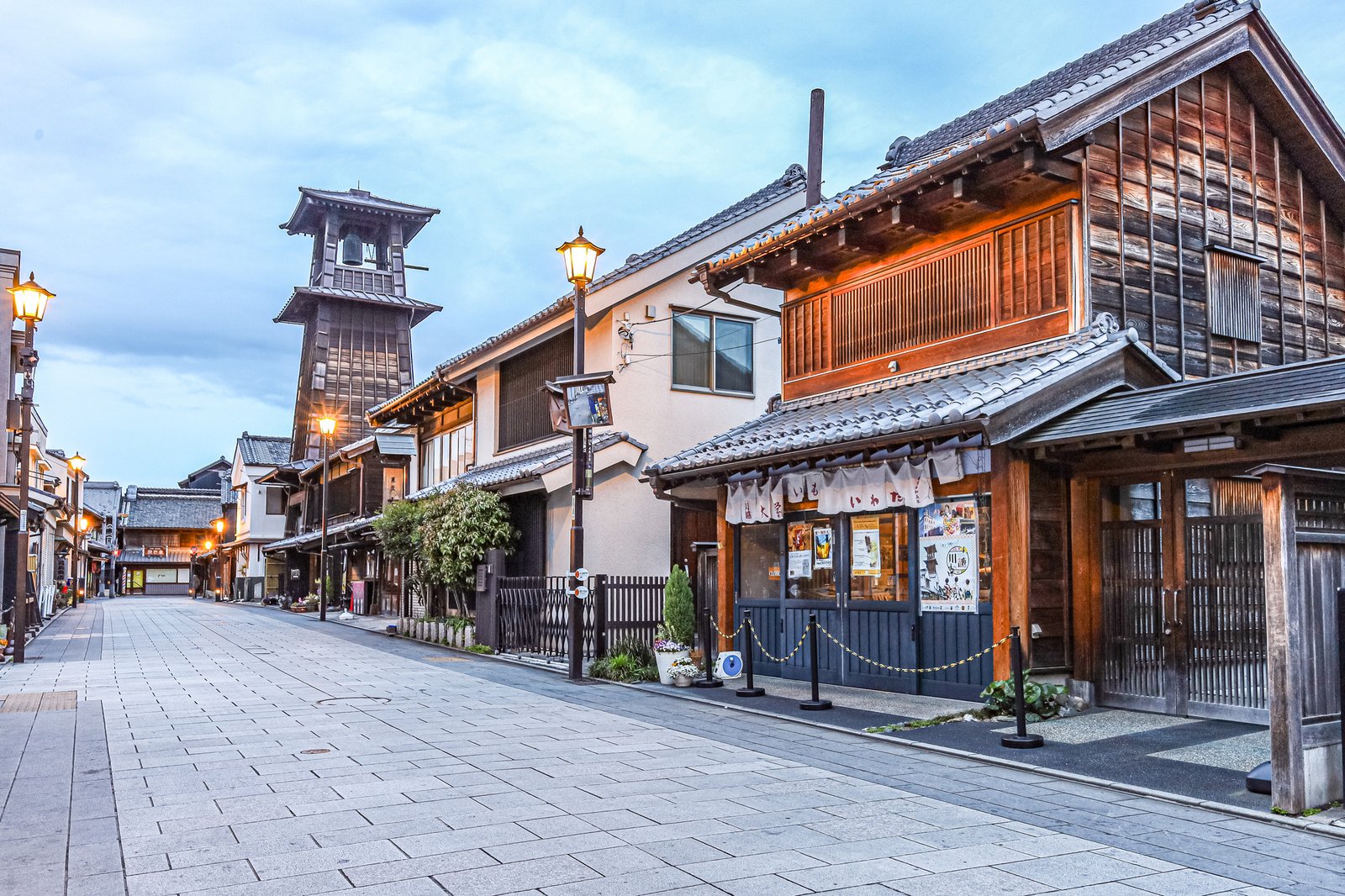
Kawagoe is a city in Saitama. The Agency for Cultural Affairs database describes its preservation district as a district that has the townspeople’s quarter of the castle town of Kawagoe as its core, where fire-resistant storehouse-style townhouses were built after the great fire of 1893, and where Western-style buildings and Western-style townhouses were added from the Taisho era (Agency for Cultural Affairs database (in Japanese)). The database records the district as an important preservation district for groups of traditional buildings, selected on 1 December 1999.
Who this is for: travellers in Tokyo who want a day trip by train to walk the old merchant street.
The short version: take the Tobu Tojo Line from Ikebukuro Station to Kawagoe Station, then one of the two sightseeing loop buses to the old town. The city says both loop buses may change their service or not run over the New Year and on festival days with traffic restrictions. Always follow the official pages linked below.
Train, then which loop bus
| If… | Then lean towards… | Check |
|---|---|---|
| You start from Ikebukuro | The Tobu Tojo Line to Kawagoe Station | Tobu Railway, access to Kawagoe |
| You want the rail fare both ways on one ticket | Tobu’s one-day discount pass for the round trip | Tobu Railway, Kawagoe guide (PDF) |
| You leave Kawagoe Station by the west exit | The loop bus from stop 2, on the route that goes to the old town first | West-exit loop bus operator, timetable and map (PDF) |
| You leave Kawagoe Station by the east exit | The loop bus from stop 3 | East-exit loop bus operator, timetable and fares (in Japanese) |
Trains and buses
| Item | Time | Where to check |
|---|---|---|
| Train, Ikebukuro Station to Kawagoe Station | About 30 minutes; 26 minutes on the fastest trains | Tobu Railway, access to Kawagoe and Kawagoe guide (PDF) |
| Loop bus, west exit (stop 2) to the Kura no machi(Old Town) stop | 12 minutes on the route that goes to the old town first | West-exit loop bus operator, timetable and map (PDF) |
| Loop bus, east exit (stop 3) to the old-town stop on the main street | 24 minutes | East-exit loop bus operator, timetable and fares (in Japanese) |
- Rail pass: Tobu’s guide describes the KAWAGOE DISCOUNT PASS Premium as a one-day discounted Tobu Railway pass for the round trip between Ikebukuro and Kawagoe or Kawagoeshi stations, at 1,200 yen for adults and 600 yen for children, valid for the day of use and not sold on the days of the Kawagoe Festival or from 31 December to 3 January (Tobu Railway, Kawagoe guide (PDF)).
- Going back: the same guide says to take a Tojo Line train bound for Ikebukuro, as trains bound for Motomachi-Chukagai or Shin-Kiba cost a separate fare.
- East-exit loop bus fares: the operator lists 230 yen from the east exit to the old-town stops on the main street, and says IC cards such as PASMO and Suica are accepted; some runs end before those stops (East-exit loop bus operator, timetable and fares (in Japanese)). West-exit loop bus fares: Check official with the operator’s timetable and map (PDF).
- Changes and closures: the city says both loop buses may change their service or not run over the New Year and on festival days with traffic restrictions, and that fares and closures should be checked with the operators, so check before you go (Kawagoe City, sightseeing loop buses (in Japanese)).
What to do: decide which station exit you will use before you arrive, as the two loop buses leave from different exits. Where to verify: the city’s loop bus page (in Japanese).
Getting there and how long it takes
- Ikebukuro to Kawagoe: Tobu Railway gives about 30 minutes from Ikebukuro Station to Kawagoe Station on the Tobu Tojo Line (Tobu Railway, access to Kawagoe).
- Kawagoe Station to the old town by bus: the city lists two sightseeing loop buses from Kawagoe Station, one from stop 2 at the west exit and one from stop 3 at the east exit, both passing the storehouse townscape and the bell tower (Kawagoe City, sightseeing loop buses (in Japanese)). The city’s bell tower page says the bell tower is a two-minute walk from the old-town bus stop on the main street (Kawagoe City, the bell tower (in Japanese)).
- On foot: the same page gives a 15-minute walk to the bell tower from a station on a second railway line; Check official with the city’s bell tower page (in Japanese).
What to do: match your train to a loop bus departure, or plan to walk. Where to verify: the east-exit loop bus timetable (in Japanese) and the west-exit loop bus timetable (PDF).
What to see
The city’s page on the preservation district says it runs about 430 metres north to south and 200 metres east to west along the main street, and covers the heart of the townspeople’s quarter as it has been since the early Edo period (Kawagoe City, the preservation district (in Japanese)). It describes the storehouse-style townhouses as two-storey shop storehouses in black plaster facing the street, with huge decorative ridge-end tiles on gabled or hip-and-gable roofs. On the ground floor, it says, the shops were shut with lift-up shutters, with side pockets to store the earthen doors; the upper floor mostly has double-leaf earthen doors. The oldest storehouse-style townhouse in Kawagoe, it says, was built in 1792.
What to do: look up at the roofs and the upper-floor doors as you walk the main street. Where to verify: the city’s preservation district page (in Japanese).
Why the street is built of storehouses, and the bell tower
The city’s page says some storehouse-style townhouses already stood in the district in the Edo period, but after the great fire of 1893 the merchants all took up fire-resistant storehouse construction as they rebuilt, and by about 1907 the street was lined with them (Kawagoe City, the preservation district (in Japanese)). It adds that changes to a building’s exterior in the district need a permit from the city, and are first discussed with a residents’ committee under the district’s own town-making rules.
The city’s bell tower page says the first tower is said to have been built on its present site by the lord of Kawagoe Castle between 1627 and 1634, and that the present tower was rebuilt the year after the fire of 1893 (Kawagoe City, the bell tower (in Japanese)). It has three tiers and is about 16 metres high, and an automatic striker rings the bell four times a day, at 6:00, noon, 15:00 and 18:00.
What to do: time your walk past the bell tower for one of the four strikes. Where to verify: the city’s bell tower page (in Japanese).
Official sources
| Topic | Source | Checked |
|---|---|---|
| Townspeople’s quarter, fire of 1893, Western-style buildings, selection in 1999 | Agency for Cultural Affairs database | 2026-11-11 |
| District size, storehouse townhouses, oldest of 1792, permits and residents’ committee | Kawagoe City, the preservation district | 2026-11-11 |
| Bell tower history, height, strike times, bus stop and walking times | Kawagoe City, the bell tower | 2026-11-11 |
| Loop buses, stops at the station, changes and closures | Kawagoe City, sightseeing loop buses | 2026-11-11 |
| Train time from Ikebukuro | Tobu Railway, access to Kawagoe | 2026-11-11 |
| Fastest train, rail pass, trains back to Ikebukuro | Tobu Railway, Kawagoe guide (PDF) | 2026-11-11 |
| East-exit loop bus times and fares | East-exit loop bus operator, timetable and fares | 2026-11-11 |
| West-exit loop bus times and stop names | West-exit loop bus operator, timetable and map (PDF) | 2026-11-11 |