Place name in Japanese: 桂浜, Katsurahama.
Katsurahama, Kochi: the Tosaden Kotsu bus from Kochi Station, the no-swimming rule, the Ryoma statue of 1928, and the moon in the Yosakoi song
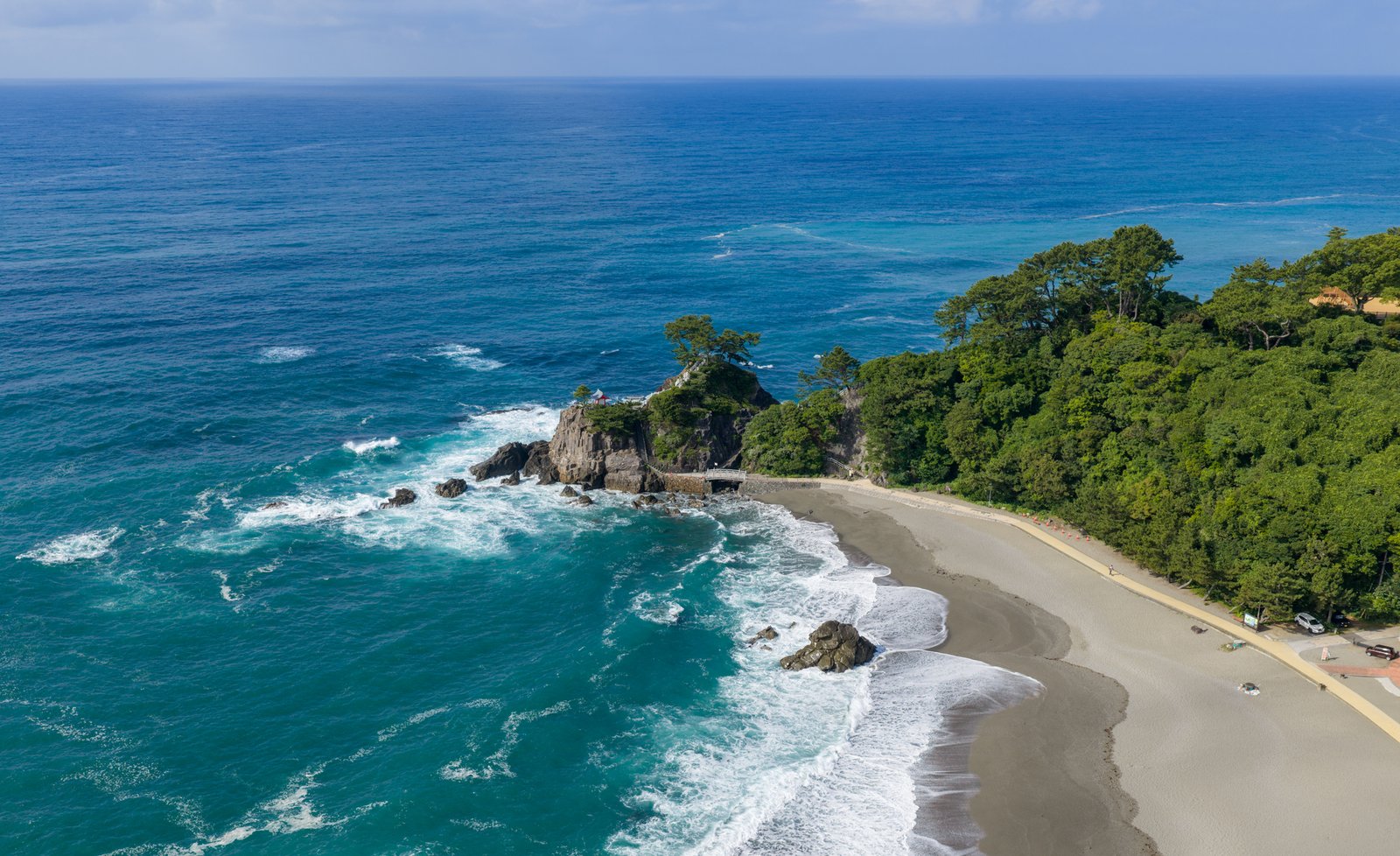
Katsurahama is a beach facing the Pacific in Urado, Kochi City. Kochi City describes it as a scenic spot facing the Pacific and an urban park, with the Sakamoto Ryoma statue on Ryuzu Point looking out to sea (Kochi City, Katsurahama Park (in Japanese)). The park, which prints its name as “KATSURAHAMA PARK”, is run by a designated manager, and describes the beach as a bow-shaped stretch of sand between Ryuzu Point and Ryuo Point (KATSURAHAMA PARK, about the park (in Japanese)).
Who this is for: travellers going to Katsurahama for a few hours from central Kochi who want to know which bus to take, what the park asks of visitors on the shore, and the story of the statue on the point.
The short version: Tosaden Kotsu’s Katsurahama Line runs from Kochi Station Bus Terminal to Katsurahama in 37 to 38 minutes by the operator’s timetable. The park says swimming is not allowed because the waves change suddenly, and the city asks visitors not to go near the water’s edge. The park is open at all hours, with no closing days and no entry fee.
What to plan for
| If… | Then lean towards… | Check |
|---|---|---|
| You are starting from JR Kochi Station | The Tosaden Kotsu Katsurahama Line from platform 5 at Kochi Station Bus Terminal | Tosaden Kotsu, Katsurahama Line weekday timetable (in Japanese) |
| You are going at the weekend or on a public holiday | The weekend and holiday timetable, which differs from the weekday one | Tosaden Kotsu, Katsurahama Line weekend and holiday timetable (in Japanese) |
| You are driving | The coastal Prefectural Road 34, not the old road through Urado | Kochi City, Katsurahama Park, tourism page (in Japanese) |
| You want to go into the sea | Another place: the park says swimming is not allowed here | KATSURAHAMA PARK, frequently asked questions (in Japanese) |
On the shore: what the park and the city ask
The park says it can be used 24 hours a day, has no closing days and charges no entry fee. It says swimming is not allowed, because the waves near the shore change a great deal and sudden high waves can cause accidents in the water. It also asks visitors not to fly drones, not to bring large dogs, not to fish and not to ride bicycles in the park; smokers are asked to use the designated smoking area (KATSURAHAMA PARK, frequently asked questions (in Japanese)). Its page of rules adds the acts the city parks ordinance does not allow, including damaging the park, taking plants, making fires or using cooking stoves, and entering closed-off areas (KATSURAHAMA PARK, rules for using the park (in Japanese)).
Kochi City’s page asks visitors never to go near the water’s edge, because the waves change a great deal near the shore and the water becomes deep suddenly (Kochi City, Katsurahama Park, tourism page (in Japanese)).
What to do: watch the sea from the sand, not from the water’s edge. Where to verify: the park’s questions page (in Japanese).
Getting there: the Katsurahama Line and the coast road
Tosaden Kotsu’s Katsurahama Line runs from Kochi Station Bus Terminal by way of Minami-Harimayabashi and Nagahama to Katsurahama, and every journey leaves from platform 5 at the terminal. In its timetable revised on 1 October 2026, the weekday buses leave Kochi Station Bus Terminal from 6:40 to 19:00 and reach Katsurahama 38 minutes later, and the last bus back from Katsurahama leaves at 20:30. At weekends and on public holidays the buses leave from 6:40 to 18:00 and take 37 minutes, and the last bus back leaves at 19:10 (Tosaden Kotsu, Katsurahama Line weekday timetable (in Japanese); Tosaden Kotsu, Katsurahama Line weekend and holiday timetable (in Japanese)).
Kochi City gives about 30 minutes by the Tosaden Kotsu bus from JR Kochi Station or Harimayabashi, and about 15 minutes by car from the Kochi-minami interchange of the Kochi Tobu Expressway. It warns that the old road through the streets of Urado is narrow and that there is a risk of collisions when cars pass, and asks drivers to use the coastal Prefectural Road 34 instead (Kochi City, Katsurahama Park, tourism page (in Japanese)).
What to do: before you leave the beach, check the time of the last bus back for that day of the week. Where to verify: the Tosaden Kotsu timetables page (in Japanese).
The statue young people of Kochi raised the money for, unveiled in 1928
Kochi City says that young volunteers of Kochi Prefecture raised 25,000 yen, as it was then, to build the statue of Sakamoto Ryoma, and that it was unveiled at 14:00 on 27 May 1928. It shows Ryoma in kimono, with his hands tucked inside it, and in boots, looking out over the Pacific; the figure is 5.3 m tall and 13.5 m with its base (Kochi City, Sakamoto Ryoma statue (in Japanese)).
The Sakamoto Ryoma Memorial Museum, a Kochi prefectural museum, tells more. It says the idea came from Irimajiri Yoshiyasu, then a student at Waseda University, who set up a society to build the statue and ran a fundraising campaign across the country. At the unveiling, it says, a destroyer sent by the Navy Ministry lay offshore, soldiers of the local 44th Regiment stood at the foot of the statue, and 500 guests watched the red and white curtain fall. It gives the figure as 17 shaku 5 sun, about 5.3 m, and the whole as 44 shaku 5 sun, about 13.4 m, and quotes the plaque on the back of the base, which names the builders as the young people of Kochi Prefecture and the sculptor of the model as Motoyama Hakuun (The Sakamoto Ryoma Memorial Museum, the Sakamoto Ryoma statue (in Japanese)).
The city adds that every year, for about two months around 15 November, which it gives as both Ryoma’s birthday and the day he died, an observation platform is set up beside the statue so that visitors can look over the Pacific at Ryoma’s eye level (Kochi City, Sakamoto Ryoma statue (in Japanese)).
What to do: at the statue, look for the plaque on the back of the base. Where to verify: the museum’s page on the statue (in Japanese).
A beach the Yosakoi song names for the moon, and its five-coloured stones
The park says Katsurahama has long been known as a place for viewing the moon, and that the Tosa folk song Yosakoi-bushi sings of it in the line “for the moon, the place is Katsurahama”. It describes the deep blue sea, the five-coloured stones spread along the shore and the green pines behind the beach (KATSURAHAMA PARK, about the park (in Japanese)). Kochi City’s page on the beach quotes the same line and, under the Katsurahama moon-viewing gathering, speaks of the mid-autumn full moon seen there (Kochi City, Katsurahama (in Japanese)).
On Ryuzu Point, besides the statue, the city lists a monument to Omachi Keigetsu, a monument to Ryoma’s achievements and paths such as the camellia walk (Kochi City, Katsurahama Park (in Japanese)).
What to do: on the sand, look for the colours of the stones the park describes. Where to verify: the park’s page about Katsurahama (in Japanese).
What we have not verified
Check official before you go: the bus fares and any timetable change (Tosaden Kotsu, route timetables and fares (in Japanese)). Check official before you go: the dates of the observation platform beside the statue (KATSURAHAMA PARK, about the park (in Japanese)). Check official before you go: car park fees and opening hours (KATSURAHAMA PARK, frequently asked questions (in Japanese)).
- Designations: no national designation for Katsurahama was found in the Agency for Cultural Affairs database; none is given here.
- The airport bus: the city gives about 30 minutes from Kochi Ryoma Airport to Harimayabashi by the airport bus; its times are not checked.
- The date of the moon-viewing gathering: not checked.
- English names: the park prints “KATSURAHAMA PARK” and the museum “The Sakamoto Ryoma Memorial Museum”; the other names on this page are this site’s renderings of the Japanese names.
Official sources
| Topic | Source | Checked |
|---|---|---|
| The park, Ryuzu Point and its monuments | Kochi City, Katsurahama Park | 2026-11-11 |
| Access, the coast road, the water’s edge | Kochi City, Katsurahama Park, tourism page | 2026-11-11 |
| The beach and the moon-viewing gathering | Kochi City, Katsurahama | 2026-11-11 |
| The statue, its unveiling and the platform | Kochi City, Sakamoto Ryoma statue | 2026-11-11 |
| The statue’s building and its plaque | The Sakamoto Ryoma Memorial Museum, the Sakamoto Ryoma statue | 2026-11-11 |
| The beach, the moon and the stones | KATSURAHAMA PARK, about the park | 2026-11-11 |
| Opening, swimming, park rules | KATSURAHAMA PARK, frequently asked questions | 2026-11-11 |
| Acts not allowed in the park | KATSURAHAMA PARK, rules for using the park | 2026-11-11 |
| Bus timetables and fares | Tosaden Kotsu, route timetables and fares | 2026-11-11 |
| Katsurahama Line, weekdays | Tosaden Kotsu, Katsurahama Line weekday timetable | 2026-11-11 |
| Katsurahama Line, weekends and holidays | Tosaden Kotsu, Katsurahama Line weekend and holiday timetable | 2026-11-11 |