Place name in Japanese: 上高地, Kamikōchi.
Kamikochi, Nagano: walking the valley floor, the year-round private-car restriction, and the shuttle buses
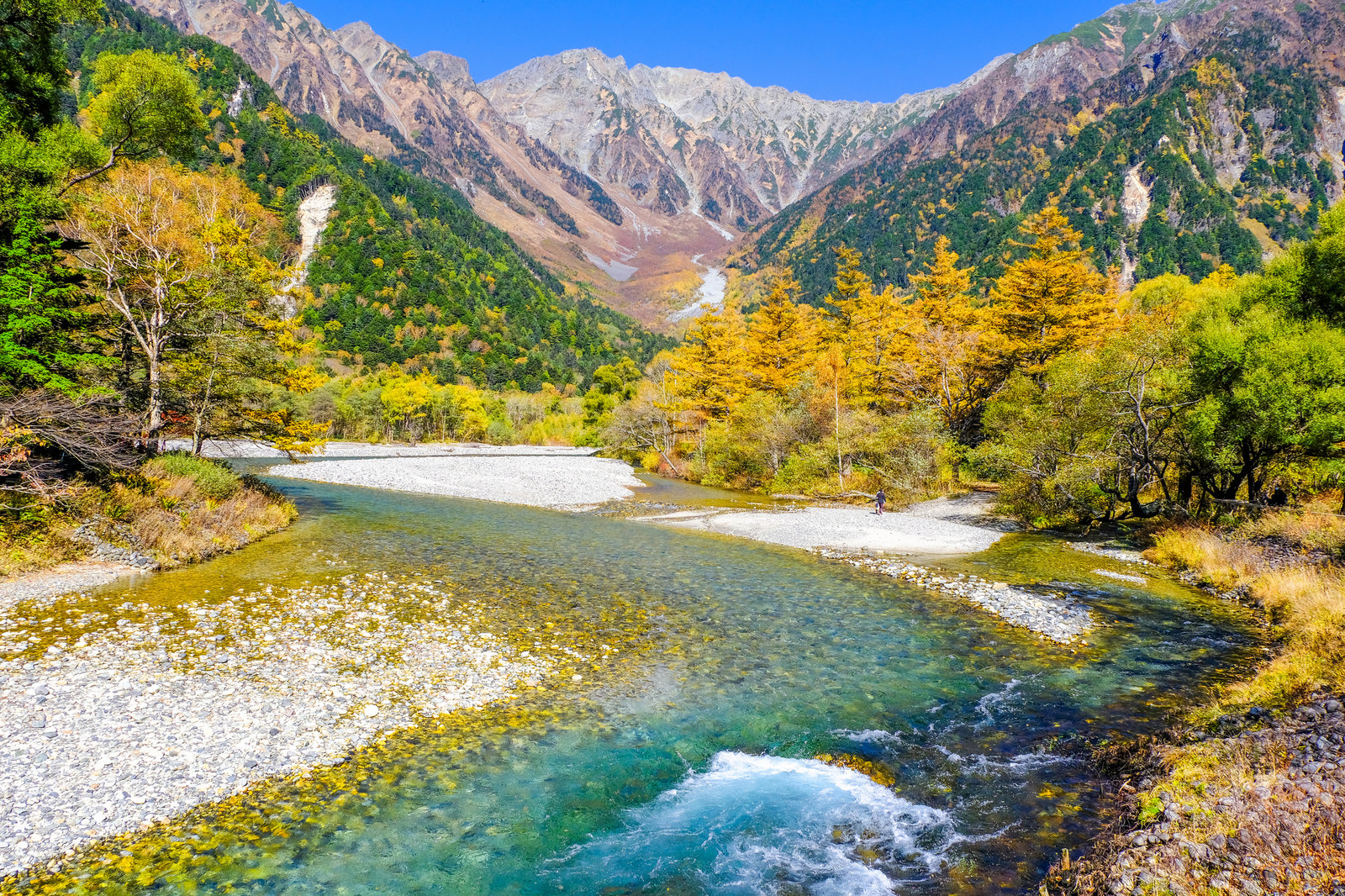
Kamikochi is a valley without private cars: the official Kamikochi site says private cars cannot enter at any time of year, and that drivers park outside and change to a shuttle bus or taxi. Once there, the walks run along the Azusa River on boardwalks and gravel paths, between Taisho Pond and Kappa Bridge, a suspension bridge near the bus terminal (about page).
Who this is for: travellers from the United States who are planning a day or a night in Kamikochi from Matsumoto or Takayama, and want to know how to get in without a car, when the valley is open, and which walk fits the time they have.
The short version: on the official Kamikochi site as fetched on 2026-11-10, private cars, including rental cars and motorcycles, may not go beyond the Kama Tunnel at any time of year; drivers park at Sawando on the Matsumoto side or at the Hirayu Parking Area on the Takayama side and take a shuttle bus or taxi. The site’s FAQ gives the tourist season as running from the opening ceremony on 27 April to the closing ceremony on 15 November, and says that from 16 November to mid-April facilities close and no transport runs beyond the Kama Tunnel. The walk from Taisho Pond to Kappa Bridge takes about 75 to 80 minutes on the site’s own estimate. Always follow the official pages linked below.
Which walk fits your time
| If… | Then lean towards… | Check |
|---|---|---|
| You have about an hour | The site’s one-hour course: bus terminal, Kappa Bridge, the right bank of the Azusa River, the Weston Monument, Tashiro Bridge, the left bank, and back to the bus terminal | Walking page |
| You want to walk one way, from Taisho Pond to Kappa Bridge | Get off the shuttle at the Taisho Pond stop and walk up to Kappa Bridge: about 75 minutes on the right bank or about 80 minutes on the left bank, then about 6 minutes to the bus terminal | Walking page and Sawando parking page |
| You want to go upstream from Kappa Bridge | Kappa Bridge to Myojin: about 60 minutes on the right bank or about 50 minutes on the left bank | Walking page |
| You have most of a day | The site’s longer courses, which add Myojin Pond and, on the five-hour course, Tokusawa | Walking page |
The walking page says its times assume about 3.0 km an hour and do not include stops to look at nature or rest.
Season, hours and closures
All entries below are from the official Kamikochi site and the bus operator’s page as fetched on 2026-11-10.
| Item | What the official page says | Check official |
|---|---|---|
| Tourist season | From the opening ceremony on 27 April to the closing ceremony on 15 November; from 16 November to mid-April, facilities close and no transport runs beyond the Kama Tunnel (a few lodgings open over the New Year) | FAQ |
| Road open to buses, taxis and light vehicles such as bicycles | Outside the winter closure; the page lists the 2025 period, 17 April to 15 November, 5:00 to 19:00, and 5:00 to 20:00 in July and August | Check official: Car restriction page |
| Night closure | The Nakanoyu Gate, the entrance to Kamikochi, is closed at night except in emergencies; it can be passed until 19:00 in spring and autumn and until 20:00 in July and August only | FAQ |
| Private cars | Not allowed beyond the Kama Tunnel at any time of year, including rental cars and motorcycles | Car restriction page |
| Sawando car parks | Open 17 April to 15 November, with part closed in winter; the city car parks run 24 hours with automatic gates | Check official: Sawando parking page |
| Parking and shuttle fares | Listed on the official pages | Check official: Sawando parking page and FAQ |
| Bus times | Listed by the operators | Check official: Alpico page |
The car restriction page says Kamikochi is very crowded on Saturdays, Sundays and public holidays during the summer holidays, during the Obon period, and in the October autumn-colour season, and asks visitors to allow plenty of time.
What to do: check your date against the season row before you book anything, and plan to be back at the bus terminal before the last bus. Where to verify: the FAQ and the Alpico page.
Getting there
- From Matsumoto Station by train and bus: according to the official Kamikochi site’s public transport page, the Matsumoto Dentetsu Line train takes about 30 minutes from Matsumoto Station to Shin-Shimashima Station, then a route bus takes about 1 hour from Shin-Shimashima Station to the Kamikochi Bus Terminal. For this Matsumoto–Shin-Shimashima–Kamikochi bus line, services departing Kamikochi only now use a reservation system in which you book a specific service, according to the same page. Check official: the public transport page. According to the same page, the Matsumoto Dentetsu Line leaves from platform 7 inside JR Matsumoto Station, with no ticket gate between it and the JR platforms, and that tickets are sold at the JR ticket machines (public transport page).
- From Matsumoto Station or the Matsumoto Bus Terminal by direct bus: according to the official Kamikochi site’s public transport page, a route bus runs to the Kamikochi Bus Terminal in about 1 hour 30 minutes; according to Alpico’s page, the Matsumoto Bus Terminal to Kamikochi service is reservation-priority (public transport page; Alpico page). Check official for how reservations work: the Alpico page.
- From Takayama: the page shows a route bus from Takayama Station or the Takayama Bus Center to the Hirayu Bus Terminal, about 1 hour, then a shuttle bus to the Kamikochi Bus Terminal, about 25 minutes (public transport page).
- By car from the Matsumoto side: park at Sawando and change to a shuttle bus or taxi. The Sawando page says the shuttle runs from Sawando to the Kamikochi Bus Terminal and also stops at Taisho Pond and in front of the Kamikochi Imperial Hotel (Sawando parking page).
- By car from the Takayama side: park at the Hirayu Parking Area and change to a shuttle bus or taxi (car restriction page).
- Direct buses from Tokyo, Nagoya, Osaka and Kyoto: the official direct bus page lists services that need a reservation (direct bus page).
What to do: take bus times and fares from the operators’ pages on the day you plan. Where to verify: the public transport page and the Alpico page.
How cars came and went
The bus terminal where most visits begin has its own place in the official timeline on the Kamikochi site: it says buses came in as far as Kappa Bridge in July 1935, and that the bus terminal was completed in 1965 (about page). It records that the restriction on private cars on the prefectural road into Kamikochi began in April 1975, and that the restriction on tour buses began on 24 July 2004 (about page). The same page calls the car restriction one of the main measures taken to protect the valley, saying it keeps the effect of exhaust gas to a minimum (about page). Earlier, the timeline lists Kamikochi’s designation as a place of scenic beauty and natural monument on 24 March 1928, its inclusion in Chubusangaku National Park on 4 December 1934, and its designation as a special place of scenic beauty and special natural monument on 29 March 1952 (about page). The timeline also says that on 6 July 1927 Kamikochi was chosen in the valley section of a selection of scenic places (about page); the Ministry of the Environment’s table of the 1927 Nippon Hakkei selection, organised by two newspapers, lists the Kamikochi valley in Nagano under valleys among its eight views (Ministry of the Environment table, PDF).
What to do: read the full timeline before you go, and see the Getting there section above for the buses that run in place of private cars. Where to verify: the about page.
How the pond at one end of the walk appeared
The walk to Kappa Bridge starts or ends at Taisho Pond, and the official timeline says this pond appeared after a large eruption of the volcano Mt. Yakedake on 6 June 1915 (about page). The same timeline records an earlier large explosion of Mt. Yakedake on 8 December 1907 (about page). The site’s spot page lists Taisho Pond and Mt. Yakedake one after the other (spot page), and its FAQ explains that when walking maps speak of the right and left banks, they mean the banks as seen looking from the Hotaka peaks towards Mt. Yakedake and Taisho Pond (FAQ).
What to do: get off the shuttle at the Taisho Pond stop and start the walk there. Where to verify: the Sawando parking page for the stop and the walking page for the route.
On the paths: shoes, rules and photography
The FAQ says most of the walking paths are unpaved, with boardwalks and gravel, and suggests walking or trekking shoes and layers that can cope with changes in temperature (FAQ). It says there are almost no rubbish bins in Kamikochi and asks visitors to take their rubbish home, that most public toilets ask for a tip in a box at the door, and that visitors should not bring pets other than assistance dogs (FAQ). The bus operator’s page asks passengers to follow seven rules in Kamikochi: no collecting plants or insects, no feeding wild animals, take all rubbish home, no bringing in pets or non-native species, no stepping off the paths, no cycling into the mountain area, and no flying drones (Alpico page). On photography, the FAQ asks visitors to take turns at the photo spots and keep to good manners (FAQ).
What to do: wear shoes for gravel and boardwalk, carry a bag for your rubbish, and keep to the paths. Where to verify: the FAQ.
Official sources
| Topic | Source | Checked |
|---|---|---|
| Year-round private-car restriction, the Kama Tunnel, the Sawando and Hirayu parking areas, road open period, crowded periods | kamikochi.or.jp/access/restrictions/ | 2026-11-10 |
| Route from Matsumoto Station and Takayama, reservations on the Shin-Shimashima bus line, platform and tickets for the Matsumoto Dentetsu Line | kamikochi.or.jp/access/train/ | 2026-11-10 |
| Sawando car parks and shuttle stops | kamikochi.or.jp/access/sawando/ | 2026-11-10 |
| Direct buses from major cities | kamikochi.or.jp/access/bus/ | 2026-11-10 |
| Season, night closure, paths, rubbish, toilets, pets, photography | kamikochi.or.jp/learn/faq/ | 2026-11-10 |
| Timeline: buses, car restriction, designations, 1915 eruption, 1927 selection, Kappa Bridge as a suspension bridge | kamikochi.or.jp/learn/about/ | 2026-11-10 |
| Spots along the valley | kamikochi.or.jp/learn/spots/ | 2026-11-10 |
| Walking courses and times | kamikochi.or.jp/enjoy/walking/ | 2026-11-10 |
| Alpico: Kamikochi routes, reservation-priority services and visitor rules | alpico.co.jp/traffic/local/kamikochi/ | 2026-11-10 |
| Ministry of the Environment: the 1927 selection table (PDF) | env.go.jp/nature/ari_kata/shiryou/031208-4-3.pdf | 2026-11-10 |