Place name in Japanese: 鎌倉大仏, Kamakura Daibutsu.
The Great Buddha of Kamakura at Kotoku-in, Kanagawa: inside the statue, the lost Daibutsu-den Hall and the Enoshima Electric Railway to Hase
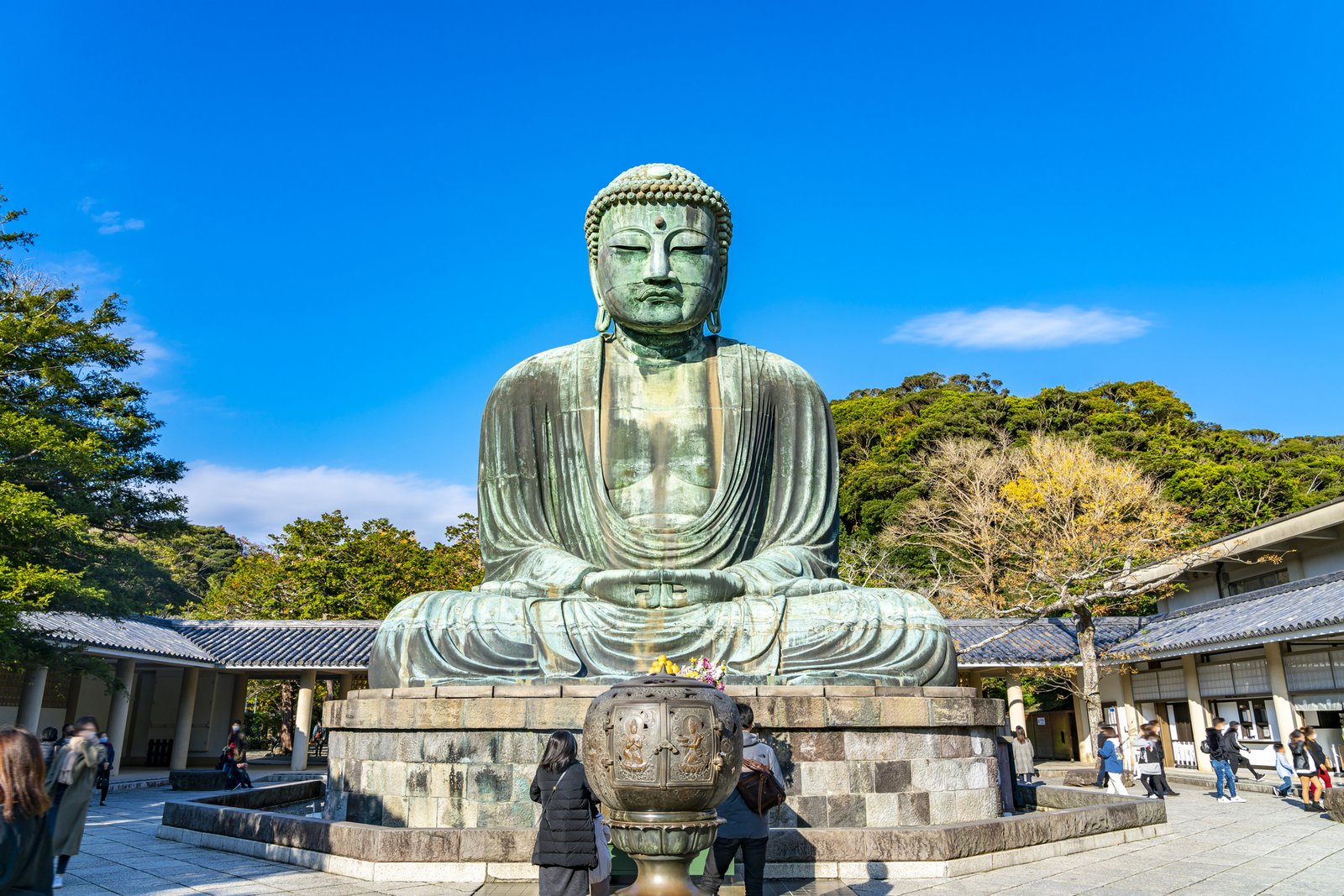
Kotoku-in is a Jodo Sect temple in Hase, Kamakura, and its principal image is the copper statue of Amida-butsu that the temple says is commonly known as Kamakura Daibutsu, the Great Buddha of Kamakura (Kotoku-in, the Great Buddha and Kotoku-in). The Agency for Cultural Affairs lists the statue under “National Treasures and Important Cultural Properties (fine arts)”, with a designation as an Important Cultural Property on 28 December 1897 and as a National Treasure on 8 February 1958 (Agency for Cultural Affairs, Cultural Heritage Online (in Japanese)). It lists the site of the Daibutsu-den Hall, which once housed the statue, under “Historic Sites, Places of Scenic Beauty and Natural Monuments”, designated on 27 February 2004 (Agency for Cultural Affairs, Cultural Heritage Online (in Japanese)).
Who this is for: travellers who want to see the statue, step inside it, and understand the hall that is no longer there, and who will check the hours and the trains on the official pages before they go.
The short version: take the JR Yokosuka Line to Kamakura, change to the Enoshima Electric Railway and get off at Hase. The railway gives a 10-minute walk to Kotoku-in; the Kamakura City Tourist Association gives 7 minutes. Go inside the statue before the interior closes, which is earlier than the temple grounds. Do not bring food in, and do not film inside the statue. Always follow the official pages linked below.
What to plan for
| If… | Then lean towards… | Check |
|---|---|---|
| You want to go inside the statue | Arrive well before the interior closes; it closes earlier than the grounds | Kamakura City Tourist Association, Kotoku-in (in Japanese) |
| You are coming from Kamakura Station | The Enoshima Electric Railway to Hase, then a walk | Enoshima Electric Railway, Hase Station |
| You use a wheelchair or a pushchair | The temple’s barrier-free route, with ramps; wheelchairs can be borrowed at the ticket counter | Kotoku-in, guide to the temple grounds |
| You plan to eat on the way | Finish eating before you enter; food is not allowed on the grounds | Kotoku-in, FAQ |
Hours, fees and the interior
The Kamakura City Tourist Association prints these hours and fees for Kotoku-in (Kamakura City Tourist Association, Kotoku-in (in Japanese)):
| What | Hours (as printed) | Fee (as printed) |
|---|---|---|
| Temple grounds, April to September | 8:00–17:30, entry until 15 minutes before the gate closes | Adults (junior high school and over) 300 yen; primary school children 150 yen |
| Temple grounds, October to March | 8:00–17:00, entry until 15 minutes before the gate closes | Adults (junior high school and over) 300 yen; primary school children 150 yen |
| Inside the Great Buddha | 8:00–16:30, all year; entry until 16:20 | 50 yen |
- Who pays nothing: the association says children below school age, and people who qualify for the temple’s fee exemption, are free; the temple lists who qualifies, including holders of an identification booklet for the disabled (Kamakura City Tourist Association (in Japanese); Kotoku-in, FAQ).
- Booking and re-entry: the temple says school groups do not need to book, and that visitors cannot re-enter without paying again (Kotoku-in, FAQ).
- Closures: before you go, check the temple’s page and the association’s page for the day’s hours and whether the interior is open (Kotoku-in, FAQ).
What to do: go inside the statue first if you arrive in the afternoon, because the interior closes before the grounds do. Where to verify: the association’s Kotoku-in page (in Japanese).
Rules on the grounds
- Food and drink: the temple says eating, drinking and bringing food or drink onto the grounds are prohibited, except drinks in sealed containers such as water bottles; visitors who are eating while walking are not let in, and there are no bins (Kotoku-in, FAQ).
- Filming and drones: the temple says filming inside the Great Buddha is prohibited and that flying drones is strictly prohibited (Kotoku-in, FAQ).
- Pets: apart from assistance dogs, the temple says pets must stay in cages or carriers and may not walk on the grounds (Kotoku-in, FAQ).
- Wheelchairs: the temple says the grounds have ramps but also bumpy areas, so a helper should come along; it lends a limited number of wheelchairs at the ticket counter from 9:00 a.m. to 4:00 p.m., for use on the grounds only (Kotoku-in, FAQ).
- Parking: the temple says it has no car park and cannot answer questions about car parks nearby; car park details: Check official (Kotoku-in, FAQ).
What to do: finish any snacks bought on the walk before you reach the gate. Where to verify: the temple’s FAQ.
Getting there: the Enoshima Electric Railway to Hase
- To Kamakura: JR East’s timetable lists Kamakura Station on the Yokosuka Line (JR East, Kamakura Station timetable).
- Kamakura to Hase: the Enoshima Electric Railway’s Hase Station page gives 5 minutes from Kamakura, with an adult fare of 200 yen and a child fare of 100 yen (Enoshima Electric Railway, Hase Station).
- Hase to Kotoku-in: the railway gives a 10-minute walk from Hase Station; the Kamakura City Tourist Association gives 7 minutes on foot (Enoshima Electric Railway, Hase Station; Kamakura City Tourist Association (in Japanese)).
- Step-free exit: the railway says wheelchair and pushchair users on a Fujisawa-bound train who want to get off at Hase should tell the staff at the station where they board, so that a temporary exit with a slope can be opened (Enoshima Electric Railway, Hase Station).
- By bus: the association says a bus from the east exit of Kamakura Station stops a minute’s walk from the temple; operator and stop details: Check official (Kamakura City Tourist Association (in Japanese)).
- Timetable on the day: before you travel, check the Enoshima Electric Railway’s Hase Station timetable (Enoshima Electric Railway, Hase Station timetable).
What to do: at Kamakura, change from the JR Yokosuka Line to the Enoshima Electric Railway and ride to Hase. Where to verify: the Hase Station page.
The straw sandals from Hitachi-Ota
On the inside wall of the corridor to the right as you face the Great Buddha, the temple says, hangs a pair of huge warazori, straw sandals 1.8 metres long, 0.9 metres wide and weighing 45 kilograms, a gift from the Matsuzaka Children’s Club of Hitachi-Ota City in Ibaraki Prefecture (Kotoku-in, guide to the temple grounds).
The temple says the children first wove and gave the sandals in 1951, when Japan was still recovering from the Second World War, with the wish that “the Great Buddha would don them to walk around Japan, bringing happiness to the people” (Kotoku-in, guide to the temple grounds). It says the club has kept the custom going: since 1956 it has made a new pair of giant warazori and presented them to Kotoku-in once every three years (Kotoku-in, guide to the temple grounds).
The same page describes the Kangetsu-do Hall, which the temple says is believed to have been part of the imperial palace in mid-15th-century Hanyang, present-day Seoul, and which was moved from a mansion in Meguro, Tokyo, and given to the temple in 1924 (Kotoku-in, guide to the temple grounds).
What to do: after seeing the statue from the front, walk to the corridor on its right to find the warazori. Where to verify: the guide to the temple grounds.
The hall that is no longer there, and how the statue was cast
The Agency for Cultural Affairs says casting began on 17 August 1252 and that the Azumakagami chronicle describes the statue as a gilt-bronze image of Shakyamuni; a bell inscription dated 1264 names a caster of the “new Great Buddha”, so it was finished by then at the latest (Agency for Cultural Affairs, the Daibutsu-den Hall site (in Japanese)). The temple, for its part, calls the statue an image of Amida-butsu, says the Azumakagami dates the start of work to 1252, and says the priest Joko is believed to have gathered donations for it; the artist has not been identified (Kotoku-in, the Great Buddha and Kotoku-in).
The Agency says the hall over the statue fell around 1305, was blown down in a great wind in 1334 and again in 1369, and has no record of being rebuilt after that; a monk who visited in 1486 wrote that there was no hall and the statue sat in the open (Agency for Cultural Affairs (in Japanese)). The temple names typhoons in 1334 and 1369 and a severe earthquake in 1498 (Kotoku-in, the Great Buddha and Kotoku-in).
Excavations by the city board of education in 2000 and 2001, the Agency says, found the sloping layers of soil that were piled up round the moulds as the casting rose, and pits about 3 m across and 2 m deep packed with gravel and tuff to steady the foundation stones; the hall was reconstructed as a building five bays square, about 44 m by 42 m (Agency for Cultural Affairs (in Japanese)). It says the statue has kept its position and the direction it faces since it was made, and that 53 disc-shaped andesite foundation stones, about 2 m across and 60 cm thick, lie scattered on the grounds today (Agency for Cultural Affairs (in Japanese)).
The temple says that, from the lattice pattern on the interior walls, the statue was cast in 40 separate pours, and that three variations of a joining technique called ikarakuri were used for different parts (Kotoku-in, overview of the Great Buddha). Its casting diagram describes the body alone as needing seven large casting stages, with soil piled up from the bottom to hold the outer and inner moulds, and the soil and inner mould finally taken out through a window in the back (Kotoku-in, the casting method). It gives the statue’s height as 11.312 m, or 13.35 m including the platform, and says traces of the gold that once covered it remain on both cheeks (Kotoku-in, overview of the Great Buddha).
What to do: inside the statue, look for the lattice lines of the separate pours; outside, look for the large round foundation stones on the grounds. Where to verify: the temple’s overview and the Agency’s entry (in Japanese).
Official sources
| Topic | Source | Checked |
|---|---|---|
| Statue, Jodo Sect, 1252, the hall, restoration | Kotoku-in, the Great Buddha and Kotoku-in | 2026-11-11 |
| Measurements, interior, gold, castings | Kotoku-in, overview of the Great Buddha | 2026-11-11 |
| Casting stages | Kotoku-in, the casting method | 2026-11-11 |
| Warazori, Kangetsu-do Hall, barrier-free route | Kotoku-in, guide to the temple grounds | 2026-11-11 |
| Interior, exemptions, food, filming, pets, wheelchairs, parking | Kotoku-in, FAQ | 2026-11-11 |
| Hours, fees, walk, bus | Kamakura City Tourist Association, Kotoku-in | 2026-11-11 |
| National Treasure designation | Agency for Cultural Affairs, Cultural Heritage Online, the statue | 2026-11-11 |
| Historic Site, the hall, excavation | Agency for Cultural Affairs, Cultural Heritage Online, the Daibutsu-den Hall site | 2026-11-11 |
| Kamakura to Hase, fare, walk, step-free exit | Enoshima Electric Railway, Hase Station | 2026-11-11 |
| Hase timetable | Enoshima Electric Railway, Hase Station timetable | 2026-11-11 |
| JR Yokosuka Line | JR East, Kamakura Station timetable | 2026-11-11 |