Place name in Japanese: 偕楽園, Kairakuen.
Kairakuen, Mito: the bus from Mito Station, the walk from shade into the plum trees, and the rules carved on the back of a stone
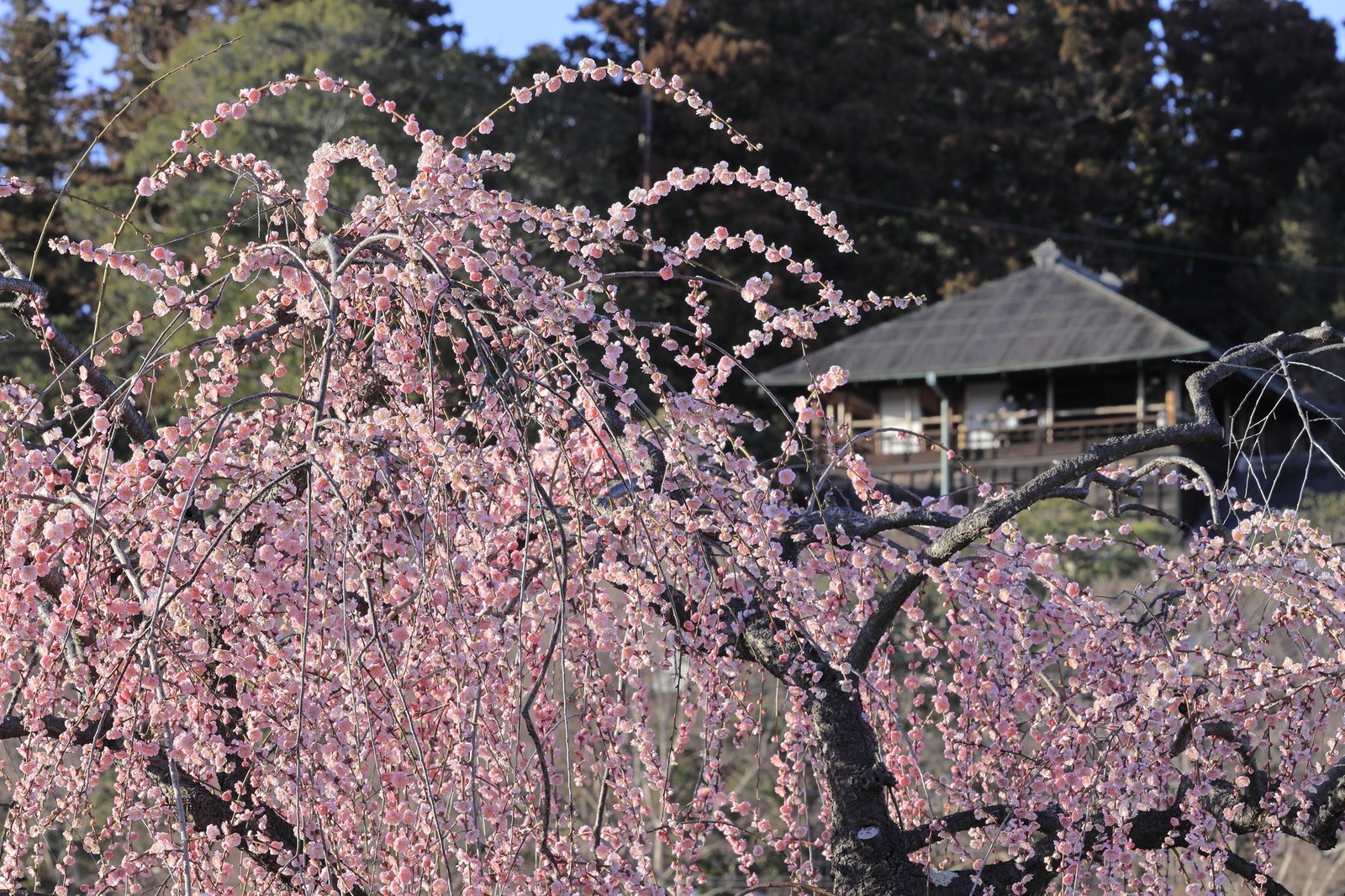
Mito city’s cultural properties page says Kairakuen was opened in 1842 by Tokugawa Nariaki, the ninth lord of the Mito domain, on a scenic site he chose beside Lake Senba, and that it was planned as the place of rest paired with the domain’s school, the place of study (Mito City Board of Education, Tokiwa Park (Kairakuen) (in Japanese)). The prefecture’s board of education adds that ordinary people were allowed in on set days (Ibaraki Prefectural Board of Education, Tokiwa Park (in Japanese)).
Who this is for: travellers going from Mito Station by bus who want to know which stop serves which gate, what to see on the way to Koubuntei and how the garden got its name.
The short version: the bus company’s route 10 leaves Mito Station’s north exit from stand 4 and stops near both the front gate and the east gate. Enter by the front gate to walk through the bamboo and cedar woods before the plum trees, as the city describes. Garden and Koubuntei hours and fees differ, so check each before you go.
Front gate, east gate and Koubuntei
| If… | Then lean towards… | Check |
|---|---|---|
| You want the walk the city describes, from shade into the plum trees | Get off at the stop for the front gate of Koubuntei | Bus company, route 10 timetable (in Japanese) |
| You want the shortest way to the plum grove | Get off at one of the two stops for the east gate and Tokiwa Shrine | Bus company, route 10 timetable (in Japanese) |
| You want to go inside Koubuntei | Allow for its own hours and fee, separate from the garden’s | Ibaraki Prefecture, Koubuntei (in Japanese) |
| You use a wheelchair | Plan to see Koubuntei’s front garden and the waiting area of its tea room, not the inside | Ibaraki Prefecture, Kairakuen FAQ (in Japanese) |
Times, hours and fees
| Item | Time or fee | Where to check |
|---|---|---|
| Garden opening hours | Check official | Ibaraki Prefecture, Kairakuen FAQ (in Japanese) |
| Garden admission | Check official | Ibaraki Prefecture, Kairakuen FAQ (in Japanese) |
| Koubuntei opening hours and closing days | Check official | Ibaraki Prefecture, Koubuntei (in Japanese) |
| Koubuntei admission | Check official | Ibaraki Prefecture, Kairakuen FAQ (in Japanese) |
| Bus times on route 10 | Check official | Bus company, route 10 timetable (in Japanese) |
- Seasons: the prefecture’s pages give one set of hours from mid-February to 30 September and another from 1 October to mid-February, for both the garden and Koubuntei.
- Which part is paid: the prefecture’s FAQ says the paid area is the main garden, not including Sakurayama and Maruyama.
- Before you go: read the prefecture’s FAQ for the hours and admission of the season you plan to visit (Ibaraki Prefecture, Kairakuen FAQ (in Japanese)).
What to do: decide on the front gate or the east gate before you board, since they have different stops. Where to verify: the bus company’s route 10 timetable (in Japanese).
Getting there and how long it takes
- The bus: the bus company runs route 10 from Mito Station via the old domain school and the prefectural history museum to Kairakuen and on to Mito Kobun Terrace, then back to Mito Station, and says the route was extended to Mito Kobun Terrace from 1 April 2026 (Bus company, route 10 timetable (in Japanese)).
- Where to board: its guide to Mito Station lists route 10 at stand 4 of the north exit (Bus company, Mito Station bus stands (in Japanese)).
- The stops: the timetable lists, in order, the stop for the front gate of Koubuntei, a stop for the east gate and the north approach of Tokiwa Shrine, and a stop in front of Kairakuen and Tokiwa Shrine (Bus company, route 10 timetable (in Japanese)).
- Busy days: it says extra buses at busy times, such as the Mito plum festival, may run by a route that does not call at the old domain school or Mito Kobun Terrace (Bus company, route 10 timetable (in Japanese)).
What to do: before you leave the garden, check where and when to board for the return, since the route is a loop that goes back to Mito Station by other stops. Where to verify: the bus company’s timetable (in Japanese).
What to see
The city’s page describes the garden as built on the idea of yin and yang set out in Nariaki’s founding text: the shade of the bamboo grove and the cedar wood, and the brightness of the plum grove (Mito City Board of Education, Tokiwa Park (Kairakuen) (in Japanese)). Through the front gate, it says, come a quiet grove of moso bamboo and a wood of tall cedars; several garden gates lead on to Koubuntei. Koubuntei has three storeys, and only from the top floor, Rakujuro, does the view open, over the plum grove below and Lake Senba beyond the garden.
The prefecture’s board of education lists the rooms of Koubuntei: the lord’s room, a hall with lacquered edges where poetry gatherings were held, Taikoken, the tea room Karoan and Rakujuro on the third floor, with an arched bridge joining the main building to the inner quarters (Ibaraki Prefectural Board of Education, Tokiwa Park (in Japanese)). Outside it are about 3,000 plum trees with azaleas and bush clover, and, beyond the cedar wood, the front gate, the stone of Nariaki’s founding text, Sen’ekidai, the Senko Bosetsu stone and the spring Togyokusen. It says Koubuntei was destroyed in the war in 1945 and restored in 1957; the city’s page gives the rebuilding as 1958 (Mito City Board of Education, Tokiwa Park (Kairakuen) (in Japanese)).
The city says the garden was opened to the public in 1873 under the name Tokiwa Park, and that the area it lists includes Sakurayama and Maruyama across the Sakura River as well as the main garden (Mito City Board of Education, Tokiwa Park (Kairakuen) (in Japanese)).
What to do: climb to Rakujuro, the top floor of Koubuntei, for the view the city describes. Where to verify: the prefecture’s Koubuntei page (in Japanese) for its hours.
What the founding stone says
The prefecture’s garden site publishes Nariaki’s founding text with a summary in modern Japanese (Ibaraki Prefecture, Kairakuen-ki text and summary (PDF, in Japanese)). The text compares people to a bow and a horse: a bow stays strong because its string is drawn and then slackened, and a horse stays sound because it is ridden and then rested. Nariaki writes that he found the site on his first return to Mito as lord, with the peaks of Tsukuba to the west and Lake Senba to the south; that he planted several thousand plum trees there to make it the first place spring arrives; and that he named the garden Kairakuen because he wished to share its pleasures with many people. The summary dates the stone to the fifth month of 1839.
The back of the stone carries the rules. The summary gives them as: entry from six in the morning until ten at night; men and women to keep proper bounds; no drinking or rowdiness; no picking plum branches or fruit; no entering by palanquin unless ill; and no fishing or hunting.
What to do: when you reach the founding stone, which the prefecture’s board of education lists among the sights of the garden, look for the rules on its back. Where to verify: the prefecture’s PDF (in Japanese).
Why Koubuntei is named for the plum
The Japan Heritage portal says Nariaki planted plum trees, written as kobun, a name for the plum that stands for learning, both to please visitors and to urge them to study (Japan Heritage portal, Tokiwa Park (Kairakuen) (in Japanese)). The city’s page says Koubuntei was named after a story linking the plum and learning, and that people there enjoyed poetry and eased the strain of their studies (Mito City Board of Education, Tokiwa Park (Kairakuen) (in Japanese)).
What to do: look at the plum grove from Koubuntei with the name in mind. Where to verify: the Japan Heritage portal (in Japanese).
Official sources
| Topic | Source | Checked |
|---|---|---|
| Opening, layout, Tokiwa Park, Koubuntei rebuilding | Mito City Board of Education, Tokiwa Park (Kairakuen) | 2026-11-11 |
| Opening to the public, Koubuntei rooms, plum trees, stones | Ibaraki Prefectural Board of Education, Tokiwa Park | 2026-11-11 |
| The plum and learning | Japan Heritage portal, Tokiwa Park (Kairakuen) | 2026-11-11 |
| Founding text and rules | Ibaraki Prefecture, Kairakuen-ki text and summary | 2026-11-11 |
| Koubuntei hours | Ibaraki Prefecture, Koubuntei | 2026-11-11 |
| Garden hours, fees, paid area, wheelchair access | Ibaraki Prefecture, Kairakuen FAQ | 2026-11-11 |
| Route 10, stops, times | Bus company, route 10 timetable | 2026-11-11 |
| Bus stand at Mito Station | Bus company, Mito Station bus stands | 2026-11-11 |
What we have not verified
- The year Koubuntei was restored after 1945, which the prefecture’s board of education gives as 1957 and the city as 1958 (Ibaraki Prefectural Board of Education, Tokiwa Park (in Japanese); Mito City Board of Education, Tokiwa Park (Kairakuen) (in Japanese)).
- The walking time from each bus stop to its gate, which the bus company’s pages we used do not give (Bus company, route 10 timetable (in Japanese)).
- English names: Lake Senba, Tokiwa Park, Tokiwa Shrine, Sakurayama, Maruyama, the Sakura River, Mito Kobun Terrace, Rakujuro, Taikoken, Karoan, Sen’ekidai, Senko Bosetsu, Togyokusen and Tsukuba are our own romanisations from Japanese; Koubuntei follows the prefecture’s page (Ibaraki Prefecture, Koubuntei (in Japanese)).