Izumo Taisha, Shimane: the main hall, the tall shrine of the old accounts, and worship hours and access
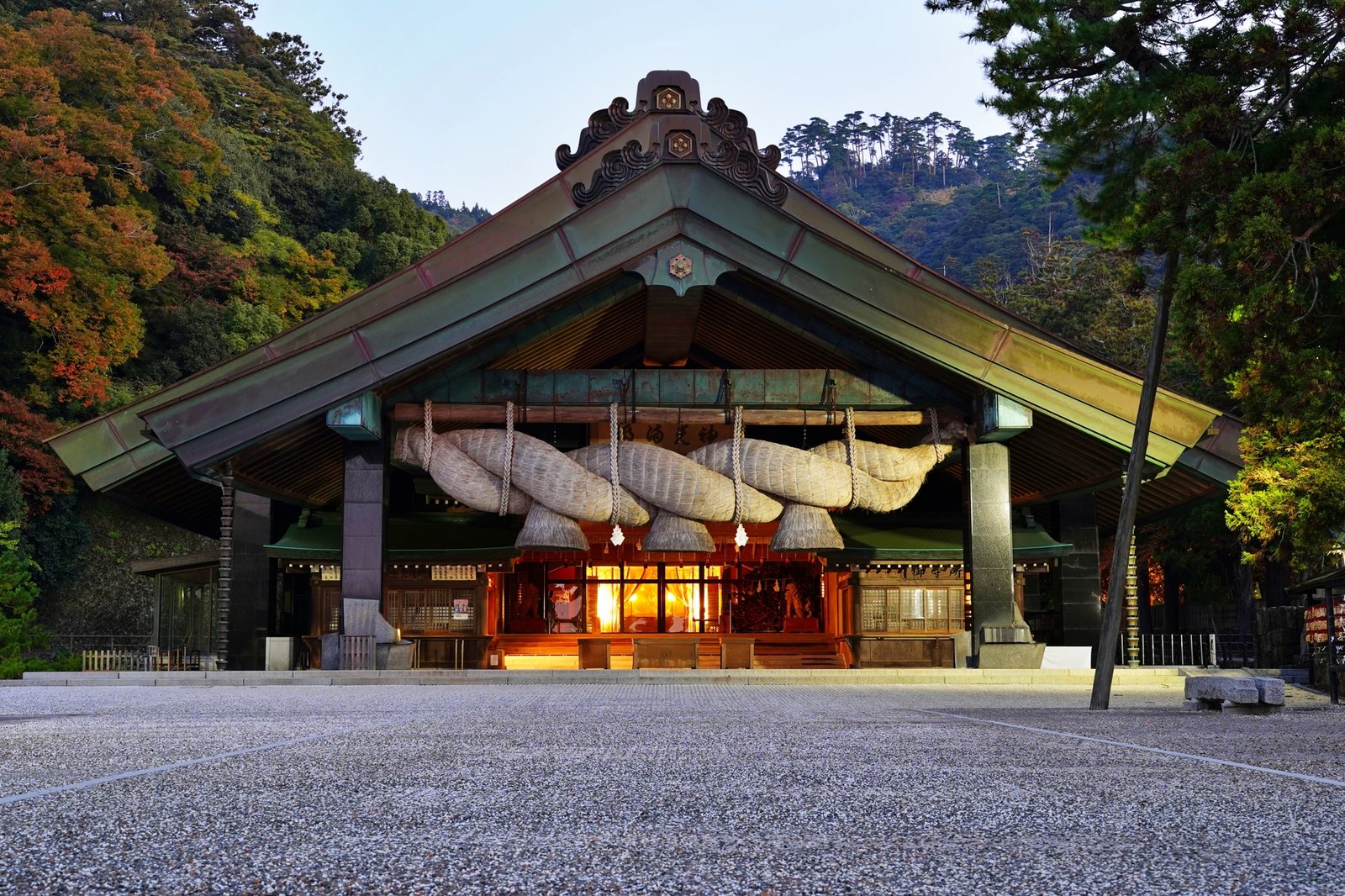
The main hall of Izumo Taisha stands 24 metres high, and the shrine says its ancient hall once rose to twice that. In the spring of 2000, during work in the grounds, a pillar made of three cedar trunks bound together came out of the ground, matching an old plan of that hall, and the central one now stands in the shrine’s Treasure Hall.
Who this is for: visitors to Shimane who want the shrine’s worship hours, prayer times and the bus from JR Izumo City Station before they go, and a short, sourced account of the founding story and of the tall hall in the shrine’s records.
The short version: on the shrine’s notice of 3 May 2026, as fetched on 2026-11-09, the grounds are open for worship from 6:00 to 19:00, and the area behind the main hall closes at 16:30. By public transport, take the Ichibata Bus from JR Izumo City Station, about 25 minutes. Always follow the official pages linked below.
Which time and which way in fit your visit
| If… | Then lean towards… | Check |
|---|---|---|
| You want to walk around the main hall and the shrines behind it | Arriving before 16:30, when the area behind the main hall closes | Worship hours notice |
| You arrive after 19:00 | Worship from in front of the bronze torii, since the inner fenced area is closed | Worship hours notice |
| You want an amulet, a talisman or a shrine stamp | The office hours of 8:30 to 16:30, or the temporary counter early in the morning and in the evening | Worship hours notice |
| You want a prayer ceremony | The prayer times below, which differ between two of the shrine’s pages | Worship hours notice |
| You need a wheelchair | The free loan at the shrine office, 8:30 to 16:30 | FAQ |
| You are arriving by train | The Ichibata Bus from JR Izumo City Station, about 25 minutes | Access |
Worship hours, prayers, fees and closures
All values below are from the shrine’s own pages as fetched on 2026-11-09.
| Item | Detail | Where to check |
|---|---|---|
| Worship hours | 6:00 to 19:00 | Worship hours notice |
| Area behind the main hall | Closes at 16:30 | Worship hours notice |
| After 19:00 | The inner fenced area is closed; worship from in front of the bronze torii | Worship hours notice |
| Amulets, talismans and shrine stamps | 8:30 to 16:30; temporary counter 6:30 to 8:30 and 16:30 to 19:00 | Worship hours notice |
| Prayer ceremonies (worship hours notice) | 9:15 to 16:30, held every 45 minutes from 9:15; reception 8:40 to 16:00 | Worship hours notice |
| Prayer ceremonies (FAQ) | 9:00 to 16:00, held every day at no fixed times; reception from 8:30 | FAQ |
| Prayer offering | 5,000 yen, 8,000 yen, or 10,000 yen and over, as you wish; group prayers differ | FAQ |
| Admission | Check official | Worship hours notice |
| Closed days | Check official | Worship hours notice |
| Treasure Hall hours and fees | Check official | Worship hours notice |
| Wheelchair loan | Free, 8:30 to 16:30, at the shrine office | FAQ |
| Parking | Three car parks for 385, 360 and 20 cars; fees: check official | Access |
- Prayer times on two pages: the worship hours notice dated 3 May 2026 and the FAQ give different prayer and reception times, as shown in the two rows above.
- Prayer offerings: the FAQ gives the amounts for an individual prayer and asks groups to phone, since group prayers have different offerings.
- Wheelchairs: the loan is free and for use inside the shrine grounds only.
- Worship: the FAQ gives the shrine’s form of worship as two bows, four claps and one bow.
What to do: plan to be behind the main hall before 16:30, and pick one of the two prayer timetables only after checking the pages on the day. Where to verify: the worship hours notice and the FAQ.
Getting there
The shrine’s English pages give its address as 195 Kizuki-Higashi, Taisha, Izumo City, Shimane Prefecture, 699-0701.
- By train and bus: the shrine’s access page gives JR Izumo City Station, then the Ichibata Bus, about 25 minutes; the English access page gives the bus as bound for Izumo Oyashiro Shrine or Hinomisaki. The English access page names the stop to get off at as the Seimon-mae bus stop, with the bus leaving from bus stop No. 1.
- To JR Izumo City Station: the English access page gives the Shinkansen to Okayama Station and a change to the Yakumo Express.
- By air: the access page gives the airport bus from Izumo Airport to JR Izumo City Station, about 25 minutes, then the Ichibata Bus.
- By car: the access page gives the Izumo interchange on the expressway, then national route 431. Parking is in the three car parks above.
What to do: check bus times and fares with the bus operator before you travel. Where to verify: the shrine’s access page and the English access page.
How the shrine came to be, in its own account
The shrine’s page on its deity says Okuninushi no Kami, known widely as Daikoku-sama, opened up the land with the people in the age of the gods, and is now revered as a god of en-musubi, the tying of bonds, which the shrine says means not only bonds between men and women but the ties by which all living things flourish together (deity page). The shrine says that after the land was handed over to Amaterasu Omikami in the kuni-yuzuri, a grand hall was built for Okuninushi no Kami, and its history page says the Kojiki (712) and the Nihon shoki (720) describe the hall’s thick boards and long pillars (history page). The shrine gives no year for its founding; the FAQ says the name is commonly read Izumo Taisha and formally Izumo Oyashiro (FAQ). The English pages say the shrine was called Kizuki no Oyashiro in earlier times, that the present main hall dates from works completed in 1744, and that the name was changed to Izumo Oyashiro in 1871 (English pages).
What to do: read the founding as the shrine’s own account. Where to verify: the deity page, the history page and the English pages.
The main hall and the great rope at the Kaguraden
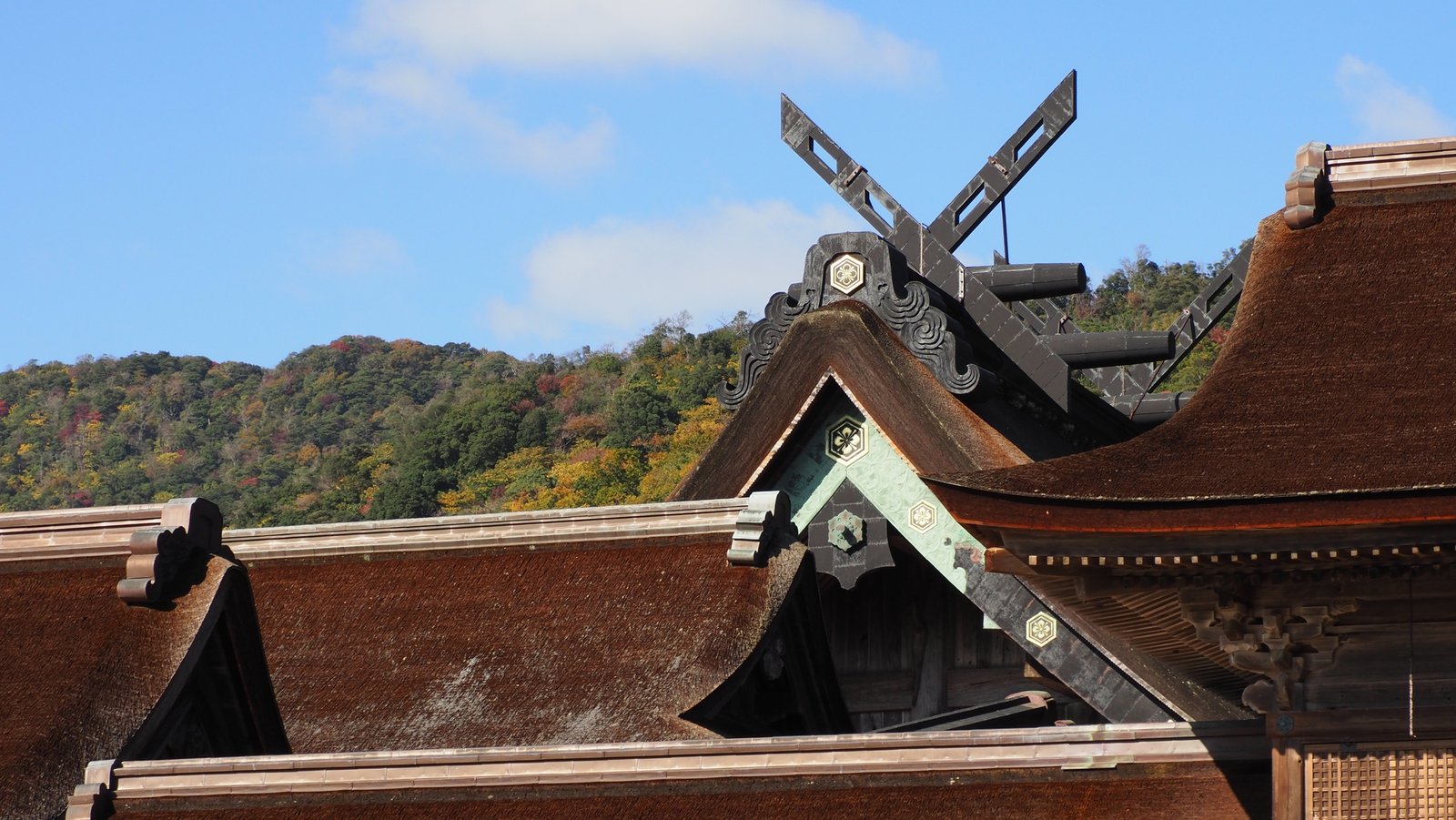
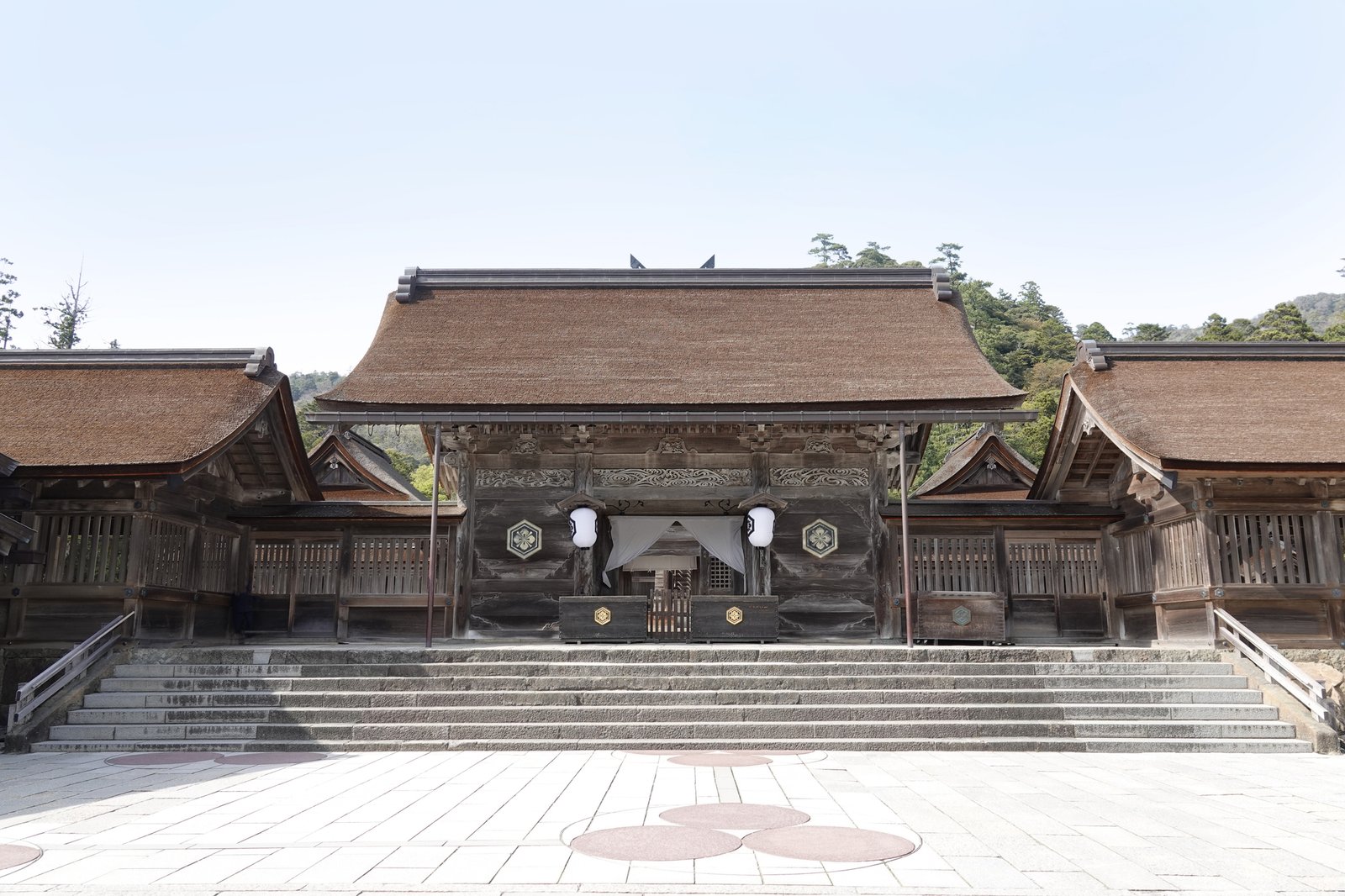
The shrine’s page on the main hall says the present hall was built in 1744 and designated a National Treasure in 1952. It is 24 metres high and keeps the Taisha style of shrine building: a gabled roof with the entrance on the gable end, and a square plan of nine pillars arranged like the character for a rice field, with a thick central pillar called the shin-no-mihashira. The seat of the deity inside faces west, not south like the hall.
The great sacred rope at the front of the Kaguraden, another hall in the grounds, is given two sets of figures on two of the shrine’s pages:
| Rope | Length | Weight | Source |
|---|---|---|---|
| Kaguraden rope (Kaguraden page) | About 13 metres | 5.2 tonnes | Kaguraden page |
| Kaguraden rope (FAQ) | 13.6 metres | 4.7 tonnes | FAQ |
| Rope at the hall of worship (FAQ) | 6.5 metres | 1 tonne | FAQ |
What to do: see the main hall from in front of the yatsuashi-mon gate, and the great rope at the front of the Kaguraden. Where to verify: the main hall page and the Kaguraden page.
Why the old main hall is said to have been so tall
The pillar on show in the Treasure Hall is the central pillar of the ancient main hall, which the FAQ says was taken up after it came to light in front of the yatsuashi-mon gate in the spring of 2000 (FAQ). The shrine’s main hall page says that in ancient times three large trees were bound with iron rings into one pillar, and the hall stood 48 metres high, or 16 in the old unit of length (main hall page). Its history page puts the heights as the shrine’s tradition: about 96 metres (32 old units) in the oldest times and about 48 metres (16 old units) after that (history page). The same page says the textbook Kuchizusami listed the large buildings of its day with the Izumo hall first, and the English pages describe it as a tenth-century text that puts the hall above the Daibutsuden (Great Buddha Hall) at Todaiji Temple (history page, English pages). The main hall page says a plan of the ancient hall handed down in the family of the shrine’s chief priests shows the hall, and the history page says the pillar found in 2000, three cedar trunks each about 135 centimetres across bound into one, was just as that plan drew it (main hall page, history page).
What to do: see the central pillar in the Treasure Hall and, outside, the spot in front of the yatsuashi-mon gate where it was found. Where to verify: the FAQ and the history page.
Official sources
| Topic | Source | Checked |
|---|---|---|
| Deity page: Okuninushi no Kami, en-musubi, the hall built after the handing over of the land | izumooyashiro.or.jp/ookami/ | 2026-11-09 |
| Worship hours notice of 3 May 2026: worship hours, closing areas, counters, prayers, wheelchairs | izumooyashiro.or.jp/archives/news/12552 | 2026-11-09 |
| Access page: bus, air and car routes, parking | izumooyashiro.or.jp/access/ | 2026-11-09 |
| Main hall page: 1744, National Treasure in 1952, height and Taisha style, ancient pillar and hall height, plan | izumooyashiro.or.jp/keidai-index/gohonden | 2026-11-09 |
| Kaguraden page: size and weight of the great rope | izumooyashiro.or.jp/keidai-index/kaguraden | 2026-11-09 |
| History page: the Kojiki and Nihon shoki, the 96-metre and 48-metre traditions, Kuchizusami, the pillar found in 2000 | izumooyashiro.or.jp/history/ | 2026-11-09 |
| FAQ: readings of the name, rope sizes, worship form, prayers and offerings, wheelchairs, where the pillar was found and is shown | izumooyashiro.or.jp/faq/ | 2026-11-09 |
| English pages: address, Kizuki no Oyashiro, Kuchizusami and Todaiji, 1744 works, 1871 name change | izumooyashiro.or.jp/en | 2026-11-09 |
| English access page: bus stop names, rail route to JR Izumo City Station | izumooyashiro.or.jp/en/access/ | 2026-11-09 |