Place name in Japanese: 一乗谷, Ichijōdani.
Ichijodani, Fukui: the Asakura valley, its stone gates, the restored street and a cherry-blossom poetry gathering
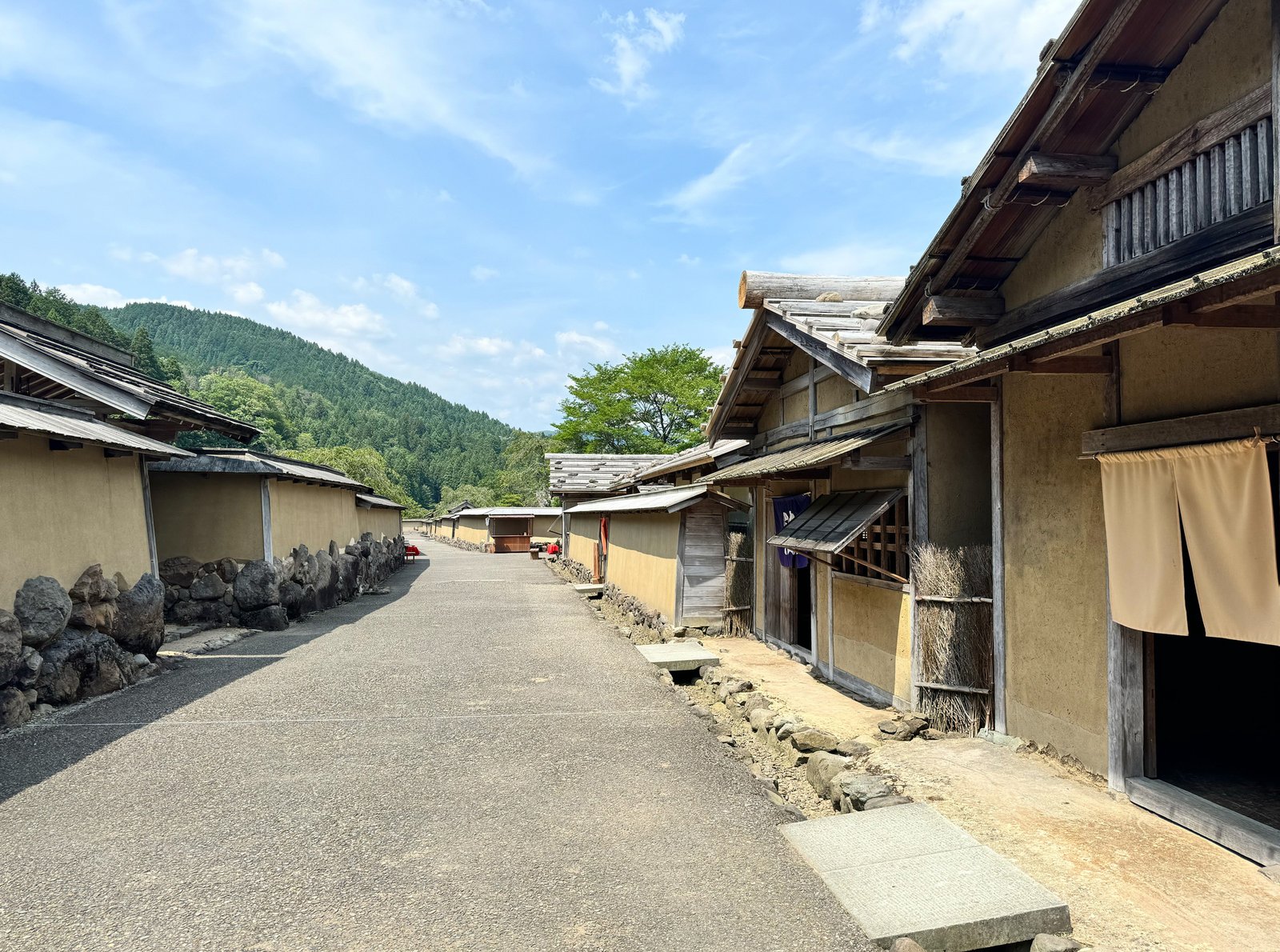
Ichijodani is a narrow valley south of central Fukui City where the Asakura clan, the warlords of Echizen, kept their base. The national cultural properties database describes it as a place where mountains close in from east and west and a strip of narrow flat land runs along the Ichijodani River, which flows north, and says that from 1471 it was the Asakura base for five generations and 103 years (Agency for Cultural Affairs, Ichijodani special historic site entry (in Japanese)).
Who this is for: travellers with half a day or a day in Fukui who want to walk the remains of a Sengoku-period castle town, see a restored street, and visit the prefectural museum on the site.
The short version: go by the JR Etsumi-hoku Line to Ichijodani Station or by Keifuku Bus route 62 from Fukui Station. The restored street charges admission; the museum has its own ticket, and the city lists a combined ticket for both. Walk between the gates of the valley, look at the gardens, and look for the site of Nanyoji, where a shogun-to-be was entertained under cherry trees.
Train, bus or car: choose your way
| Your situation | Our suggestion | Where to check |
|---|---|---|
| You come by train from Fukui | The JR Etsumi-hoku Line to Ichijodani Station; the museum gives 3 minutes on foot from the station to the museum, and the city gives about 15 minutes on foot to the restored street | Fukui Prefecture, museum access page (in Japanese) |
| You come by bus from Fukui | Keifuku Bus route 62, the Ichijodani-Togo Line, which calls at the museum, Asakura-yakata-mae and the restored street | Keifuku Bus, route 62 sheet for weekdays (PDF, Japanese only) |
| You come by car | From the Fukui interchange of the Hokuriku Expressway along Route 158 toward Ono; the museum gives about 10 minutes | Fukui Prefecture, museum access page (in Japanese) |
| You want the museum and the restored street | The combined ticket the city lists for both | Fukui City, admission FAQ (in Japanese) |
Hours, fees and buses to confirm
| Item | Value | Where to check |
|---|---|---|
| Restored street admission and combined ticket | Check official | Fukui City, admission FAQ (in Japanese) |
| Restored street hours and closing days | Check official | Fukui City, Ichijodani in the Kirin ga Kuru guide (in Japanese) |
| Museum hours, closing days and admission | Check official | Fukui Prefecture, museum visitor guide (in Japanese) |
| Bus route 62 times on weekdays | Check official | Keifuku Bus, route 62 sheet for weekdays (PDF, Japanese only) |
| Bus route 62 fares | Not verified (see below) | Keifuku Bus, route 62 fare sheet (PDF, Japanese only) |
| Train times | Not verified (see below) | Fukui Prefecture, museum access page (in Japanese) |
- The museum’s closing days: the museum’s guide says its closing days may change and points to its opening calendar (Fukui Prefecture, museum visitor guide (in Japanese)).
- Buses: the city’s page notes that trains and buses are few (Fukui City, Ichijodani in the Kirin ga Kuru guide (in Japanese)). The museum gives the bus stop at Fukui Station West Exit for route 62 (Fukui Prefecture, museum access page (in Japanese)).
- Before you go: look up your return bus or train for the day you travel, and check the museum calendar if you come on a Monday.
What to do: on route 62, choose between the museum stop and the restored street stop before you board, since the bus calls at both. Where to verify: the operator’s sheet for weekdays (PDF, Japanese only).
The gates that closed the valley
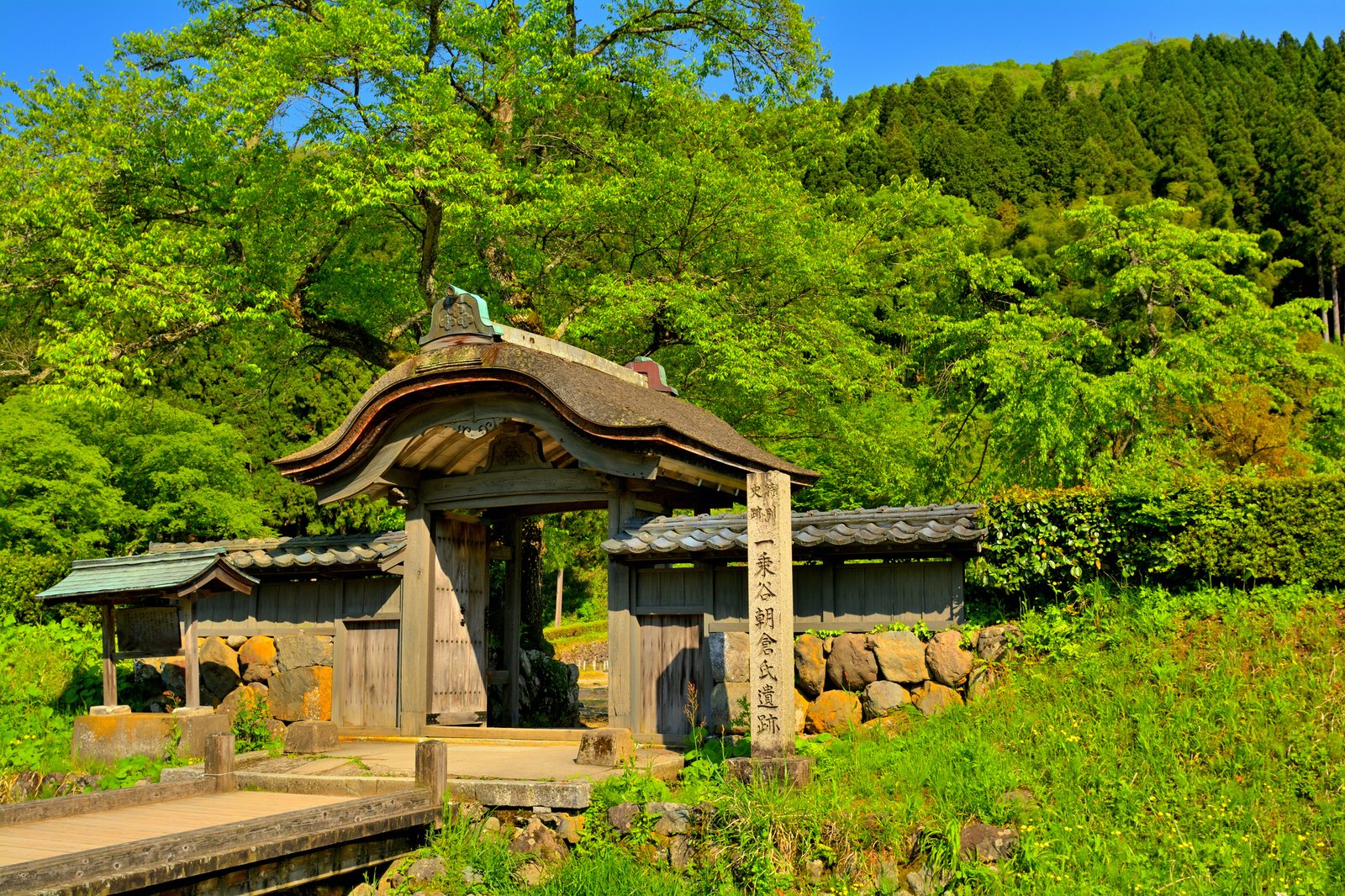
The database entry says the gates, or kido, stood north and south of the Asakura residence as earthworks crossing the valley from east to west: the lower gate to the north and the upper gate to the south (Agency for Cultural Affairs, Ichijodani special historic site entry (in Japanese)). The stretch between them, about 1.5 km long, was the heart of Ichijodani and was called the Kido-no-uchi, inside the gates. At the lower gate, a wall of huge stones forms a staggered entrance. The castle stood on top of Mt. Ichijojo behind the residence, to the east, with four enclosures, including the main one, along the ridge.
The prefectural museum’s page adds that the lower gate at the foot of the mountain has a square entrance of piled great stones, and that the castle on the mountain to the east was protected by vertical moats (Fukui Prefecture, museum page on the site (in Japanese)).
What to do: walk from the lower gate to the restored street, inside the stretch the database calls the Kido-no-uchi. Where to verify: the database entry (in Japanese).
The restored street and the samurai house
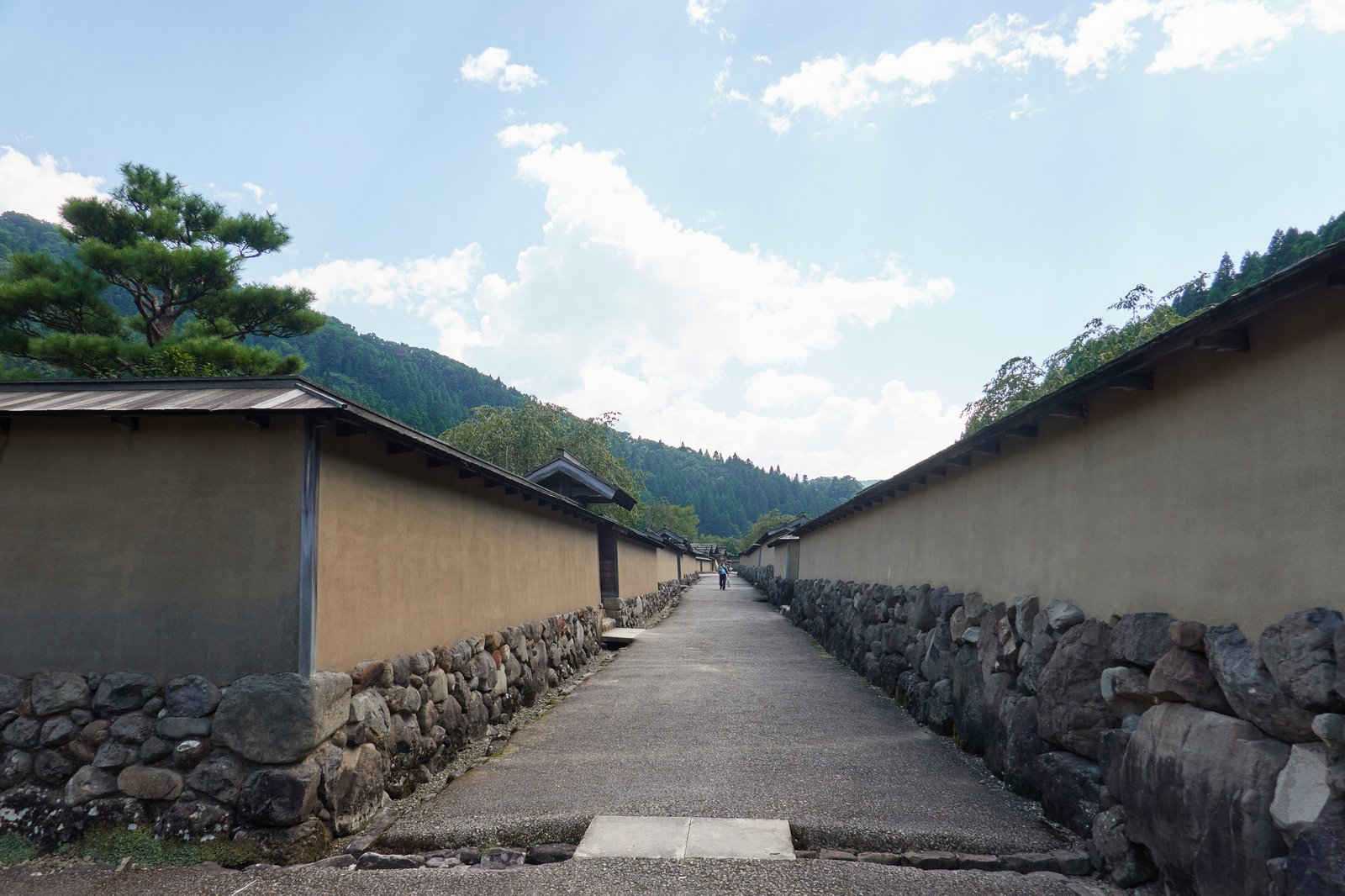
The city’s page says the restored street rebuilds samurai residences and townhouses of craftsmen and others on the basis of the excavations; the stone bases of the walls and the foundation stones are the ones excavated, and the pillars, walls and fittings were restored on the basis of excavated finds (Fukui City, Ichijodani in the Kirin ga Kuru guide (in Japanese)).
The museum’s page describes the restored samurai house as a medium-sized residence on a plot 30 m by 30 m (Fukui Prefecture, museum page on the site (in Japanese)). The excavation found gates at two points in the earthen wall, a main house 11.3 m by 7.5 m in the middle, and a tea room one and a half ken square and a garden in the south-east corner; a storehouse, a well and a toilet have also been rebuilt. The house stands on 60 cm of earth laid over the excavated remains. The same page says the roads had turns, T-junctions and dead ends for defence, and that a unit of 30 m, or 100 shaku, was used in laying out the town.
What to do: in the samurai house, look for the tea room in the corner and the well and toilet, which the museum names among the rebuilt parts. Where to verify: the museum’s page (in Japanese).
Designations: the site, the gardens and the finds
The national cultural properties database lists the Ichijodani Asakura Family Site as a Special Historic Site, first designated on 8 July 1930, made a special designation on 29 July 1971 and extended on 23 July 2009, in Kidonouchi-cho, Abaka-cho, Higashi-shinmachi and Nishi-shinmachi in Fukui City (Agency for Cultural Affairs, Ichijodani special historic site entry (in Japanese)).
It lists the Ichijodani Asakura Family Gardens as a Special Place of Scenic Beauty, first designated on 8 July 1930 and made a special designation on 28 May 1991, and describes the remains of residences and gardens revealed by excavation as showing the culture of the warlords at the end of the Muromachi period (Agency for Cultural Affairs, Asakura gardens entry (in Japanese)). The museum’s page names the four gardens: the Asakura-yakata, Yudono, Suwa-yakata and Nanyoji gardens, and says that no documents about the Yudono site survive, so it is not known when it was built or who lived there (Fukui Prefecture, museum page on the site (in Japanese)).
The database also lists the excavated objects from the site, 2,343 principal items from the Asakura residence and the townhouse area, as an Important Cultural Property, designated on 8 June 2007, owned by Fukui Prefecture and kept at the Fukui Prefectural Ichijodani Asakura Family Site Museum (Agency for Cultural Affairs, excavated objects entry (in Japanese)). Its commentary says the objects include imported ceramics from China, Korea and Thailand, shogi pieces, and gun bullets found at a gunsmith’s house together with the lead rods used as their raw material.
Five generations in a narrow valley
The database entry gives the story of the site in its commentary (Agency for Cultural Affairs, Ichijodani special historic site entry (in Japanese)). In 1471 Asakura Toshikage moved his residence here from Kuromaru Castle, and Ichijodani remained the Asakura base for five generations and 103 years. The shogun Ashikaga Yoshiaki once came here seeking protection, and in the first year of Tensho the Asakura were destroyed by Oda Nobunaga. The commentary explains that a long valley running north and south, with the Ichijodani River flowing north through a strip of flat land, was easy to defend and was often chosen as a base by medieval lords. The gardens entry gives the years of the Asakura base as 1471 to 1573 (Agency for Cultural Affairs, Asakura gardens entry (in Japanese)).
What to do: stand on the valley floor near the Asakura residence and look at how close the mountains are on both sides. Where to verify: the database entry (in Japanese).
The poetry gathering under the cherry trees
The database entry records the site of Nanyoji on high ground east of the Asakura residence, and says it is handed down as the place where Asakura Yoshikage held a cherry-blossom viewing banquet for Ashikaga Yoshiaki, with part of its old garden remaining (Agency for Cultural Affairs, Ichijodani special historic site entry (in Japanese)). The prefectural museum’s page tells it in more detail (Fukui Prefecture, museum page on the site (in Japanese)): Nanyoji was a nunnery for daughters of the Asakura family, and in the third month of 1568 it is said to have entertained Yoshiaki, later the fifteenth shogun, with a poetry gathering while viewing the weeping cherry trees in its grounds.
What to do: at the Nanyoji garden, remember the poetry gathering said to have been held there. Where to verify: the museum’s page (in Japanese).
Official sources
| Topic | Source | Checked |
|---|---|---|
| Special historic site, the gates, the castle, the story of the Asakura, Nanyoji | Agency for Cultural Affairs, Ichijodani special historic site entry | 2026-11-14 |
| Special place of scenic beauty, the years of the Asakura base | Agency for Cultural Affairs, Asakura gardens entry | 2026-11-14 |
| Excavated objects | Agency for Cultural Affairs, excavated objects entry | 2026-11-14 |
| Restored street, its hours and closing days, train and bus notes | Fukui City, Ichijodani in the Kirin ga Kuru guide | 2026-11-14 |
| Admission and the combined ticket | Fukui City, admission FAQ | 2026-11-14 |
| Museum hours, closing days, admission | Fukui Prefecture, museum visitor guide | 2026-11-14 |
| Train, bus and car routes | Fukui Prefecture, museum access page | 2026-11-14 |
| Gates, samurai house, roads, the four gardens, Nanyoji | Fukui Prefecture, museum page on the site | 2026-11-14 |
| Bus route 62 weekday times | Keifuku Bus, route 62 sheet for weekdays (PDF) | 2026-11-14 |
| Bus route 62 fares | Keifuku Bus, route 62 fare sheet (PDF) | 2026-11-14 |
What we have not verified
- Train times: the museum’s access page points to a railway timetable, which we did not read (Fukui Prefecture, museum access page (in Japanese)).
- Weekend buses: we read only the weekday timetable for route 62; the operator also lists Saturday and Sunday or holiday timetables (Keifuku Bus, route 62 page (Japanese only)).
- Walking times: the museum gives 3 minutes from Ichijodani Station to the museum and the city gives about 15 minutes to the restored street; we did not walk them (Fukui City, Ichijodani in the Kirin ga Kuru guide (in Japanese)).
- Bus fares: the operator’s fare sheet for route 62 is a grid of stops, and we could not read the fare between Fukui Station and the site from it with certainty (Keifuku Bus, route 62 fare sheet (PDF, Japanese only)).
- Height of the castle mountain: the database commentary gives 435 m for the summit of Mt. Ichijojo, and the museum’s page gives 473 m for the mountain on which the castle was built; we have not settled which to use, so neither figure appears above (Fukui Prefecture, museum page on the site (in Japanese)).
- Names: Ichijodani, Asakura, Echizen, Ichijodani River, Kido-no-uchi, Mt. Ichijojo, Kuromaru Castle, Asakura Toshikage, Asakura Yoshikage, Ashikaga Yoshiaki, Oda Nobunaga, Nanyoji, Asakura-yakata, Yudono, Suwa-yakata, Kidonouchi-cho, Abaka-cho, Higashi-shinmachi, Nishi-shinmachi, Etsumi-hoku Line, Ichijodani-Togo Line and Asakura-yakata-mae are our romanizations of the Japanese names on the pages above.