Hikonejo in Hikone, Shiga: a keep thought complete by 1606, a World Heritage nomination still in progress, and visiting details
Who this is for: A reader planning a visit to Hikonejo in Hikone, Shiga prefecture, who wants to know from official pages what the keep is, why the castle is being put forward for World Heritage, and what the hours, fees and climb involve, as listed when we checked on 2026-11-09.
The short version: The keep of Hikonejo is a national treasure, designated on 29 March 1952, and the Agency for Cultural Affairs’ heritage database says it is thought to have been complete by 1606 at the latest. On 3 September 2026, Hikone city reports, a council under the Agency for Cultural Affairs provisionally selected the castle to be put forward as Japan’s World Cultural Heritage nomination. That is a domestic nomination, not a registration: the city’s schedule points to a decision in 2028. The castle is about 15 minutes’ walk from JR Hikone station, and on 2026-11-09 the castle’s official site listed general admission at 1,000 yen.
What the official pages answer, and what they leave to you
| If… | Then lean towards… | Check |
|---|---|---|
| You want to know how old the keep is | Completed by 1606 at the latest, as the Agency’s database puts it; the city gives around 1606–07 | Agency for Cultural Affairs, heritage database |
| You want to know whether it is a World Heritage site | Not registered: it is Japan’s nomination, with a decision expected no earlier than 2028 on the city’s schedule | Hikone city |
| You are planning the day | The hours and fees below, as listed on 2026-11-09 | Castle official site |
| You or someone with you has limited mobility | Expect about 50 metres of climb with no lifts; the city says wheelchair users cannot visit the keep’s interior | Hikone city |
A castle built over about 20 years
Hikone city’s cultural-property page says construction of the castle began early in the 17th century and took about 20 years to complete. The official sources differ on the exact start year and on which member of the ruling clan began the work, so this page leaves both to them. The castle was the seat of that ruling family through the Edo period, according to the Agency for Cultural Affairs’ entry for the castle site.
The Agency’s commentary on the keep adds a short record of what happened afterwards: a roof repair in 1796, reinforcement work in 1841, and, in 1878, a narrow escape from demolition, after which the keep survived to the present.
The designations came in the 1950s. The keep, with its attached turrets, is a national treasure under the official designation covering the keep and its attached turrets, designated an important cultural property on 22 September 1951 and a national treasure on 29 March 1952; the city of Hikone is the owner. The castle site was designated a historic site on 9 June 1951 and a special historic site on 19 July 1956, with an addition on 1 March 2016, according to the city.
To read the full designation records, start from the Agency’s database and the city’s cultural-property page.
Reading the place: white plaster, gold fittings and moved buildings
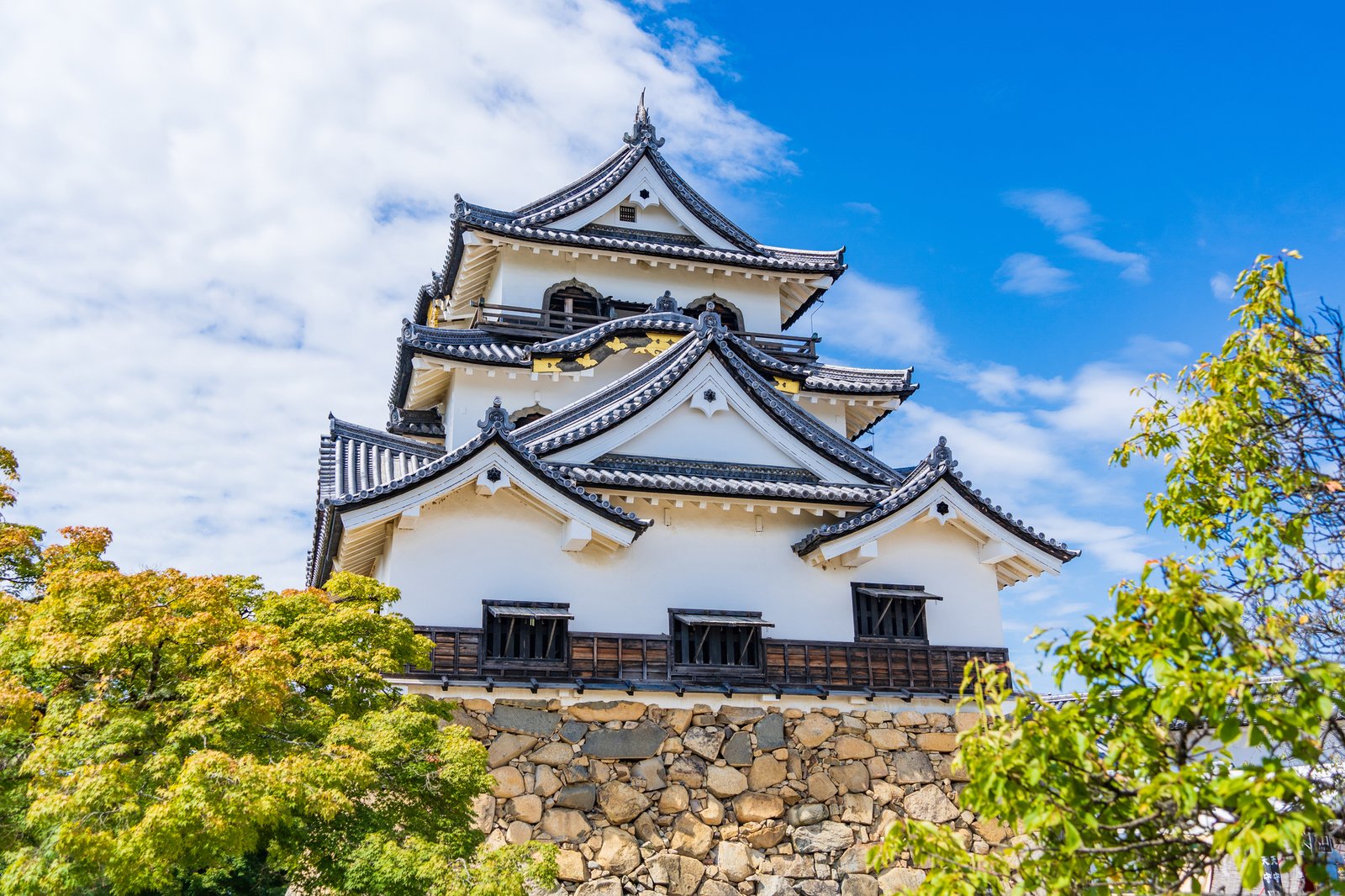
Start with the keep. The Agency’s database describes three roofs over three storeys, with a basement stairwell and an entrance, and walls, eave undersides and gables finished in plaster, with gold-leaf ornamental fittings and black lacquer used freely. The castle’s official site gives its height as 20.5 metres, including 5 metres of stone walls.
Some of what you see may have come from elsewhere. The Agency’s commentary records that brushed inscriptions dated 1606 have been found in the keep, and that the keep is said to have been moved from an earlier castle when Hikonejo was built. Many old timbers are used in the present keep, the commentary notes, and it treats the relocation theory as broadly accepted, while adding that the building date of that earlier castle itself is not clear. Hikone city puts it the same way, as a presumption: after the survey made during the dismantling repair of 1960, the keep is presumed to have been moved from that earlier castle.
The gate called Taikomon is a firmer case of reuse, though the source is unnamed: the city writes that a survey of its parts during dismantling repair showed it had been moved from a castle gate somewhere. At Tenbin-yagura, the city points to the stone walls: looking from the dry moat side, the right-hand side is stonework from the time the castle was built, laid in the style named on the city’s page.
Inside the keep, the reuse gives way to a practical detail. The castle’s official site gives the stair angles as 62 degrees from floor one to floor two and 60 degrees from floor two to floor three.
Two smaller buildings carry their own stories. The stable is an important cultural property designated on 1 July 1963, according to the city. And at Umoregi-no-ya, the city explains, the figure who later became the 13th head of the ruling family spent 15 years from the age of 17 to 32. The 14th son of the 11th head, he was moved here after his father died, named the house himself, and studied Zen, martial arts, noh and kyogen, Japanese classical studies and waka poetry, pottery and the tea ceremony.
To see these, walk from the keep to Taikomon and Tenbin-yagura, and read the city’s cultural-property page and the Agency’s entries before you go.
- Official: Agency for Cultural Affairs, keep · Agency for Cultural Affairs, commentary · Hikone city · Castle official site
World Heritage: a nomination about more than the keep
Hikone city has worked towards World Heritage listing for more than 30 years: it writes that the castle was placed on Japan’s World Heritage tentative list in 1992. On 3 September 2026, the city reports, a council body under the Agency for Cultural Affairs issued a report provisionally selecting the castle to be put forward as Japan’s World Cultural Heritage nomination.
That is the stage the castle is at now: a domestic nomination, with registration not yet decided. The city’s expected schedule runs as follows: a provisional nomination dossier to UNESCO by 30 September 2026; in 2027, approval by the Cabinet in Japan, the formal dossier to UNESCO by 1 February, and an ICOMOS review including a site visit; and in 2028, a decision at the World Heritage Committee. Shiga prefecture, which submitted the draft nomination dossier (fifth edition) with the city on 25 May 2026, lists a registration review at the World Heritage Committee in fiscal year 2028 and writes that the specific review and schedule are not yet decided.
What is being put forward is more than the keep. The city’s newsletter says the aim covers the political zone, which it defines as the area inside the middle moat. The palace there was where the lord and his senior retainers discussed government together, and also where the lord lived. In the mayor’s statement of 3 September 2026, the city describes a system of rule in which the lord and powerful retainers kept residences at the core of the castle and governed by council, and says that the palace site, retainers’ residence sites, moats, stone walls, keep and turrets at Hikonejo preserve it as a whole.
Follow the city’s World Heritage page for each step, and do not treat the castle as registered until an official page says so.
Hours, fees and the climb (as listed on 2026-11-09)
These figures come from the castle’s official site, run by the castle’s management body, and the city’s visitor page (updated 2025-12-30), both checked on 2026-11-09. The fees apply from 1 October 2024.
| Item | As listed on 2026-11-09 |
|---|---|
| Opening hours | 8:30–17:00, last entry 16:30 |
| Building interiors (keep, Tenbin-yagura, Taikomon, western three-storey turret, stable) | Close at 16:45 |
| Days open | Every day of the year (the Hikone City Museum of History closes 25–31 December, per the official site) |
| Castle ticket, including the garden: general | 1,000 yen |
| Castle ticket, including the garden: elementary and junior high school students | Check official |
| Set ticket with the castle museum: general | Check official |
| Garden alone: general | Check official |
| Groups of 30 or more | 20% off the individual price |
| Hikone City Museum of History and the stable | Free |
- The climb: the city says there is a height difference of about 50 metres from the paid-area entrance to the keep, and no lifts or similar facilities. The official site counts about 140 stone steps to the top.
- Wheelchairs: the city says wheelchair users cannot visit the keep on their own, and cannot visit the keep’s interior even with assistance.
- Inside the buildings: no outdoor shoes in the keep and turrets; umbrellas and walking sticks may not be taken into the keep, though folding ones are allowed. Drones may not be flown.
- Closures: the city may close all or part of the viewing area at short notice for bad weather or repairs.
Before you go, check the official site and the city’s visitor page for your date.
Getting there
The castle’s official site and the Hikone tourism association both give about 15 minutes on foot from JR Hikone station. Travelling by shinkansen, change at Maibara and take a JR conventional line to Hikone station, about 5 minutes. There are three entrances with ticket offices; the official site says the front gate is closest to Hikone station. The official site also lists a bus between the station and the castle; check its operating days on the bus page linked from the official site. By car, the official site gives 10 to 15 minutes from the Hikone interchange.
Check the route on the official access page before you set out.
Before you go
- Check the hours, fees and any closure for your date on the official site and the city’s visitor page.
- Plan for the climb: about 50 metres up, about 140 steps, and steep stairs inside the keep.
- Treat the World Heritage status as a nomination; check the city’s World Heritage page for the latest step.
Always follow the official pages linked below.
What we have not verified
- The exact start year of construction and who began it, which official sources give differently.
- How the keep escaped demolition in 1878.
- The bus’s operating days, the line names and journey times from major cities.
- Any special openings, and hours, fees or closures after 2026-11-09.
- Official English names for Hikonejo and the buildings and facilities named here.
Official sources
| Topic | Source | Checked |
|---|---|---|
| Keep: national-treasure name, designations 1951 and 1952, three roofs over three storeys, completed by 1606 at the latest (thought), plaster, gold-leaf fittings, black lacquer, owner | Agency for Cultural Affairs, heritage database | 2026-11-09 |
| Keep said to have been moved from an earlier castle, old timbers, theory broadly accepted, 1796 and 1841 works, 1878 escape from demolition | Agency for Cultural Affairs, commentary | 2026-11-09 |
| Castle site designated 1951; seat of the ruling family through the Edo period | Agency for Cultural Affairs, castle site | 2026-11-09 |
| Stable, designated 1963 | Hikone city, cultural properties | 2026-11-09 (page updated 2024-09-02) |
| About 20 years of construction; keep around 1606–07; relocation presumed after the 1960 survey; Taikomon moved from a castle gate; Tenbin-yagura stonework; historic-site and special-historic-site dates; Umoregi-no-ya | Hikone city, cultural properties | 2026-11-09 (page updated 2024-09-02) |
| 2026-09-03 report provisionally selecting the domestic nomination; 1992 tentative list; expected schedule to 2028; governance by council | Hikone city, World Heritage | 2026-11-09 (page updated 2026-09-03) |
| Political zone inside the middle moat; the palace as a place of joint deliberation | Hikone city newsletter | 2026-11-09 (page updated 2026-01-01) |
| Draft nomination dossier (fifth edition) submitted 2026-05-25; review in fiscal 2028; schedule not decided | Shiga prefecture | 2026-11-09 |
| Hours, last entry, building closing, open every day, fees from 2024-10-01, group discount, free facilities | Castle official site, admission | 2026-11-09 |
| Height 20.5 m, about 140 steps, stair angles, three entrances, shoes, umbrellas and sticks, drones | Castle official site | 2026-11-09 |
| Hours and fees; about 50 m of climb; no lifts; wheelchair access; closures for weather or repairs | Hikone city, visitor page | 2026-11-09 (page updated 2025-12-30) |
| About 15 minutes from Hikone station; change at Maibara; bus; car | Castle official site, access | 2026-11-09 |
| About 15 minutes from JR Hikone station; about 5 minutes from Maibara | Hikone tourism association | 2026-11-09 |