Place name in Japanese: 銀山温泉, Ginzan Onsen.
Ginzan Onsen, Obanazawa: the bus from Oishida Station, winter Park & Ride and the silver mine behind the name
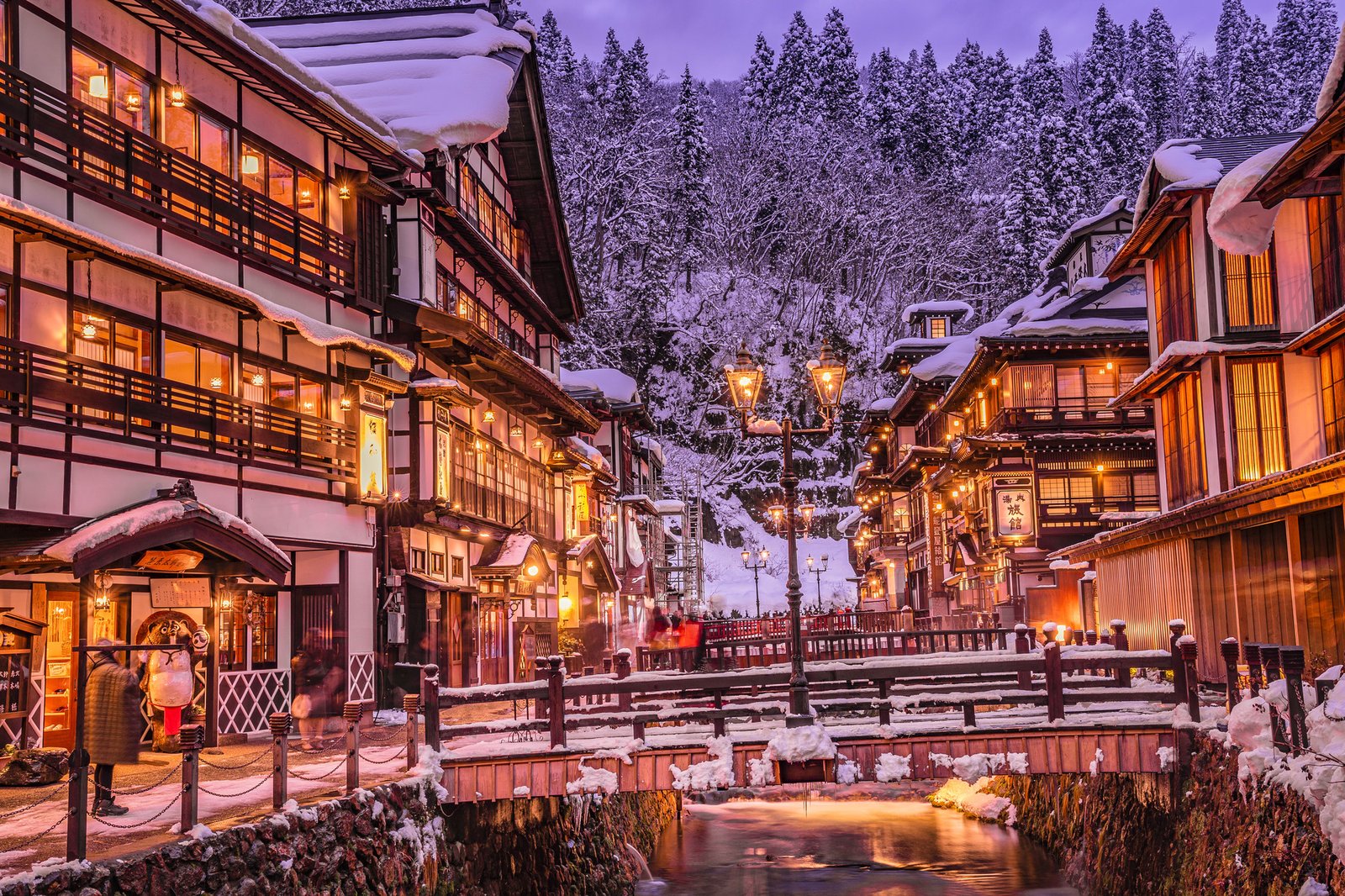
Ginzan Onsen is a hot spring town in the mountains of Obanazawa, Yamagata. The Ginzan Onsen association says its name comes from a silver mine that flourished in the early Edo period, and that inns of Western-style, multi-storey wooden construction, built from the end of the Taisho era to the early Showa era, line both banks of the river (Ginzan Onsen, history and hot springs (in Japanese)).
Who this is for: travellers who want to visit the town on a day trip or before a stay, by train and bus or by car, and who will check the bus times and the winter rules on the official pages before they go.
The short version: take the Yamagata Shinkansen to Oishida Station, then the route bus to Ginzan Onsen. If you come by car on a day trip, park at Taisho Roman-kan and take the shuttle bus. In winter, the town runs Park & Ride with timed, bookable shuttles, and asks you never to walk the road from Taisho Roman-kan. Always follow the official pages linked below.
Train and bus, or car and shuttle
| If… | Then lean towards… | Check |
|---|---|---|
| You come by train | The route bus between Oishida Station and Ginzan Onsen; the operator says no booking is needed | Route bus timetable and fares (in Japanese) |
| You come by car on a day trip | Park at Taisho Roman-kan and take the Ginzan Onsen Bus shuttle | Ginzanso, Ginzan Onsen Bus |
| You come by car in the winter Park & Ride period | Book a timed shuttle from Taisho Roman-kan | Ginzan Onsen, Winter Access 2026–2027 |
| You are staying at an inn in the town | Ask your inn about its car park and transfers, as the restriction office advises | Ginzan Onsen car restriction office, access (in Japanese) |
Getting there and how long it takes
- By train: JR East’s timetable for Oishida Station lists the Yamagata Shinkansen, for Shinjo in one direction and for Yamagata and Fukushima in the other, and the Ou Line (JR East, Oishida Station timetable).
- By route bus: the bus operator’s timetable runs from Oishida Station to Ginzan Onsen, with some services from Yamagata Airport; it says no booking is needed, fares are paid in cash only with no IC cards, and children and people with disabilities pay half (Route bus timetable and fares (in Japanese)). It gives the adult one-way fare between Oishida Station and Ginzan Onsen as 1,000 yen. Times: Check official.
- By car: Obanazawa City asks drivers not to take cars into the hot spring town, and asks day visitors to use the car park at Taisho Roman-kan (Obanazawa City, Ginzan Onsen (in Japanese)). The restriction office says winter tyres are a must in winter, and that snowbanks block the view in places (Ginzan Onsen car restriction office, access (in Japanese)).
- Shuttle outside the winter period: Ginzanso says the Ginzan Onsen Bus runs from Taisho Roman-kan via the Ginzan Onsen Parking Lot and Ginzanso to Ginzan Onsen, for 500 yen a day for adults and free for elementary school pupils and younger, called with a button at the stop; it takes no advance bookings (Ginzanso, Ginzan Onsen Bus). Hours: Check official.
- Suspensions: the bus operator says winter services can be badly disrupted by bad weather, and the city asks visitors to allow plenty of time because snow can disrupt public transport, so check the timetable before you set out (Route bus timetable (in Japanese), Obanazawa City, Ginzan Onsen (in Japanese)).
What to do: match your train to the route bus at Oishida Station; the bus operator warns that one afternoon departure from Ginzan Onsen does not connect with the up Yamagata Shinkansen. Where to verify: the timetable page (in Japanese).
Winter: Park & Ride from Taisho Roman-kan
The Ginzan Onsen association runs Park & Ride, restrictions on private vehicles and timed admission in winter; it gives the 2026–2027 period as 19 December 2026 to 7 March 2027, and says it may be extended depending on snowfall (Ginzan Onsen, Winter Access 2026–2027).
| Item | Times | Fares | Booking | Where to check |
|---|---|---|---|---|
| Winter shuttle, Taisho Roman-kan and Ginzan Onsen | Check official | Check official | Advance booking closes at 17:00 the day before; same-day tickets only if seats remain | Ginzan Onsen, Winter Access 2026–2027 |
- Why the rules: the association says there is only one access road, and a vehicle stuck in the snow can stop emergency vehicles reaching the town (Ginzan Onsen, Winter Access 2026–2027).
- Do not walk: it says not to walk between Taisho Roman-kan and Ginzan Onsen in winter, as walkers would have to use the road, with risks from blizzards, ice and traffic (Ginzan Onsen, Winter Access 2026–2027).
- In the street: it asks visitors to walk on the river side of the central diamond markers, away from snow falling from roofs (Ginzan Onsen, Winter Access 2026–2027).
- Route bus in winter: the association’s page says that, under planned arrangements, route-bus passengers without an advance admission booking will be asked to change at Taisho Roman-kan, while the restriction office’s access page says train travellers on the route bus need no Park & Ride. Which applies on your day: Check official (Ginzan Onsen, Winter Access 2026–2027, Ginzan Onsen car restriction office, access (in Japanese)).
- Closures and suspensions: Ginzanso says the shuttle may not run between Ginzanso and Ginzan Onsen in heavy snow and that the Ginzan Onsen car park may close; check the winter page and the weather before you set out (Ginzanso, Ginzan Onsen Bus).
What to do: book a shuttle time before the day if you can, because the association says waits tend to grow towards evening and have reached three hours. Where to verify: the Winter Access page.
In the town
- Gas lamps: the Obanazawa tourism association says the gas lamps come on at around 16:30 in winter and around 17:00 in summer (Obanazawa tourism association, Ginzan Onsen (in Japanese)).
- Foot bath and communal bath: Obanazawa City lists a free foot bath in the middle of the town that uses the spring water as it is, and a communal bath; hours and closing days: Check official (Obanazawa City, Ginzan Onsen (in Japanese)).
- Closures: the city says the old mine tunnel near the town is closed for the time being for safety checks, so check its page before you plan a walk there (Obanazawa City, Ginzan Onsen (in Japanese)). The tourism association says some places on its walking courses close in winter and asks visitors to follow the signs on site (Obanazawa tourism association, Ginzan Onsen (in Japanese)).
What to do: use the toilets at Taisho Roman-kan before you walk in, because the tourism association says there are almost none in the town itself. Where to verify: the tourism association page (in Japanese).
How a flood gave the town its wooden inns
The Ginzan Onsen association says that in the Meiji era the town lay about 12 km off the main road along a narrow, rough track, a hard day’s journey from Obanazawa, and that after the silver mine declined the people who stayed lived by running inns and small shops for visitors taking the waters (Ginzan Onsen, history and hot springs (in Japanese)).
It says a great flood of the river in 1913 swept away almost all the inns, and that afterwards the spring gave little water, river water got in and the temperature was low, so the baths were little used; a power station built on the river in 1921 became a first step towards recovery (Ginzan Onsen, history and hot springs (in Japanese)). In 1926, it says, boring for the source brought up plenty of hot water, and the inns all rebuilt at once in Western-style wooden buildings of three or four storeys; with bridges and the road improved, the town could at last be reached by car from Obanazawa in 30 minutes (Ginzan Onsen, history and hot springs (in Japanese)). The association adds that a townscape preservation ordinance was passed in 1986 to keep the inns (Ginzan Onsen, history and hot springs (in Japanese)).
What to do: walk both banks of the river and compare the inn fronts, built in the rebuilding the association describes. Where to verify: the history page (in Japanese).
The silver mine behind the name
The Agency for Cultural Affairs lists the old silver mine site under Historic Sites, Places of Scenic Beauty and Natural Monuments, designated on 21 December 1985 (Agency for Cultural Affairs, Cultural Heritage Online (in Japanese)). It calls the mine one of the silver mines representative of the Edo period, developed in the Keicho era, and says it is said to have once produced silver on a par with Sado, Iwami and Ikuno; the designated area covers part of the eastern workings with tunnels and drainage channels, the mountain shrine that guarded the mine, and the castle site of the clan that held the area (Agency for Cultural Affairs, Cultural Heritage Online (in Japanese)).
Obanazawa City, which calls the site a national Historic Site, records a tradition that the silver was found in 1456, and says that at its height the mine had 25,000 people; a great collapse in 1689 closed it, after which the place came into its own as a hot spring for cures (Obanazawa City, the silver mine site (in Japanese)). The association’s chronology dates the finding of the hot spring to the Keicho era, 1596 to 1614 (Ginzan Onsen, chronology (in Japanese)).
The city adds that the entrance to the town was once a checkpoint where a toll of one tenth of the value of goods was taken; the site is now an empty plot (Obanazawa City, Ginzan Onsen (in Japanese)).
What to do: look for the checkpoint site at the entrance to the town as you arrive. Where to verify: the city’s Ginzan Onsen page (in Japanese).
Official sources
| Topic | Source | Checked |
|---|---|---|
| Name, history, flood, rebuilding | Ginzan Onsen, history and hot springs | 2026-11-11 |
| Hot spring found in the Keicho era | Ginzan Onsen, chronology | 2026-11-11 |
| Winter Park & Ride, shuttle booking, walking rules | Ginzan Onsen, Winter Access 2026–2027 | 2026-11-11 |
| Car access, winter tyres, route bus in winter | Ginzan Onsen car restriction office, access | 2026-11-11 |
| Shuttle outside winter | Ginzanso, Ginzan Onsen Bus | 2026-11-11 |
| Route bus timetable and fares | Route bus timetable and fares | 2026-11-11 |
| Route bus in winter, connections | Route bus timetable | 2026-11-11 |
| Trains at Oishida Station | JR East, Oishida Station timetable | 2026-11-11 |
| Cars, baths, mine tunnel, checkpoint | Obanazawa City, Ginzan Onsen | 2026-11-11 |
| Silver mine tradition, collapse | Obanazawa City, the silver mine site | 2026-11-11 |
| Designation | Agency for Cultural Affairs, Cultural Heritage Online | 2026-11-11 |
| Gas lamps, winter closures, toilets | Obanazawa tourism association, Ginzan Onsen | 2026-11-11 |