Place name in Japanese: 富士山本宮浅間大社, Fujisan Hongū Sengen Taisha.
Fujisan Hongu Sengen Taisha Shrine, Shizuoka: the two-storey main hall, Wakutama Ike Pond and the Minobu Line to Fujinomiya
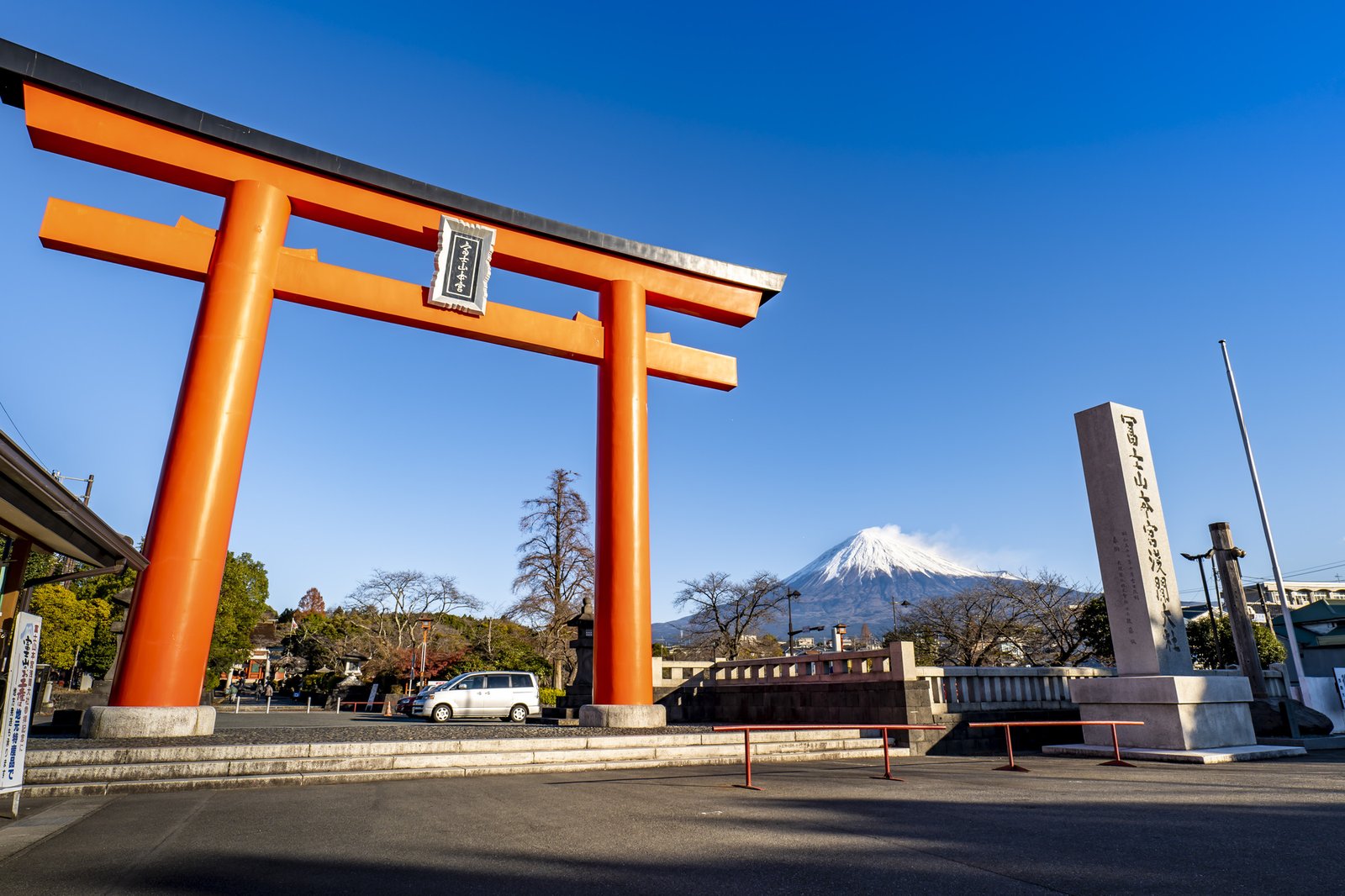
Fujisan Hongu Sengen Taisha Shrine stands in Fujinomiya, Shizuoka. UNESCO lists it as component 1418-002, “Fujisan Hongu Sengen Taisha Shrine”, of the World Heritage property “Fujisan, sacred place and source of artistic inspiration”, inscribed in 2013 under criteria (iii) and (vi) (UNESCO World Heritage Centre, maps; UNESCO World Heritage Centre, Fujisan). Fujinomiya City says the shrine is said to have been created to enshrine the deity of Mount Fuji, Konohanasakuyahime-no-mikoto, in order to calm the mountain’s repeated eruptions (Fujinomiya City, Fujisan Hongu Sengen Taisha Shrine).
Who this is for: travellers who want to see the shrine’s main hall and the spring-fed pond in its grounds, and who will check the gate hours and train times on the official pages before they go.
The short version: take the JR Minobu Line to Fujinomiya Station; Fujinomiya City gives a 10-minute walk from there to the shrine. The city says the shrine is open every day and free to visit, with gate hours that change with the season. See the two-storey main hall, then walk to Wakutama Ike Pond in the grounds. Always follow the official pages linked below.
What to plan for
| If… | Then lean towards… | Check |
|---|---|---|
| You are coming by train | The JR Minobu Line to Fujinomiya Station, then a 10-minute walk | Fujinomiya City, the shrine (in Japanese) |
| You want to arrive early or leave late | The gate hours for the month of your visit | Fujinomiya City, the shrine (in Japanese) |
| You want to see the buildings Tokugawa Ieyasu had built | The main hall, the worship hall and the tower gate | Fujinomiya City, Fujisan Hongu Sengen Taisha Shrine |
| You want to see the spring | Wakutama Ike Pond in the grounds | Agency for Cultural Affairs, Wakutama Ike Pond (in Japanese) |
Gate hours and fees
Fujinomiya City says the shrine is open every day of the year and that visiting is free (Fujinomiya City, the shrine (in Japanese)). It prints these gate hours, for normal days (Fujinomiya City, the shrine (in Japanese)):
| Months | Gate hours (as printed) |
|---|---|
| November to February | 6:00 a.m. to 7:00 p.m. |
| March and October | 5:30 a.m. to 7:30 p.m. |
| April to September | 5:00 a.m. to 8:00 p.m. |
- Days that differ: the city marks these as the hours for normal days; before you go, check the city’s page for the gate hours on the day of your visit (Fujinomiya City, the shrine (in Japanese)).
- Festivals and prayers: dates and fees for festivals or prayers are not on the pages fetched for this article; Check official (Fujinomiya City, the shrine (in Japanese)).
What to do: for an early visit in summer, aim for the hour after the gate opens. Where to verify: the city’s shrine page (in Japanese).
Getting there: the JR Minobu Line to Fujinomiya
- Train: The operator’s timetable for Minobu Line trains from Fuji towards Minobu and Kofu lists Fujinomiya, and gives a guide time from Fuji of about 18 minutes by Local train and about 11 minutes by the Ltd. Exp. FUJIKAWA; it notes that times vary by train (Minobu Line timetable from Fuji, railway operator (PDF)).
- Station: The operator’s station guide lists Fujinomiya Station on the Minobu Line and a connecting route bus company (Fujinomiya Station guide, railway operator (in Japanese)).
- Walk: Fujinomiya City gives a 10-minute walk from Fujinomiya Station on the JR Minobu Line (Fujinomiya City, the shrine (in Japanese)).
- Bus: the city says a route bus from stand 4 at the station stops near the pond, with a fare of 150 yen; route and times: Check official (Fujinomiya City, the shrine (in Japanese)).
- Timetable on the day: before you travel, check the operator’s timetable; the timetable itself says times and destinations may change at short notice (Minobu Line timetable from Fuji, railway operator (PDF)).
What to do: change to the Minobu Line at Fuji and get off at Fujinomiya. Where to verify: the Minobu Line timetable (PDF).
How the land above the eighth station came back to the shrine
The Agency for Cultural Affairs’ World Heritage commentary says that as worship ascents of Fuji grew, rights over mountain fees and the routes were set, and in 1609 the Tokugawa shogunate gave Fujisan Hongu Sengen Taisha Shrine first claim to the offerings left at the summit (Agency for Cultural Affairs, Cultural Heritage Online, World Heritage component (in Japanese)). It says the shrine used this as a foothold to manage the summit area, and that in 1779 a ruling by the shogunate recognised its control of the land above the eighth station (Agency for Cultural Affairs (in Japanese)).
The Agency says that around 1877 the Meiji government made the land above the eighth station state land, and that after a Supreme Court judgment in 1974 it was returned to the shrine in 2004 (Agency for Cultural Affairs (in Japanese)). Fujinomiya City gives the same sequence and describes the 2004 step as a transfer, or return, to the shrine (Fujinomiya City, the shrine (in Japanese)).
What to do: stand in front of the main hall and remember that, by these accounts, the land above the eighth station was returned to this shrine in 2004. Where to verify: the Agency’s World Heritage commentary (in Japanese).
The two-storey main hall, the pond and the spear stone
The Agency for Cultural Affairs lists the main hall in its database as an Important Cultural Property under “National Treasures and Important Cultural Properties (structures)”, designated on 27 May 1907, and gives its date as Keichō 9, 1604; it describes it as five bays by four, two-storeyed, with a cypress-bark roof (Agency for Cultural Affairs, database of nationally designated cultural properties (in Japanese)). The Agency’s World Heritage commentary and Fujinomiya City both say the present buildings were built in 1606 under Tokugawa Ieyasu; the city adds that he built them in gratitude for his victory at Sekigahara (Agency for Cultural Affairs (in Japanese); Fujinomiya City, Fujisan Hongu Sengen Taisha Shrine).
The Agency says the main hall has a two-storey form with its own style name, painted red: the lower storey is five bays by four with a hipped roof, and the upper storey is a three-bay shrine with a flowing roof (Agency for Cultural Affairs (in Japanese)). Fujinomiya City gives the ridge height as 45 shaku, 13.6 m (Fujinomiya City, the shrine (in Japanese)).
Cultural Heritage Online lists Wakutama Ike Pond under “Historic Sites, Places of Scenic Beauty and Natural Monuments”, designated on 7 November 1944 (Agency for Cultural Affairs, Cultural Heritage Online (in Japanese)); the Agency’s database of designated properties gives its type as Special Natural Monument, with special designation on 29 March 1952 (Agency for Cultural Affairs, Wakutama Ike Pond (in Japanese)). The Agency’s description says the groundwater that wells up at the foot of Fuji gathers here in the shrine grounds, after passing through cracks in the lava and coming out at several places nearby (Agency for Cultural Affairs, Cultural Heritage Online (in Japanese)). Fujinomiya City says the pond is divided into an upper and a lower pond near the purification place, and that formerly only the upper pond was called Wakutama Ike (Fujinomiya City, the shrine (in Japanese)). UNESCO says pilgrims used lakes and springs for cold ablutions, Mizugori, to purify their bodies before climbing the mountain (UNESCO World Heritage Centre, Fujisan); the Agency says this practice at the pond continued into the 1920s and 1930s and is no longer carried out (Agency for Cultural Affairs (in Japanese)).
On the stone steps in front of the tower gate, Fujinomiya City says, lies a natural stone used to stand and rest the spear in which the deity dwelt during a procession to Yamamiya that was held until the early Meiji period (Fujinomiya City, the shrine (in Japanese)). The city says the two guardian figures in the tower gate were made in February 1614, and that inscriptions on their backs name their carvers (Fujinomiya City (in Japanese)).
What to do: from the side of the worship hall, look for the roof of the upper storey of the main hall; then find the stone on the steps of the tower gate before walking to the pond. Where to verify: the city’s shrine page (in Japanese).