Place name in Japanese: 富士五湖, Fuji Goko.
Fuji Five Lakes, Yamanashi: a round trip of the five lakes by train and sightseeing bus from Kawaguchiko Station
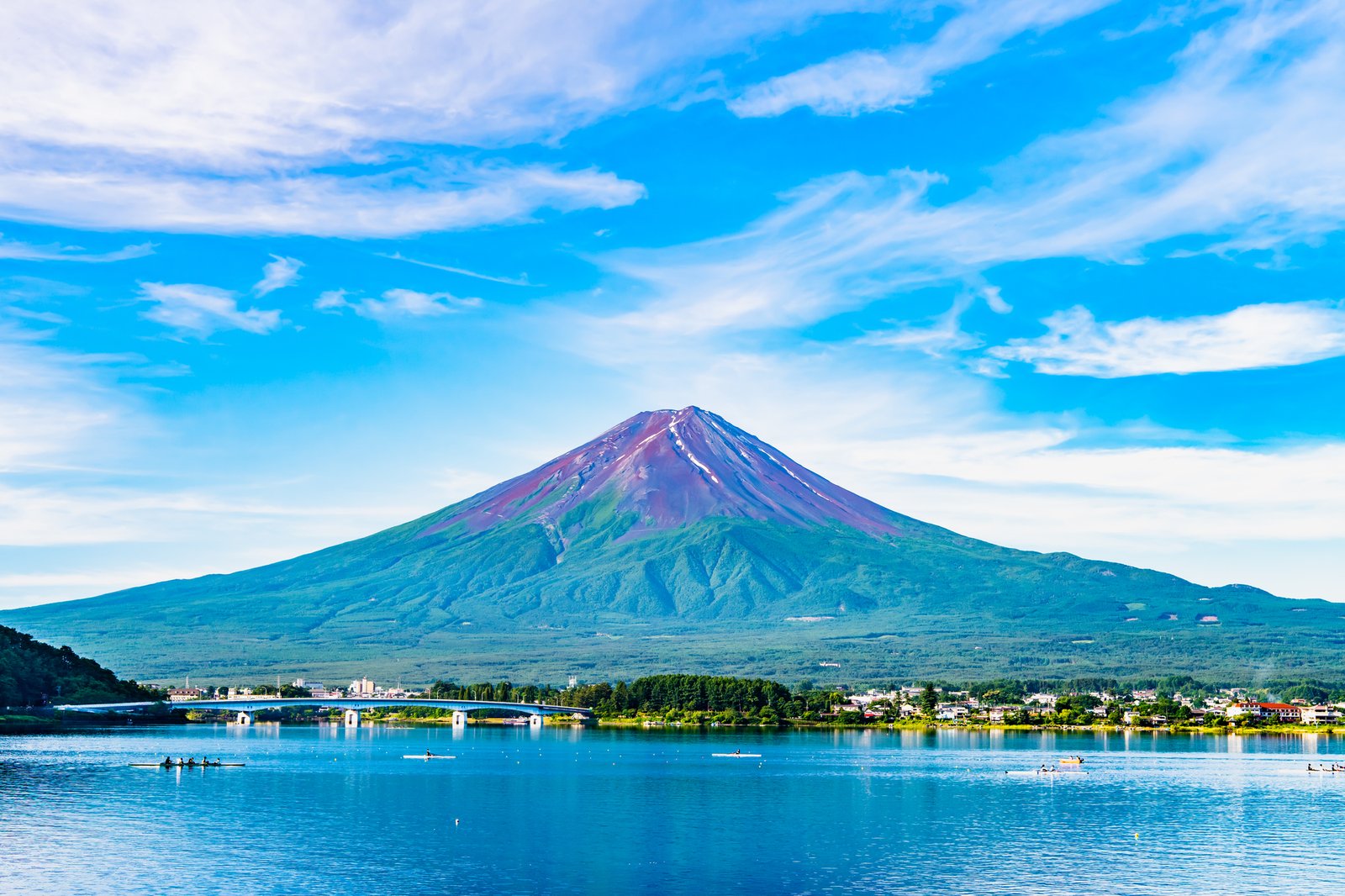
Five lakes lie along the northern foot of Mount Fuji, and four sightseeing bus lines leave from one bus terminal at Kawaguchiko Station to reach them. In 1927 the lakes were picked together, as one place, in a nationwide selection of scenic spots.
Who this is for: travellers based in Tokyo who want to see the lakes and the views of Mount Fuji from their shores, not to climb the mountain, and who need the train, the buses and the passes sorted before they go.
The short version: take the Fuji Excursion limited express from Shinjuku to Kawaguchiko Station; the railway gives its fastest downbound run as 1 hour 53 minutes. From the station, the Red Line goes round Lake Kawaguchiko, the Green Line goes to Lake Saiko, the Blue Line goes to Lake Shojiko and Lake Motosuko, and the Fujikko-go goes to Lake Yamanakako. Always follow the official pages linked below.
Which lake to put first
| If… | Then lean towards… | Check |
|---|---|---|
| You have half a day and want to stay close to the station | Lake Kawaguchiko on the Red Line, with the ropeway and the sightseeing boat near one stop | Red, Green and Blue Line page |
| You want lava caves and the forest on the old lava | Lake Saiko on the Green Line | Red, Green and Blue Line page |
| You want the two western lakes on one bus line | Lake Shojiko and Lake Motosuko on the Blue Line | Red, Green and Blue Line page |
| You are going east of the mountain | Lake Yamanakako on the Fujikko-go | Fujikko-go page |
| You will ride buses many times in a day | A one-day or two-day pass for the lines you will use | Sightseeing bus overview |
Hours, fees and closures
All values below are from the operators’ pages as fetched on 2026-11-10. The Fujigoko Tourism Association guide gives no opening hours or fees for the lakes.
| Item | Hours | Fees | Closures | Where to check |
|---|---|---|---|---|
| Lakes and lakeshores | Check official | Check official | Check official | Fujigoko Tourism Association guide |
| Red, Green and Blue Line buses | Check official | Single ride from 180 yen (adult), zone-based fare; 1-Day Pass adult 1,500 yen, child 750 yen; 2-Day Pass adult 2,000 yen, child 1,000 yen | Special timetables may be in effect on certain days, such as the New Year holiday period | Red, Green and Blue Line page |
| Fujikko-go bus | Runs 11 times a day from Kawaguchiko Station | Single ride from 100 yen (adult), zone-based fare; 1-Day Pass adult 1,800 yen, child 900 yen; 2-Day Pass adult 2,200 yen, child 1,100 yen | Special timetables may be in effect on certain days, such as the New Year holiday period | Fujikko-go page |
| Bus ticket counters | Kawaguchiko Station 6:30 AM to 7:00 PM; Mt. Fuji Station 8:50 AM to 5:00 PM; Yamanakako Asahigaoka Bus Terminal 9:00 AM to 4:00 PM | Check official | Check official | Fujikko-go page |
| Fuji Excursion, Shinjuku to Kawaguchiko | Four round trips a day, with one more depending on the season | 4,200 yen one way (basic fare 2,580 yen and limited express ticket 1,620 yen) | Check official | Fuji Excursion page |
| Mt. Fuji Panorama Ropeway, Kawaguchiko sightseeing boat, Lake Motosuko sightseeing boat | Check official | Check official | Check official | Red, Green and Blue Line page |
- Passes for the Red, Green and Blue Lines: sold at the Kawaguchiko Station bus ticket counter, on the buses (1-Day Pass only) and online. No reservation is needed, as these are regular local buses.
- Passes for the Fujikko-go: the page calls them a free coupon for all sightseeing buses. They are sold at the bus ticket offices at Kawaguchiko Station, Mt. Fuji Station and Yamanakako Asahigaoka Bus Terminal, and on board (1-Day Pass only). No reservation is needed.
- Delays: both bus pages say delays may occur because of traffic.
- Fuji Excursion tickets: the railway says you need a limited express ticket on top of the basic fare ticket. You choose a reserved-seat ticket, which fixes the train and seat, or a ticket that fixes only the date and section. The page gives children’s express fares in brackets.
What to do: decide which lakes you will reach by bus before you buy a pass, since the Fujikko-go passes cost more than the passes on the page for the three coloured lines. Where to verify: the Red, Green and Blue Line page and the Fujikko-go page.
Getting there: Tokyo to Kawaguchiko Station
- Direct train: the Fujikyu Railway says the Fuji Excursion limited express (also written Fuji Kaiyu on its English page) runs from Shinjuku, with some trains from Chiba, directly to Kawaguchiko Station on the Fujikyu Railway Line. Between Shinjuku and Otsuki it runs coupled to a JR limited express.
- Changing to the buses: the bus company says the sightseeing buses connect directly from Kawaguchiko Station and Mt. Fuji Station on the Fujikyu Railway Line, and that all four lines in this guide leave from the bus terminal at Kawaguchiko Station.
- Train and road status on the day: see JR East’s train status for the Kanto area, and for roads the JARTIC road traffic map.
What to do: buy a limited express ticket as well as the basic fare ticket for the Fuji Excursion. Where to verify: the Fuji Excursion page.
The round trip from Kawaguchiko Station
The bus company runs three coloured lines from Kawaguchiko Station for the western side, and a fourth bus, the Fujikko-go, for the eastern side (sightseeing bus overview).
| Lake | Bus from Kawaguchiko Station | Stop named on the bus page |
|---|---|---|
| Lake Kawaguchiko | Red Line, round the northern shore | Pleasure boat/ropeway entrance, Oishi Park, Kawaguchiko Herb Museum |
| Lake Saiko | Green Line | Saiko, Nenba Minshuku, Saiko Iyashi-no-Sato Nenba |
| Lake Shojiko | Blue Line | Shoji |
| Lake Motosuko | Blue Line | Lake Motosu |
| Lake Yamanakako | Fujikko-go | Yamanakako Asahigaoka Bus Terminal (ticket counter) |
Source: the Red, Green and Blue Line page and the Fujikko-go page.
The tourism association’s English guide gives these figures for the five lakes:
| Lake | Area | Depth | Circumference | Height |
|---|---|---|---|---|
| Lake Yamanakako | 6.80 km² | 13.2 m | 13.87 km | 982 m |
| Lake Kawaguchiko | 5.70 km² | 14.6 m | 20.94 km | 830 m |
| Lake Saiko | 2.10 km² | 71.7 m | 9.85 km | 900 m |
| Lake Shojiko | 0.50 km² | 15.2 m | 6.80 km | 900 m |
| Lake Motosuko | 4.70 km² | 121.6 m | 11.82 km | 900 m |
Source: the Fujigoko Tourism Association guide, dated 2015.
Lake Kawaguchiko
The tourism association’s guide says the northern shoreline is rugged and gives many viewpoints of Mount Fuji from the lakefront, with cherry blossoms in spring, lavender in early summer, autumn leaves in autumn and snowy landscapes in winter. It calls the view of the mountain reflected in the lake Sakasa Fuji (Mount Fuji upside down). The lake is in Fujikawaguchiko Town (guide).
- From the station: the Red Line circles the northern shore. From the Pleasure boat/ropeway entrance stop, the bus page gives the Mt. Fuji Panorama Ropeway as about 3 minutes on foot and the sightseeing boat as about 4 minutes on foot. It says the ropeway ride takes about 3 minutes up to a summit of 1,075 m (bus page).
What to do: start the round trip here on the Red Line. Where to verify: the Red, Green and Blue Line page.
Lake Saiko
The guide says kunimasu salmon, a fish native to Lake Tazawako in Akita Prefecture that was thought to have died out in the 1940s, were found living in Lake Saiko in 2010. It describes Saiko Iyashinosato Nenba as a re-creation of a thatched-roof settlement, and the Saiko Bat Cave as a lava cave over 350 metres long (guide).
- From the station: the Green Line links Saiko, the Aokigahara forest and the Narusawa Hyoketsu (ice cave). The bus page gives Saiko Iyashi-no-Sato Nenba as a 3-minute walk from the stop of the same name, and gives the Narusawa Hyoketsu and the Fugaku Fuketsu (wind cave) each a stop of the same name (bus page).
What to do: ride the Green Line out to the caves and stop at Nenba on the way. Where to verify: the Red, Green and Blue Line page.
Lake Shojiko
The guide says the view from Tategohama looks as if Mount Fuji is cradling the smaller Mount Omuro, and calls it Kodaki Fuji (Mount Fuji cradling a child). It also says a nature observation route here follows the movement of the Aokigahara lava flow (guide).
- From the station: the bus company says you can reach the lake on the Blue Line, which runs to Shoji, Lake Motosu and the venue of the Fuji Shibazakura Festival (sightseeing bus overview, bus page).
What to do: get off at Shoji on the way out to Lake Motosuko. Where to verify: the Red, Green and Blue Line page.
Lake Motosuko
The guide lists the lake as lying in Minobu and Fujikawaguchiko towns, and gives scuba diving, sockeye salmon fishing and camping as things people do here (guide).
- From the station: take the Blue Line to the Lake Motosu stop. The bus page says the Moguran sightseeing boat lets you watch aquatic life and the changes in the lakebed, and that the Lake Motosu Tourist Information Center is about a 9-minute walk away (bus page).
What to do: go to the end of the Blue Line and come back the same way. Where to verify: the Red, Green and Blue Line page.
Lake Yamanakako
The guide places the lake on the east side of Mount Fuji, on a 1,000-metre-high plain. It says Diamond Fuji, when the sun sets over the summit, can be seen here from early November to early February, and that whooper swans stay on the lake through the winter (guide).
- From the station: the Fujikko-go leaves from Kawaguchiko Station 11 times a day and tours Fujiyoshida, Oshino Hakkai and Yamanakako. The bus company says it is the bus to take for Yamanakako (Fujikko-go page, sightseeing bus overview).
What to do: give Yamanakako its own day on a Fujikko-go pass. Where to verify: the Fujikko-go page.
How the five lakes were chosen in 1927
The Ministry of the Environment keeps a table of a 1927 selection of scenic places run by two newspapers of the day (Ministry of the Environment table). The table says the aim was to choose the scenery that stood for the new Showa era, by new tastes. Nominations were invited by vote in eight categories: mountains, valleys, waterfalls, hot springs, lakes, rivers, coasts and plains, and the top ten in each were picked. From these a committee chose eight views and, at the same time, recommended a further 25 places and 100 more. The Fuji Five Lakes appear as one entry among the 25, in the lakes category, for Yamanashi, with a mark in the column for national parks.
What to do: read the selection as the ministry’s table records it. Where to verify: the Ministry of the Environment table.
The three lakes at the same height
The tourism association’s guide gives Lake Saiko, Lake Shojiko and Lake Motosuko the same height, 900 metres, against 830 metres for Lake Kawaguchiko and 982 metres for Lake Yamanakako (guide). The same guide says the three lakes share a consistently fixed water level, so it is assumed that they are all connected by an underground water vein (guide). An article by Masato Koyama in the erosion-control journal Sabo to Chisui says that in 864 a large fissure eruption on the north-west flank of the mountain sent out the Aokigahara lava, which filled in lakes and left Motosuko, Shojiko and Saiko close to their present shape (Sabo to Chisui article). The article says Shojiko and Saiko had been one large lake, called Senoumi, until the lava divided it, so that before that eruption the five lakes were four (Sabo to Chisui article). It adds that the lava also ran into Motosuko and filled a little of its east side, and that the forest of Aokigahara has since grown on top of the lava (Sabo to Chisui article). The bus company’s Green Line runs to the Aokigahara forest and to the Narusawa Hyoketsu, which its page calls one of the lava caves (bus page).
What to do: look for the lava along the Green Line and at Lake Shojiko’s nature observation route. Where to verify: the Fujigoko Tourism Association guide and the Sabo to Chisui article.
Official sources
| Topic | Source | Checked |
|---|---|---|
| Ministry of the Environment table of the 1927 selection: organisers’ aim, method, the Fuji Five Lakes among the 25 | env.go.jp/nature/ari_kata/shiryou/031208-4-3.pdf | 2026-11-10 |
| Fujigoko Tourism Association English guide (2015): lake figures, towns, seasons, views, kunimasu salmon, lava, the shared water level | mt-fuji.gr.jp/cms_mt-fuji/pdf/kouseisisan_english.pdf | 2026-11-10 |
| Fujikyu Bus: Red, Green and Blue Lines, stops, passes, ticket counters, ropeway, boats | bus.fujikyu.co.jp/en/fujitour/kawaguchiko/ | 2026-11-10 |
| Fujikyu Bus: Fujikko-go, passes, ticket counters | bus.fujikyu.co.jp/en/fujitour/fujikko/ | 2026-11-10 |
| Fujikyu Bus: overview of the sightseeing buses, which bus goes to which lake | bus.fujikyu.co.jp/en/fujitour/ | 2026-11-10 |
| Fujikyu Railway: Fuji Excursion, fastest run, round trips, fares and tickets | fujikyu-railway.jp/en/fujikaiyuu/ | 2026-11-10 |
| Article by Masato Koyama in the erosion-control journal Sabo to Chisui: the 864 eruption, Aokigahara lava, Senoumi | mlit.go.jp/common/001017601.pdf | 2026-11-10 |