Place name in Japanese: 延暦寺, Enryaku-ji.
Enryaku-ji on Mount Hiei, Shiga: the Todo, Saito and Yokawa areas, the cable cars and buses up the mountain, and what to check before you go
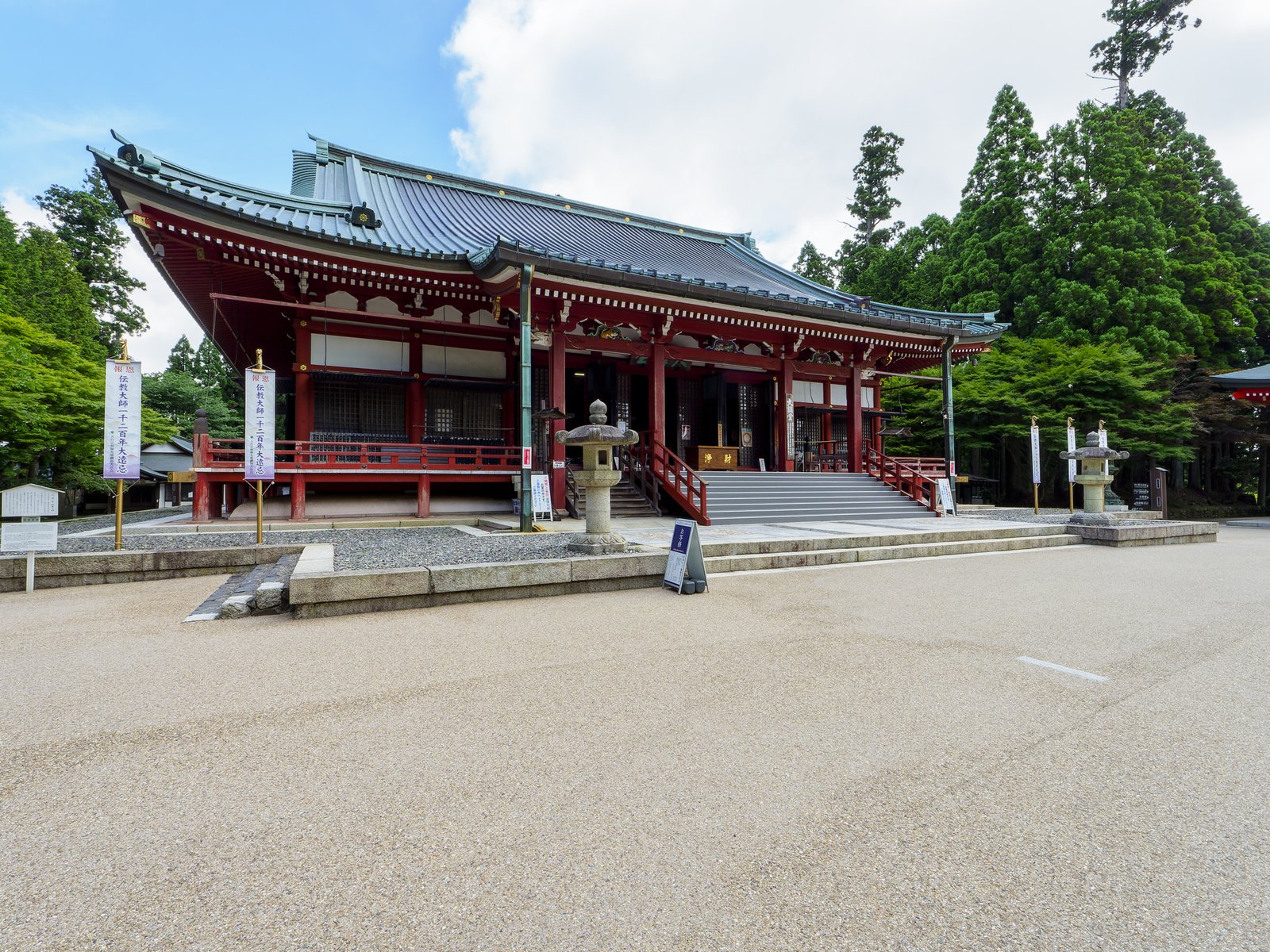
Enryaku-ji is a temple spread across Mount Hiei, in Sakamoto-honmachi, Otsu, Shiga. UNESCO lists Enryaku-ji as component 688-005 of the World Heritage property Historic Monuments of Ancient Kyoto (Kyoto, Uji and Otsu Cities), with a property area of 497.7 ha and a buffer zone of 1,005 ha (UNESCO World Heritage Centre, maps of the property); the property’s page gives 1994 as the date of inscription and says its seventeen component parts are in Kyoto and Uji Cities in Kyoto Prefecture and Otsu City in Shiga Prefecture (UNESCO World Heritage Centre). The Agency for Cultural Affairs lists the Konponchudo of Enryaku-ji, dated 1640, as a National Treasure, designated an Important Cultural Property on 5 April 1899 and a National Treasure on 31 March 1953 (Agency for Cultural Affairs, database of nationally designated cultural properties: Konponchudo (in Japanese)), and lists the Tenporindo of Enryaku-ji, dated 1347, as an Important Cultural Property designated on 7 April 1900 (Agency for Cultural Affairs, database of nationally designated cultural properties: Tenporindo (in Japanese)).
Who this is for: travellers planning a day on Mount Hiei who want to know how the temple’s three areas are laid out, which way up the mountain is running, and what is open inside the main hall during its repair.
The short version: the temple says Enryaku-ji is the name for about 100 halls spread over the mountain, divided into the Todo, Saito and Yokawa areas, with one ticket for all three. From the Shiga side, the Sakamoto Cable runs up from Sakamoto; on the Kyoto side, the operator of the Eizan Cable and Ropeway says both are suspended until further notice, and gives no date for them to run again when checked on 15 November 2026. Check official before you go: Keifuku Electric Railroad, Eizan Cable and Ropeway (in Japanese and English). A shuttle bus links the areas from spring to early December. The interior of Konponchudo is closed to visitors for about two years from January 2026.
What to plan for
| If… | Then lean towards… | Check |
|---|---|---|
| You want to see all three areas in one day | The shared ticket for Todo, Saito and Yokawa, and the shuttle bus between them | Enryaku-ji, visiting times and fees (in Japanese) |
| You are starting from the Shiga side | JR Hieizan-Sakamoto or Keihan Sakamoto-Hieizanguchi Station, then the Sakamoto Cable | Enryaku-ji, getting here (in Japanese) |
| You planned to go up from Yase on the Kyoto side | The Eizan Cable and Ropeway are suspended until further notice, the operator says; check official before you set out | Keifuku Electric Railroad, Eizan Cable and Ropeway (in Japanese and English) |
| You want to see the main hall’s Buddha and lamp | The Manbaido hall nearby, where the temple has placed them during the repair | Enryaku-ji, notice on the special enshrinement (in Japanese) |
The three areas and their opening times
The temple says that “Enryaku-ji” is the collective name for about 100 halls scattered over 1,700 ha of temple ground on Mount Hiei, and that there is no single building called Enryaku-ji. It divides the mountain into three areas, Todo to the east, Saito to the west and Yokawa to the north, each with its own main hall. It suggests allowing from 1 hour for Todo and from 40 minutes each for Saito and Yokawa, and gives about 5 minutes by shuttle bus or about 30 minutes on foot from Todo to Saito, and about 10 minutes by shuttle bus or about 90 minutes on foot from Saito to Yokawa (Enryaku-ji, overview of the grounds (in Japanese)).
The halls in Todo, and Shiga-in and Shogen-ji at the foot of the mountain, are open from 9:00 to 16:00 all year. In Saito and Yokawa they open at 9:00 from March to November and at 9:30 from December to February, closing at 16:00. Entry is accepted until 15:45, and the temple says it may close early or change the times for storms, snow or other events. One ticket covers Todo, Saito and Yokawa: 1,000 yen for adults, 600 yen for junior and senior high school students and 300 yen for primary school children; the National Treasure Hall, the temple’s museum, is a separate 500, 300 and 100 yen. Tickets are paid for at each area’s ticket office or bought online (Enryaku-ji, visiting times and fees (in Japanese)).
What to do: if you want all three areas, start early enough to reach Yokawa before 15:45. Where to verify: the temple’s visiting times and fees (in Japanese).
Getting up the mountain and between the areas
The temple’s access page gives three public routes. From JR Kyoto Station or Keihan Sanjo Station, the Hieizan Drive Bus goes to the temple’s bus terminal in Todo, in about 70 minutes. From Keihan Demachiyanagi, the Eizan Railway goes to Yase-Hieizanguchi, then the Eizan Cable to Cable Hiei, the Eizan Ropeway to Hieizan-cho and the shuttle bus to the same bus terminal, also about 70 minutes. From JR Hieizan-Sakamoto or Keihan Sakamoto-Hieizanguchi Station, the Sakamoto Cable goes to Cable Enryakuji Station, in about 40 minutes. The page marks the shuttle bus as suspended in winter (Enryaku-ji, getting here (in Japanese)).
On the Kyoto side, Keifuku Electric Railroad’s page for the Eizan Cable and Ropeway, checked again on 15 November 2026, says, in Japanese and in English, that both are suspended until further notice for repair and inspection of a defective component of the cable cars (Keifuku Electric Railroad, Eizan Cable and Ropeway (in Japanese and English)). Its March 2026 release had given the 2026 operating period as 20 March 2026 to 3 January 2027 (Keifuku Electric Railroad, news release of 5 March 2026 (in Japanese)).
On the Shiga side, Hieizan Railway, which runs the Sakamoto Cable, says the up and down cars leave at the same time and take about 11 minutes. Its timetable shows departures every 30 minutes, from 8:00 to 17:30 from March to November and from 8:30 to 17:00 from December to February (Hieizan Railway, Sakamoto Cable timetable and fares (in Japanese)).
Between the areas, Kojak Bus says its Hieizan shuttle bus runs daily from the Vernal Equinox Day to the first Sunday in December, linking Hieizan-cho, Todo, the temple’s bus terminal, Saito and Yokawa, and that from 7 December 2026 to 3 January 2027 it runs only between Hieizan-cho and the temple’s bus terminal (Kojak Bus, route timetables and fares (in Japanese)).
What to do: if you go after the first Sunday in December, plan Saito and Yokawa without the shuttle bus, and check the Kyoto-side cable before you choose that route. Where to verify: the temple’s access page (in Japanese).
Konponchudo during its repair
The temple says Konponchudo and its corridor are being repaired over about 15 years from 2016, mainly the copper roof of the hall, the shingle-style roof of the corridor and the painting of the whole (Enryaku-ji, the Konponchudo repair (in Japanese)). Its notice says that the inside of Konponchudo has been closed to visitors for about two years from January 2026. From 8 January 2026 the standing image placed in front of the hall’s hidden Yakushi Buddha, and the lamp the temple calls the Inextinguishable Dharma Light, have been placed in the Manbaido hall nearby. The twelve guardian figures of the hall’s main image are on show at the National Treasure Hall until December 2027 (planned), for which the museum fee is needed (Enryaku-ji, notice on the special enshrinement (in Japanese)).
What to do: go to Manbaido, not Konponchudo, to see the image and the lamp while the hall is closed. Where to verify: the temple’s notice (in Japanese).
Konponchudo from 788 to the repair that began in 2016
The temple’s page on the repair sets out the hall’s history. In 788 Saicho, who founded Enryaku-ji, built the Ichijo Shikan-in, with a Yakushi hall at its centre, a Monju hall to the north and a sutra store to the south. In 823 Emperor Saga gave the temple the name Enryaku-ji, and the hall was renamed Konponchudo. It was rebuilt as a large hall in 887, and in 980 a valley was filled in to enlarge it to the 11 bays it has today, with a corridor and a middle gate. In 1571 it was burnt in Oda Nobunaga’s attack, and in 1585 Hashiba Hideyoshi put up a temporary hall (Enryaku-ji, the Konponchudo repair (in Japanese)).
The page goes on: in 1642 the third Tokugawa shogun, Iemitsu, rebuilt it after nine years of work; in 1753 it was repainted; in 1798 the shingle roof of the hall was replaced with copper; in 1955 it had a half-dismantling repair; and the present repair began in 2016. The temple says the repair was first planned for about ten years and about 5 billion yen, and that research showing how the hall looked when Iemitsu rebuilt it, and during the Edo-period repairs, led to a 15-year schedule and about 7.3 billion yen (Enryaku-ji, the Konponchudo repair (in Japanese)). The Agency for Cultural Affairs’ database gives the hall’s date as 1640 (Agency for Cultural Affairs, database of nationally designated cultural properties: Konponchudo (in Japanese)).
What to do: read the hall you see from outside as the building rebuilt under Iemitsu. Where to verify: the temple’s page on the repair (in Japanese).
Three central halls, and a gate modelled on Mount Wutai
The temple says that each of its three areas has a central hall, called a “chudo”, and that the Konponchudo in Todo is the head hall of Enryaku-ji, with the Yakushi Buddha as its main image. Todo, it says, is where Saicho opened the temple, and it holds Konponchudo, the Great Lecture Hall with images of the founders of the schools that trained on the mountain, and the Amida Hall for memorial services (Enryaku-ji, Todo (in Japanese)).
The same page describes the Monjuro, east of Konponchudo across a high flight of stone steps, as the temple’s gate, the first one walkers pass through when they come up the main slope on foot. The temple says Jikaku Daishi Ennin founded it on the model of the hall of Monju (Manjusri) on Mount Wutai in China, that it burnt in 1668, and that the present building was put up after the fire. The Great Lecture Hall, it adds, was moved here in 1964 from the Sanbutsudo hall in Sakamoto at the foot of the mountain (Enryaku-ji, Todo (in Japanese)).
What to do: at Todo, look for the Monjuro at the top of the stone steps east of Konponchudo. Where to verify: the temple’s page on Todo (in Japanese).
What we have not verified
Check official before you go: when the Eizan Cable and Ropeway will run again, and their times and fares (Keifuku Electric Railroad, Eizan Cable and Ropeway (in Japanese and English)). Check official before you go: the Sakamoto Cable fares (Hieizan Railway, Sakamoto Cable timetable and fares (in Japanese)). Check official before you go: the shuttle bus times and fares, and the winter service (Kojak Bus, route timetables and fares (in Japanese)). Check official before you go: the Hieizan Drive Bus season and times (Enryaku-ji, getting here (in Japanese)). Check official before you go: until when the viewing stage at the Konponchudo repair is open (Enryaku-ji, notice on the special enshrinement (in Japanese)).
- Saito and Yokawa: the temple’s pages for these two areas were not read; the halls there are not described here.
- The Tenporindo: the database entry gives no area; which area it stands in is not checked.
- The year of the rebuilding: the temple gives 1642 and the database 1640; the reason is not checked.
- Roads and car parks: the toll roads up the mountain and their winter conditions are not checked.
- English names: the temple prints its name as “Hieizan Enryakuji”; the other names on this page are this site’s renderings of the Japanese names, except “Eizan Cable & Ropeway”, which the operator prints.
Official sources
| Topic | Source | Checked |
|---|---|---|
| World Heritage component, area and buffer zone | UNESCO World Heritage Centre, maps of the property | 2026-11-11 |
| World Heritage property and inscription | UNESCO World Heritage Centre | 2026-11-11 |
| Konponchudo, National Treasure | Agency for Cultural Affairs, database: Konponchudo | 2026-11-11 |
| Tenporindo, Important Cultural Property | Agency for Cultural Affairs, database: Tenporindo | 2026-11-11 |
| The three areas and the time to allow | Enryaku-ji, overview of the grounds | 2026-11-11 |
| Opening times and tickets | Enryaku-ji, visiting times and fees | 2026-11-11 |
| Routes up the mountain | Enryaku-ji, getting here | 2026-11-11 |
| Eizan Cable and Ropeway suspension | Keifuku Electric Railroad, Eizan Cable and Ropeway | 2026-11-15 |
| Eizan Cable and Ropeway 2026 operating period | Keifuku Electric Railroad, news release of 5 March 2026 | 2026-11-11 |
| Sakamoto Cable times | Hieizan Railway, Sakamoto Cable timetable and fares | 2026-11-11 |
| Shuttle bus season and winter service | Kojak Bus, route timetables and fares | 2026-11-11 |
| Konponchudo closure and Manbaido | Enryaku-ji, notice on the special enshrinement | 2026-11-11 |
| Konponchudo history and repair | Enryaku-ji, the Konponchudo repair | 2026-11-11 |
| Todo, the central halls and the Monjuro | Enryaku-ji, Todo | 2026-11-11 |