Place name in Japanese: 道後温泉, Dōgo Onsen.
Dōgo Onsen, Ehime: bathing at Dōgo Onsen Honkan, the Iyotetsu tram and the egret on the roof
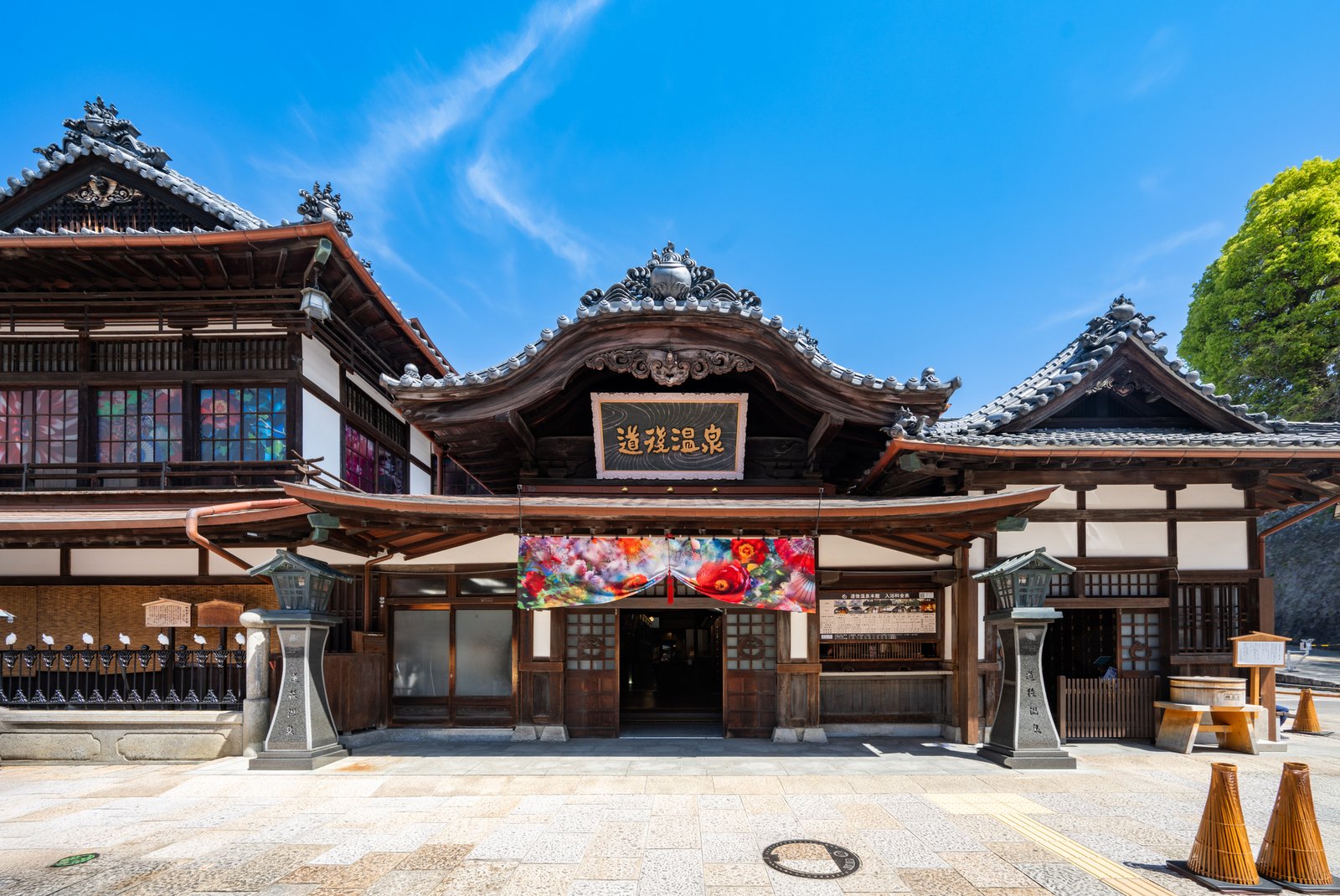
Dōgo Onsen is a hot spring town in Matsuyama, Ehime. Its public bathhouse, Dōgo Onsen Honkan, is a group of four wooden buildings that the Agency for Cultural Affairs lists as an Important Cultural Property, designated on 27 December 1994 (Agency for Cultural Affairs, Cultural Heritage Online (in Japanese)). The operator says it was the first public bathhouse to be designated (Dōgo Onsen, Dōgo Onsen Honkan).
Who this is for: travellers who want to bathe in a working bathhouse that is also a listed building, and who will check the courses, hours and tram times on the official pages before they go.
The short version: take the Iyotetsu tram, Line 3 from Matsuyama City Station or Line 5 from JR Matsuyama Station, to Dogo Onsen. At the Honkan, choose a course: bathing only in Kami-no-yu, or a course with a rest room upstairs. The two reservation rooms and the guided Yūshinden tour need a booking; the other courses cannot be booked. Always follow the official pages linked below.
Which course to choose
| If… | Then lean towards… | Check |
|---|---|---|
| You want a quick bath, as local people do | Kami-no-yu downstairs, bathing only, 60 minutes | Dōgo Onsen Honkan, fees and hours |
| You want to rest in a yukata after bathing | Kami-no-yu or Tama-no-yu 2nd floor seats, with a rental yukata and tea and Japanese sweets | Dōgo Onsen Honkan, fees and hours |
| You want a private room for a group | The Tama-no-yu 3rd floor reservation rooms, Shirasagi-no-ma Room or The Soaring Room, booked in advance; the operator notes there is no bath in the room | Dōgo Onsen Honkan, fees and hours |
| You want to see the imperial bath without bathing | The guided Yūshinden viewing, booked in advance | Dōgo Onsen Honkan, fees and hours |
Dōgo Onsen Honkan: courses, fees and hours
The operator’s English page prints these figures; it gives the ages as “Adult: over 12 / Child: 2-11 (Yūshinden: Child: 6-11)” (Dōgo Onsen Honkan, fees and hours).
| Course (as printed) | Fee (as printed) | Open hours | Closing time | Available time | Booking |
|---|---|---|---|---|---|
| Kami-no-yu downstairs | Adult: 700yen / Child: 350yen | 6:00–23:00 | 22:30 | 60minutes | Reservations not available |
| Kami-no-yu 2nd floor seats | Adult: 1,300yen / Child: 650yen | 6:00–22:00 | 21:00 | 60minutes | Reservations not available |
| Tama-no-yu 2nd floor seats | Adult: 2,000yen / Child: 1,000yen | 6:00–22:00 | 21:00 | 60minutes | Reservations not available |
| Tama-no-yu 3rd floor private room | Adult: 2,500yen / Child: 1,250yen | 6:00–22:00 | 20:30 | 90minutes | Reservations not available |
| Shirasagi-no-ma Room | 6,000yen per group + Adult: 1,300yen / Child: 650yen | 6:30, 9:30, 12:30, 15:30, 18:30 | Limited to 5 groups per day | 90minutes | reservations required |
| The Soaring Room | 3,000yen per group + Adult: 1,300yen / Child: 650yen | 8:00, 11:00, 14:00, 17:00, 20:00 | Limited to 5 groups per day | 90minutes | reservations required |
| Yūshinden (with a guide) | Adult: 500yen / Child: 250yen | 9:00–17:00 | 16:30 | 30minutes | reservations required |
- What the courses include: the operator says the Tama-no-yu courses allow bathing in Kami-no-yu or Tama-no-yu and include viewing the Yūshinden, and that shampoo, conditioner, body soap and a hair dryer are provided (Dōgo Onsen Honkan, fees and hours).
- Booking: the operator says reservations for the private rooms are taken on its reservation site until 10:00 p.m. the day before, and same-day reservations by phone (Dōgo Onsen Honkan, fees and hours).
- Closures: the operator’s site shows the current waiting time for the bathhouses; check it and the hours for your course before you go. Closure days: Check official (Dōgo Onsen Honkan, fees and hours).
What to do: decide on a course before you reach the ticket counter, because the operator says the 3-Bathhouse Tour Ticket covers only Kami-no-yu downstairs at the Honkan and cannot be changed to another course, even by paying the difference. Where to verify: the Honkan page.
What the renovation changed
The operator says conservational repair work began in January 2019 while the Onsen stayed open, that the entire building, including the resting rooms, reopened on 11 July 2024, and that the work was completed on 20 December 2024 (Dōgo Onsen, Dōgo Onsen Honkan). It lists these changes:
- Two new private rooms: Shirasagi-no-ma Room and The Soaring Room, on the third floor, were not previously open to guests.
- Baths: the bathing room now called Tama-no-yu for women was used as Kami-no-yu for women before the work; walls were added to some baths for earthquake resistance.
- Shopping Area: a new shop area on the first floor, which also offers luggage storage.
- Bathing tickets: a new ticket design by Yuji Sumikawa, a technical illustrator living in Matsuyama City.
All four points come from the Honkan page.
What to do: on the second floor, look into the Exhibition Room, which the operator says is free to visit and shows old Yufuda bathing tickets and tea ceremony utensils. Where to verify: the Honkan page.
Getting there and how long it takes
- By tram from JR Matsuyama Station: Iyotetsu gives tram Line 5, bound for Dogo Onsen, about 25 minutes with no change; fare 230 yen cashless or 250 yen in cash (Iyotetsu, access to Dogo (in Japanese)).
- By tram from Matsuyama City Station: Iyotetsu gives tram Line 3, bound for Dogo Onsen, about 20 minutes; fare 230 yen cashless or 250 yen in cash (Iyotetsu, access to Dogo (in Japanese)). On Iyotetsu’s route map both lines run via Okaido to Dogo Onsen (Iyotetsu, route map (PDF)).
- From Matsuyama Airport: Iyotetsu gives the airport limousine bus to the stop in front of Dogo Onsen Station, about 40 minutes with no change; fare 1,180 yen cashless or 1,200 yen in cash (Iyotetsu, access to Dogo (in Japanese)).
- Suspensions: before you travel, check the tram and bus times on Iyotetsu’s pages; timetable details: Check official (Iyotetsu, access to Dogo (in Japanese)).
- By car: the operator lists municipal car parks around Dōgo Onsen; spaces and fees: Check official (Dōgo Onsen, access).
What to do: match the tram line to your starting station, Line 5 from JR Matsuyama Station and Line 3 from Matsuyama City Station. Where to verify: the route map (PDF).
How Isaniwa Yukiya rebuilt the Honkan
Matsuyama City says that Isaniwa Yukiya became the first mayor of Dōgo Yunomachi when the town and village system came in, at a time when the bathhouse buildings had grown old and needed rebuilding (Matsuyama City, Isaniwa Yukiya (in Japanese)). He planned a three-storey building; because it would cost a large sum, 135,000 yen at the time, many residents opposed it (Matsuyama City, Isaniwa Yukiya (in Japanese)). The operator adds that opponents even barricaded themselves inside Hōgon-ji Temple, and that Isaniwa argued a building would only be of value if it stayed unrivalled 100 years later; the rebuilding was completed in 1894 (Dōgo Onsen, history).
The city says that over about ten years, starting with another bath building, he rebuilt the Kami-no-yu building and completed Tama-no-yu and the Yūshinden, giving the bathhouse the three-storey form it has today (Matsuyama City, Isaniwa Yukiya (in Japanese)). It also says he argued for a railway to bring bathers from central Matsuyama, and that the company he founded in 1893 began running trains to Dōgo in 1895 (Matsuyama City, Isaniwa Yukiya (in Japanese)). The operator says the Yūshinden was built in 1899 as a bathing facility for imperial use (Dōgo Onsen, Yūshinden).
What to do: on the guided Yūshinden tour, look at the bath, which the operator says dates from the Meiji period and can be viewed but not used. Where to verify: the Yūshinden page.
The egret on the roof
The operator says a compilation of local lore completed in 1710 tells of an egret with an injured leg that came every day to soak it in hot water gushing from the rocks, until the leg healed and the egret flew away; people who saw this began to bathe there too (Dōgo Onsen, history). It says a stone called Sagi Ishi was later placed to mark the legend, and that it is now kept at Hōjō-en square in front of Dogo Onsen Station (Dōgo Onsen, history).
Matsuyama City calls the egret the symbol of Dōgo Onsen and points to the one standing on top of the Honkan (Matsuyama City, the egret legend (in Japanese)). The city says the Kami-no-yu building, completed in 1894, carries a tower called Shinrokaku on its great hip-and-gable roof, and that its builder, Sakamoto Matahachirō, came from a family of master builders for the Matsuyama domain’s castle (Matsuyama City, cultural properties (in Japanese)). The city adds that the roof is built on trusses, the windows use giyaman glass, and only Shinrokaku follows the new units of measurement the Meiji government had just decreed (Matsuyama City, cultural properties (in Japanese)).
The operator says the egret’s wings on Shinrokaku are engraved with the names of the people who built the Kami-no-yu building, so the wings were kept when the egret was repaired (Dōgo Onsen, Dōgo Onsen Honkan). It says the Tokidaiko drum in the tower is struck 6 times at 6:00 a.m., 12 times at noon and 6 times at 6:00 p.m., and that its sound has been designated one of the 100 Soundscapes of Japan (Dōgo Onsen, history). It says the spring water, from 18 sources at 20–55°C, is blended to about 42°C with no reheating and no added water (Dōgo Onsen, history).
What to do: be outside the Honkan at noon to hear the Tokidaiko, then walk to Hōjō-en to find the Sagi Ishi. Where to verify: the history page.
Official sources
| Topic | Source | Checked |
|---|---|---|
| Courses, fees, hours, booking, renovation, Shinrokaku egret | Dōgo Onsen, Dōgo Onsen Honkan | 2026-11-11 |
| Yūshinden | Dōgo Onsen, Yūshinden | 2026-11-11 |
| Egret legend, Isaniwa Yukiya, Tokidaiko, spring water | Dōgo Onsen, history | 2026-11-11 |
| Car parks | Dōgo Onsen, access | 2026-11-11 |
| Tram and bus, times and fares | Iyotetsu, access to Dogo (in Japanese) | 2026-11-11 |
| Tram lines | Iyotetsu, route map (PDF) | 2026-11-11 |
| Designation | Agency for Cultural Affairs, Cultural Heritage Online | 2026-11-11 |
| Buildings, Sakamoto Matahachirō, Shinrokaku | Matsuyama City, cultural properties | 2026-11-11 |
| The egret as a symbol | Matsuyama City, the egret legend | 2026-11-11 |
| Isaniwa Yukiya | Matsuyama City, Isaniwa Yukiya | 2026-11-11 |