Place name in Japanese: 羽黒山, Haguro-san.
Mount Haguro, Dewa Sanzan, Yamagata: the stone steps and the five-storey pagoda, the bus and toll road, winter on the steps, and Gassan and Yudono by season
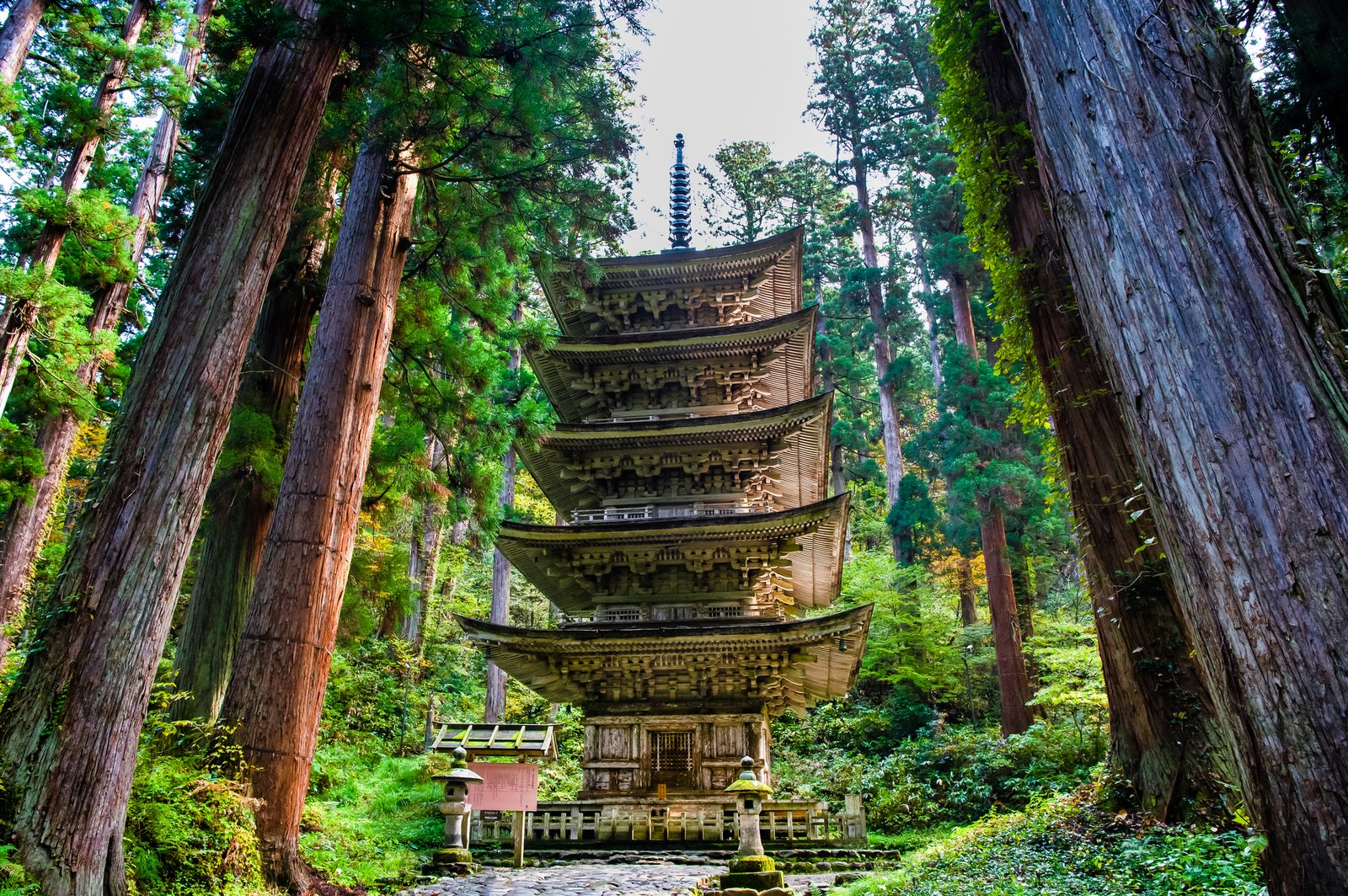
Dewa Sanzan is the name for three sacred mountains in Yamagata: Gassan at the centre, Mount Haguro to the north and Yudono to the south-west, as the prefecture describes them (Yamagata Prefecture, Dewa Sanzan (in Japanese)). The Agency for Cultural Affairs lists the Five-storey Pagoda of Mount Haguro, in Haguro-machi, Tsuruoka, dated 1372, as a National Treasure, designated an Important Cultural Property on 23 April 1908 and a National Treasure on 11 June 1966 (Agency for Cultural Affairs, database of nationally designated cultural properties: Five-storey Pagoda of Mount Haguro (in Japanese)), and lists the cedar avenue of Mount Haguro as a Special Natural Monument, designated on 9 June 1951 and given its special designation on 13 August 1955 (Agency for Cultural Affairs, database of nationally designated cultural properties: cedar avenue of Mount Haguro (in Japanese)). Tsuruoka City says that a Japan Heritage story on Dewa Sanzan, “a journey of rebirth”, was recognised on 25 April 2016 (Tsuruoka City, Japan Heritage (in Japanese)).
Who this is for: travellers planning a day on Mount Haguro who want to know how far the steps go, how to reach the gate and the summit, what changes in winter, and whether Gassan and Yudono are open when they go.
The short version: the Haguro tourist association says Mount Haguro can be visited all year, and that from the Zuishinmon gate there are 2,446 stone steps to the summit, with the pagoda about 300 steps in. Shonai Kotsu runs a bus from Tsuruoka to the gate and the summit, and a toll road to the summit that does not close in winter. The steps are not cleared of snow. Gassan and Yudono can be visited only in their open seasons.
What to plan for
| If… | Then lean towards… | Check |
|---|---|---|
| You want to walk the steps and see the pagoda | The bus to the Zuishinmon gate, then the steps on foot | Haguro tourist association, frequently asked questions (in Japanese) |
| You want the summit without the full climb | The bus to its last stop at the summit, or the toll road by car | Shonai Kotsu, Haguro toll road (in Japanese) |
| You are going between December and March | Boots for the steps, and an early start | Haguro tourist association, winter on Mount Haguro (in Japanese) |
| You also want Gassan or Yudono | Their open seasons, which are short | Haguro tourist association, frequently asked questions (in Japanese) |
The stone steps, the pagoda and the summit
The Haguro tourist association says Mount Haguro is open to visitors all year. It gives 2,446 steps from the Zuishinmon gate to the summit, about 300 of them to the pagoda, and about 60 minutes on foot one way to the summit and about 10 to 15 minutes to the pagoda. The pagoda cannot be reached by car or bicycle; there are car parks near Zuishinmon, and the summit, where the shrine’s Sanjin Gosaiden hall stands, can be reached by car on the toll road from the Ideha Bunka Kinenkan in about 15 to 20 minutes. For shoes, it advises trainers or other shoes that are easy to walk in, not heels or sandals, and boots in rain or winter (Haguro tourist association, frequently asked questions (in Japanese)).
The Agency for Cultural Affairs describes the cedar avenue as running 1.7 km from the gate up the first, second and third slopes, with cedars 200 to 300 years old and 1 to 4 m round at eye level, 284 on the right and 301 on the left (Agency for Cultural Affairs, database: cedar avenue of Mount Haguro (in Japanese)).
What to do: if you plan to walk to the summit, allow about an hour each way on foot from the gate. Where to verify: the tourist association’s questions page (in Japanese).
Getting there: the Shonai Kotsu bus and the toll road
Shonai Kotsu’s timetable for its Haguro route runs from the bus terminal in central Tsuruoka and Tsuruoka Station via the Haguro Zuishinmon stop to Haguro summit, with some journeys going on to the eighth station of Gassan. The timetable is the one revised on 1 April 2026; it marks some times as running only from April to November, some as not running at weekends and on public holidays, and the journeys to Gassan’s eighth station as running only on set days from July to September, and it says buses may run late in traffic or be cancelled at short notice for weather (Shonai Kotsu, Tsuruoka to Haguro and Gassan timetable (in Japanese)).
By car, Shonai Kotsu runs the Haguro toll road, which it describes as the back approach to the summit, 2.0 km long. It says the road is open all year with no winter closure. Its hours are 9:00 to 16:00 from 24 November to 31 March, 8:00 to 16:00 from 1 April to the day before Golden Week, 8:00 to 17:00 from the day after Golden Week to 30 June and from 1 September to 23 November, and 7:30 to 17:00 during Golden Week and from 1 July to 31 August, with the road open all night on 31 December; it adds that the hours may change for the shrine’s festivals (Shonai Kotsu, Haguro toll road (in Japanese)).
What to do: from 24 November, plan to be back through the toll gate by 16:00. Where to verify: the toll road page (in Japanese).
Winter on the steps
The tourist association says that the stone steps are not cleared when snow falls, and asks visitors to change into boots or other footwear for snow before walking them; the Ideha Bunka Kinenkan lends boots and walking poles free of charge. In winter it allows 30 to 40 minutes to reach the pagoda, so loans run from 9:30 to 15:00 and must be returned by 16:00; the building is open from 9:30 to 16:00 from December to March and is closed on Tuesdays, and for the 2026 season it is closed from 29 December to 3 January. It warns that in snow the steps and the path can no longer be told apart, that the Mamakozaka slope turns to ice, and asks visitors not to push on along the steps in snow, but to check at Zuishinmon. For drivers it asks for studless winter tyres, or chains for those without them (Haguro tourist association, winter on Mount Haguro (in Japanese)). Its questions page adds that, depending on the snow, it may be possible to get as far as the pagoda (Haguro tourist association, frequently asked questions (in Japanese)).
What to do: in snow, plan for the pagoda only, and ask at Zuishinmon before you go further. Where to verify: the tourist association’s winter notice (in Japanese).
Gassan and Yudono by season
The tourist association gives Gassan’s open season as 1 July to 31 August, with a route bus from Haguro summit to the eighth station that runs only in a set period, and says the Gassan Park Line road closes for winter from September or October until about late June. It gives Yudono’s open season as 1 June to about early November, with the closing festival on 1 November, and says worship at the Yudono main shrine is barefoot only (Haguro tourist association, frequently asked questions (in Japanese)). For 2026, Shoko Travel’s page gave a shuttle bus between Tsuruoka Station, the Zuishinmon gate and Senninzawa at Yudono from 3 July to 12 October, running on Fridays to Mondays, public holidays and the Obon period (Shoko Travel, Dewa sightseeing shuttle bus (in Japanese)).
What to do: outside July and August, plan Mount Haguro on its own. Where to verify: the tourist association’s questions page (in Japanese).
Tenyu, the steps and the cedars, in the early Edo period
Yamagata Prefecture tells how the approach took its present form. It says Tenyu, the 50th superintendent of the mountain, is honoured as the restorer of Mount Haguro because in the early Edo period he rebuilt the mountain after it had fallen into ruin in the wars of the Sengoku period. He became a disciple of the monk Tenkai, brought the whole mountain over to the Tendai school, and spread Dewa Sanzan worship across the Kanto region under the shogunate’s protection. Over 13 years he made the cedar avenue and the 2,446 stone steps of the main approach, and he brought water 8 km from Mizunomisawa to the Haraigawa stream to make the Fudo falls, now the Suga waterfall (Yamagata Prefecture, Dewa Sanzan (in Japanese)).
The prefecture adds that the cedars, saplings in Tenyu’s time, are now old trees designated by the state as a Special Natural Monument, and that Dewa Sanzan became mountains of Shinto shrines only through the separation of Shinto and Buddhism in the Meiji period; before that, they were mountains where kami and buddhas were worshipped together (Yamagata Prefecture, Dewa Sanzan (in Japanese)).
What to do: on the steps, read the cedars on either side as the planting the prefecture credits to Tenyu. Where to verify: the prefecture’s page on Dewa Sanzan (in Japanese).
The pagoda: a tradition of the 930s, a building of 1372, and a pillar cut in 1608
The Agency for Cultural Affairs’ database says that Mount Haguro, with Gassan and Yudono, was a sacred site of Shugendo, and that many halls were built on the mountain; the pagoda originally belonged to one of its Buddhist temples. Shrine tradition, it says, holds that Taira no Masakado built a pagoda in the Johei era (931 to 938), but the present pagoda was built in 1372. Each of its five storeys is three bays square with a veranda around it (Agency for Cultural Affairs, database: Five-storey Pagoda of Mount Haguro (in Japanese)).
The database adds that the pagoda was repaired several times in the early modern period, when the first-storey framing, the brackets and eaves of the fourth and fifth storeys and the finial were among the parts replaced, but that it still follows its original form closely. The central pillar, it says, is said to have been cut at the second storey during the repair of 1608. The database lists the shrines of Gassan, Dewa and Yudono together as the owner (Agency for Cultural Affairs, database: Five-storey Pagoda of Mount Haguro (in Japanese)).
What to do: at the pagoda, count three bays on each side of each storey. Where to verify: the database entry for the pagoda (in Japanese).
What we have not verified
Check official before you go: the bus times and fares, and the days the bus runs to Gassan’s eighth station (Shonai Kotsu, Tsuruoka to Haguro and Gassan timetable (in Japanese)). Check official before you go: the toll road fares (Shonai Kotsu, Haguro toll road (in Japanese)). Check official before you go: whether Yudono is still open that season, and the Yudono toll road hours (Haguro tourist association, frequently asked questions (in Japanese)). Check official before you go: the snow on the steps that day, and the boot loan hours (Haguro tourist association, winter on Mount Haguro (in Japanese)). Check official before you go: whether there will be a shuttle bus to Yudono in 2027 (Shoko Travel, Dewa sightseeing shuttle bus (in Japanese)).
- The shrine’s own pages: the pages of Dewa Sanzan Shrine that we tried returned an error and were not read; the shrine’s own visiting information, including its reception hours, is not checked.
- Gassan’s summit route and the mountain huts: not checked.
- The shrine’s other buildings: designations other than the two listed above are not checked.
- English names: the names on this page are this site’s renderings of the Japanese names.
Official sources
| Topic | Source | Checked |
|---|---|---|
| The three mountains and Tenyu’s work | Yamagata Prefecture, Dewa Sanzan | 2026-11-11 |
| Five-storey Pagoda, National Treasure | Agency for Cultural Affairs, database: Five-storey Pagoda of Mount Haguro | 2026-11-11 |
| Cedar avenue, Special Natural Monument | Agency for Cultural Affairs, database: cedar avenue of Mount Haguro | 2026-11-11 |
| Japan Heritage recognition | Tsuruoka City, Japan Heritage | 2026-11-11 |
| Steps, times on foot, seasons for the three mountains | Haguro tourist association, frequently asked questions | 2026-11-11 |
| Winter on the steps | Haguro tourist association, winter on Mount Haguro | 2026-11-11 |
| Bus to Haguro and Gassan | Shonai Kotsu, Tsuruoka to Haguro and Gassan timetable | 2026-11-11 |
| Toll road to the summit | Shonai Kotsu, Haguro toll road | 2026-11-11 |
| Shuttle bus to Yudono, 2026 | Shoko Travel, Dewa sightseeing shuttle bus | 2026-11-11 |