Place name in Japanese: 知覧, Chiran.
Chiran, Kagoshima: the samurai residence gardens, how the fumoto district took shape, and hours, admission and access
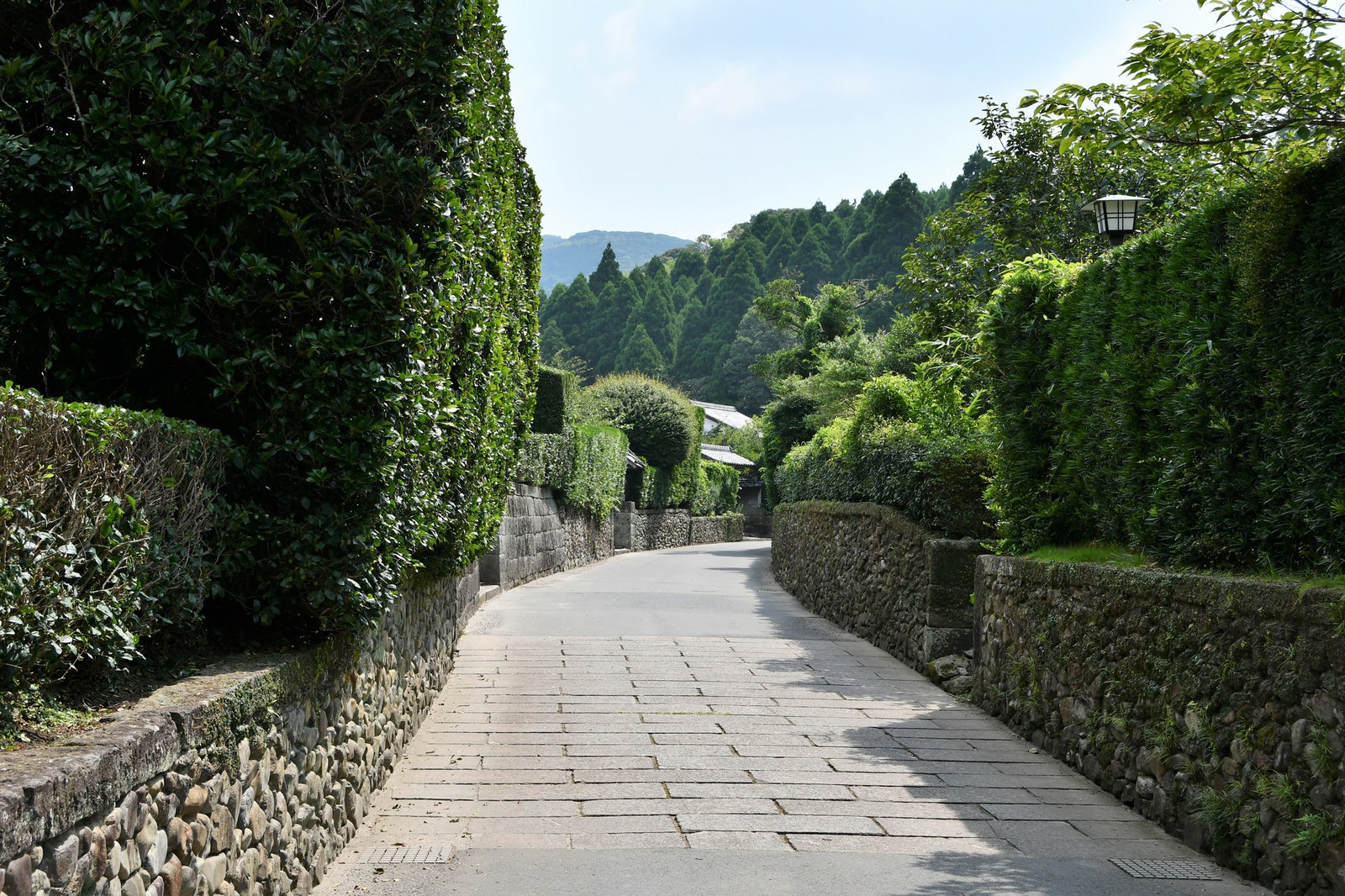
In Chiran, the stone walls and hedges run on from one samurai house to the next, so the street itself is part of what you come to see. Minamikyushu city’s cultural properties page says seven gardens in this district were designated a national place of scenic beauty on 23 February 1981, and it gives two accounts of when the samurai district took shape, one tied to the first lord of Chiran (1651 to 1719) and one to the 18th lord (1732 to 1772).
Who this is for: visitors to Kagoshima who want the opening hours, admission and bus route for the samurai residence gardens in Chiran before they go, and a short, sourced account of why the gardens and the street look the way they do.
The short version: on Minamikyushu city’s tourism page as fetched on 2026-11-10, the gardens are open from 9:00 to 17:00 and close on no day of the year. Individual admission is 530 yen for adults and 320 yen for children; groups of 30 or more pay 430 yen and 250 yen. By bus, take the service bound for Chiran from Kagoshima central station and get off at the Bukeyashiki (samurai residences) entrance stop. Always follow the official pages linked below.
Which ticket and which route fit your visit
| If… | Then lean towards… | Check |
|---|---|---|
| Your party has fewer than 30 people | Individual admission: 530 yen per adult, 320 yen per child | City tourism page |
| You are in a group of 30 or more | The group rate: 430 yen per adult, 250 yen per child | City tourism page |
| You bring a disability certificate of one of the three kinds the city lists | The reduced adult rate of 320 yen, which also applies to one carer | City tourism page |
| You are travelling by public transport from Kagoshima central station | The bus bound for Chiran, getting off at the Bukeyashiki entrance stop | Gardens’ access page |
| You are driving | Free parking: the city asks you to use the car parks around the district | City tourism page |
Hours and admission
The figures below are from Minamikyushu city’s tourism page for the gardens as fetched on 2026-11-10; the gardens’ hours and admission page gives the same hours and fees.
| Item | Adult | Child |
|---|---|---|
| Individual | 530 yen | 320 yen |
| Group of 30 or more | 430 yen | 250 yen |
| Hours | 9:00 to 17:00 | 9:00 to 17:00 |
| Closed days | Open every day of the year | Open every day of the year |
- Children: the city’s page defines the child rate as for primary and junior high school pupils and younger, while the gardens’ hours and admission page says it is for primary and junior high school pupils only.
- Disability certificates: visitors who bring a physical disability certificate, a rehabilitation certificate for intellectual disability, or a mental health and welfare certificate pay a reduced 320 yen (the reduction is for adults only), and up to one carer accompanying them also pays the reduced adult rate of 320 yen.
- Hours: 9:00 to 17:00, open every day of the year; the gardens’ hours and admission page gives these hours from 1 January to 31 December.
- Audio guide: the city lists a multilingual audio guide, including English, that plays on your own smartphone after you scan a QR code; data charges are your own. The gardens’ site says an audio guide over free Wi-Fi is available in each of gardens 1 to 7 (gardens’ news list).
What to do: take the rate that matches your party, and bring your certificate if you are using the reduced rate. Where to verify: the city tourism page and the gardens’ hours and admission page.
Getting there
The city’s tourism page gives the gardens’ address in Chiran, Minamikyushu, Kagoshima, with the postcode 897-0302.
- By bus: the gardens’ access page gives the bus from Kagoshima central station bound for Chiran, getting off at the Bukeyashiki entrance stop, and from there to the gardens. The city’s page says the gardens are a short walk from that stop (Check official: city tourism page). The Japan Heritage site for the Satsuma samurai towns gives about 80 minutes from Kagoshima central station to the Bukeyashiki entrance stop, and about 120 minutes from Kagoshima airport if you take the airport express bus to Kagoshima central station and change to the bus bound for Chiran.
- Timetable: Kagoshima prefecture’s tourism site publishes a public transport timetable for Chiran dated 1 October 2026 (Check official: Chiran timetable (PDF)).
- By car: the city’s page gives 10 minutes by car from the Chiran interchange. The Japan Heritage site gives about 75 minutes by car from the interchange at Kagoshima airport to the centre of Chiran by way of the Chiran interchange (Check official: city tourism page and Japan Heritage site’s Chiran page). Parking is free, and the city asks you to use the car parks around the district.
What to do: plan your bus around the current timetable rather than a fixed time. Where to verify: the gardens’ access page, the city tourism page, the Japan Heritage site’s Chiran page and the Chiran timetable (PDF).
The designations and the two accounts of the district’s origin
The national cultural heritage database lists the Chiran Fumoto teien (the Chiran Fumoto gardens) as a place of scenic beauty, designated on 23 February 1981. Writing about Kagoshima as a whole rather than Chiran alone, the Japan Heritage story of the Satsuma samurai towns says that many groups of outer-castle samurai residences known as fumoto, placed around mountain castle sites across the prefecture, remain today. The gardens’ about page says the area was selected as a national important preservation district for groups of traditional buildings in November 1981 (gardens’ about page; the city tourism page also calls the district a national one), and the city’s tourism page gives the district’s area as 18.6 hectares.
Minamikyushu city’s cultural properties page explains that in the Edo period the Satsuma domain divided its territory into districts known as outer castles, built samurai residences around a central residence, and governed from these scattered districts rather than gathering its samurai in Kagoshima; Chiran was one of these districts. The gardens’ about page describes this central residence in Chiran as the lord’s residence. The city’s cultural properties page also says the samurai residences took shape in the middle of the Edo period and gives two accounts of when: in the time of the first lord of Chiran (1651 to 1719), or in the time of the 18th lord (1732 to 1772). According to the Japan Heritage page for Chiran Fumoto, the present streetscape is said to have been laid out in the time of a lord of Chiran (1732 to 1772).
What to do: read the dates above as separate records: the city’s two accounts, the designation date in the national database, and the Japan Heritage summary’s account of the 1732 to 1772 lord’s time. Where to verify: the national cultural heritage database, the city cultural properties page, the gardens’ about page, the Japan Heritage summary of Chiran Fumoto and the Japan Heritage story of the Satsuma samurai towns.
Why the gardens and the street look the way they do
The stone walls and hedges you walk past are continuous from house to house, and Minamikyushu city’s cultural properties page counts this, together with the gardens, among the features of the district (city cultural properties page). The same page lists these among the features: a built-up mound at the back with a tall standing stone as the main axis of a dry waterfall (the page notes in parentheses that one garden is a pond garden), stone arrangements, stone pagodas and stone lanterns, large clipped plantings of azaleas behind them, wave-shaped hedges beyond those, tea and podocarp in the hedges, and tuff for the garden stones (city cultural properties page). Of the seven designated gardens, the Japan Heritage summary says one is a pond garden and all the others are karesansui (dry landscape) gardens (Japan Heritage summary of the gardens). The city gives the reason for the February 1981 scenic-beauty designation as the gardens’ design, methods that have something in common with Ryukyu gardens, and their value for understanding how garden culture spread (city cultural properties page). The same Japan Heritage summary describes the district as having gardens with a design influenced by Ryukyu and China (Japan Heritage summary of the gardens).
What to do: look at the stone walls and hedges along the street as well as inside each garden, and at the mountain to the east of the street, which the Japan Heritage summary of the gardens describes as their borrowed scenery. Where to verify: the city cultural properties page and the Japan Heritage summary of the gardens.
Official sources
| Topic | Source | Checked |
|---|---|---|
| National cultural heritage database: place of scenic beauty, designation date | online.bunka.go.jp/heritages/detail/162728 | 2026-11-09 |
| Minamikyushu city cultural properties page: designation reason and date, outer-castle districts, two accounts of the district’s origin, garden features | www.city.minamikyushu.lg.jp/…/399.html | 2026-11-09 |
| Minamikyushu city tourism page: district area and its national selection, admission and its conditions, hours, address, access by bus and car, parking, audio guide | www.city.minamikyushu.lg.jp/kankosite/kankospot/1/5543.html | 2026-11-10 |
| The gardens’ hours and admission page: 1 January to 31 December, 9:00 to 17:00, open every day, individual and group fees, child rate for primary and junior high school pupils only | chiran-bukeyashiki.com/pages/26/ | 2026-11-10 |
| The gardens’ news list: audio guide over free Wi-Fi in gardens 1 to 7, notice dated 2024-03-25 | chiran-bukeyashiki.com/pages/44/?detail=1&b_id=204&view=list | 2026-11-10 |
| The gardens’ about page: the area selected as an important preservation district for groups of traditional buildings in 1981, the central residence as the lord’s residence | chiran-bukeyashiki.com/pages/2/ | 2026-11-10 |
| The gardens’ access page: bus from Kagoshima central station, car routes, timetable links | chiran-bukeyashiki.com/pages/7/ | 2026-11-09 |
| Japan Heritage summary of the gardens: one pond garden and the other gardens karesansui, borrowed scenery of the mountain to the east, gardens with a design influenced by Ryukyu and China | japan-heritage.bunka.go.jp/…/4702/ | 2026-11-10 |
| Japan Heritage summary of Chiran Fumoto: the present streetscape said to have been laid out in the time of a lord of Chiran (1732 to 1772) | japan-heritage.bunka.go.jp/…/4697/ | 2026-11-10 |
| Japan Heritage story of the Satsuma samurai towns: fumoto, across Kagoshima, as groups of outer-castle samurai residences around mountain castle sites | japan-heritage.bunka.go.jp/…/story082/ | 2026-11-10 |
| Japan Heritage site for the Satsuma samurai towns, Chiran page: bus and car times | kagoshima-fumoto.jp/minamikyushu/ | 2026-11-09 |
| Kagoshima prefecture tourism site: Chiran public transport timetable, dated 1 October 2026 | www.kagoshima-kankou.com/…/ChiranBusTimetable.pdf | 2026-11-09 |