Place name in Japanese: 備中松山城, Bitchū Matsuyama-jō.
Bitchu Matsuyama Castle, Takahashi: the shuttle to Fuigo-toge, the walk up to the keep, the town’s repairs of 1928 to 1940, and a keep with a hearth and a shrine shelf
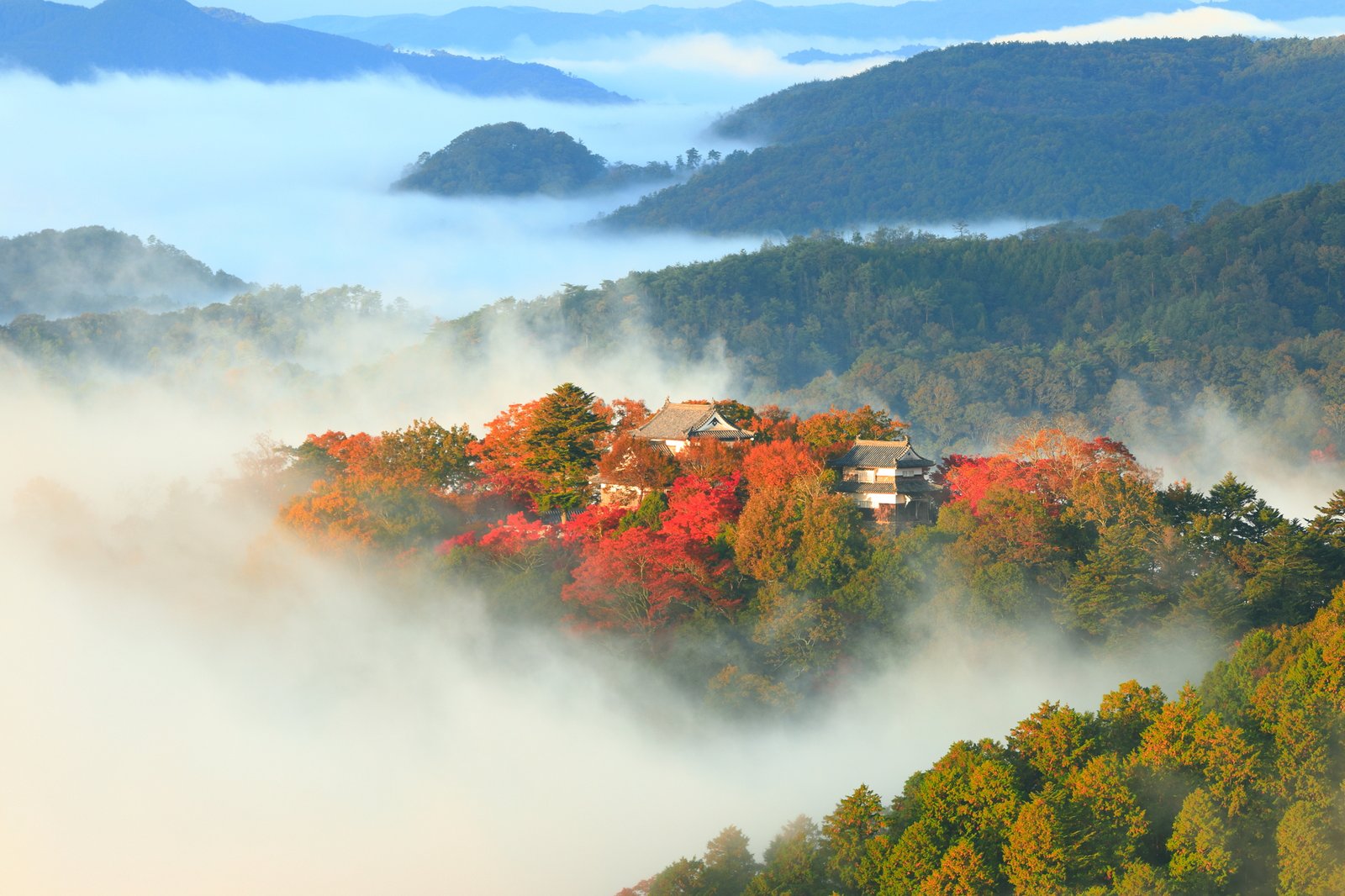
The Agency for Cultural Affairs database lists the keep (tenshu) of Bitchu Matsuyama Castle in Takahashi, Okayama Prefecture, as an Important Cultural Property, designated on 8 May 1941, and describes it as a two-tier, two-storey turret with a tiled roof, dated 1681 to 1683 in the mid-Edo period, owned by the State and managed by Takahashi City (Agency for Cultural Affairs, Bitchu Matsuyama Castle keep (in Japanese)). A separate entry lists Bitchu Matsuyama Castle ruins in Takahashi as a Historic Site, designated on 7 November 1956 (Agency for Cultural Affairs, Bitchu Matsuyama Castle ruins (in Japanese)).
Who this is for: travellers coming to Takahashi by train or car for a day, who want to know how to get up the mountain, how long the walk to the keep takes, when the castle is open, and how the keep came through the twentieth century.
The short version: From JR Bitchu-Takahashi Station, a taxi or the shared sightseeing taxi takes about 10 minutes to Fuigo-toge, the car park below the castle; on shuttle days, cars park lower down and a bus runs up about every 15 minutes. From Fuigo-toge the city gives about 20 minutes on foot along a maintained mountain path with slippery parts, so wear shoes that are easy to walk in.
What to plan for
| If… | Then lean towards… | Check |
|---|---|---|
| You arrive by train at JR Bitchu-Takahashi Station | A taxi or the shared sightseeing taxi to Fuigo-toge, then the walk up | Takahashi City, shared sightseeing taxi (in Japanese) |
| You are driving on a shuttle day | The Shiromibashi Park car park and the shuttle bus to Fuigo-toge | Takahashi City Tourist Association, shuttle bus (in Japanese) |
| You are driving on a day without the shuttle | The road up to the Fuigo-toge car park, which has 14 spaces | Takahashi City, access to the castle (in Japanese) |
| You arrive in the late afternoon | The last entry time for the season, and the last shuttle up | Bitchu Matsuyama Castle, visitor information (in Japanese) |
Getting there: the train to Takahashi and the last stretch to Fuigo-toge
Takahashi City gives the JR Hakubi Line from JR Okayama Station to Bitchu-Takahashi Station as about 50 minutes by local train and about 35 minutes by the limited express Yakumo, and from JR Yonago Station as about 3 hours by local train and about 1 hour 40 minutes by the Yakumo. From the station, it says, a taxi takes about 10 minutes, and a driver told “Bitchu Matsuyama Castle” will go up to the Fuigo-toge car park whether or not the shuttle bus is running. The city loop bus from the Takahashi bus centre takes about 10 minutes to the Matsuyamajo Tozanguchi stop, from where the castle path is about 50 minutes on foot to the keep, and the whole way from the station on foot is about 90 minutes. Large coaches cannot enter the castle town from National Route 180, because the roads are narrow (Takahashi City, access to the castle (in Japanese)).
The city’s shared sightseeing taxi runs every day of the year, four return trips a day, taking about 10 minutes between the tourist information office in front of the station and Fuigo-toge. It leaves the station at 10:00, 11:30, 13:00 and 14:20, and leaves Fuigo-toge at 11:50, 13:20, 14:40 and 16:10. The fare is 1,000 yen per person one way, and seats must be reserved with the Takahashi tourist information office by 17:00 on the day before (Takahashi City, shared sightseeing taxi (in Japanese)).
On the days marked in its calendar for April 2026 to March 2027, the Takahashi City Tourist Association runs a shuttle bus between the Shiromibashi car park, at the fifth station of the mountain, and Fuigo-toge, at the eighth, about every 15 minutes from 8:45. From April to September the last bus up leaves at 16:30 and the last bus down at 17:45; from October to March, at 15:30 and 16:45. It sells round trips and no one-way tickets, and says the service may sometimes run with a jumbo taxi, and may be added or cancelled at short notice because of the weather or the number of visitors (Takahashi City Tourist Association, shuttle bus (in Japanese)). While the shuttle runs, private cars cannot use the road between Shiromibashi Park and Fuigo-toge. The city gives the Shiromibashi Park car park 110 spaces and says it has charged a fee since 4 September 2026, 1,000 yen for a car and 500 yen for a motorcycle, paid in cash (Takahashi City, Bitchu Matsuyama Castle (in Japanese)).
What to do: if you come by train and want the shared taxi, reserve it the day before. Where to verify: the city’s page on the shared sightseeing taxi (in Japanese).
The walk from Fuigo-toge to the keep
Takahashi City says the walk from Fuigo-toge to the area around the main enclosure is a mountain path of about 20 minutes, maintained but with slippery parts, and asks visitors to wear shoes that are easy to walk in and to take care (Takahashi City, Bitchu Matsuyama Castle (in Japanese)). The tourist association says the path is laid out as a promenade but is an earth path (Takahashi City Tourist Association, shuttle bus (in Japanese)), and the castle’s own site gives the distance from Fuigo-toge to the keep as 700 m (Bitchu Matsuyama Castle, access (in Japanese)). The city’s access page gives the walk as about 20 to 30 minutes, and says the road above Fuigo-toge is narrow and kept for emergency and staff vehicles (Takahashi City, access to the castle (in Japanese)).
The castle’s visitor information gives about 2 hours for a visit, including the walk from Fuigo-toge and back, and about 50 minutes on foot to the keep from the lower car park (Bitchu Matsuyama Castle, visitor information (in Japanese)).
What to do: wear shoes with grip, and leave time for the walk down before the last shuttle. Where to verify: the city’s page on the castle (in Japanese).
Opening hours and admission
The castle’s visitor information gives the opening hours as 9:00 to 17:30 from April to September, with entry until 17:00, and 9:00 to 16:30 from October to March, with entry until 16:00. It is closed from 29 December to 3 January. Admission to the keep is 500 yen for adults and 200 yen for primary and junior high school pupils, with a discount for groups of 30 or more (Bitchu Matsuyama Castle, visitor information (in Japanese)). The city’s page on the castle prints the same hours, closing days and admission (Takahashi City, Bitchu Matsuyama Castle (in Japanese)).
What to do: in winter, plan to reach the gate before 16:00. Where to verify: the castle’s visitor information (in Japanese).
A teacher’s survey and the town’s repairs, 1928 to 1940
The castle’s English history page says that after the ordinance of 1873 on disposing of castles, the lord’s residence at the foot of the mountain, the Onegoya, was destroyed, while the keep, turrets and gates on the summit were spared because they were inconvenient to reach, and were left abandoned (Bitchu Matsuyama Castle, history (English)). Takahashi City’s chronology records that in 1928 Takahashi Town completed a repair of the two-storey turret behind the keep (Takahashi City, chronology (in Japanese)); the city’s page on the castle buildings says that repair was paid for with money given by volunteers (Takahashi City, the castle’s Important Cultural Properties (in Japanese)).
In 1930, the chronology says, Shinano Tomoharu, a teacher at Takahashi Junior High School, published a book on the castle and its town, and in 1937 the Takahashi Conservation Committee was formed to support the castle’s restoration. The castle’s site says Shinano climbed the mountain many times to survey the keep and record its structure and dimensions, and that his book led local people to form the committee (Bitchu Matsuyama Castle, history (in Japanese)). In 1939, the chronology says, Takahashi Town put more than 18,000 yen of town money into taking the keep apart for repair and mending the earthen walls, work finished in 1940 and remembered as the Great Showa Renovation (Takahashi City, chronology (in Japanese)). The castle’s site adds an episode, told as one that has come down, that local primary and junior high school pupils, girls’ school students and others carried about 20,000 roof tiles up to the summit at that time (Bitchu Matsuyama Castle, history (in Japanese)). The city’s history page dates the repair of the San-no-hira turret east wall to the following year, 1941 (Takahashi City, history of the castle (in Japanese)).
What to do: read the city’s chronology before you go; it also lists the later repairs. Where to verify: the city’s chronology (in Japanese).
A hearth, a raised room and a shrine shelf: inside the keep
Takahashi City’s page on the castle buildings says the lord Mizunoya Katsumune began rebuilding the castle in 1681 and finished in 1683, and that the keep is said to have taken its present form then. It describes the keep as two-tiered and two-storeyed, about 11 m high, and says that old documents call it a “three-tier turret”: three tiers outside, but in fact two floors. On the ground floor there is an irori hearth and the shozoku-no-ma, a room set a step higher which the city says was for the lord alone; at the front of the upper floor a shrine shelf, the goshadan, held three treasured swords as the object of worship. The keep was originally reached by a corridor from the Hachi-no-hira turret, the city says, but in the repair of 1940 the decay was too far gone to return it to its original form, so the two were separated, and the keep now looks a little different from its old self.
The same page describes the surviving earthen wall east of the San-no-hira turret, seen straight ahead after you pass the Ote gate and turn left. Lumps of kneaded earth were piled up as a core and finished with plaster, it says, and the restored walls were rebuilt after this surviving wall, with the loopholes set out in the same way. A step in the wall marks where the old part ends and the restored part begins, and the city suggests looking for it on the spot (Takahashi City, the castle’s Important Cultural Properties (in Japanese)).
What to do: inside the keep, look for the hearth and the raised room; outside, find the step in the wall. Where to verify: the city’s page on the castle buildings (in Japanese).
What we have not verified
Check official before you go: the shuttle fare, and the days the shuttle runs (Takahashi City Tourist Association, shuttle bus (in Japanese)). Check official before you go: the shared taxi times and how to reserve (Takahashi City, shared sightseeing taxi (in Japanese)). Check official before you go: opening hours, admission and closing days (Bitchu Matsuyama Castle, visitor information (in Japanese)).
- City loop bus times: the bus operator’s timetable page could not be fetched, so the times are not given here.
- Train times on the JR Hakubi Line: not checked.
- Other designations: the city and the castle’s site name further buildings and a wall with designations; the two Agency for Cultural Affairs database entries above are the ones read for designations.
- Names: Fuigo-toge, the car parks and some people and places in the history are given in this site’s renderings; the pages read print them in different forms or not at all in English.
Official sources
| Topic | Source | Checked |
|---|---|---|
| Designation of the keep | Agency for Cultural Affairs, Bitchu Matsuyama Castle keep | 2026-11-11 |
| Designation of the castle ruins | Agency for Cultural Affairs, Bitchu Matsuyama Castle ruins | 2026-11-11 |
| Train, taxi, bus, car | Takahashi City, access to the castle | 2026-11-11 |
| Shared sightseeing taxi | Takahashi City, shared sightseeing taxi | 2026-11-11 |
| Shuttle bus | Takahashi City Tourist Association, shuttle bus | 2026-11-11 |
| Path, parking, hours | Takahashi City, Bitchu Matsuyama Castle | 2026-11-11 |
| Distance to the keep | Bitchu Matsuyama Castle, access | 2026-11-11 |
| Hours and admission | Bitchu Matsuyama Castle, visitor information | 2026-11-11 |
| Repairs of 1928 to 1940 | Takahashi City, chronology | 2026-11-11 |
| Repair of the wall in 1941 | Takahashi City, history of the castle | 2026-11-11 |
| The survey and the roof tiles | Bitchu Matsuyama Castle, history | 2026-11-11 |
| The ordinance of 1873 | Bitchu Matsuyama Castle, history (English) | 2026-11-11 |
| The keep and the wall | Takahashi City, the castle’s Important Cultural Properties | 2026-11-11 |