Place name in Japanese: 雨晴海岸, Amaharashi Kaigan.
Amaharashi Coast, Takaoka: the Tateyama view, the Himi Line and the roadside station
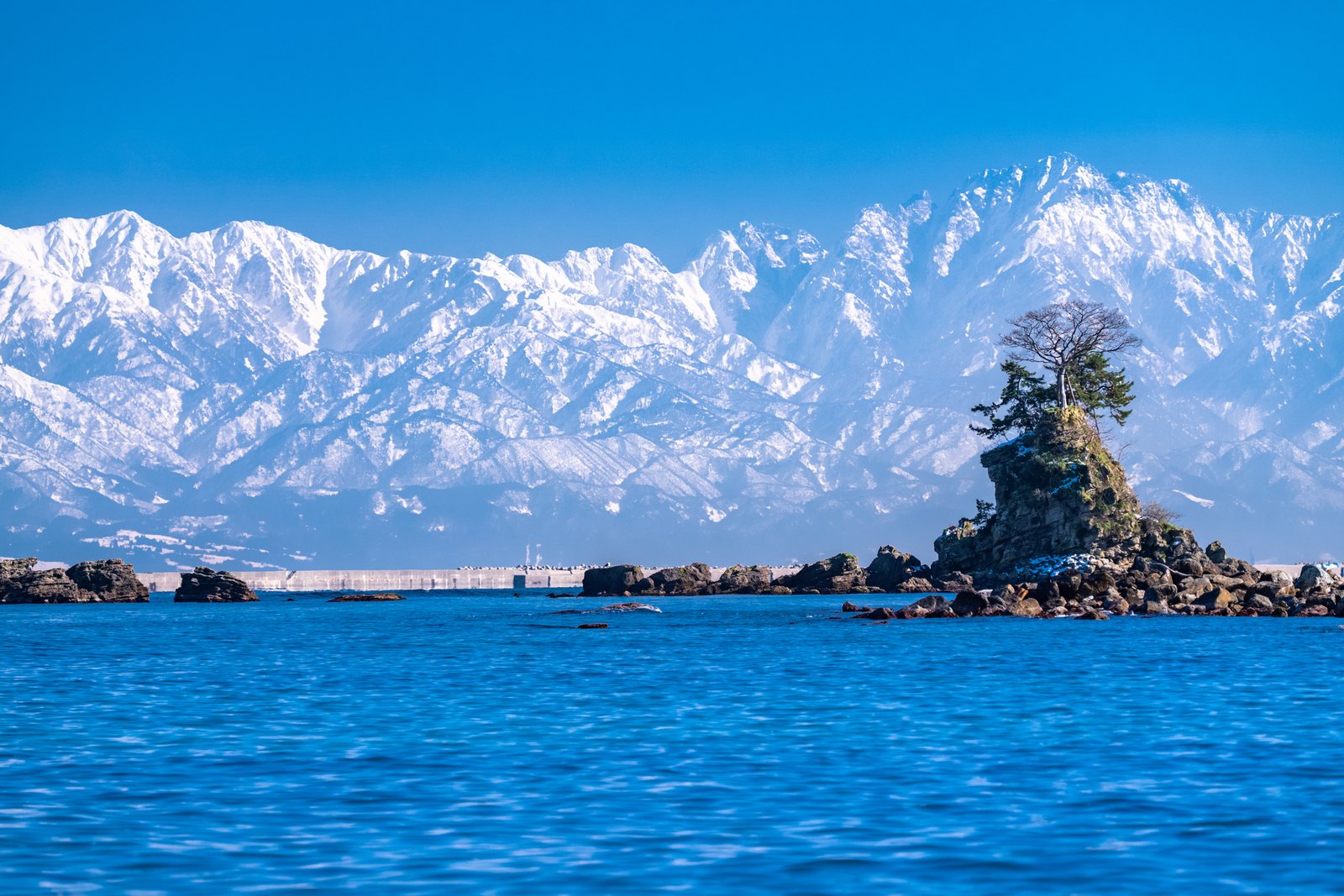
The Agency for Cultural Affairs database records a Place of Scenic Beauty named the Places of Scenic Beauty of Oku no Hosomichi, which includes Arisoumi, and prints the designation date as 18 March 2014, also printed as Heisei 26.03.18 in the Agency’s dating (Agency for Cultural Affairs database (in Japanese)). A later measure in the same record, dated 7 October 2015, also printed as Heisei 27.10.07, says the already designated Arisoumi (Me-iwa) had the Yoshitsune-iwa area added and the name was changed to Arisoumi (Agency for Cultural Affairs database (in Japanese)). Takaoka City places this at Ota in Takaoka, Toyama, and says that from the coast around Yoshitsune-iwa you can look out to the Tateyama range with Me-iwa, which it calls a symbol of the rough shore of Arisoumi, in the foreground (Takaoka City, Places of Scenic Beauty of Oku no Hosomichi — Arisoumi (in Japanese)).
Who this is for: travellers who want the Himi Line fares from Takaoka, the hours of the roadside station, and what official pages say about seeing the Tateyama range across the bay.
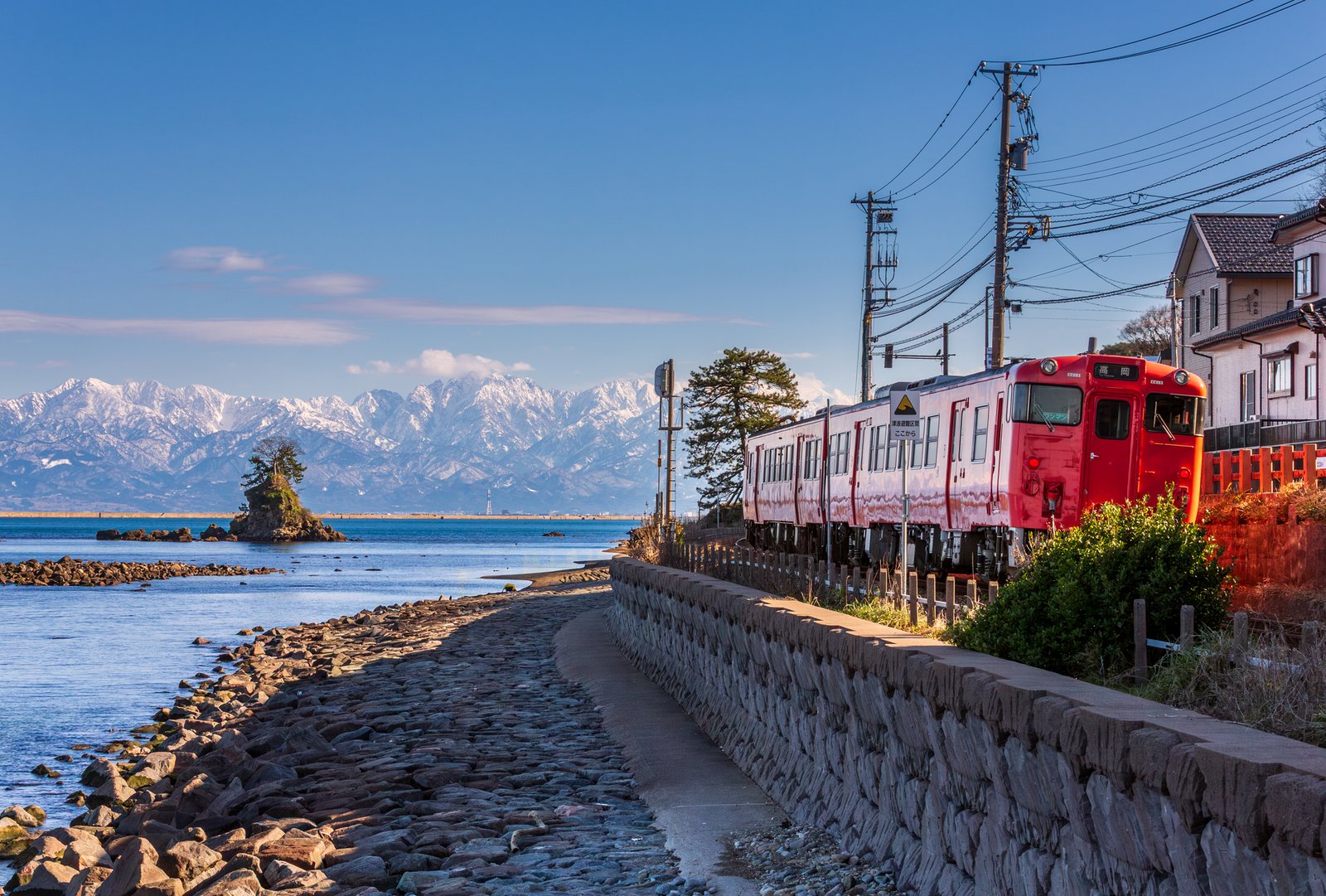
The short version: take the Himi Line from platform 7 at Takaoka Station to Amaharashi Station; the city says the ride is about 20 minutes and the roadside station is about a five-minute walk from the station. It prints a one-way fare of 240 yen for adults (12 and over) and 120 yen for children (6 and over and under 12). The roadside station building is open from 9:00 to 17:00; toilets, the first-floor information facility and the observation decks are open 24 hours. The city says you can see the 3,000-metre-class Tateyama range across Toyama Bay when the weather is favourable. Check the operator timetable and the city pages on the day you go.
Take the train or check the car parks first
| If… | Then lean towards… | Check |
|---|---|---|
| You want to avoid road and car-park congestion at the coast | The Himi Line to Amaharashi Station | Takaoka City, visiting the coast on the Himi Line (in Japanese) |
| You want train times from Amaharashi Station | The operator timetable for the station | JR West, Amaharashi Station timetable (in Japanese) |
| You are arriving by car and the main car parks are full | The second and temporary car parks named on the city page, and the live cameras | Takaoka City, weekend congestion at the roadside station (in Japanese) |
| You want the view of the Tateyama range across the bay | Go when the weather is favourable, and use the decks at the roadside station | Takaoka City, weekend congestion at the roadside station (in Japanese) |
What to do: if you can, take the train when the roads by the coast are busy, and check the timetable and the city parking page before you set out. Where to verify: the city page on the Himi Line (in Japanese) and the operator timetable (in Japanese).
Times, hours and fees
| Item | Time or fee | Where to check |
|---|---|---|
| Roadside station building, Amaharashi | 9:00 to 17:00; open every day except temporary closures; hours may be extended in season or for events | Takaoka City, notices from the roadside station (in Japanese); open days: Takaoka City, weekend congestion at the roadside station (in Japanese) |
| Toilets, first-floor information facility and observation decks | Open 24 hours | Takaoka City, notices from the roadside station (in Japanese) |
| Car parks at the roadside station | The city prints that the car parks are open 24 hours | Takaoka City, weekend congestion at the roadside station (in Japanese) |
| Himi Line, Takaoka to Amaharashi, one way | 240 yen for adults (12 and over); 120 yen for children (6 and over and under 12) | Takaoka City, visiting the coast on the Himi Line (in Japanese) |
| Current departure times on the Himi Line | Check official | JR West, Amaharashi Station timetable (in Japanese) |
| 20 per cent discount at two city car parks by Takaoka Station, when you also ride the Himi Line | The city prints an example of 770 yen reduced to 610 yen for three hours at Takaoka Central Car Park; Check official | Takaoka City, visiting the coast on the Himi Line (in Japanese) |
What to do: use the printed hours and fares above, and check the linked pages if you are travelling in a busy season, when hours may be extended. Where to verify: the city notices page (in Japanese) and the city page on the Himi Line (in Japanese).
Getting there and how long it takes
The city’s access page points to West Japan Railway Company’s Himi Line from Takaoka Station, platform 7, to Amaharashi Station, and says the ride is about 20 minutes (Takaoka City, visiting the coast on the Himi Line (in Japanese)). A city page about the roadside station says it is about a five-minute walk from Amaharashi Station, and a short walk from the Iwasaki stop of Kaetsunou Bus (Takaoka City, weekend congestion at the roadside station (in Japanese)). Check the bus operator for times.
The same access page says roads around the coast and the roadside-station car parks become very congested on holidays and in the sightseeing season, and that riding the Himi Line avoids that wait (Takaoka City, visiting the coast on the Himi Line (in Japanese)). The congestion page asks drivers to allow extra time at weekends, when traffic may be heavy from morning to evening and the car parks may stay full for a long time, and to use the second and temporary car parks when the main ones are full (Takaoka City, weekend congestion at the roadside station (in Japanese)). Live cameras for the west and east car parks (not the second or temporary car parks) are on the roadside station’s parking page, which the city links as an official site (Roadside station Amaharashi, parking cameras (in Japanese)).
What to do: prefer the operator timetable for train times, and leave more time if you come by car at a weekend. Where to verify: the operator timetable (in Japanese) and the city congestion page (in Japanese).
What to see
Takaoka City describes the coast as a scenic place tied to the Man’yoshu, and writes of reefs along the shore and of a 3,000-metre-class view of the Tateyama range across Toyama Bay (Takaoka City, visiting the coast on the Himi Line (in Japanese)). On the conditions for that view, a city page about the roadside station says you can see the range across the bay when the weather is favourable (Takaoka City, weekend congestion at the roadside station (in Japanese)). The same page says decks and a gently stepped deck walk were built so that the coast can be seen from several angles (Takaoka City, weekend congestion at the roadside station (in Japanese)).
What to do: stand on the official decks and look for Me-iwa and Yoshitsune-iwa against the bay, and for the range when the weather allows. Where to verify: the city congestion page (in Japanese) and the city page on Arisoumi (in Japanese).
A Place of Scenic Beauty on the Narrow Road to the Deep North
The Agency’s commentary on the group of sites says Matsuo Basho travelled the north and the Hokuriku road to places known from earlier poems, and completed the travel account Oku no Hosomichi, and that the designated places are landscapes that still convey the atmosphere of the time of that work (Agency for Cultural Affairs database (in Japanese)). Takaoka City, giving the reasons for the designation of Arisoumi, says Basho took the seascape of reefs at Arisoumi (Me-iwa) into a verse, that Arisoumi is a representative poetic place-name of Etchu drawing on an earlier poem by Otomo no Yakamochi, and that the shore shows the rough-reef landscape that is the original meaning of the word ariso, at a place tied to Arisoumi and Shibutani, poetic place-names drawn from the Man’yoshu (Takaoka City, Places of Scenic Beauty of Oku no Hosomichi — Arisoumi (in Japanese)). A tradition remains, the city says, that Minamoto no Yoshitsune’s party sheltered from the rain at Yoshitsune-iwa; from the coast around that rock, it says, you can look to the Tateyama range with Me-iwa in the foreground, and the view has a high value for appreciation (Takaoka City, Places of Scenic Beauty of Oku no Hosomichi — Arisoumi (in Japanese)).
What to do: from the shore or the decks, look at the reefs the city names and, when the weather is favourable, at the range beyond them. Where to verify: the city page on Arisoumi (in Japanese).
Official sources
| Topic | Source | Checked |
|---|---|---|
| Designation date, additional designation and name change, group commentary | Agency for Cultural Affairs database | 2026-11-14 |
| Same designation, Cultural Heritage Online | Cultural Heritage Online | 2026-11-14 |
| Location, reasons for designation, tradition at Yoshitsune-iwa, view of the range | Takaoka City, Places of Scenic Beauty of Oku no Hosomichi — Arisoumi | 2026-11-14 |
| Himi Line fares and ages, ride time, platform 7, congestion, city car-park discount | Takaoka City, visiting the coast on the Himi Line | 2026-11-14 |
| Roadside station hours, 24-hour toilets, information facility and decks | Takaoka City, notices from the roadside station | 2026-11-14 |
| Walk from the station, open days, parking, weekend congestion, view when the weather is favourable | Takaoka City, weekend congestion at the roadside station | 2026-11-14 |
| Live car-park cameras (operator page linked from the city) | Roadside station Amaharashi, parking cameras | 2026-11-14 |
| Operator timetable for Amaharashi Station (clocks not extractable from the page we opened) | JR West, Amaharashi Station timetable | 2026-11-14 |
| Station English readings, names only | JR West, Amaharashi Station; JR West, Takaoka Station | 2026-11-14 |
What we have not verified
- Current departure times on the Himi Line. The operator timetable page we opened had no extractable clock times; use that timetable (JR West, Amaharashi Station timetable (in Japanese)).
- How late the roadside station stays open when hours are extended in season or for events. Official English names for the coast, the Place of Scenic Beauty, the rocks, the roadside station and the Himi Line, beyond JR West’s print of Amaharashi and Takaoka for the two stations.
- Seasonal or other finer conditions for seeing the Tateyama range from this coast, beyond the city’s print that the range can be seen when the weather is favourable (Takaoka City, weekend congestion at the roadside station (in Japanese)).
- Bus times at the Iwasaki stop. We did not fetch a bus-operator timetable.